California Affidavit - Death of Joint Tenant
What is this form?
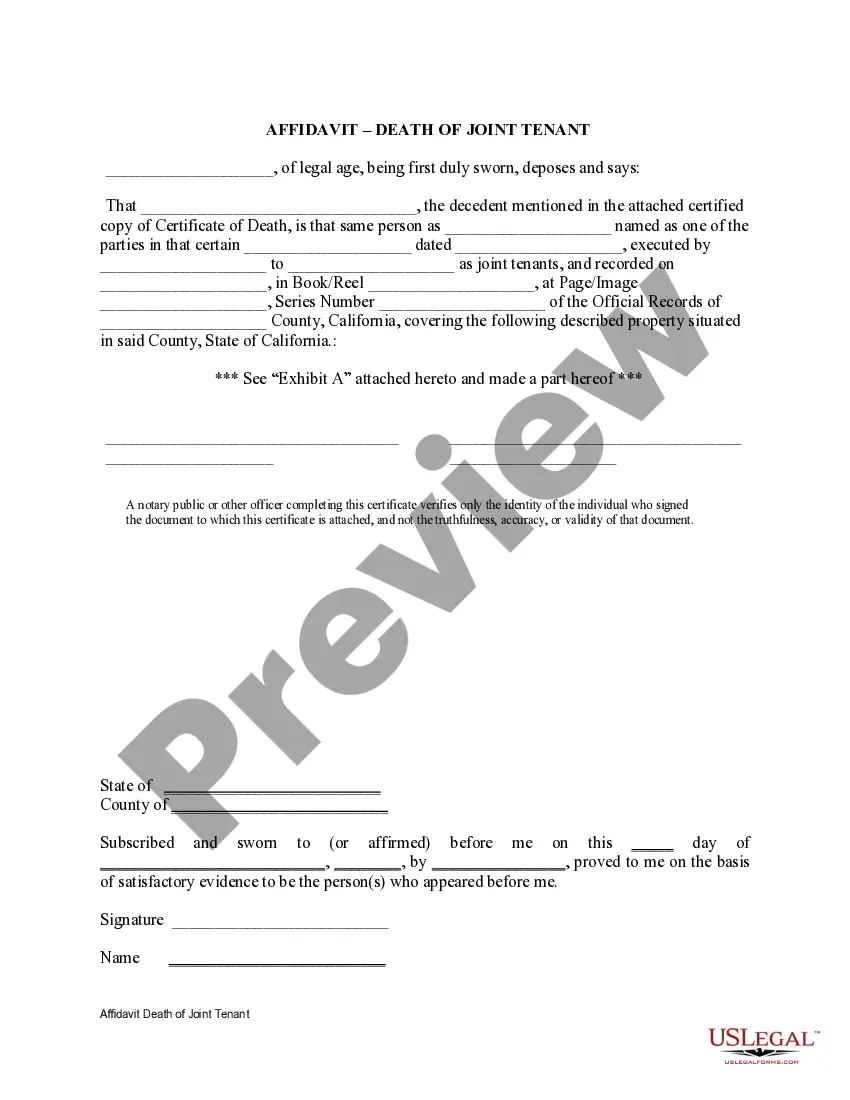
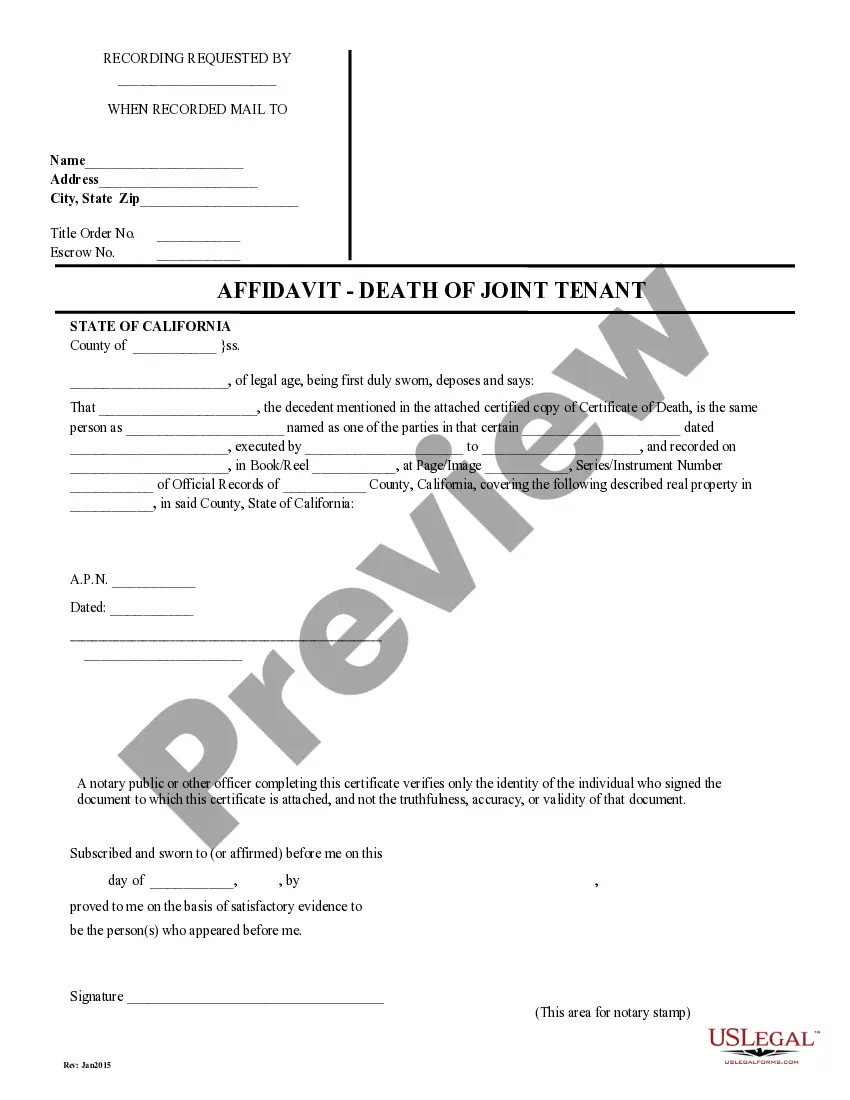
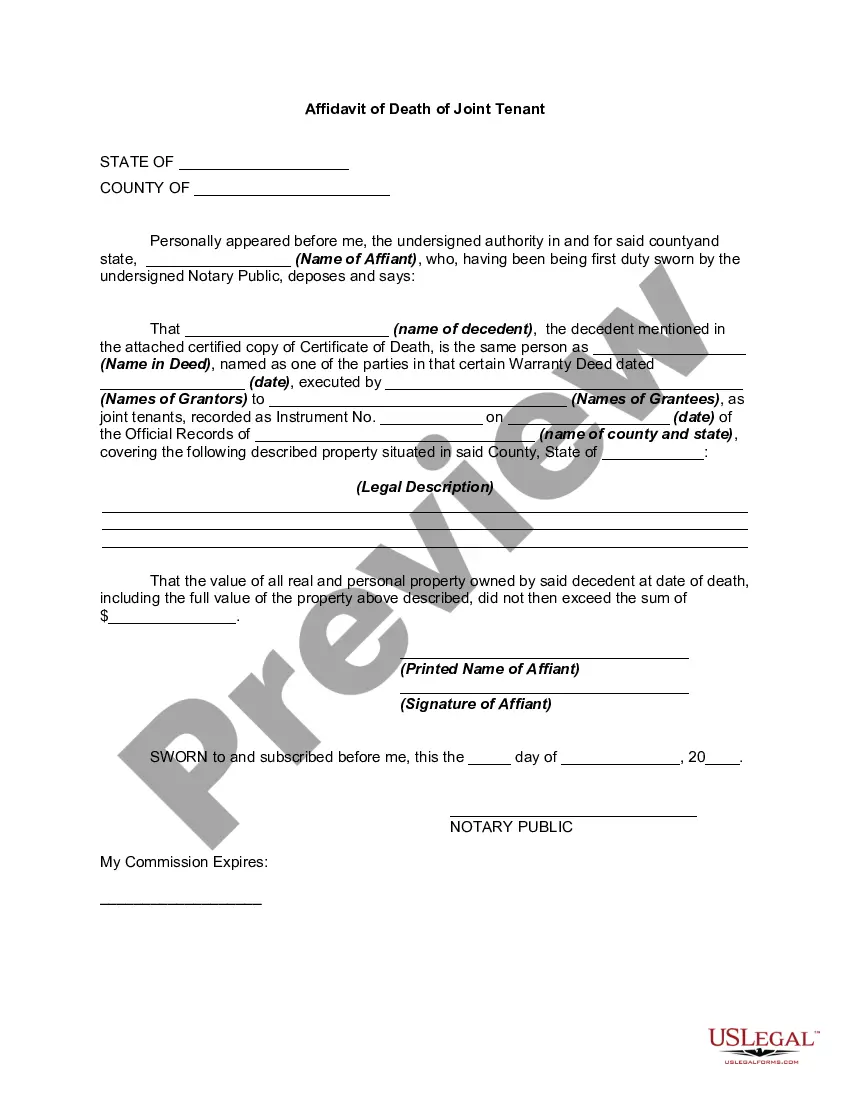
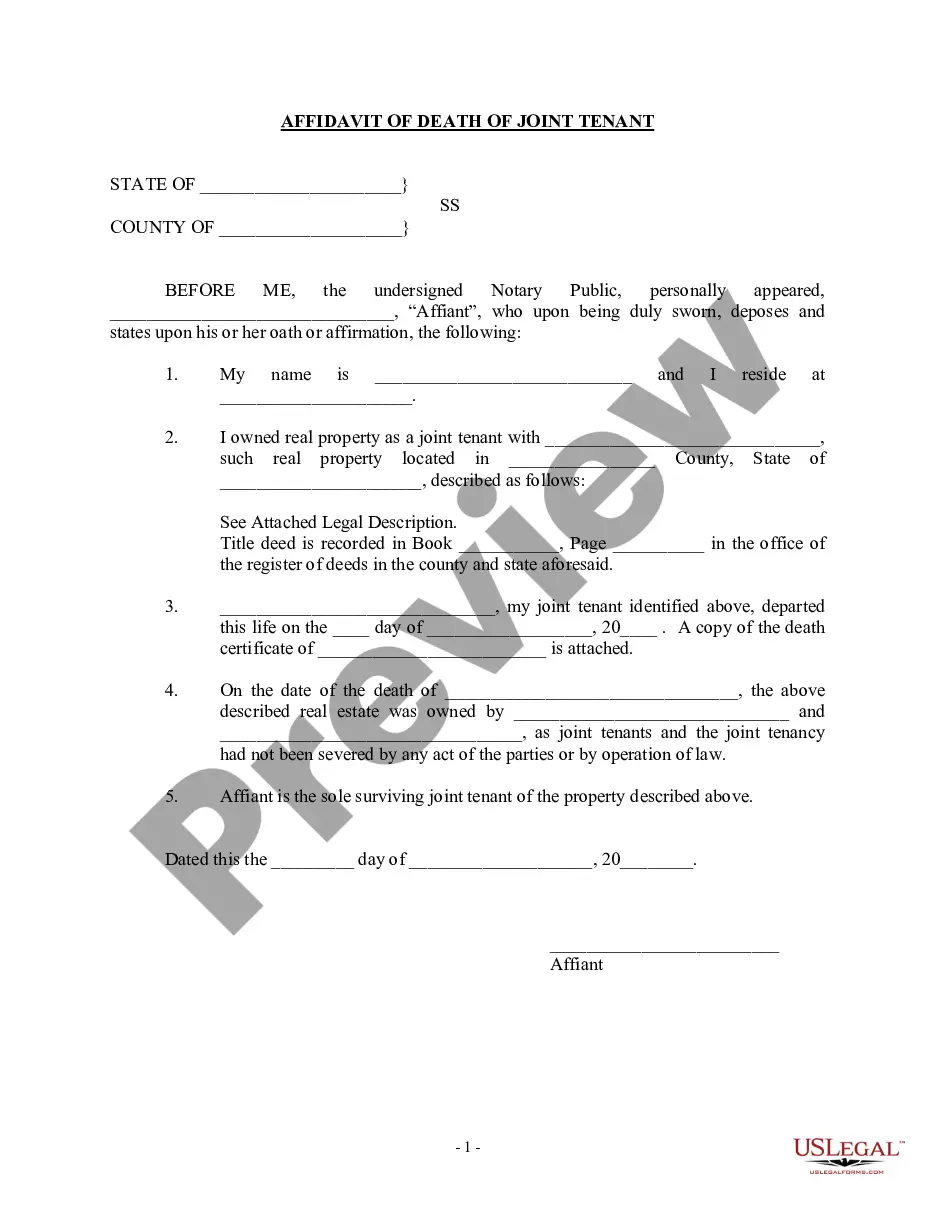
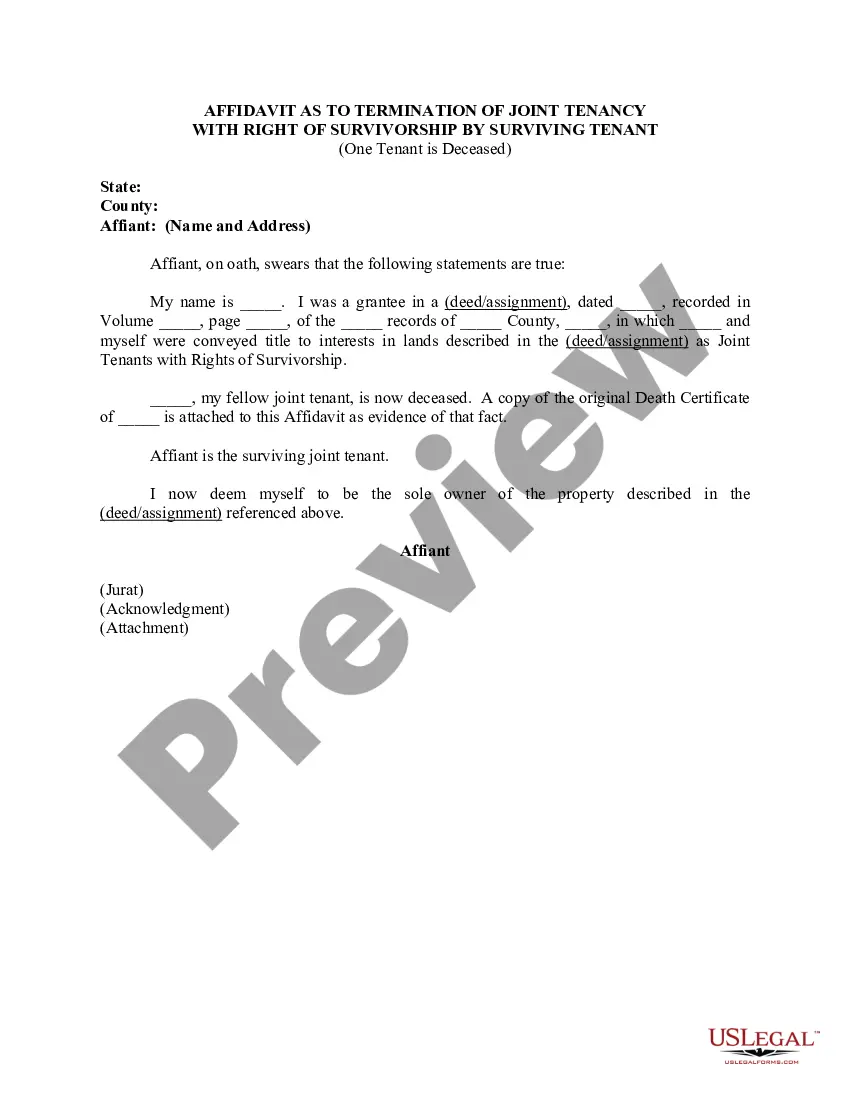
The Affidavit - Death of Joint Tenant is a legal document used by the surviving joint tenant to formally declare the death of a co-owner. This affidavit is essential for transferring ownership of jointly held property to the surviving owner, ensuring a smooth transition of title without requiring a court action. Unlike other forms of ownership transfer, this affidavit is specific to joint tenancy situations.
Key parts of this document
- Identification of the survivor and the deceased joint tenant.
- Reference to the certified copy of the Certificate of Death.
- Details of the joint tenancy agreement including the date, parties involved, and the recorded information.
- Property description covered under the joint tenancy.
- Notary acknowledgement to confirm the identity of the signer.

Situations where this form applies
This form is needed when one joint tenant passes away, and the surviving tenant wishes to assert their right to the property. It is particularly useful for real estate transactions where the deceased's interest in the property must be transferred in order to facilitate property sales, refinancing, or simply to clear the title.
Intended users of this form
This form is intended for:
- Individuals who are the surviving joint tenants of a deceased co-owner.
- Persons managing the estate of the deceased where the property is held in joint tenancy.
- Legal representatives or family members processing property transfers after a joint tenant's death.
How to complete this form
- Identify the survivors: Enter the full name of the surviving joint tenant.
- Provide details for the deceased: Include the name of the deceased joint tenant as listed in the death certificate.
- Document the joint tenancy agreement: Fill in the details such as the date and involved parties.
- Describe the property: Attach and reference the property description in âExhibit A.â
- Have the affidavit notarized: Sign the affidavit in front of a notary public for validation.
Does this form need to be notarized?
Yes, this form must be notarized to be legally valid. US Legal Forms offers integrated online notarization services, allowing you to verify your identity securely via video call. This can be done anytime, without the need for travel.
Get your form ready online
Our built-in tools help you complete, sign, share, and store your documents in one place.
Make edits, fill in missing information, and update formatting in US Legal Forms—just like you would in MS Word.
Download a copy, print it, send it by email, or mail it via USPS—whatever works best for your next step.
Sign and collect signatures with our SignNow integration. Send to multiple recipients, set reminders, and more. Go Premium to unlock E-Sign.
If this form requires notarization, complete it online through a secure video call—no need to meet a notary in person or wait for an appointment.
We protect your documents and personal data by following strict security and privacy standards.

Make edits, fill in missing information, and update formatting in US Legal Forms—just like you would in MS Word.

Download a copy, print it, send it by email, or mail it via USPS—whatever works best for your next step.

Sign and collect signatures with our SignNow integration. Send to multiple recipients, set reminders, and more. Go Premium to unlock E-Sign.

If this form requires notarization, complete it online through a secure video call—no need to meet a notary in person or wait for an appointment.

We protect your documents and personal data by following strict security and privacy standards.
Common mistakes to avoid
- Failing to attach the certified copy of the Certificate of Death.
- Incorrectly listing property details or failing to reference Exhibit A.
- Not having the document notarized, which can render it invalid in some jurisdictions.
Quick recap
- The Affidavit - Death of Joint Tenant facilitates the transfer of property ownership after a joint tenant passes away.
- Proper completion and notarization of the form are crucial for legal validity.
- Consulting a legal professional may be wise to navigate the complexities involved.
Looking for another form?
Form popularity
FAQ
If an ?other than original transferor? joint tenant dies or transfers his interest then then whether there is a change in ownership depends on if an ?original transferor? joint tenant remains. So long as there is an original transferor there is no reassessment.
Joint tenancy is a way for two or more people to own property in equal shares so that when one of the joint tenants dies, the property can pass to the surviving joint tenant(s) without having to go through probate court.
HOW DO I RECORD AN AFFIDAVIT? Take a certified copy of the death certificate of the deceased joint tenant and your affidavit to the recorder's office in the county where the real property is located. The recorder's office also requires a Preliminary Change of Ownership Report (PCOR) when filing the affidavit.
California Affidavit of Surviving Spouse Information Section 100(a) of the California Probate Code states that when a married person dies, one-half of the couple's community property belongs to the surviving spouse and the other half stays in the decedent's name, ostensibly for probate distribution.
If parties hold title as joint tenants and one is deceased, the survivor may file an Affidavit of Death of Joint Tenant. It may be advisable to consult an attorney due to the legal aspects involving a change in ownership of real property. The above forms can be purchased at most office supply or stationery stores.
Property owned in joint tenancy automatically passes to the surviving owners when one owner dies. No probate is necessary. Joint tenancy often works well when couples (married or not) acquire real estate, vehicles, bank accounts or other valuable property together.
Record the Affidavit and file the PCOR at the Recorder's Office in the county where the property is located. If you attached the property description (instead of typing it out), be sure to include the attachment when you record the Affidavit.
Where it is held as joint tenants, on the death of one of the owners, the property becomes owned by the other joint owner. For example, Joe owns a property as a joint tenant with his dad, Stan. When Stan dies, the property automatically passes to Joe as sole owner.