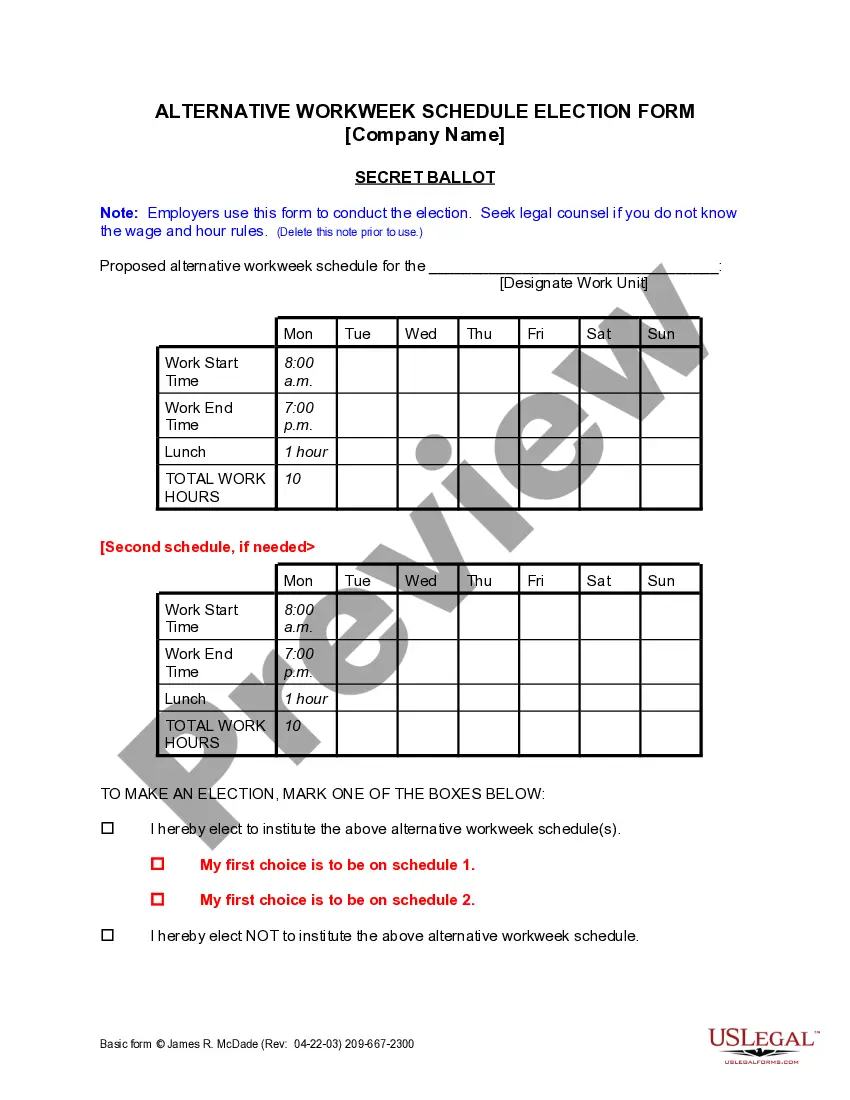
California Alternative Workweek Schedule Election Form
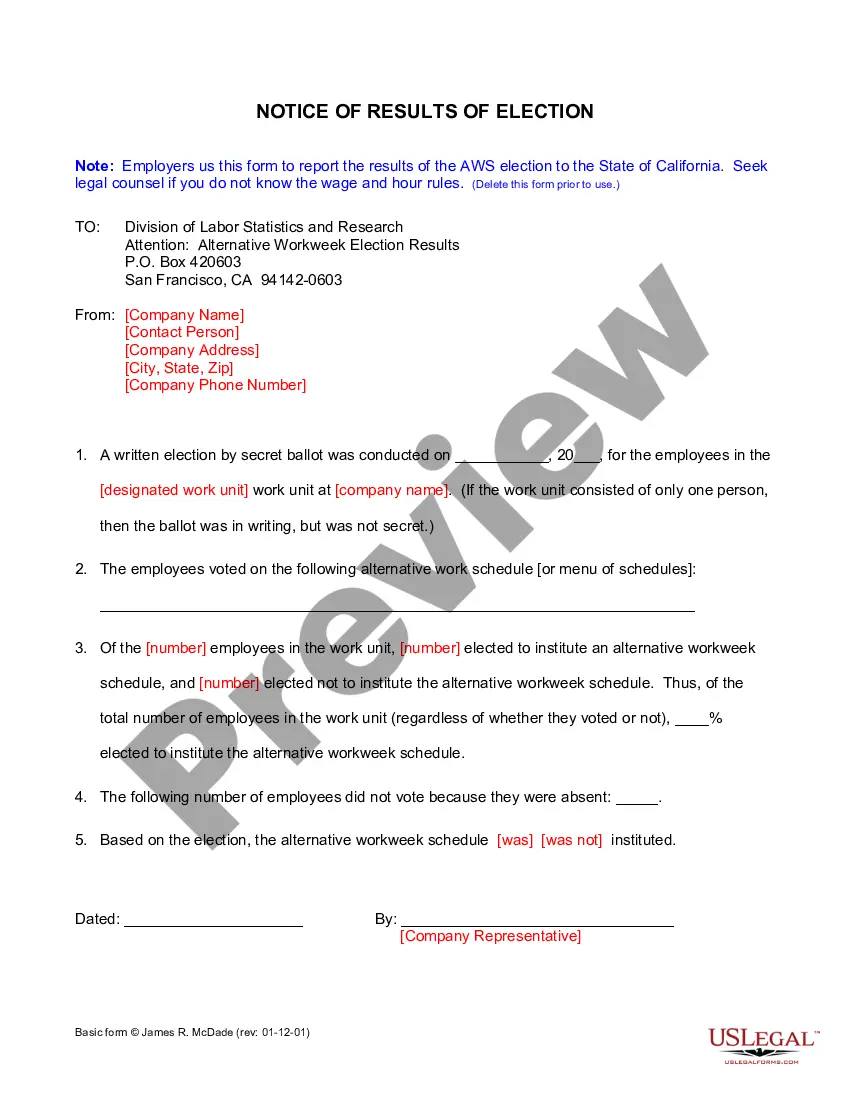
What is this form?
The Alternative Workweek Schedule Election Form is used by employers to conduct elections regarding alternative workweek schedules. This form allows employees to express their preferences for adjusted working hours, which differs from traditional work schedules. It ensures compliance with labor laws and helps facilitate a flexible working environment.
Main sections of this form
- Company Name: Name of the employer conducting the election.
- Proposed Work Schedule: Details of the alternative workweek schedule including workdays and start/end times.
- Work Unit Designation: Identification of the specific work unit the schedule applies to.
- Election Options: Sections for employees to choose their preferred schedule or opt out.
- Signature Field: Requires a signature to validate the election outcome.
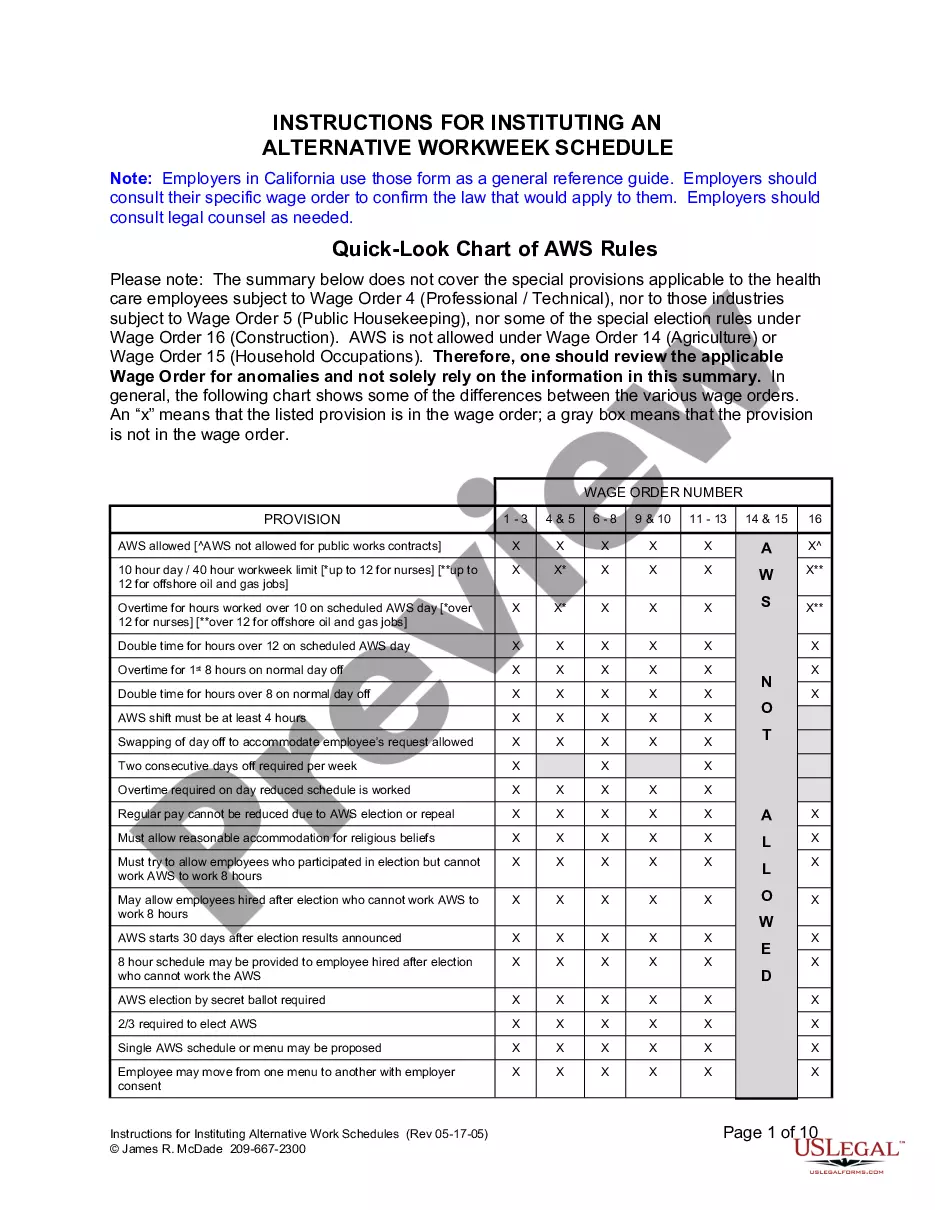
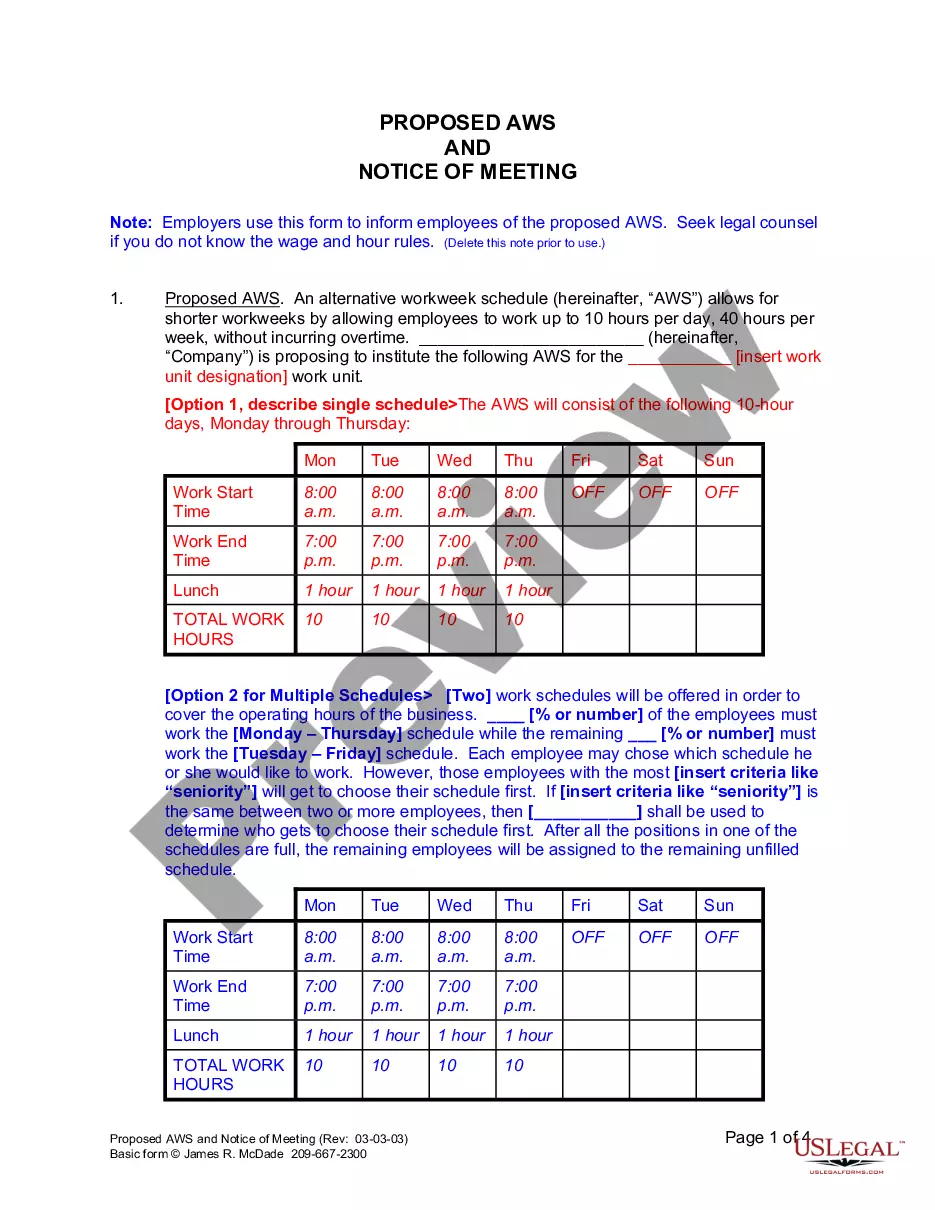
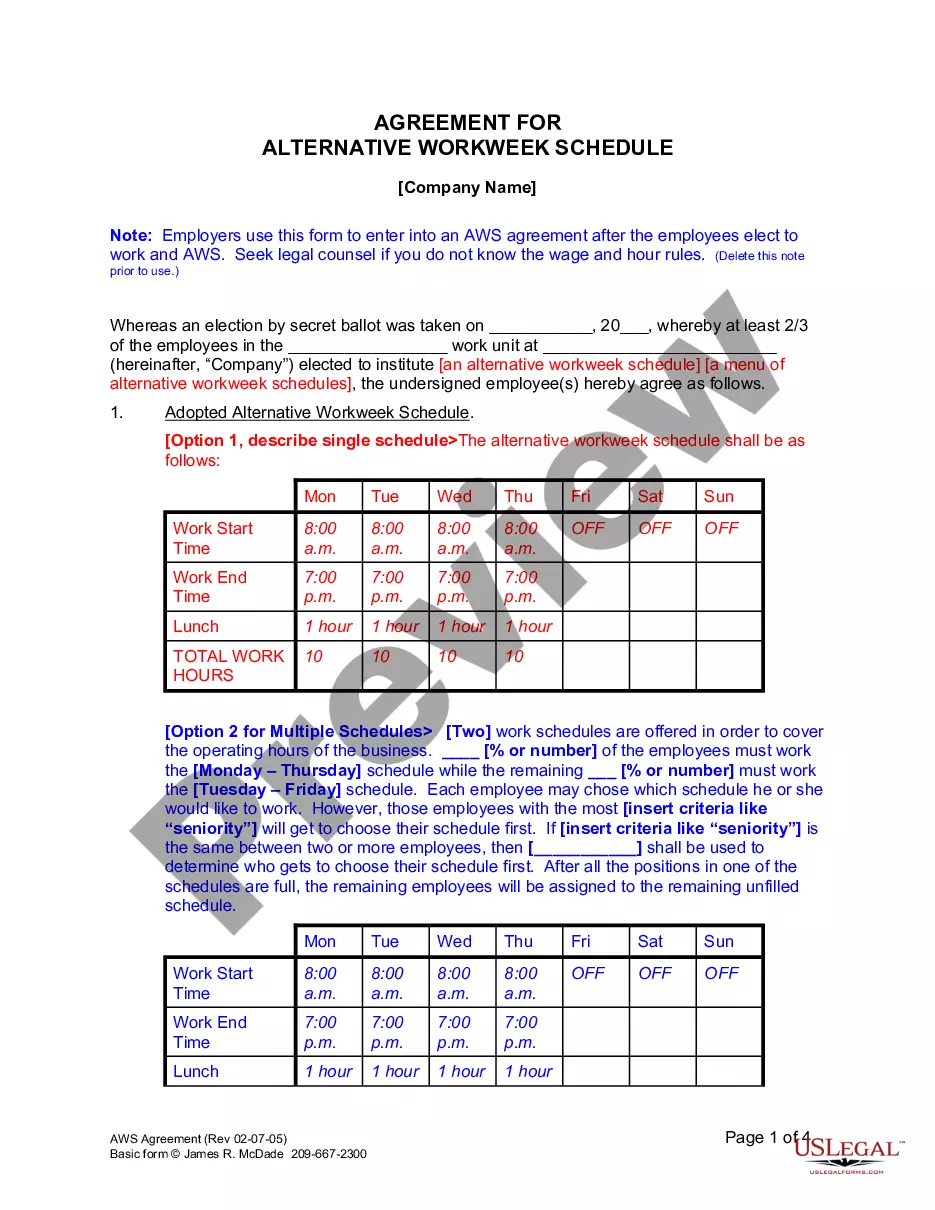
When to use this document
This form should be used when an employer wishes to propose a new alternative workweek schedule, allowing employees to vote on whether to adopt this new schedule. It is especially relevant when the company aims to enhance work-life balance, boost employee morale, or when current working hours are not meeting operational needs.
Who can use this document
- Employers considering alternative workweek options.
- Human resource professionals managing work schedules.
- Employees who are part of the proposed work unit.
Instructions for completing this form
- Fill in the company name at the top of the form.
- Define the proposed alternative workweek schedule, including workdays and hours.
- Designate the specific work unit affected by this schedule.
- Have employees mark their election preferences clearly.
- Collect completed forms and ensure proper documentation of the election results.
Notarization guidance
This form usually doesn’t need to be notarized. However, local laws or specific transactions may require it. Our online notarization service, powered by Notarize, lets you complete it remotely through a secure video session, available 24/7.
Get your form ready online
Our built-in tools help you complete, sign, share, and store your documents in one place.
Make edits, fill in missing information, and update formatting in US Legal Forms—just like you would in MS Word.
Download a copy, print it, send it by email, or mail it via USPS—whatever works best for your next step.
Sign and collect signatures with our SignNow integration. Send to multiple recipients, set reminders, and more. Go Premium to unlock E-Sign.
If this form requires notarization, complete it online through a secure video call—no need to meet a notary in person or wait for an appointment.
We protect your documents and personal data by following strict security and privacy standards.

Make edits, fill in missing information, and update formatting in US Legal Forms—just like you would in MS Word.

Download a copy, print it, send it by email, or mail it via USPS—whatever works best for your next step.

Sign and collect signatures with our SignNow integration. Send to multiple recipients, set reminders, and more. Go Premium to unlock E-Sign.

If this form requires notarization, complete it online through a secure video call—no need to meet a notary in person or wait for an appointment.

We protect your documents and personal data by following strict security and privacy standards.
Common mistakes
- Not deleting instructional notes before distribution.
- Failing to specify the correct work unit.
- Overlooking legal counsel regarding wage and hour rules.
Benefits of completing this form online
- Easy accessibility: Download and complete the form at your convenience.
- Editable format: Customize the form in accordance with your specific needs.
- Reliable templates drafted by licensed attorneys ensure legal compliance.
What to keep in mind
- The Alternative Workweek Schedule Election Form is essential for employers wishing to implement flexible work hours.
- It ensures compliance with labor laws and allows employees to voice their preferences.
- Understanding the correct use and completion of this form can facilitate smoother transitions to new work schedules.
Looking for another form?

Form popularity
FAQ
Definitions. (A) An Alternative workweek schedule means any regularly scheduled workweek requiring an employee to work more than eight hours in a 24-hour period.
Some examples of alternative schedules are working a second or third shift or only working on weekends.Examples of an alternative schedule would be only working from 4 p.m. to 6 p.m. Mondays, Wednesdays, and Fridays, or working from 6 a.m. to 6 p.m. on Saturdays and Sundays.
Definitions. Alternate work schedules (AWS) is an umbrella term that refers to compressed work schedules and flexible work schedules.It refers to the scheduled hours of the workday during which an employee must either be present at work, on leave, or using credit hours.
Definition. Alternative work schedules encompass a variety of options that create workplace flexibility related to how many hours employees work and when and where they work.Alternative scheduling also might include telecommuting options or arrangements such as job-sharing and part-time schedules.
Step 1: Determine Which Alternative Workweek Schedules Apply to the Organization. Step 2: Identify Employee Groups. Step 3: Determine Workweek Days and Hours. Step 4: Communicate Proposed Schedule Changes to Employees. Step 5: Hold Pre-Election Meetings. Step 6: Hold Secret Ballot Elections.
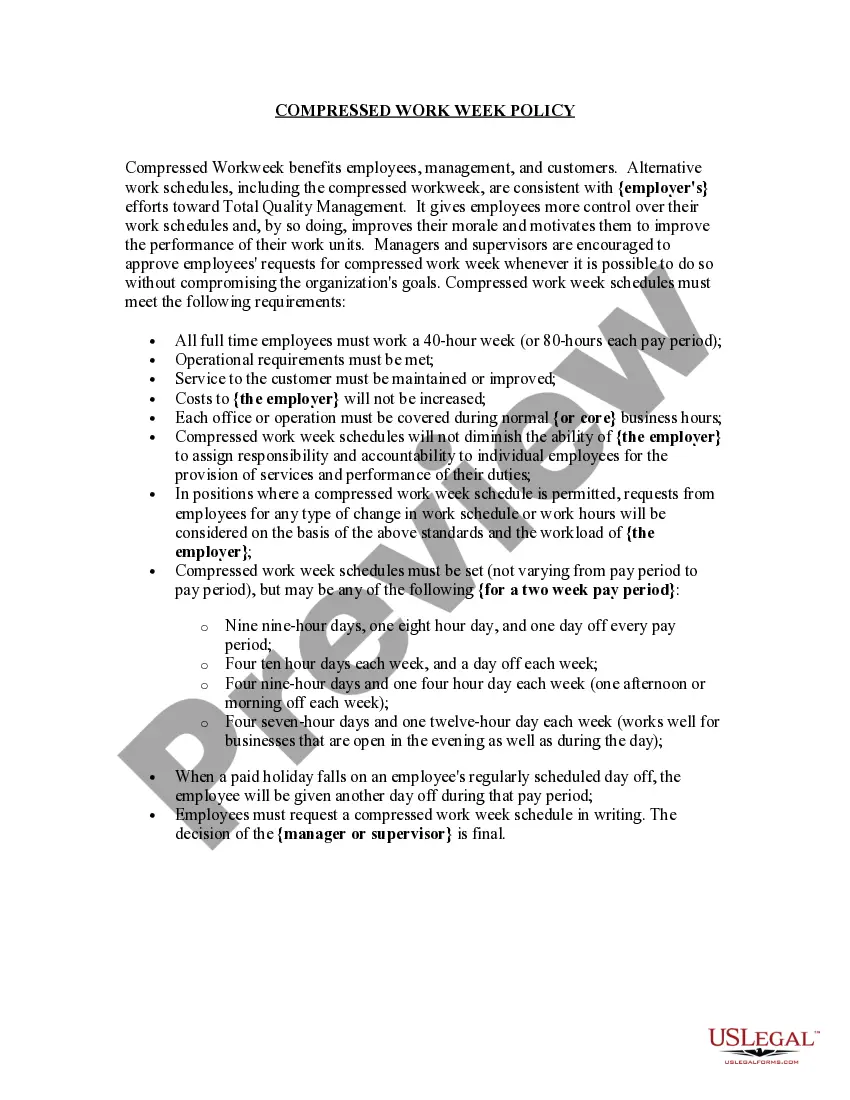
What is a 4/10 compressed work schedule? The most common type of compressed work arrangement is called a 4/10 schedule, during which an employee works four 10-hour days (Monday through Thursday), with Friday, Saturday and Sunday off. Key takeaway: The 4/10 compressed work schedule shortens each workweek to four days.
4/10 Compressed Work Schedule Two teams are required, with each team working 10 hours a day for 4 straight days. Team 1 works Monday to Thursday while Team 2 works Tuesday to Friday.
A: Alternative work arrangements are work arrangements that include flexible work schedules, job sharing of one position between several employees and having a regular work location at a place other than a campus work site.Work schedules are set in advance and are determined by the business needs of the work group.
Under the 9/80 schedule, employees work for nine days in which 80 hours are compressed into those nine days. Employees working the 9/80 schedule would not receive overtime pay despite working an additional eight hours but would however receive an extra day off from work every two weeks.