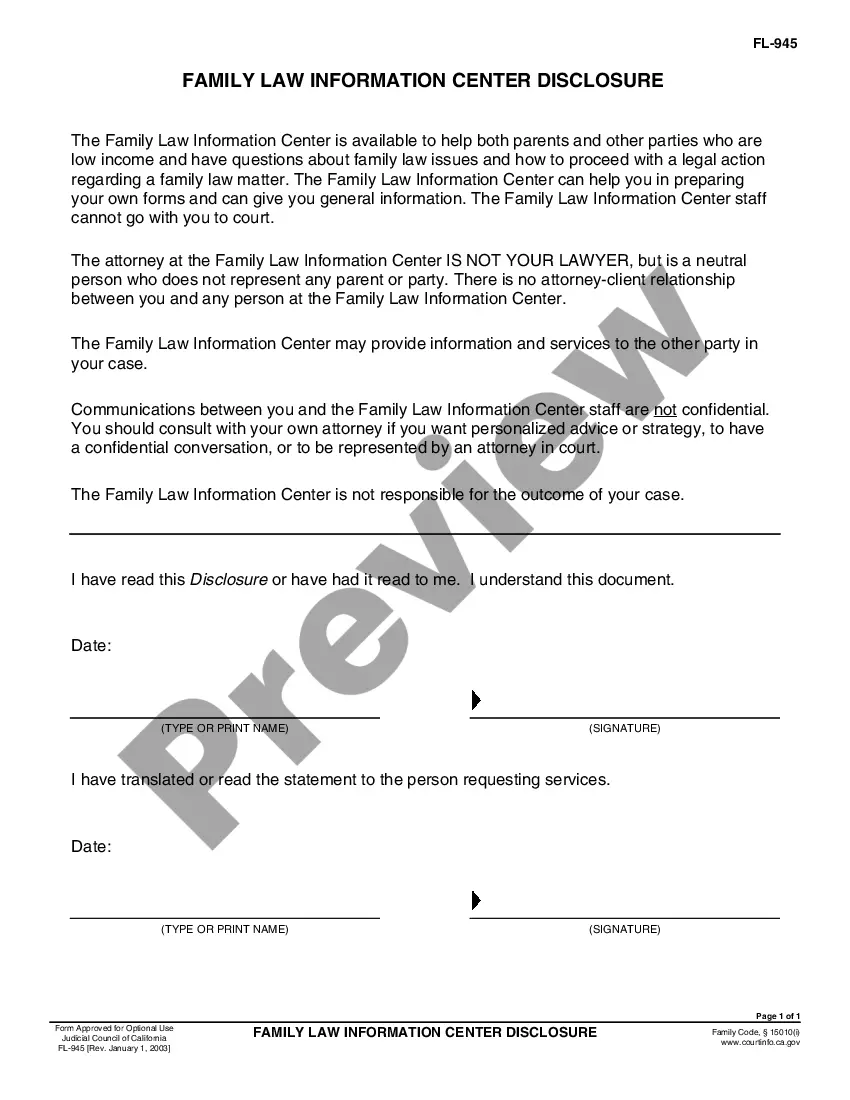
Family Law Information Center Disclosure: This is an official form from the California Judicial Counsel, which complies with all applicable laws and statutes. USLF amends and updates the Judicial Counsel forms as is required by California statutes and law.
California Family Law Information Center Disclosure
Instant download
This website is not affiliated with any governmental entity
Public form
Description
Get your form ready online
Our built-in tools help you complete, sign, share, and store your documents in one place.
Built-in online Word editor
Make edits, fill in missing information, and update formatting in US Legal Forms—just like you would in MS Word.
Export easily
Download a copy, print it, send it by email, or mail it via USPS—whatever works best for your next step.
E-sign your document
Sign and collect signatures with our SignNow integration. Send to multiple recipients, set reminders, and more. Go Premium to unlock E-Sign.
Notarize online 24/7
If this form requires notarization, complete it online through a secure video call—no need to meet a notary in person or wait for an appointment.
Store your document securely
We protect your documents and personal data by following strict security and privacy standards.

Make edits, fill in missing information, and update formatting in US Legal Forms—just like you would in MS Word.

Download a copy, print it, send it by email, or mail it via USPS—whatever works best for your next step.

Sign and collect signatures with our SignNow integration. Send to multiple recipients, set reminders, and more. Go Premium to unlock E-Sign.

If this form requires notarization, complete it online through a secure video call—no need to meet a notary in person or wait for an appointment.

We protect your documents and personal data by following strict security and privacy standards.
Looking for another form?

How to fill out California Family Law Information Center Disclosure?
If you are in search of precise California Family Law Information Center Disclosure templates, US Legal Forms is precisely what you require; locate documents supplied and validated by state-approved attorneys.
Utilizing US Legal Forms not only alleviates concerns regarding legitimate forms; it also saves you time, effort, and money!
And while that's all. In just a few simple steps, you have an editable California Family Law Information Center Disclosure. Once you create an account, all future purchases will be processed even more effortlessly. When you have a US Legal Forms subscription, simply Log In to your account and click the Download button you see on the form's page. Then, when you need to utilize this blank again, you'll always be able to find it in the My documents section. Don't waste your time searching through countless forms on various sites. Obtain accurate copies from a single reliable service!
- Begin by completing your registration process by providing your email and creating a password.
- Follow the directions below to set up your account and locate the California Family Law Information Center Disclosure template suited for your needs.
- Use the Preview function or review the file description (if it exists) to confirm that the form is the one you desire.
- Verify its validity in your residing state.
- Click Buy Now to place your order.
- Select a preferred pricing plan.
- Create an account and pay using a credit card or PayPal.
Form popularity
FAQ
To submit evidence to family court in California, gather all relevant documents and complete any necessary forms. Typically, you will need to file these with the court clerk before your hearing. For assistance in navigating the submission process, consult the California Family Law Information Center Disclosure, which provides helpful advice and resources.
Disclosures for family law in California involve transparent sharing of financial information, assets, and liabilities between parties. This process ensures both parties are informed and can affect the court’s decisions in custody and support matters. You can find detailed guidance on these disclosures through the California Family Law Information Center Disclosure, making your compliance easier.
Writing a declaration for family court in California involves outlining your statement facts and perspectives clearly and concisely. Start with an introduction of yourself, followed by relevant details regarding your case. The California Family Law Information Center Disclosure can provide you with specific formats and tips to ensure your declaration meets all legal standards.
Organizing evidence for family court involves categorizing documents, photographs, and any other materials based on themes relevant to your case. Use binders or folders to keep items sorted, and label everything clearly for easy access during your hearing. For further clarity on how to manage evidence, the California Family Law Information Center Disclosure offers valuable insights.
To present evidence in court in California, you must first organize your evidence clearly and adhere to court procedures. Bring copies of all documents for the judge and opposing party, and be prepared to explain their significance. Utilizing the guidance from the California Family Law Information Center Disclosure can help you understand how to structure your presentation effectively.
In California family court, admissible evidence includes documents, photographs, recordings, and witness testimonies relevant to your case. This type of evidence must follow specific rules and be obtained legally. Understand that the California Family Law Information Center Disclosure outlines what constitutes admissible evidence, ensuring you present a strong case.
You can file a California corporate disclosure statement online by visiting the California Secretary of State’s website. Once there, navigate to the corporate filings section and follow the prompts. This process streamlines your submission and ensures you complete your filing efficiently. For more assistance, the California Family Law Information Center Disclosure can guide you in understanding legal obligations.
In California, family law cases are generally considered confidential, meaning that case details are typically not disclosed to the public. However, certain documents may be accessible under specific circumstances. To navigate concerns about confidentiality and privacy in family law, resources like the California Family Law Information Center Disclosure can offer crucial guidance.
The cut-off for discovery in California often hinges on the deadlines set by the court’s scheduling order, which generally occurs before a trial. Parties are required to complete all discovery actions prior to this cut-off to ensure that all relevant information is presented at trial. It is important to refer to the California Family Law Information Center Disclosure to stay on track with these deadlines.
The rules for discovery in California family law govern how evidence and information can be shared between parties. These rules allow for various forms of discovery, such as interrogatories, depositions, and requests for documents. Knowing and understanding these rules can significantly impact your case, which is why the California Family Law Information Center Disclosure provides essential guidance.