This form is an official California Judicial Council form which complies with all applicable state codes and statutes. USLF updates all state forms as is required by state statutes and law.
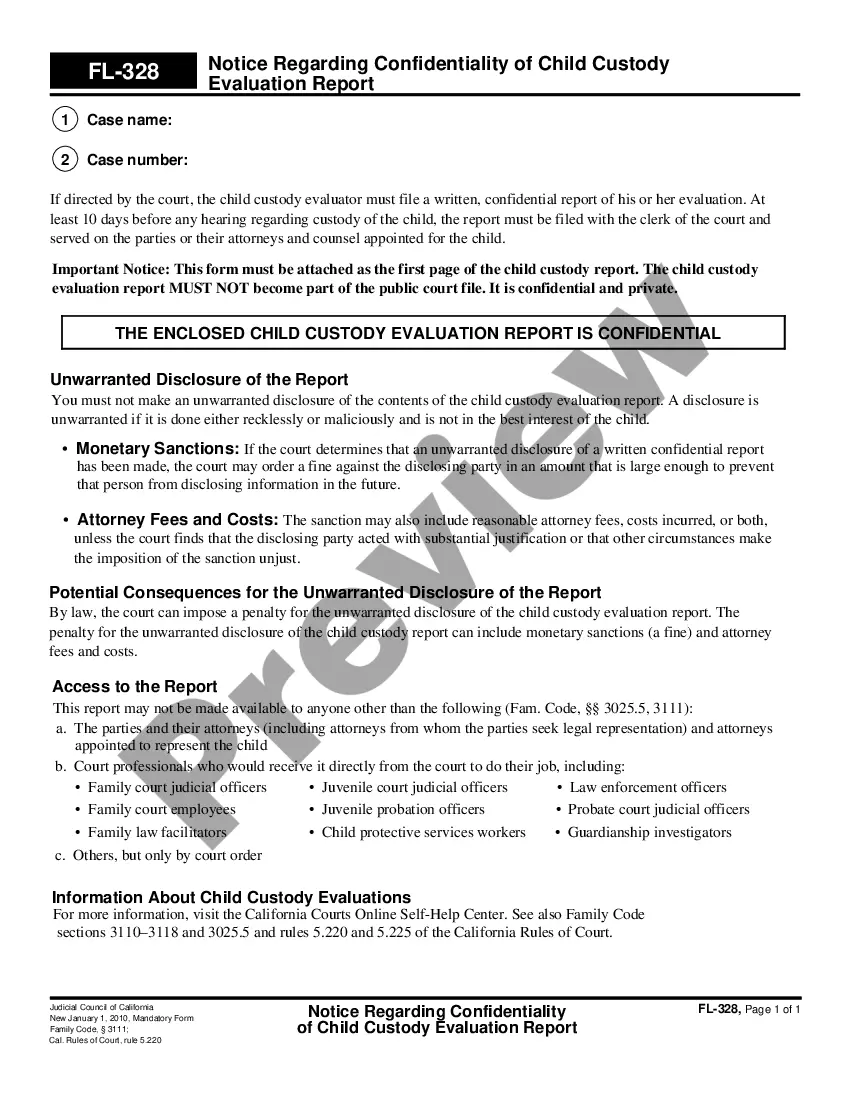
California Notice Regarding Confidentiality of Child Custody Evaluation Report
State:
California
Control #:
CA-FL-328
Format:
PDF
Instant download
This website is not affiliated with any governmental entity
Public form
Description
Get your form ready online
Our built-in tools help you complete, sign, share, and store your documents in one place.
Built-in online Word editor
Make edits, fill in missing information, and update formatting in US Legal Forms—just like you would in MS Word.
Export easily
Download a copy, print it, send it by email, or mail it via USPS—whatever works best for your next step.
E-sign your document
Sign and collect signatures with our SignNow integration. Send to multiple recipients, set reminders, and more. Go Premium to unlock E-Sign.
Notarize online 24/7
If this form requires notarization, complete it online through a secure video call—no need to meet a notary in person or wait for an appointment.
Store your document securely
We protect your documents and personal data by following strict security and privacy standards.

Make edits, fill in missing information, and update formatting in US Legal Forms—just like you would in MS Word.

Download a copy, print it, send it by email, or mail it via USPS—whatever works best for your next step.

Sign and collect signatures with our SignNow integration. Send to multiple recipients, set reminders, and more. Go Premium to unlock E-Sign.

If this form requires notarization, complete it online through a secure video call—no need to meet a notary in person or wait for an appointment.

We protect your documents and personal data by following strict security and privacy standards.
Looking for another form?
How to fill out California Notice Regarding Confidentiality Of Child Custody Evaluation Report?
If you're looking for suitable California Notice Regarding Confidentiality of Child Custody Evaluation Report samples, US Legal Forms is what you require; access documents created and validated by state-licensed attorneys.
Using US Legal Forms not only alleviates your concerns regarding legal paperwork; it also conserves your time, effort, and financial resources! Downloading, printing, and submitting a professional template is significantly more economical than hiring an attorney to draft it for you.
And that's it. With just a few simple clicks, you possess an editable California Notice Regarding Confidentiality of Child Custody Evaluation Report. Once you've established your account, all future transactions will be even more streamlined. When you have a US Legal Forms subscription, just Log In to your account and then click the Download button available on the form’s page. Then, whenever you need to use this blank form again, you'll always be able to find it in the My documents section. Don't waste your time and effort comparing multiple documents across various online sources. Obtain expert templates from a single reliable service!
- To begin, complete your registration process by entering your email and creating a secure password.
- Follow the instructions below to establish your account and locate the California Notice Regarding Confidentiality of Child Custody Evaluation Report template to address your situation.
- Utilize the Preview feature or review the document details (if available) to confirm that the template is the one you require.
- Verify its validity in the state where you reside.
- Click Buy Now to place your order.
- Select a recommended pricing plan.
- Create an account and pay using your credit card or PayPal.
- Choose a preferred format and save the document.
Form popularity
FAQ
To write a letter of declaration for child custody in California, begin with your contact information and the date. Clearly state your purpose and include relevant details about your situation, such as your relationship with the child and any agreements made. Make sure to refer to the California Notice Regarding Confidentiality of Child Custody Evaluation Report if your declaration involves reports or evaluations, as this ensures the protection of sensitive information. Lastly, sign your letter and keep a copy for your records.
Writing a declaration for child custody in California requires a clear presentation of your facts and feelings regarding your child's best interests. Start by outlining your relationship with your child, including living arrangements, educational needs, and any relevant circumstances. Incorporate the California Notice Regarding Confidentiality of Child Custody Evaluation Report to ensure sensitive information is handled appropriately. Utilizing resources like US Legal Forms can simplify the declaration process and guide you in creating a well-structured document.
A Family Code 3118 evaluation refers to a comprehensive assessment carried out to aid the court in determining child custody and visitation arrangements. This evaluation often examines the family’s emotional, psychological, and developmental needs. Awareness of the California Notice Regarding Confidentiality of Child Custody Evaluation Report is vital, as it governs the confidentiality of the findings, ensuring family privacy is maintained during the process. Utilizing platforms like USLegalForms can help you navigate these evaluations effectively.
The Evidence Code 730 evaluation is a court-ordered report designed to assess the best interests of children in custody proceedings. Typically, mental health professionals conduct these evaluations to provide insights into family dynamics and child welfare. Understanding the findings of this evaluation is crucial, particularly in light of the California Notice Regarding Confidentiality of Child Custody Evaluation Report. This ensures that sensitive information remains protected while informing custody decisions.
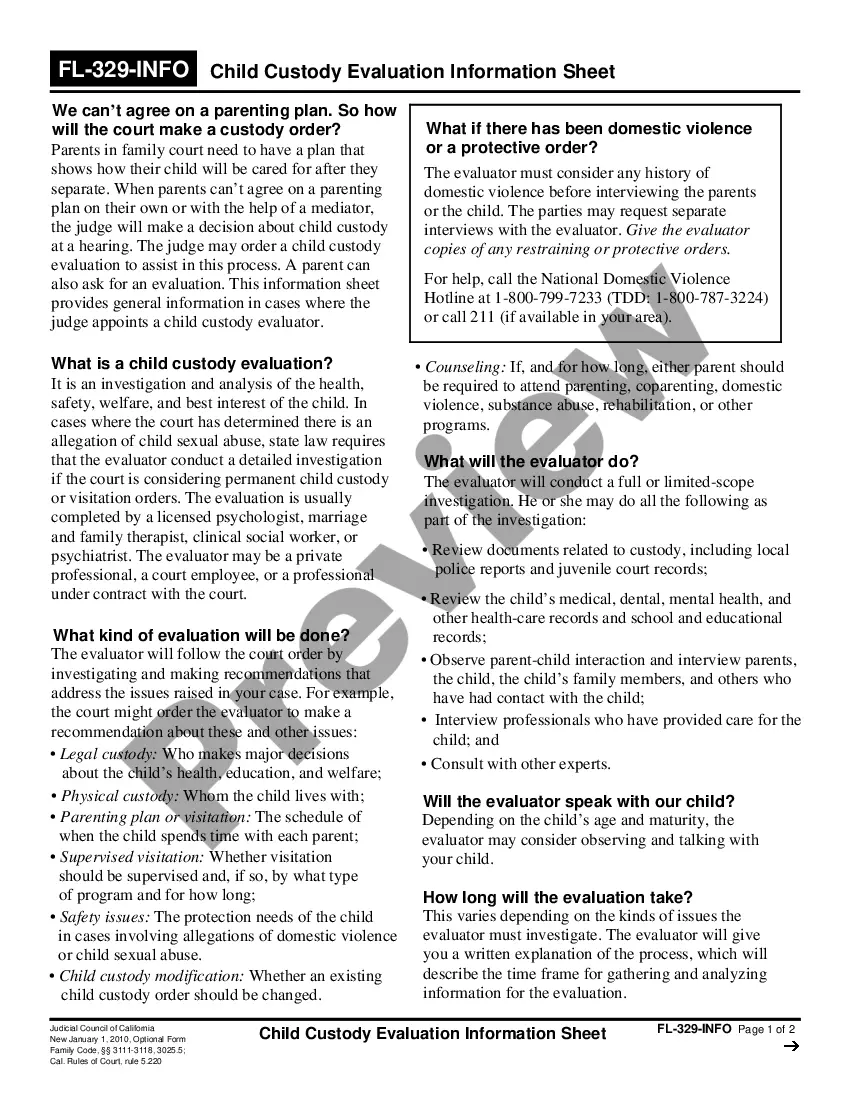
A traditional custody evaluation can include interviews with the parents and children, psychological tests, home visits, interviews with other people who know the family, and a review of documents ranging from school files to health records.Full evaluations take weeks to months to complete.
Under California Evidence Code Section 730, the court can order an examination of the parents in a custody case. A 730 evaluation is a close assessment of the family, the children's relationships with their parents and other family members, living arrangements, and a series of professional evaluations.
Listen to Your Lawyer. Eric Audras/Getty Images. Be Aware of the Evaluator's Role. The evaluator is an independent expert. Be Honest. Be completely honest. Prepare for Your Meeting. Make a Good Impression. Have a Positive Attitude. Stick to Parenting Issues. Cooperate.
730 Evaluation Cost A 730 evaluation can cost anywhere from $1,000 to $100,000. It depends on what issues need to be evaluated and what procedures the evaluator uses.
Full evaluations A traditional custody evaluation can include interviews with the parents and children, psychological tests, home visits, interviews with other people who know the family, and a review of documents ranging from school files to health records.
The investigator can see beyond divorce issues and current family problems to determine the best situation for the child, and their decisions are solely based on the child's best interests. Along with gathering input from both parents, a child and family investigator may conduct an interview with the child.