Montana Acknowledgment for Individuals
What is this form?
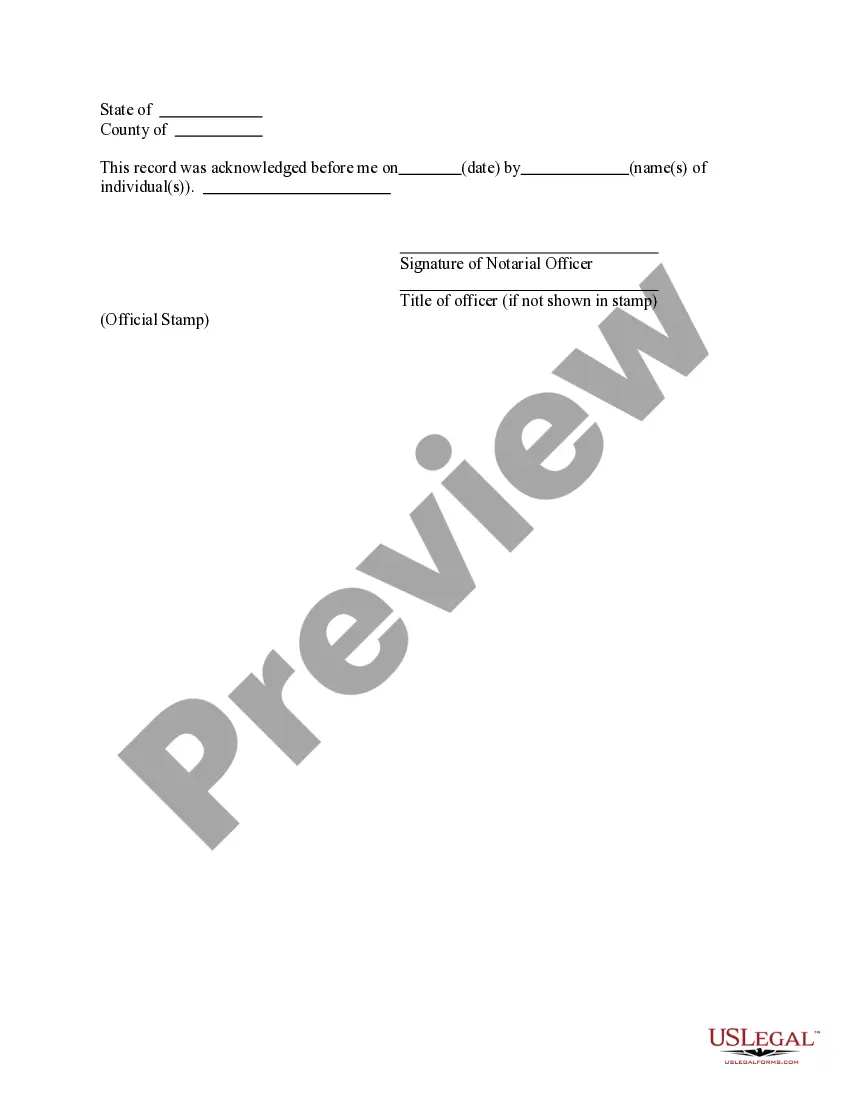
The Acknowledgment for Individuals is a legal document used to formally recognize the signing of another document in the presence of a notary or other authorized official. It serves to validate the identities of the individuals involved and ensure the authenticity of their signatures. This form differs from other acknowledgment forms in its specific application for individual signers rather than for entities or organizations.
What’s included in this form
- Date of acknowledgment
- Name(s) of individuals signing the document
- Signature of the notarial officer
- Title of officer, if applicable
- Official stamp of the notarial officer
Common use cases
This form should be used when individuals need to affirm their signatures on a legal document in front of a notary. Common scenarios include real estate transactions, financial agreements, or any other situation that requires a verified acknowledgement of signature to establish validity or compliance with state laws.
Who can use this document
- Individuals who are signing legal documents requiring notarization
- Parties involved in real estate transactions
- Those executing financial agreements
- Anyone seeking to confirm the authenticity of a signature for legal purposes
Instructions for completing this form
- Identify the individuals whose signatures are being acknowledged.
- Enter the date of acknowledgment.
- Ensure all signers are present to sign in front of the notarial officer.
- Obtain signatures from all signers on the form.
- The notarial officer will then complete the acknowledgment section, including their signature and title.
- Affix the official stamp of the notarial officer if not already provided.
Does this form need to be notarized?
This form needs to be notarized to ensure legal validity. US Legal Forms provides secure online notarization powered by Notarize, allowing you to complete the process through a verified video call, available anytime.
Get your form ready online
Our built-in tools help you complete, sign, share, and store your documents in one place.
Make edits, fill in missing information, and update formatting in US Legal Forms—just like you would in MS Word.
Download a copy, print it, send it by email, or mail it via USPS—whatever works best for your next step.
Sign and collect signatures with our SignNow integration. Send to multiple recipients, set reminders, and more. Go Premium to unlock E-Sign.
If this form requires notarization, complete it online through a secure video call—no need to meet a notary in person or wait for an appointment.
We protect your documents and personal data by following strict security and privacy standards.

Make edits, fill in missing information, and update formatting in US Legal Forms—just like you would in MS Word.

Download a copy, print it, send it by email, or mail it via USPS—whatever works best for your next step.

Sign and collect signatures with our SignNow integration. Send to multiple recipients, set reminders, and more. Go Premium to unlock E-Sign.

If this form requires notarization, complete it online through a secure video call—no need to meet a notary in person or wait for an appointment.

We protect your documents and personal data by following strict security and privacy standards.
Avoid these common issues
- Failing to ensure all individuals are present when signing.
- Not including the correct date on the acknowledgment.
- Omitting the title of the notarial officer if applicable.
- Neglecting to affix the official stamp.
Why complete this form online
- Convenient access to legally vetted templates from licensed attorneys.
- Editable digital format allows for easy completion and modification.
- Secure process that ensures legal equivalence without needing to visit a notary in person.
- Availability of the form 24/7, allowing users to complete it at their convenience.
Legal use & context
- This form serves as a critical tool in confirming the authenticity of signatures, which is essential in various legal transactions.
- It is enforceable in court, provided it is properly completed and notarized according to the applicable state laws.
- Using this form correctly ensures that the legal documents involved remain valid and binding.
Key takeaways
- The Acknowledgment for Individuals is essential for validating signatures on legal documents.
- Ensure compliance with local laws and proper notarization to avoid issues.
- Utilizing online forms simplifies the process while ensuring legal support.
Looking for another form?



Form popularity
FAQ
When the signer personally appears before the notary, he must present the entire document that he is signing.The signer MUST personally appear before the notary because there is no other way to confirm the identity of the signer and that she is signing freely and willingly.
According to the eNotarization standards developed by the National Association of Secretaries of State (NASS), Physical appearance and appears before the Notary mean that the signer and the Notary Public are physically close enough to see, hear, communicate with, and give documents to each other without relying on
One of the main ways that a notary prevents fraud in written transactions is to require that the document signer personally appear before the notary at the time of the notarization. In fact, the law prohibits a notary from notarizing a signature if the signer is not present.
We've said it before and we'll say it again: "RULE # 1 When taking an acknowledgement, witnessing a signature or performing a verification on oath or affirmation (jurat), the signer must personally appear to the notary at the time the notarization takes place." Montana law defines personal appearance as either
The Individual Acknowledgment certificate is used when an individual is signing and acknowledging on his or her own behalf.
An acknowledgment is a formal declaration before an authorized official such as a notary, by a person who has signed a document, that the document is his or her act. Acknowledgments are governed by the Uniform Acknowledgment Act. The person acknowledging the document must personally appear before the notary.
A document that's notarized is a secure way to sign the contract, but the document will still be legally binding without being notarized. It's important to be careful how you word the document, as you'll need to include all essential terms.
As long as the signer is personally present before the notary and acknowledges the signature, then the notary can proceed with performing the notarial act.If the document has already been signed, the signer can sign his or her name again above or next to the first signature. You can then proceed with the notarization.
A notary public who has a direct or indirect financial (or other beneficial) interest in a document may not notarize such a document. The better practice is not to notarize for a spouse or family member in order to preserve the integrity of the notarization and to prevent a challenge to the notarization.