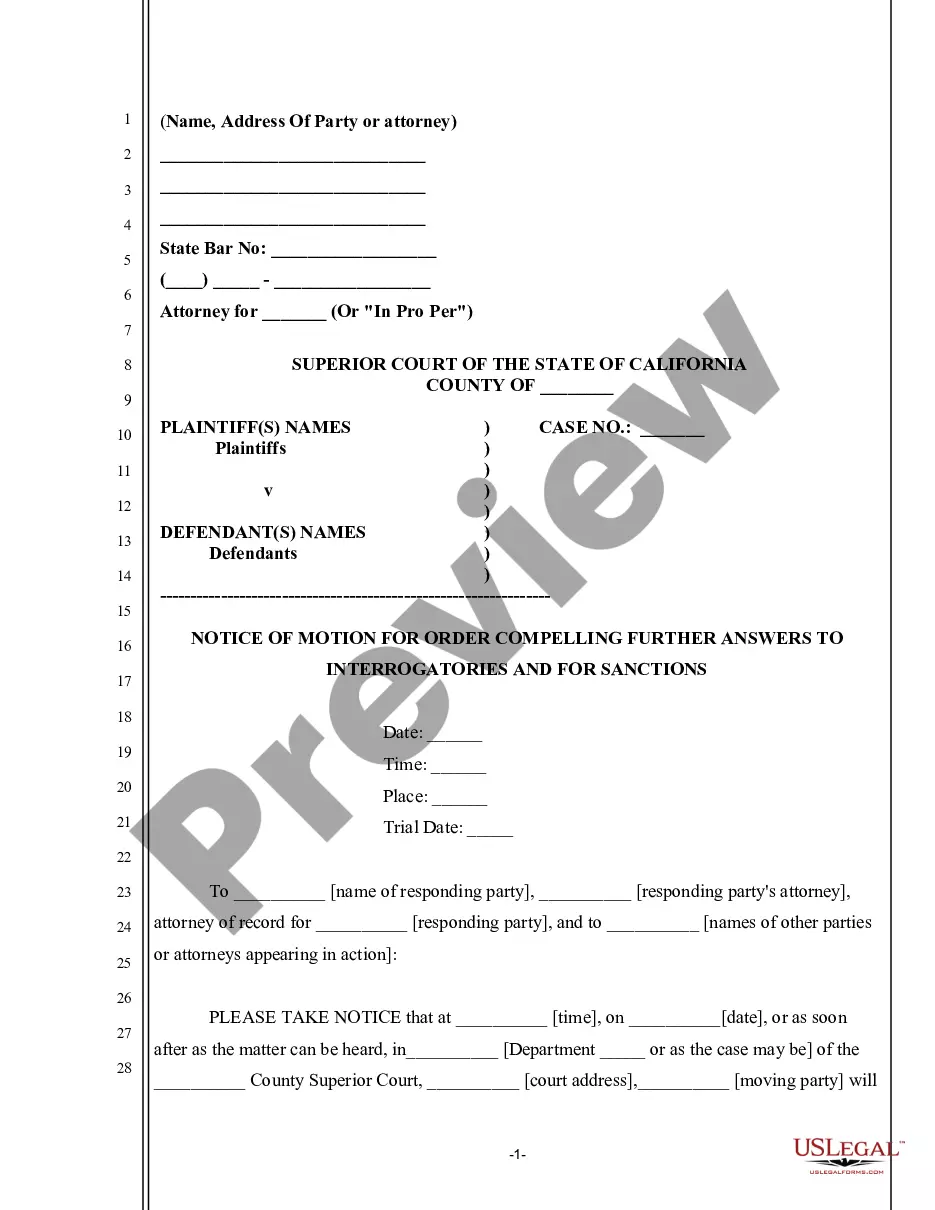
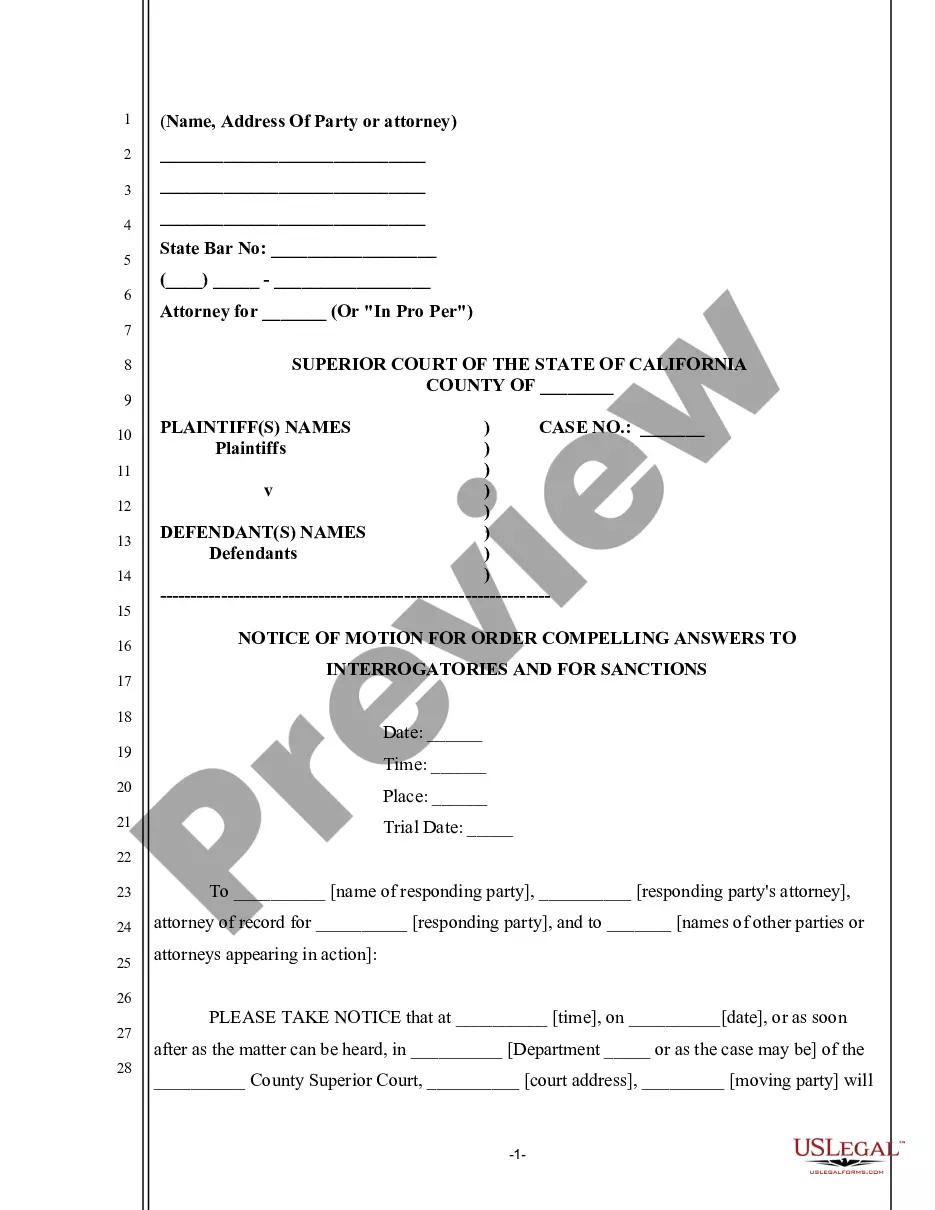
California Notice of Motion for Order Compelling Further Answers to Interrogatories and for Sanctions
What this document covers
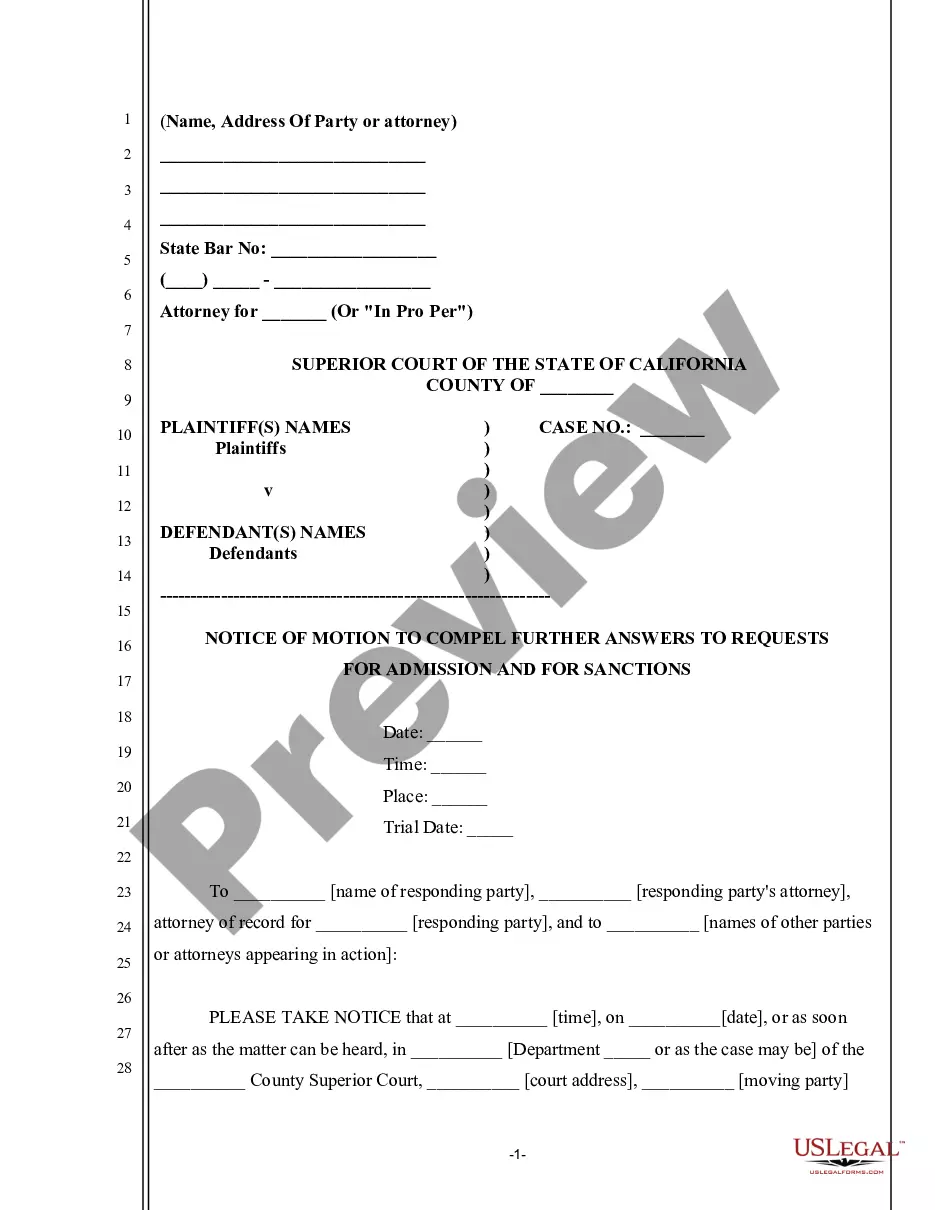
The Notice of Motion for Order Compelling Further Answers to Interrogatories and for Sanctions is a legal document used to request the court to compel a party to provide additional responses to interrogatories. This form is essential when the responding party fails to answer questions thoroughly or adequately, and it seeks to impose monetary sanctions against the party for their lack of compliance. Unlike other motion forms, this specific form focuses on interrogatory responses and the associated penalties for non-compliance, ensuring that parties to a lawsuit fulfill their obligations fully and transparently.
Key parts of this document
- Date, time, and place of the hearing
- Identifying information of the parties involved
- Details of the interrogatories and responses in dispute
- The grounds for the motion
- Request for monetary sanctions and associated costs
- Signature line for the moving party's attorney or self-represented litigant

Situations where this form applies
This form should be used when a party involved in a legal dispute has received incomplete or evasive answers to interrogatories. If your attempts to resolve the issue amicably have failed, filing this notice can compel the other party to provide the necessary information. It is particularly applicable when seeking enforcement of the discovery process in civil litigation within jurisdictions governed by statutes similar to the Code of Civil Procedure.
Who this form is for
- Parties to a civil lawsuit in California
- Attorneys representing clients seeking further answers to interrogatories
- Self-represented litigants (pro per parties)
- Individuals or entities that have received inadequate discovery responses
Completing this form step by step
- Fill in the date, time, and location of the hearing.
- Identify the responding party and their attorney's names and contact information.
- Specify the interrogatories that the responding party did not answer appropriately.
- State the reasons for compelling further responses, referencing specific responses that were inadequate.
- Detail the monetary sanctions sought and the rationale for those sanctions.
- Sign the form and include your contact information as the moving party or their attorney.
Is notarization required?
In most cases, this form does not require notarization. However, some jurisdictions or signing circumstances might. US Legal Forms offers online notarization powered by Notarize, accessible 24/7 for a quick, remote process.
Get your form ready online
Our built-in tools help you complete, sign, share, and store your documents in one place.
Make edits, fill in missing information, and update formatting in US Legal Forms—just like you would in MS Word.
Download a copy, print it, send it by email, or mail it via USPS—whatever works best for your next step.
Sign and collect signatures with our SignNow integration. Send to multiple recipients, set reminders, and more. Go Premium to unlock E-Sign.
If this form requires notarization, complete it online through a secure video call—no need to meet a notary in person or wait for an appointment.
We protect your documents and personal data by following strict security and privacy standards.

Make edits, fill in missing information, and update formatting in US Legal Forms—just like you would in MS Word.

Download a copy, print it, send it by email, or mail it via USPS—whatever works best for your next step.

Sign and collect signatures with our SignNow integration. Send to multiple recipients, set reminders, and more. Go Premium to unlock E-Sign.

If this form requires notarization, complete it online through a secure video call—no need to meet a notary in person or wait for an appointment.

We protect your documents and personal data by following strict security and privacy standards.
Avoid these common issues
- Failing to include all necessary party names and contact details.
- Not providing a clear explanation of why further answers are required.
- Omitting the specific interrogatories in dispute.
- Neglecting to sign the form or provide proper representation information.
Why complete this form online
- Convenience of downloading and filling out the form at your own pace.
- Editability allows customization for your specific case details.
- Access to legally vetted templates drafted by licensed attorneys ensures accuracy.
Looking for another form?

Form popularity
FAQ
A motion to compel answers to interrogatories is a formal application to the court, urging it to order a party to provide full responses to interrogatories. When you submit a California Notice of Motion for Order Compelling Further Answers to Interrogatories and for Sanctions, you are emphasizing the importance of disclosure in legal disputes. This motion not only seeks full compliance but also reinforces the integrity of the legal process. US Legal Forms can assist you in crafting this motion easily and accurately, ensuring you stay on the right track.
A motion to compel interrogatories specifically targets incomplete or evasive responses to written questions in a legal matter. Filing a California Notice of Motion for Order Compelling Further Answers to Interrogatories and for Sanctions allows you to seek judicial enforcement to obtain the necessary information. This process is fundamental in discovering truth and promoting fairness in legal proceedings. To simplify this process, consider using US Legal Forms, which provides guided templates for creating such motions.
A motion to compel and for sanctions encompasses two critical aspects: compelling a party to respond to interrogatories and imposing penalties for non-compliance. By filing a California Notice of Motion for Order Compelling Further Answers to Interrogatories and for Sanctions, you assert your right to complete and truthful answers while advocating for accountability. This dual approach can encourage cooperation and ensure all parties adhere to legal obligations. US Legal Forms is a valuable resource for creating and managing these legal documents effectively.
A motion to compel an answer is a legal request aimed at obtaining replies to questions posed in interrogatories that have not been adequately answered. When you file a California Notice of Motion for Order Compelling Further Answers to Interrogatories and for Sanctions, you seek the court's intervention to ensure compliance. This motion is essential in advancing your case without unnecessary delays. Using platforms like US Legal Forms can help streamline your submission and enhance your understanding of the process.
A motion to answer interrogatories is a formal request to the court to require a party to provide additional information or responses to written questions. In the context of the California Notice of Motion for Order Compelling Further Answers to Interrogatories and for Sanctions, this motion seeks clarification or full responses that a party may have initially withheld. It plays a crucial role in ensuring that all necessary facts are presented and understood during legal proceedings. For individuals navigating this process, US Legal Forms offers a variety of resources to simplify the filing.
A motion to compel is a formal request made to the court, asking it to order a party to respond to discovery requests, such as interrogatories. In the context of a California Notice of Motion for Order Compelling Further Answers to Interrogatories and for Sanctions, you seek additional answers that your opponent has failed to provide. This motion can also request sanctions against the non-compliant party. Utilizing uslegalforms can help you navigate this process efficiently, ensuring you have the correct forms and guidance.
Before filing a California Notice of Motion for Order Compelling Further Answers to Interrogatories and for Sanctions, parties must engage in a meet and confer process. This means you should attempt to discuss the discovery dispute directly with the opposing party to resolve the issue. If you cannot reach an agreement, you can then file the motion with the court. This requirement ensures that all parties have an opportunity to communicate and potentially resolve disputes without court intervention.
A motion to compel, such as the California Notice of Motion for Order Compelling Further Answers to Interrogatories and for Sanctions, can be good or bad depending on the circumstances. It serves a valuable purpose in ensuring that all parties engage in fair disclosure during discovery. However, if misused, it could escalate tensions or lead to unnecessary litigation costs. Understanding when to use a motion to compel wisely is key.
To compel answers to interrogatories, you must file a California Notice of Motion for Order Compelling Further Answers to Interrogatories and for Sanctions with the court. In this filing, clearly state the reasons why responses are necessary and outline any previous attempts to obtain answers voluntarily. The court will review your motion and may enforce compliance if it finds your requests to be valid.
To oppose a California Notice of Motion for Order Compelling Further Answers to Interrogatories and for Sanctions, prepare a strong legal argument that outlines why the motion is unwarranted. Focus on the legality of the requests and any objections you may have regarding the scope or appropriateness of the demands. Submitting a detailed written opposition can help protect your case from potential sanctions.