California Order Granting Preliminary Injunction
What this document covers
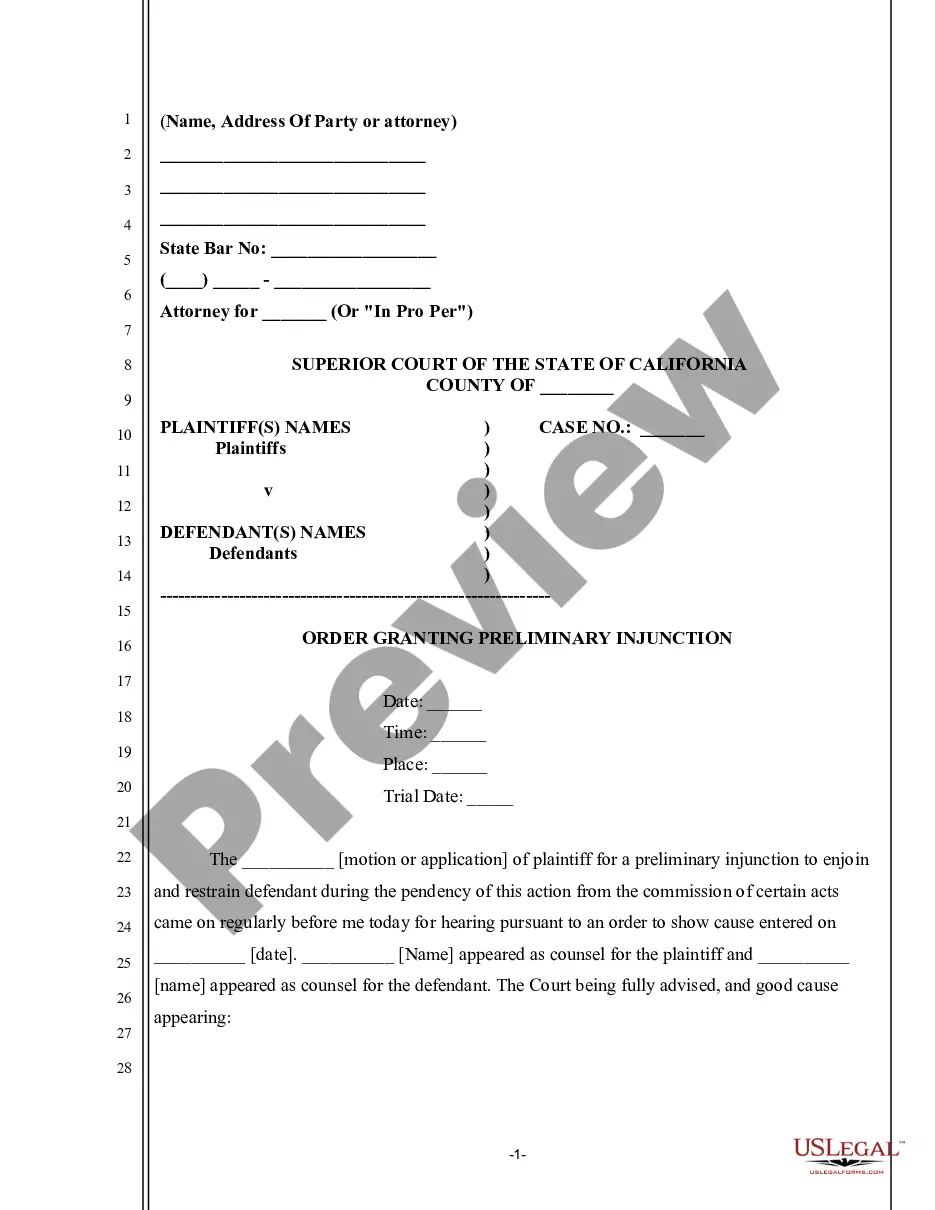
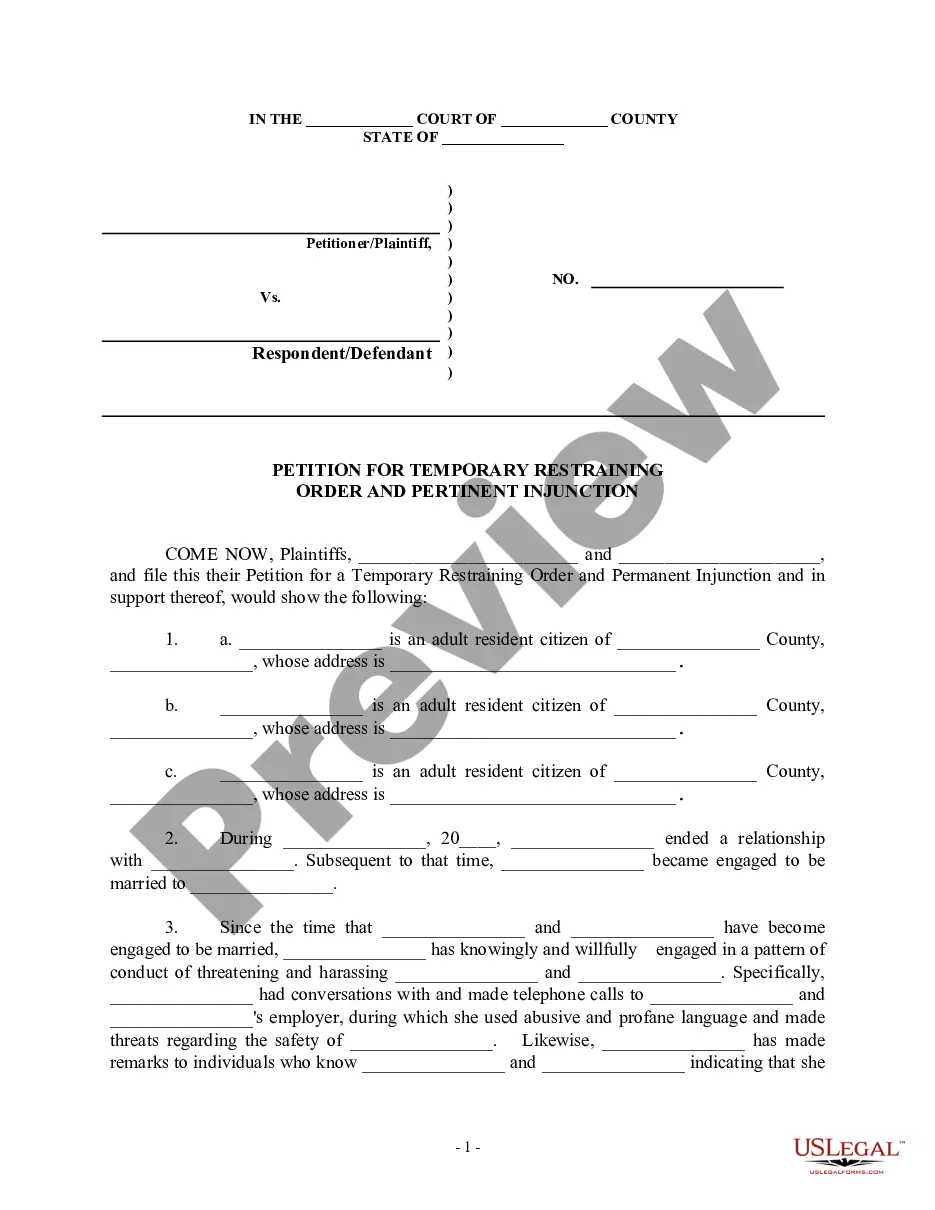
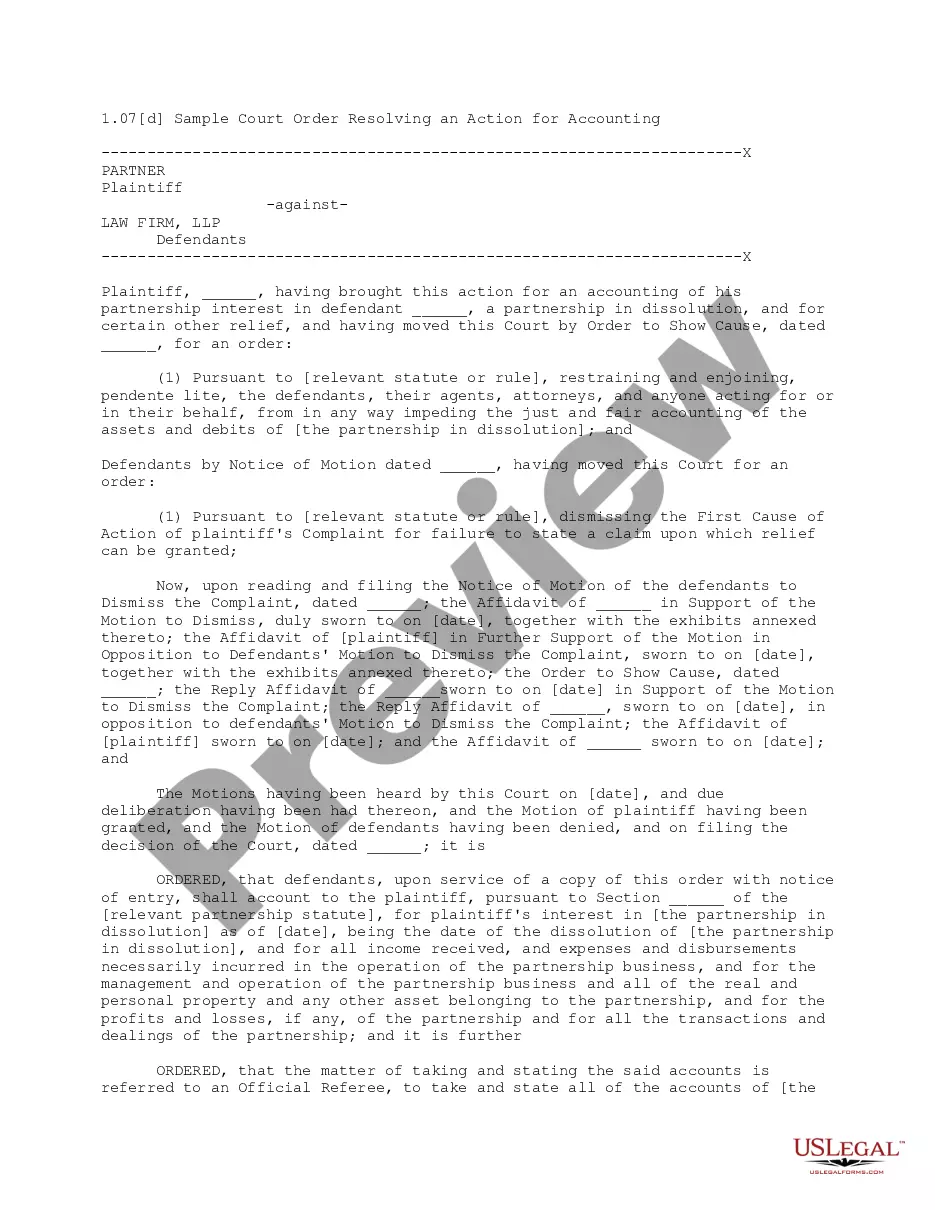
This Order Granting Preliminary Injunction is a legal document that allows a plaintiff to request a court order against a defendant, prohibiting specific actions while a case is pending. This form is crucial when urgent action is necessary to prevent potential harm before the court can make a final decision. Unlike other court orders, a preliminary injunction requires the plaintiff to file an undertaking, ensuring compensation for any damages the defendant may incur if the court later finds that the injunction was unwarranted.
What’s included in this form
- Information about the parties involved, including names and contact details.
- Case number and court hearing details, including date and time.
- Specific acts or conduct the defendant is prohibited from performing.
- Requirement for the plaintiff to file a written undertaking for indemnification.
- Signature line for the judge indicating the approval of the injunction.


When this form is needed
This form is typically used in situations where immediate legal protection is required to prevent irreparable harm. Common scenarios include cases involving family law issues, business disputes, or situations where a party seeks to stop unlawful conduct, such as harassment or violations of rights, during ongoing litigation.
Intended users of this form
- Individuals or entities acting as plaintiffs in a legal case.
- Attorneys representing clients in need of urgent legal relief.
- Parties involved in disputes where a preliminary injunction may be necessary to preserve rights or prevent harm.
How to prepare this document
- Identify and enter the names of the plaintiff(s) and defendant(s) in the relevant fields.
- Fill in the court details, including the case number and hearing date.
- Specify the acts or conduct that the defendant is being prohibited from performing.
- Indicate the amount for the written undertaking required for indemnification.
- Sign and date the form in the designated areas to finalize the injunction request.
Notarization requirements for this form
Notarization is not commonly needed for this form. However, certain documents or local rules may make it necessary. Our notarization service, powered by Notarize, allows you to finalize it securely online anytime, day or night.
Get your form ready online
Our built-in tools help you complete, sign, share, and store your documents in one place.
Make edits, fill in missing information, and update formatting in US Legal Forms—just like you would in MS Word.
Download a copy, print it, send it by email, or mail it via USPS—whatever works best for your next step.
Sign and collect signatures with our SignNow integration. Send to multiple recipients, set reminders, and more. Go Premium to unlock E-Sign.
If this form requires notarization, complete it online through a secure video call—no need to meet a notary in person or wait for an appointment.
We protect your documents and personal data by following strict security and privacy standards.

Make edits, fill in missing information, and update formatting in US Legal Forms—just like you would in MS Word.

Download a copy, print it, send it by email, or mail it via USPS—whatever works best for your next step.

Sign and collect signatures with our SignNow integration. Send to multiple recipients, set reminders, and more. Go Premium to unlock E-Sign.

If this form requires notarization, complete it online through a secure video call—no need to meet a notary in person or wait for an appointment.

We protect your documents and personal data by following strict security and privacy standards.
Avoid these common issues
- Failing to correctly identify all parties involved, which can lead to delays.
- Not specifying the prohibited actions clearly, making enforcement difficult.
- Neglecting to complete the indemnification section, risking dismissal of the request.
Why use this form online
- Convenience of filling out the form from anywhere at any time.
- Ability to easily edit and customize the form to fit specific needs.
- Access to reliable templates reviewed by licensed attorneys, ensuring legal compliance.
Looking for another form?

Form popularity
FAQ
When a preliminary injunction is granted by the court, it means that the judge has determined that there's enough evidence to require one party to act or refrain from acting pending further legal proceedings. This order is designed to maintain the status quo and prevent harm until a final decision is made. Understanding this process can be complex, so utilizing platforms like USLegalForms can guide you through obtaining a California Order Granting Preliminary Injunction with confidence.
A mandatory injunction is a court order that compels a party to take specific actions, rather than simply refraining from certain conduct. In California, this type of injunction can be granted to establish compliance or restore a prior condition. Such an order may be critical in situations where inaction can lead to irreversible harm. You may pursue a California Order Granting Preliminary Injunction to enforce compliance effectively.
A temporary restraining order (TRO) is a short-term measure typically issued without notice to the opposing party, intended to maintain the status quo until a more formal hearing can occur. In contrast, a preliminary injunction is a longer-lasting remedy that requires a hearing where both parties can present their arguments. While both seek to prevent harm, a California Order Granting Preliminary Injunction offers a more structured path following a TRO when you need sustained protection.
To achieve injunctive relief in California, you must prove specific elements within your case. Primarily, establish the likelihood of success on the underlying claim and the potential for irreparable harm. Next, show that the balance of hardships favors your position over the opposing party. Lastly, emphasize that the injunction would advance the public interest. This process often culminates in a California Order Granting Preliminary Injunction.
In California, grounds for obtaining an injunction often include the need to prevent harm or injury that cannot be remedied by monetary compensation. You may seek an injunction for issues related to property disputes, breaches of contract, or violations of statutory rights. Each case is unique, so consulting legal experts can help clarify your situation. A California Order Granting Preliminary Injunction could safeguard your interests when grounds are established.
In California, when seeking a preliminary injunction, you must consider four main factors. Firstly, you need to show a likelihood of success on the merits of your case. Secondly, demonstrate that you will suffer irreparable harm without the injunction. Thirdly, illustrate that the balance of hardships tips in your favor. Lastly, the requested injunction must serve the public interest. Understanding these factors is crucial for a California Order Granting Preliminary Injunction.
Writing a request for a California Order Granting Preliminary Injunction involves several key steps. Start by clearly stating the reasons for your request and outline the evidence supporting your claim. Include details about the irreparable harm you may face and explain why the injunction serves the public interest. Templates and resources from platforms like USLegalForms can simplify this writing process and provide a structured approach.
Although it's not mandatory to hire a lawyer when pursuing a California Order Granting Preliminary Injunction, having one can greatly benefit your case. A lawyer understands the complexities of the law and can help you prepare the necessary documentation accurately. Proper legal representation can enhance your chances of a favorable outcome. USLegalForms assists by providing resources that guide you through the process.
In California, the standard of proof for obtaining a preliminary injunction is 'likelihood of success on the merits.' This means you must convince the court that you have a reasonable chance of winning your case. Courts examine the evidence presented to determine if the injunction is necessary to prevent irreparable harm. Being well-prepared with supporting documentation can help you meet this standard.
While seeking a California Order Granting Preliminary Injunction can provide immediate relief, there are disadvantages to consider. First, injunctions can be costly and time-consuming, requiring court appearances and documentation. Additionally, the possibility of counterclaims exists, which could complicate matters. Evaluating these risks is essential before proceeding, as it informs your decision-making.