California Notice of Motion to Strike Complaint
Overview of this form
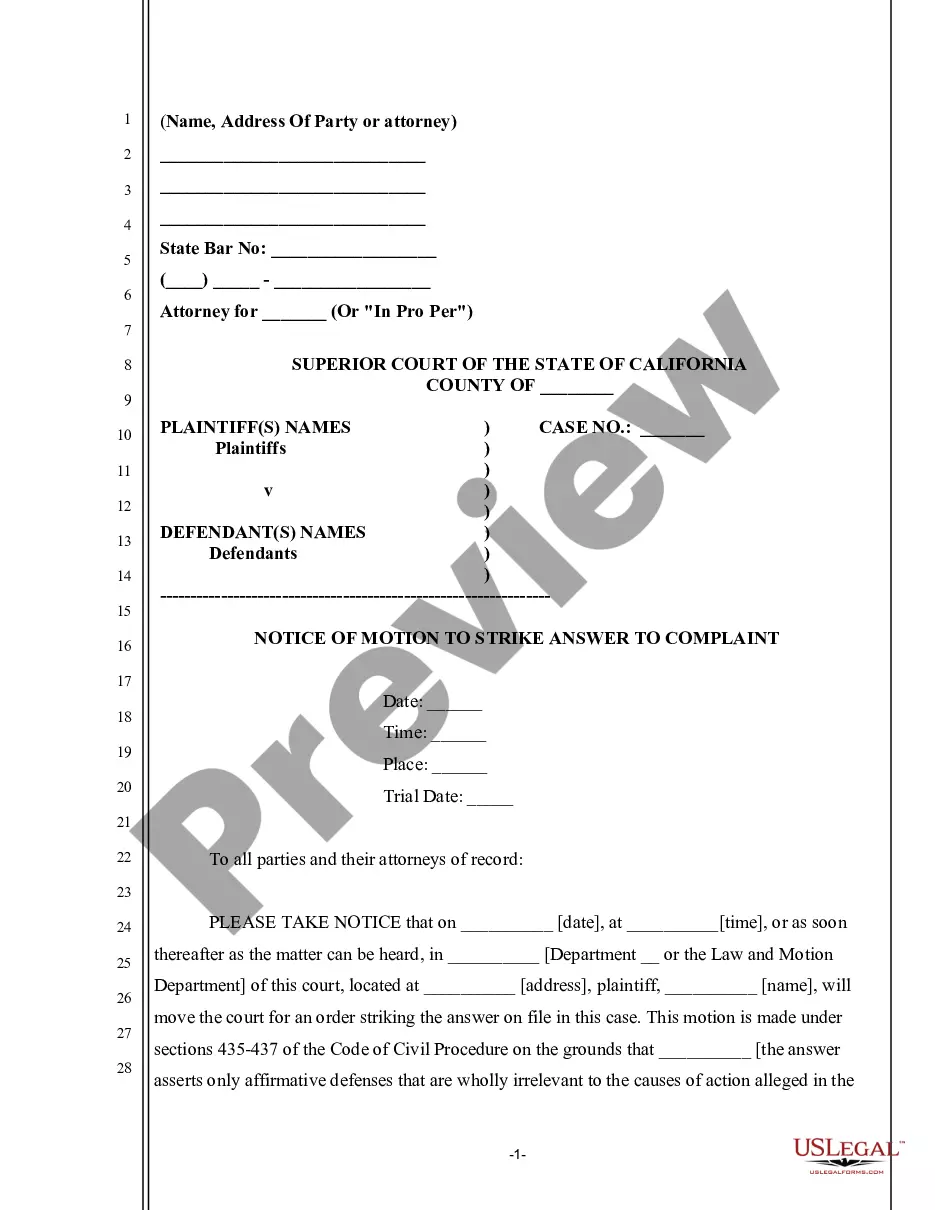
The Notice of Motion to Strike Complaint is a legal document filed by a defendant in response to a plaintiff's complaint. This form serves to formally notify the court and the opposing parties that the defendant is requesting the court to dismiss the complaint on specific legal grounds. It differs from other forms, such as answers or counterclaims, as it seeks to eliminate a complaint before the case goes to trial, based on procedural issues or lack of merit.
Key components of this form
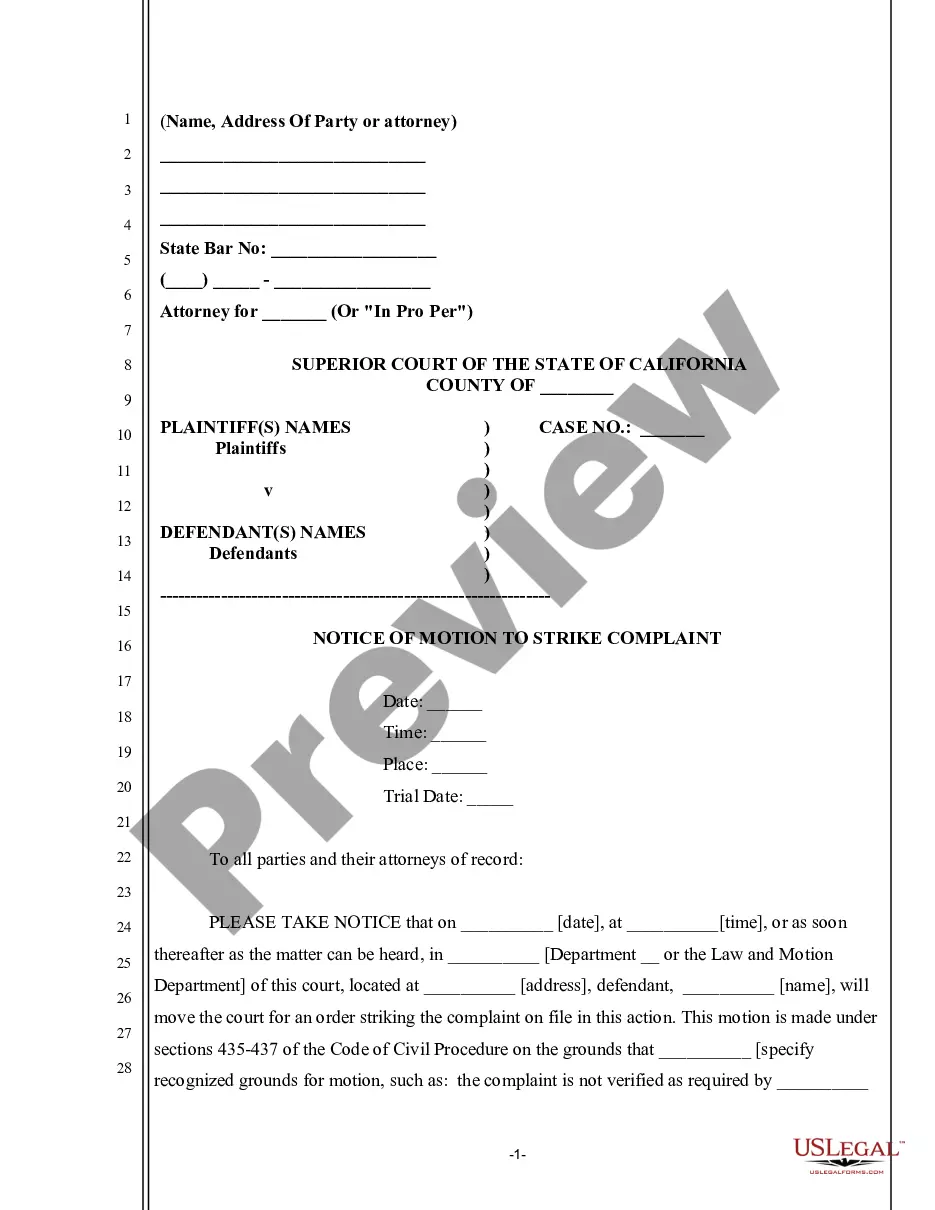
- Header section with court information and case number.
- Name and contact information of the attorney or self-represented defendant.
- Specific date, time, and location of the court hearing.
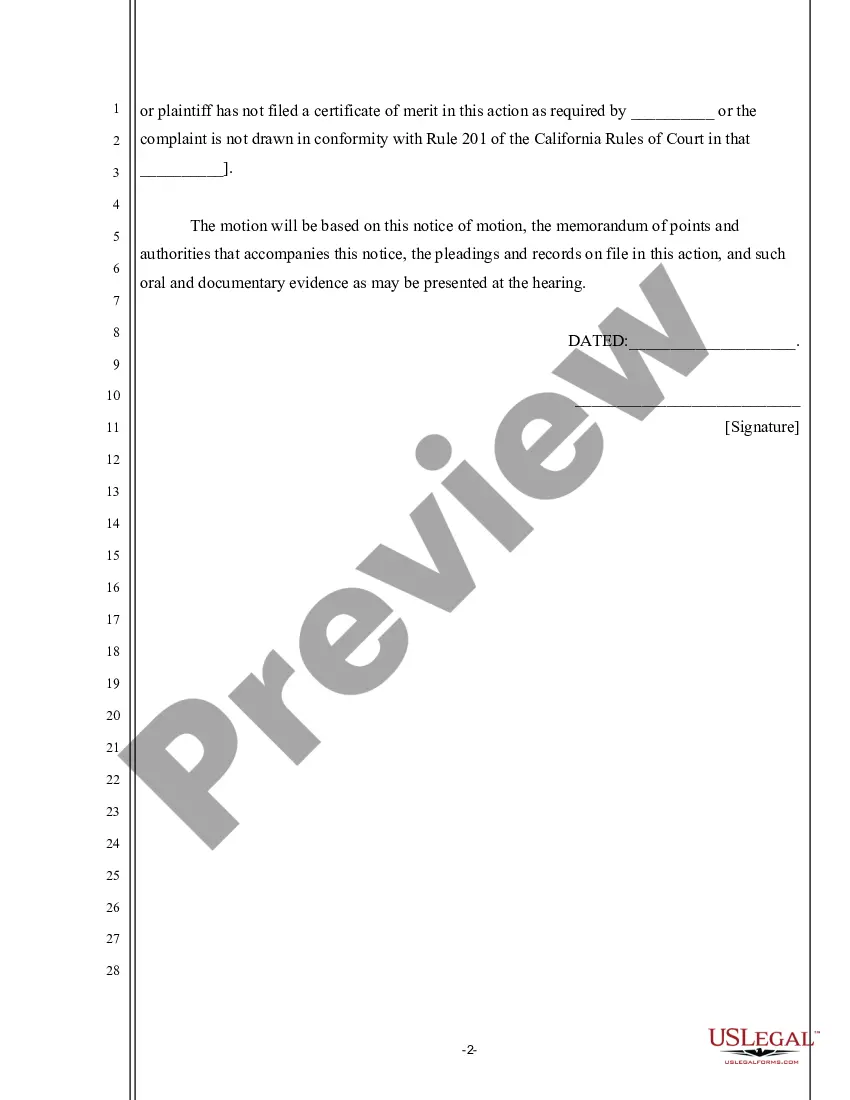
- Clear statement outlining the request to strike the complaint and the legal grounds for the motion.
- Signature block for the attorney or the party submitting the motion.
Common use cases
This form is used when a defendant believes that the complaint filed by the plaintiff is legally insufficient or fails to meet certain required standards. Common scenarios include situations where the complaint is not properly verified, does not include a certificate of merit, or fails to comply with the relevant court rules. Filing this motion can halt further proceedings until the court addresses the validity of the complaint.
Who should use this form
- Defendants in civil lawsuits who wish to contest the sufficiency of a plaintiff's complaint.
- Attorneys representing defendants in court proceedings in California.
- Individuals representing themselves (in pro per) in civil cases.
How to complete this form
- Fill out the header with the appropriate court information, case number, and date.
- Provide your name and contact information as the attorney or represent yourself as in pro per.
- Specify the date, time, and location for the hearing on your motion.
- Clearly state the grounds on which you are requesting the complaint to be struck.
- Sign and date the form before submitting it to the court.
Notarization guidance
This form does not typically require notarization unless specified by local law. It is essential to check any specific court requirements in your jurisdiction to confirm this.
Get your form ready online
Our built-in tools help you complete, sign, share, and store your documents in one place.
Make edits, fill in missing information, and update formatting in US Legal Forms—just like you would in MS Word.
Download a copy, print it, send it by email, or mail it via USPS—whatever works best for your next step.
Sign and collect signatures with our SignNow integration. Send to multiple recipients, set reminders, and more. Go Premium to unlock E-Sign.
If this form requires notarization, complete it online through a secure video call—no need to meet a notary in person or wait for an appointment.
We protect your documents and personal data by following strict security and privacy standards.

Make edits, fill in missing information, and update formatting in US Legal Forms—just like you would in MS Word.

Download a copy, print it, send it by email, or mail it via USPS—whatever works best for your next step.

Sign and collect signatures with our SignNow integration. Send to multiple recipients, set reminders, and more. Go Premium to unlock E-Sign.

If this form requires notarization, complete it online through a secure video call—no need to meet a notary in person or wait for an appointment.

We protect your documents and personal data by following strict security and privacy standards.
Avoid these common issues
- Failing to provide a valid legal basis for the motion to strike.
- Not including the correct date, time, or location for the hearing.
- Forgetting to sign the notice before filing it with the court.
- Neglecting to serve all parties involved with the motion.
Why use this form online
- Convenience of downloading and completing the form from any location.
- Editable template allows for customization to fit individual case details.
- Access to forms drafted by licensed attorneys, ensuring legal compliance.
Looking for another form?
Form popularity
FAQ
Writing an effective motion requires clarity, precision, and adherence to legal standards. Begin by stating the facts clearly and succinctly, followed by a well-reasoned argument supporting your request, such as a California Notice of Motion to Strike Complaint. Use persuasive language and include necessary legal references to justify your position. Remember to format the motion according to court rules, as compliance with these procedures can enhance your motion’s chances of being granted.
Responding to a motion to strike involves crafting a thoughtful and comprehensive reply that addresses the arguments made by the opposing party. When you receive a California Notice of Motion to Strike Complaint, examine the motion carefully and highlight any weaknesses or inaccuracies. In your response, provide clear explanations and support your arguments with relevant case law and facts. A compelling response can make a significant difference in the court's decision.
A motion to strike portion of a complaint in California allows a party to request the court to remove certain allegations or requests from the complaint that are irrelevant, redundant, or improper. This action is critical in ensuring that only valid claims are considered, which can streamline the legal process. When filing a California Notice of Motion to Strike Complaint, it is vital to show how the specific portions fail to meet legal standards. By doing so, you can maintain focus on the most critical aspects of your case.
To oppose a motion to strike, you will need to prepare and file an opposition brief that addresses the points raised in the California Notice of Motion to Strike Complaint. In your opposition, clearly outline why the motion lacks merit, support your arguments with legal citations, and present factual evidence. Be sure to adhere to the court's guidelines on formatting and submission. A well-prepared opposition can strengthen your position and increase your chances of success.
A motion to strike class refers to a request made within a legal document that challenges the classification of a class-action lawsuit. This motion is often included in the California Notice of Motion to Strike Complaint to argue that the claims do not meet the necessary criteria or should not proceed as a class action. Understanding the implications of this motion is crucial as it can significantly affect the outcome of your case. It is advisable to consult with an attorney to navigate this process effectively.
In California, you generally have 16 days to file a California Notice of Motion to Strike Complaint after being served with the complaint. However, if the motion is part of a larger case management timeline, the deadlines may vary. It is essential to check the local rules to confirm the specific time frame applicable to your situation. Timely filing ensures that you do not miss your opportunity to address any issues in the complaint.
After a motion to strike is resolved, the case will proceed based on the remaining complaint. If parts have been removed, the opposing party may choose to amend their complaint to address the court's concerns. Understanding the outcome of the California Notice of Motion to Strike Complaint can help you plan your legal strategy moving forward. Utilizing resources available on platforms like US Legal Forms can aid in navigating this transition seamlessly.
When a California Notice of Motion to Strike Complaint is granted, the court removes the specified parts of the complaint that are deemed improper. This ruling can streamline the case and focus the legal arguments on the relevant issues. It may enhance the chances of a favorable outcome by eliminating distractions. Understanding this process ensures that you are better prepared for the next steps in your case.
A motion to strike is often filed to remove portions of a complaint that are irrelevant, redundant, or legally insufficient. This legal tool helps to streamline the case by eliminating unnecessary elements that could delay proceedings. By using a California Notice of Motion to Strike Complaint, you can clarify the issues at hand and potentially strengthen your position. Engaging with a platform like US Legal Forms can simplify the process and guide you through the necessary steps.
A strike answer refers to a type of response filed with the court to contest the allegations in a complaint while also seeking to eliminate certain claims. It essentially combines deflection of the complaint with a motion to strike, creating a dual approach to legal defense. This strategy can be beneficial in reinforcing your position and enhancing your case's strength. For further guidance on this complex area, exploring resources like the California Notice of Motion to Strike Complaint is advisable.