California Stipulation Regarding Spousal Support
About this form
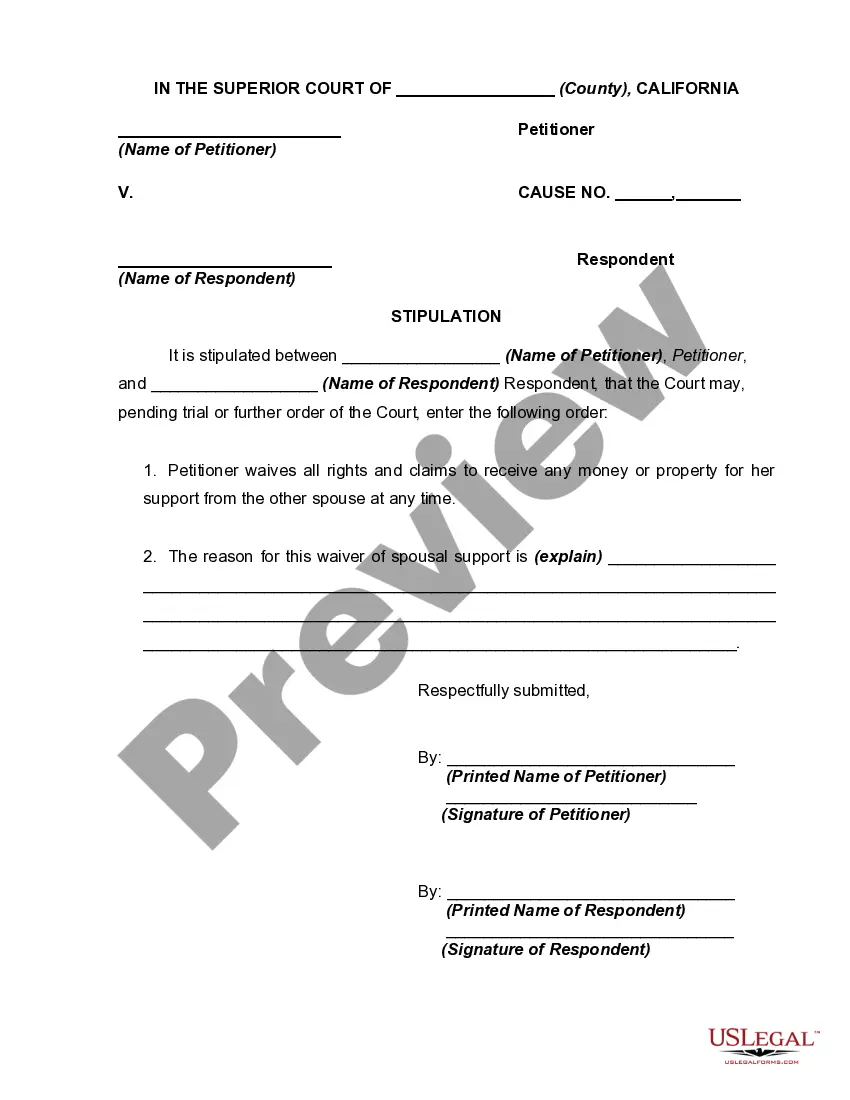
The Stipulation Regarding Spousal Support is a legal document used to formally agree on spousal support terms between parties in California. This form allows both parties to stipulate that one spouse waives their right to receive support while outlining the reasons for this waiver. It offers a simplified procedure for modifying existing support arrangements, distinguishing it from other forms, like general spousal support orders.
Key components of this form
- Caption with names of both parties and case number.
- Stipulation agreement where both parties agree to the terms.
- Details of the waiver of spousal support, including explanations.
- Signatures of both the Petitioner and Respondent, with printed names.
When to use this form
This form is typically used when one spouse no longer requires financial support from the other due to changed circumstances, such as improved financial stability or employment. It is beneficial for parties seeking to resolve support issues amicably before trial or further court orders. It is also used when both parties agree to modify existing spousal support terms due to common understanding or new developments in their situations.
Intended users of this form
- Individuals in a spousal support arrangement in California.
- Couples seeking to modify or terminate spousal support terms mutually.
- Parties who want to formalize their agreement regarding spousal support waivers.
- Individuals with an understanding of their financial situation and readiness to negotiate.
Instructions for completing this form
- Identify the parties involved by entering their names and case number at the top of the form.
- In the stipulation section, clearly state the terms agreed upon regarding spousal support.
- Provide a detailed explanation for the waiver of spousal support, explaining the circumstances that led to this decision.
- Ensure both parties sign the document in the designated areas, including printed names for clarity.
- Submit the completed form to the court as required.
Notarization guidance
This form does not typically require notarization unless specified by local law. It is advisable to double-check local regulations to ensure compliance, as notarization could add a layer of authenticity to the agreement.
Get your form ready online
Our built-in tools help you complete, sign, share, and store your documents in one place.
Make edits, fill in missing information, and update formatting in US Legal Forms—just like you would in MS Word.
Download a copy, print it, send it by email, or mail it via USPS—whatever works best for your next step.
Sign and collect signatures with our SignNow integration. Send to multiple recipients, set reminders, and more. Go Premium to unlock E-Sign.
If this form requires notarization, complete it online through a secure video call—no need to meet a notary in person or wait for an appointment.
We protect your documents and personal data by following strict security and privacy standards.

Make edits, fill in missing information, and update formatting in US Legal Forms—just like you would in MS Word.

Download a copy, print it, send it by email, or mail it via USPS—whatever works best for your next step.

Sign and collect signatures with our SignNow integration. Send to multiple recipients, set reminders, and more. Go Premium to unlock E-Sign.

If this form requires notarization, complete it online through a secure video call—no need to meet a notary in person or wait for an appointment.

We protect your documents and personal data by following strict security and privacy standards.
Common mistakes to avoid
- Failing to provide a clear explanation for the waiver of support.
- Not signing the form or missing one of the parties' signatures.
- Neglecting to include the case number or correct names of both parties.
- Leaving sections of the form blank that require completion.
Why complete this form online
- Convenient access to legal documents from home, saving time and effort.
- Editability allows parties to customize the form according to their specific circumstances.
- Reliable templates drafted by licensed attorneys, ensuring legal validity.
- Easy navigation through step-by-step guidance for form completion.
Looking for another form?
Form popularity
FAQ
To enforce spousal support in California, you should begin by collecting evidence of missed payments. Next, you can submit this evidence to the court, which may lead to a formal hearing. Utilizing resources like USLegalForms can help you better understand and navigate your options to ensure that the terms of the California Stipulation Regarding Spousal Support are upheld.
The average spousal support payment in California varies widely, depending on factors like income and lifestyle during the marriage. On average, payments can range from hundreds to thousands of dollars per month. It is important to consult the California Stipulation Regarding Spousal Support for specifics tailored to your situation, as each case is unique.
Several factors may disqualify an individual from receiving alimony in California. For example, if the spouse seeking support has adequate income or resources to support themselves, the court may deny alimony. Additionally, a history of domestic violence against the paying spouse may also be a disqualifying factor within the California Stipulation Regarding Spousal Support.
Enforcing a spousal support order in California involves a few critical steps. First, you should review the original California Stipulation Regarding Spousal Support for details about payment terms. If your ex-partner fails to make payments, you may file a motion with the court to seek enforcement, which may include wage garnishments or other legal actions.
California's guidelines for spousal support focus on ensuring fair and reasonable outcomes for both spouses. The California Stipulation Regarding Spousal Support often prioritizes the lower-earning spouse's need to maintain quality of life post-separation. Courts also look at each party's financial capabilities and other relevant circumstances. By following these guidelines, both parties can work toward a resolution that respects their needs and contributions.
Multiple factors come into play when courts assess spousal support in California. These factors include the duration of the marriage, the standard of living established during the marriage, and each spouse's earning capacity. A California Stipulation Regarding Spousal Support also considers age, health, and any contributions made by either spouse during the marriage. It's essential to have a comprehensive understanding of these elements when negotiating support.
Several conditions can disqualify individuals from receiving spousal support in California. If a spouse can prove that the other spouse has committed adultery, or if the requesting party has a significant income that meets or exceeds the other spouse's, they may not qualify. Additionally, cases where the marriage lasted less than 10 years often see different considerations. Understanding these disqualifications can greatly aid in crafting your California Stipulation Regarding Spousal Support.
The average spousal support amount in California varies significantly based on the specific circumstances of each case. Typically, the California Stipulation Regarding Spousal Support factors in the income levels of both spouses and the time they were married. Many cases show support amounts range from a few hundred to several thousand dollars per month. It's crucial to consult with a legal expert to get a better understanding of what you might expect.
In California, the rules for spousal support are outlined in the Family Code. A California Stipulation Regarding Spousal Support can be created through an agreement between the parties, detailing the amount and duration of support. Generally, support aims to maintain the receiving spouse's standard of living during the marriage. Courts will consider various factors, including both parties' income and the length of the marriage, when determining support.
The difference between a stipulation and a condition lies in their roles in legal agreements. A stipulation is a mutual agreement on certain terms, while a condition is a provision that must be fulfilled for something else to occur. Understanding these distinctions is vital when preparing a California Stipulation Regarding Spousal Support, as clear stipulations can prevent misunderstandings regarding conditions for support.