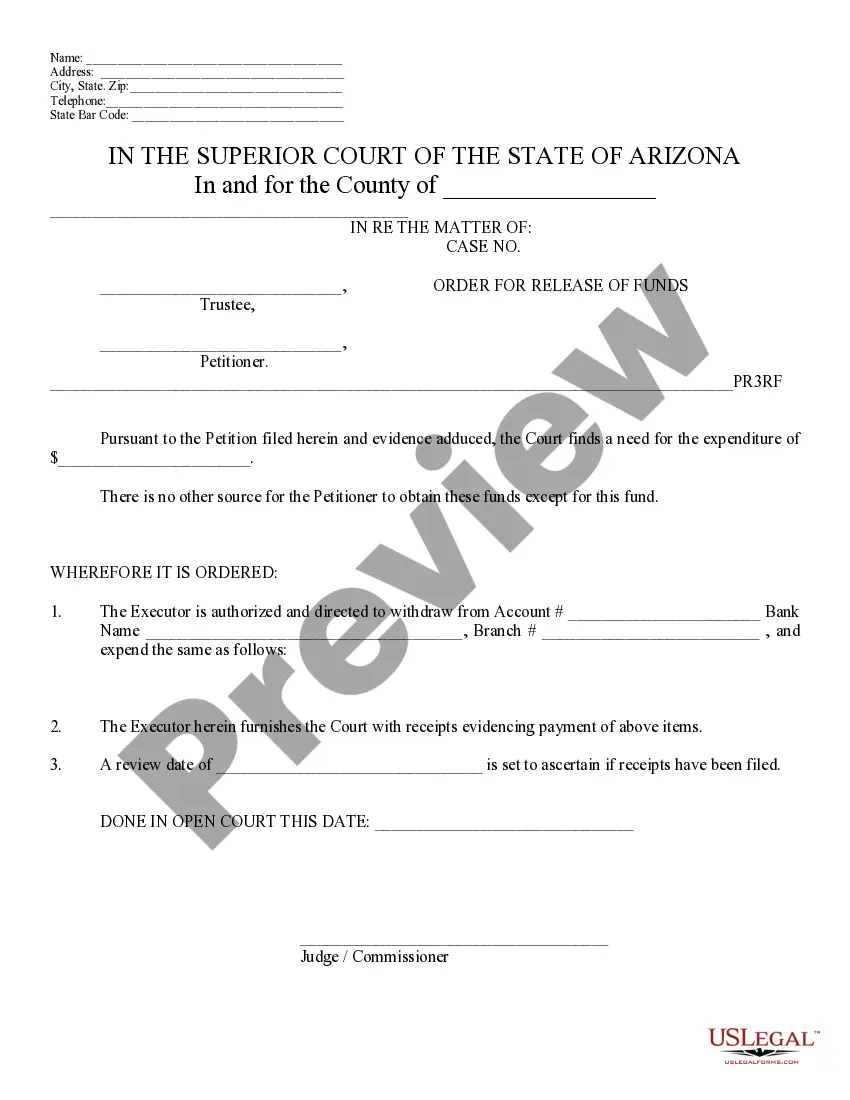
Arizona Order for Release of Funds
Overview of this form
The Order for Release of Funds is a legal document issued by a court that authorizes the withdrawal of funds from a specified account. This form is typically used in situations where a petitioner needs access to funds held in trust or other accounts, and it differs from other financial orders by focusing specifically on fund release authorized by a court order.
Form components explained
- Address and contact information of the petitioner
- Case number and court details
- Declaration by the court regarding the necessity of funds
- Authorization to withdraw specified amounts from a bank account
- Requirement to provide receipts for expenditures
- Set review date to verify compliance

Common use cases
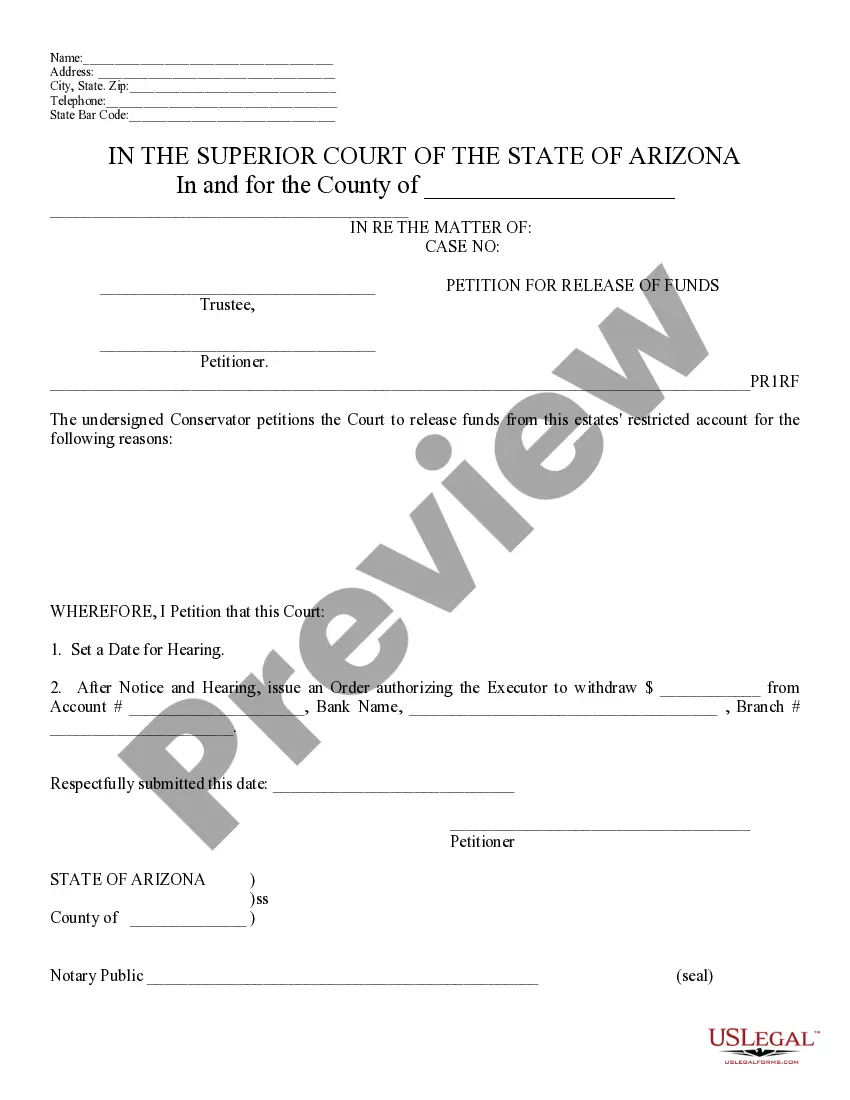
This form is commonly used when a trustee or a personal representative requires immediate access to funds that are otherwise restricted. Situations can include paying legal fees, covering urgent expenses, or conducting transactions that are critical for the management of the trust or estate. This document ensures that the withdrawal is legally sanctioned by the court.
Who should use this form
- Trustees managing a trust fund
- Executors or administrators of an estate
- Petitioners seeking court authorization for fund release
- Parties involved in legal matters requiring controlled fund access
Steps to complete this form
- Enter your name, address, and contact details at the top of the form.
- Provide the case number and relevant court information.
- State the necessity for the funds and the specific amount needed.
- List the bank account details from which the funds will be withdrawn.
- Note any receipts that will be provided as proof of fund expenditure.
- Sign and date the form before submitting it to the court.
Does this form need to be notarized?
This form does not typically require notarization to be legally valid. However, some jurisdictions or document types may still require it. US Legal Forms provides secure online notarization powered by Notarize, available 24/7 for added convenience.
Get your form ready online
Our built-in tools help you complete, sign, share, and store your documents in one place.
Make edits, fill in missing information, and update formatting in US Legal Forms—just like you would in MS Word.
Download a copy, print it, send it by email, or mail it via USPS—whatever works best for your next step.
Sign and collect signatures with our SignNow integration. Send to multiple recipients, set reminders, and more. Go Premium to unlock E-Sign.
If this form requires notarization, complete it online through a secure video call—no need to meet a notary in person or wait for an appointment.
We protect your documents and personal data by following strict security and privacy standards.

Make edits, fill in missing information, and update formatting in US Legal Forms—just like you would in MS Word.

Download a copy, print it, send it by email, or mail it via USPS—whatever works best for your next step.

Sign and collect signatures with our SignNow integration. Send to multiple recipients, set reminders, and more. Go Premium to unlock E-Sign.

If this form requires notarization, complete it online through a secure video call—no need to meet a notary in person or wait for an appointment.

We protect your documents and personal data by following strict security and privacy standards.
Avoid these common issues
- Failing to include accurate or complete contact information.
- Not providing sufficient justification for the fund request.
- Omitting bank account details or making errors in account numbers.
- Neglecting to sign and date the form before submission.
Advantages of online completion
- Easy access and download from anywhere at any time.
- Editable templates allow customization to fit your unique circumstances.
- Reliable legal language drafted by licensed professionals.
Looking for another form?

Form popularity
FAQ
In Arizona, a protective order is specifically designed to protect individuals from domestic violence, while a restraining order typically applies to non-domestic situations such as harassment or stalking. Protective orders often result from a case involving family members or intimate partners and can include various forms of relief. Understanding these differences is vital when considering an Arizona Order for Release of Funds, as it may affect your situation and legal options.
To respond to an order of protection in Arizona, it is crucial to file a written response with the court by the deadline specified in the order. In your response, present your side of the story and any evidence supporting your case. You may also request a hearing where you can provide your arguments in person. If you need help with the paperwork or procedures, US Legal Forms offers resources that can assist you in navigating this process effectively.
Yes, an order of protection goes on your record in Arizona. Once issued, it is entered into the statewide database, which law enforcement can access. This information can potentially affect various aspects of life, such as employment or housing. If you are concerned about this, consult with an attorney or look into using services like US Legal Forms for guidance on addressing records related to the Arizona Order for Release of Funds.
To motion to dismiss an order of protection in Arizona, you must file a request with the court where the order was issued. Your motion should clearly state the reasons why you believe the order is no longer necessary or valid. It is essential to provide evidence supporting your claims, as the court will review these factors before making a decision. Additionally, consider seeking legal advice or using US Legal Forms to simplify the process and ensure proper filing.
In Arizona, to secure a restraining order, you must present sufficient evidence of the threat or harm you are facing. This can include personal testimony, witness statements, or any relevant documentation. USLegalForms equips you with templates and resources that can help you compile the necessary proof, making the process of obtaining your Arizona Order for Release of Funds clearer and more efficient.
To pursue an injunction, begin by identifying the legal grounds for your request. Next, prepare a detailed petition that includes your request, the reasons for it, and any supporting evidence. Utilizing USLegalForms can be beneficial, as they provide customizable forms that can help you articulate your needs effectively when seeking an Arizona Order for Release of Funds.
Filing an injunction in Arizona requires submitting the completed petition to the appropriate court. Along with the petition, you will need to include any evidence that supports your claim. USLegalForms offers easy-to-follow guides and templates that help simplify the filing process, allowing you to focus on securing your Arizona Order for Release of Funds.
To obtain an injunction in Arizona, you must demonstrate a clear need for the court's protection. This involves filing a petition that outlines your situation and the harm you wish to prevent. You may want to consider using USLegalForms, which provides templates to streamline the application process for an injunction, ensuring your paperwork meets all legal standards.
Conditions of release in Arizona can vary based on individual circumstances and the nature of the case. Typically, these conditions may include stipulations regarding conduct, behavior, or restrictions on contact. An Arizona Order for Release of Funds might also impose specific requirements before granting access to the funds, ensuring responsible management of resources.
The burden of proof for securing an order of protection in Arizona lies with the petitioner, who must present sufficient evidence of their claims. They need to demonstrate a pattern of harmful behavior or an immediate risk to their safety. Achieving this standard helps ensure that protective measures are effectively applied to those in need.