Arizona Order for Supervised Administration
What is this form?
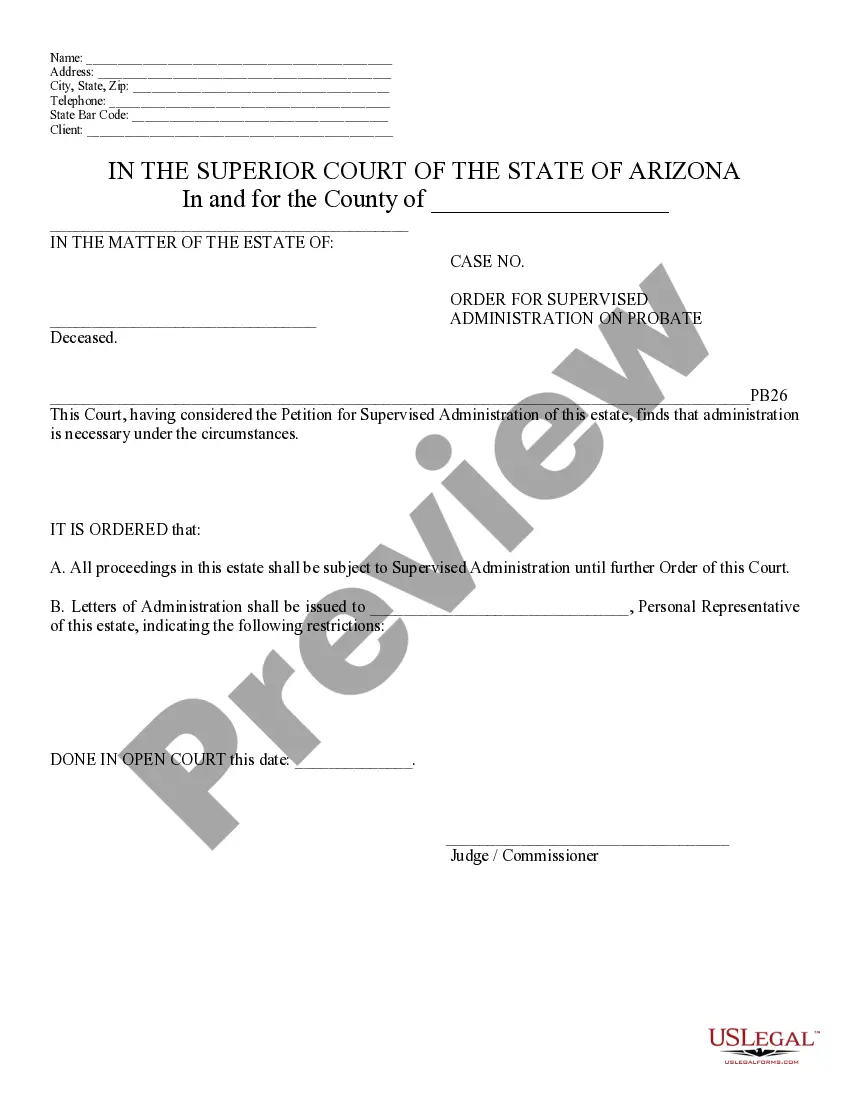
The Order for Supervised Administration is a court document that directs the administration of an estate under judicial oversight. This order is necessary when the court determines that the management of the estate requires supervision to protect the interests of parties involved. Unlike other types of administration forms, such as informal probate orders, this document ensures that all actions taken in the estate are monitored by the court to prevent mismanagement or disputes.
Form components explained
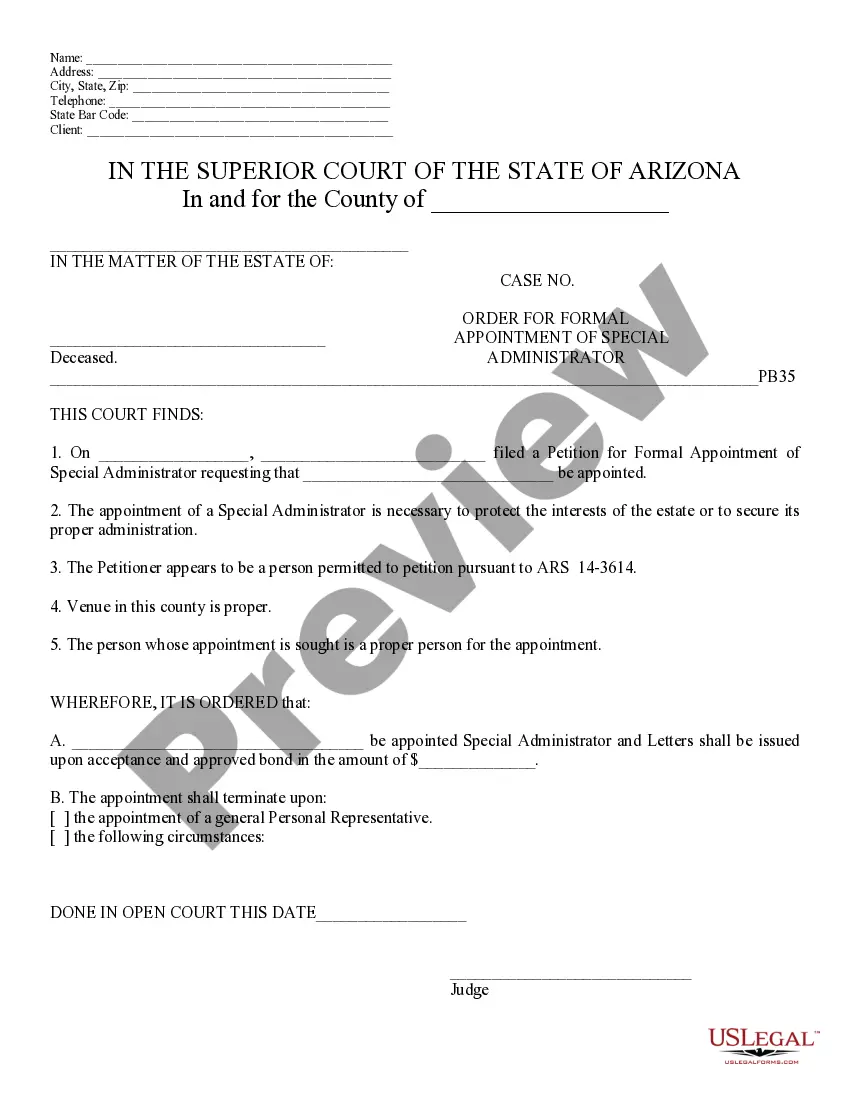
- Address and contact information of the petitioner.
- Name of the deceased and case number.
- Findings of the court regarding the need for supervised administration.
- Order for all proceedings in the estate to be supervised.
- Designation of the personal representative responsible for the estate.
- Signature of the judge or commissioner confirming the order.

When to use this form
This form is used when a court needs to supervise the administration of an estate, typically in situations where there may be concerns about the actions of the personal representative, disputes among heirs, or when the estate is large and complex. It serves as an official measure to ensure that the estate is managed according to legal requirements and the interests of all parties are safeguarded.
Who should use this form
- Executors or personal representatives overseeing an estate.
- Heirs or beneficiaries concerned about the administration of an estate.
- Attorneys representing clients in probate matters.
- Individuals petitioning the court for supervision of estate administration.
Completing this form step by step
- Fill in your address and contact information at the top of the form.
- Provide the name of the deceased and the case number assigned by the court.
- Include the name of the petitioner requesting supervised administration.
- Detail the findings that justify the need for supervised administration.
- Sign the form in the presence of a judge or commissioner, who will then sign it to validate the order.
Does this document require notarization?
Notarization is required for this form to take effect. Our online notarization service, powered by Notarize, lets you verify and sign documents remotely through an encrypted video session, available 24/7.
Get your form ready online
Our built-in tools help you complete, sign, share, and store your documents in one place.
Make edits, fill in missing information, and update formatting in US Legal Forms—just like you would in MS Word.
Download a copy, print it, send it by email, or mail it via USPS—whatever works best for your next step.
Sign and collect signatures with our SignNow integration. Send to multiple recipients, set reminders, and more. Go Premium to unlock E-Sign.
If this form requires notarization, complete it online through a secure video call—no need to meet a notary in person or wait for an appointment.
We protect your documents and personal data by following strict security and privacy standards.

Make edits, fill in missing information, and update formatting in US Legal Forms—just like you would in MS Word.

Download a copy, print it, send it by email, or mail it via USPS—whatever works best for your next step.

Sign and collect signatures with our SignNow integration. Send to multiple recipients, set reminders, and more. Go Premium to unlock E-Sign.

If this form requires notarization, complete it online through a secure video call—no need to meet a notary in person or wait for an appointment.

We protect your documents and personal data by following strict security and privacy standards.
Mistakes to watch out for
- Failing to provide complete and accurate information about the deceased or the petitioner.
- Not including required details that justify supervised administration.
- Overlooking to obtain the judge's signature, which is necessary for the order to be valid.
- Submitting the form without ensuring compliance with local court rules.
Why use this form online
- Immediate access to the form for quick completion and submission.
- Editability allows for precise tailoring to fit individual cases.
- Reliability of templates drafted by licensed attorneys ensures legal compliance.
- Simplifies the process of preparing legal documents without needing extensive legal knowledge.
Looking for another form?


Form popularity
FAQ
Rule 53 of the Arizona rules of civil procedure pertains to the appointment of special masters in civil cases. While it doesn't directly relate to probate, understanding this rule can be vital in various court matters. If you are dealing with complex estate issues, the Arizona Order for Supervised Administration can be an essential resource, ensuring that your case is handled with the necessary care and supervision.
In most cases, bank accounts with designated beneficiaries do not need to go through probate in Arizona. These accounts transfer directly to the named beneficiaries upon the account holder's death, streamlining the process. However, if there are complexities involving the estate, the Arizona Order for Supervised Administration can help manage any outstanding issues.
Rule 51 in the Arizona probate context addresses the procedural standards that must be followed during the probate process. It ensures that all parties involved are given a fair opportunity to present their claims and that the estate's valid interests are protected. Moreover, employing the Arizona Order for Supervised Administration can simplify matters when multiple claims or disputes arise.
Rule 53 of the Arizona Supreme Court specifically relates to the supervised administration of estate cases. This rule grants courts the authority to appoint personal representatives under supervision, ensuring that they're accountable for their actions. The Arizona Order for Supervised Administration is central to this process, protecting both the estate and its beneficiaries.
To apply for guardianship in Arizona, you must file a petition with the court that outlines your qualifications and the necessity for guardianship. This process can involve gathering medical documentation and other relevant evidence to support your claim. Utilizing the Arizona Order for Supervised Administration may be beneficial if the guardianship involves overseeing financial matters.
Rule 53 of the Arizona Rules of Probate Procedure outlines the procedures for supervised administration of estates. This rule provides guidelines for court oversight, ensuring that assets are managed properly throughout the probate process. The Arizona Order for Supervised Administration becomes critical here, as it ensures that all actions taken by the personal representative are monitored by the court.
In Arizona, supervised visitation is a court-ordered arrangement that allows a non-custodial parent to see their child under the supervision of a third party. This approach is often implemented when concerns about safety exist and aims to ensure a healthy relationship. The supervising individual, which could be a family member or a professional, monitors the visit to create a safe environment. If you are navigating this circumstance, integrating the principles of an Arizona Order for Supervised Administration can help ensure compliance with the court's directives.
Statute 14-2102 outlines the requirements and responsibilities of personal representatives during probate in Arizona. This law specifies how debts and claims against the estate must be handled, ensuring a fair distribution to heirs. Compliance with this statute is critical for anyone acting as a personal representative to avoid legal complications. Utilizing frameworks like the Arizona Order for Supervised Administration can help facilitate a smoother probate process.
In Arizona, the statute of limitations for probate proceedings generally establishes a timeframe within which claims against an estate must be filed, typically within six months from the date of probate. Understanding these time limits is essential for potential creditors and beneficiaries to protect their rights. Failing to file a claim within this period could result in a loss of entitlements. For guidance on navigating probate issues, an Arizona Order for Supervised Administration can provide clarity.
Statute 14-5501 in Arizona addresses the administration of assets within a trust and the conditions under which the trustee must act. It specifies the fiduciary duties imposed on trustees, which include acting in the best interest of beneficiaries and maintaining accurate records. Understanding this statute is crucial for effective trust management. Incorporating an Arizona Order for Supervised Administration can enhance transparency and accountability in administering these assets.