Arizona Petition for Formal Probate and Appointment of Personal Representative
About this form
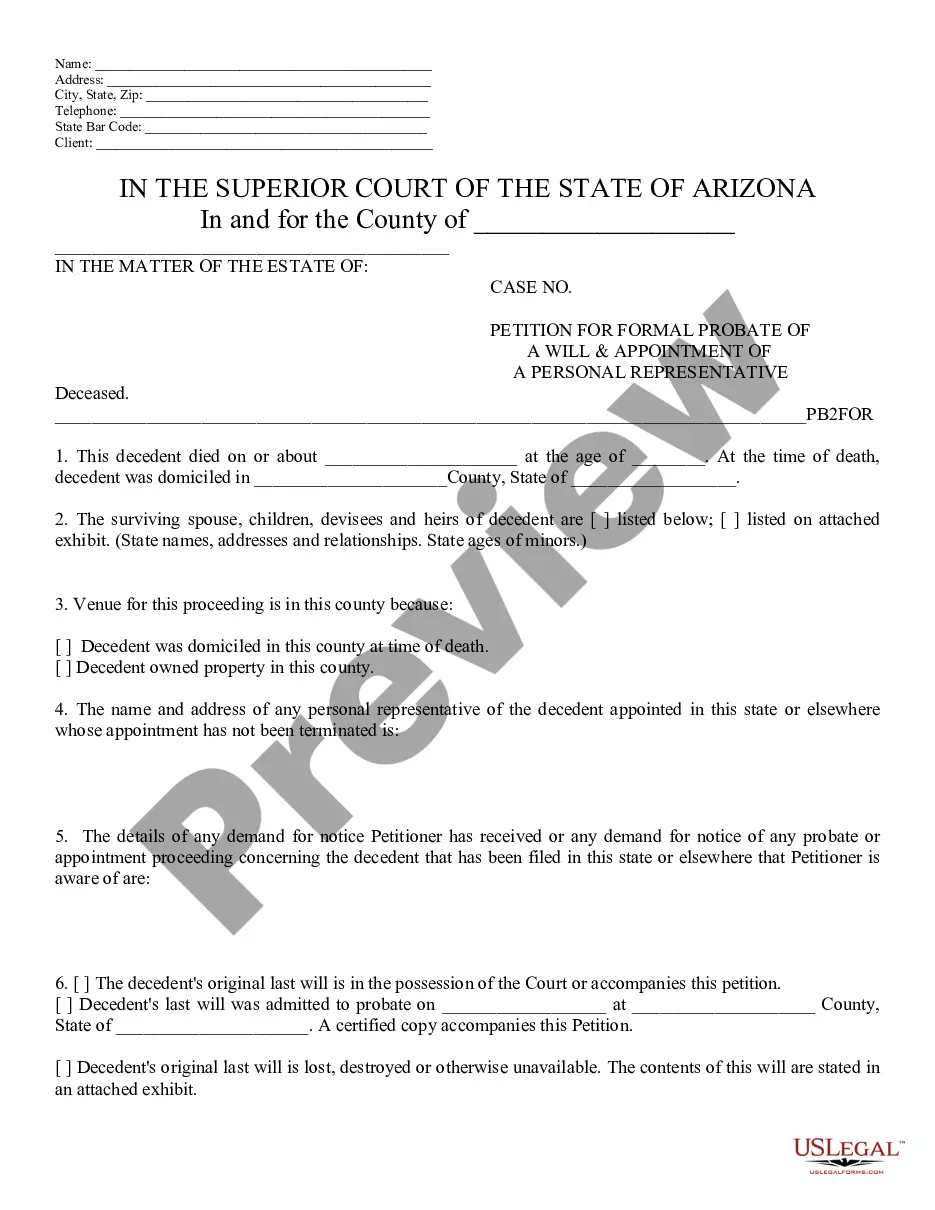
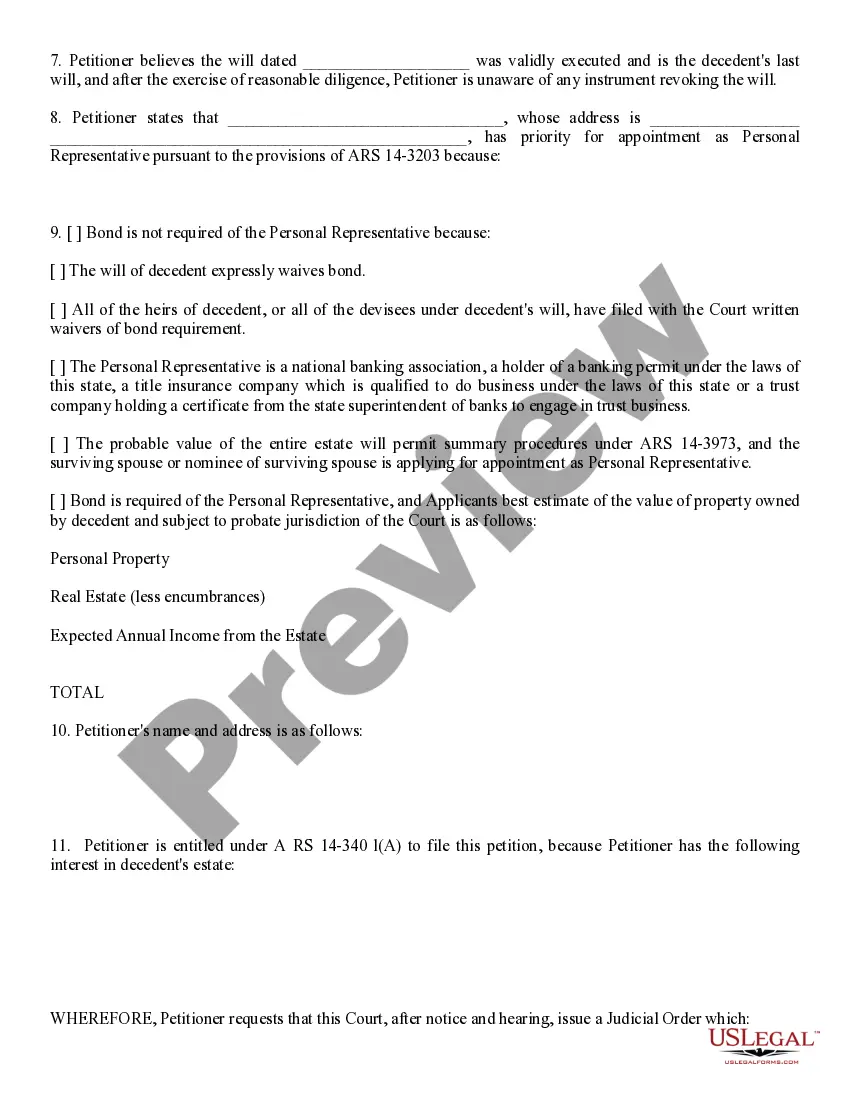
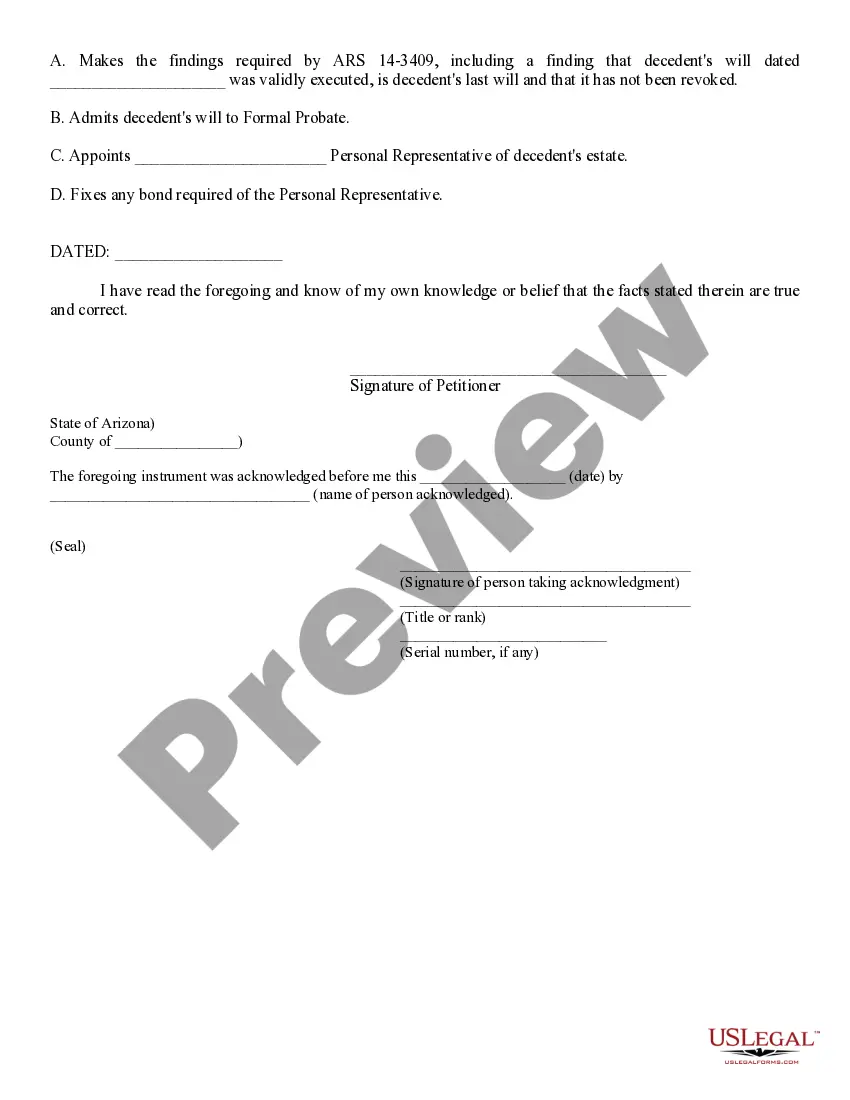
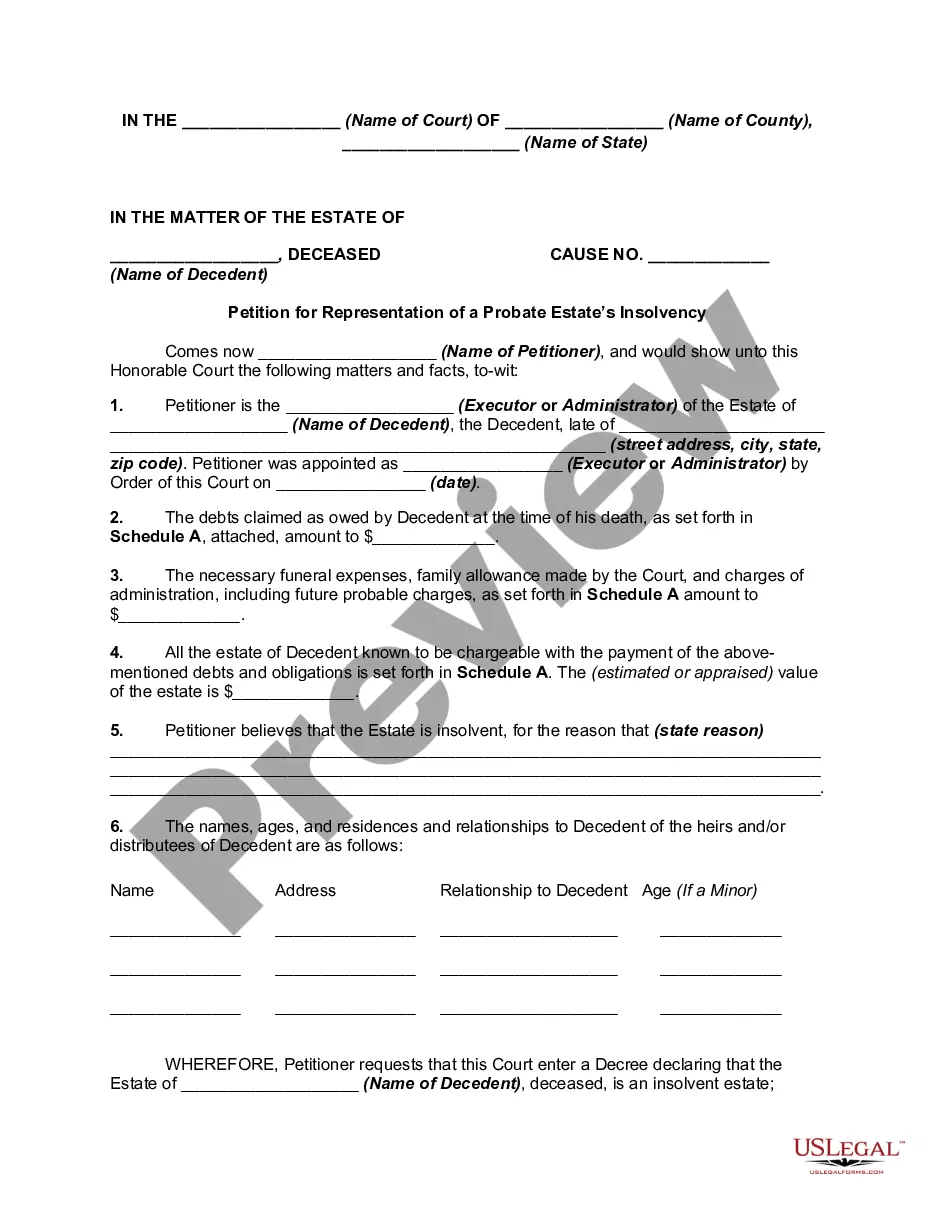
The Petition for Formal Probate and Appointment of Personal Representative is a legal document used in Arizona to initiate a formal probate process. This form requests the court to validate a deceased person's will and appoint a personal representative to manage the estate. Unlike informal probate forms, this petition requires the oversight of the court, ensuring a more structured approach to probate proceedings.
Key components of this form
- Decedentâs details including date of death and domicile.
- Information about surviving family members and heirs.
- Venue justification, explaining why probate is being sought in a particular county.
- Information on any prior appointments of personal representatives.
- Details regarding the original last will and its validity.
- Petitioner's entitlement to file the petition based on their relationship to the decedent.
Situations where this form applies
This form should be used when a person has passed away and their estate needs to be probated in Arizona. It is applicable when there is a will that needs to be validated to ensure the decedentâs wishes are honored. This form is necessary if someone wishes to assume the role of personal representative to manage and distribute the estate according to the will and state law.
Who needs this form
- Heirs or beneficiaries of the decedentâs estate.
- Family members designated in the decedentâs will to act as personal representatives.
- Individuals who have legal standing according to state law to initiate probate.
- Attorneys representing the estate or individuals involved in the probate process.
Completing this form step by step
- Provide the decedentâs personal information, including full name and date of death.
- List the surviving family members, including their relationships to the decedent and ages of any minors.
- Explain the county's jurisdiction where the petition is filed.
- Attach a copy of the decedent's will and assert its validity.
- Complete the petition with your information and signature, asserting your entitlement to file.
Notarization guidance
This form does not typically require notarization unless specified by local law. However, certain accompanying documents may need notarization, so it is advisable to check local requirements or consult an attorney.
Get your form ready online
Our built-in tools help you complete, sign, share, and store your documents in one place.
Make edits, fill in missing information, and update formatting in US Legal Forms—just like you would in MS Word.
Download a copy, print it, send it by email, or mail it via USPS—whatever works best for your next step.
Sign and collect signatures with our SignNow integration. Send to multiple recipients, set reminders, and more. Go Premium to unlock E-Sign.
If this form requires notarization, complete it online through a secure video call—no need to meet a notary in person or wait for an appointment.
We protect your documents and personal data by following strict security and privacy standards.

Make edits, fill in missing information, and update formatting in US Legal Forms—just like you would in MS Word.

Download a copy, print it, send it by email, or mail it via USPS—whatever works best for your next step.

Sign and collect signatures with our SignNow integration. Send to multiple recipients, set reminders, and more. Go Premium to unlock E-Sign.

If this form requires notarization, complete it online through a secure video call—no need to meet a notary in person or wait for an appointment.

We protect your documents and personal data by following strict security and privacy standards.
Avoid these common issues
- Failing to attach the original will or a certified copy when filing.
- Incomplete information about heirs or beneficiaries.
- Not providing proper venue justification, which can delay the process.
- Missing signatures or not notarizing the form if required.
- Failing to identify any previous personal representatives properly.
Why complete this form online
- Immediate access to professional legal documents prepared by licensed attorneys.
- Easy completion with fill-in-the-blank format tailored to your specifics.
- Downloadable and printable, enabling you to keep a physical copy for your records.
- Convenience of managing the probate process from home without needing in-person visits.
Legal use & context
- The petition must comply with Arizona probate laws for proper use.
- Ensures that the estate is managed according to the decedentâs wishes.
- Allows heirs to formally claim their rights within the judicial system.
Quick recap
- The Petition for Formal Probate is essential for managing a decedent's estate in a structured and lawful manner.
- This form serves to validate a will and appoint an individual as personal representative.
- Understanding who is eligible to file and the key elements included in the form is crucial for successful completion.
Looking for another form?

Form popularity
FAQ
A personal representative is the person appointed to manage an estate, while a successor takes over that role if the original personal representative can no longer serve. In the context of the Arizona Petition for Formal Probate and Appointment of Personal Representative, understanding this distinction is vital for smooth estate administration. Having clarity on these roles can help prevent confusion and ensure that the estate is settled in accordance with Arizona law.
In Arizona, a personal representative typically has around six months to settle an estate after being appointed through an Arizona Petition for Formal Probate and Appointment of Personal Representative. However, the exact timeline may vary depending on the estate's complexity and any disputes that might arise. It's important for the personal representative to efficiently manage this process to ensure timely distribution to beneficiaries.
In Arizona, an executor is required to keep beneficiaries informed about the estate's financial activities. This includes providing an accounting of receipts and expenditures during the estate administration process. When you file an Arizona Petition for Formal Probate and Appointment of Personal Representative, this accounting is crucial for transparency and trust among all parties involved.
In Arizona, a personal representative has significant authority to manage the estate of the deceased. This includes collecting and managing assets, paying debts, and distributing property according to the will or state law. Additionally, the personal representative can represent the estate in court and make decisions that affect the estate’s administration. Understanding these powers is vital, especially when navigating the Arizona Petition for Formal Probate and Appointment of Personal Representative.
To become a personal representative for an estate in Arizona, first ensure you meet the eligibility requirements outlined in state law. You will then need to submit the Arizona Petition for Formal Probate and Appointment of Personal Representative to the probate court. This petition should provide details about the estate and your relationship to the deceased. Once the court accepts your petition, you can begin managing the estate accordingly.
To become a personal representative in Arizona, you need to file an Arizona Petition for Formal Probate and Appointment of Personal Representative with the probate court. This petition must include relevant information about the deceased and any interested parties. After filing, a judge will review the petition, and if approved, you will receive formal appointment. It is crucial to follow the specific procedures to ensure a smooth process.
In Arizona, the highest priority for consideration as a personal representative typically goes to the surviving spouse. If there is no spouse, the next in line is the adult child of the deceased. Other family members, such as parents and siblings, may also be considered, depending on the circumstances. This process is detailed in the Arizona Petition for Formal Probate and Appointment of Personal Representative.
Formal probate in Arizona is a legal procedure that deals with the transfer of assets from a deceased person's estate under court supervision. This process is initiated by filing an Arizona Petition for Formal Probate and Appointment of Personal Representative, which allows the court to validate the will and appoint a personal representative. Formal probate provides transparency and ensures that debts and taxes are settled before the distribution of assets to heirs.
The steps for probate in Arizona generally include filing the Arizona Petition for Formal Probate and Appointment of Personal Representative, notifying beneficiaries and creditors, inventorying estate assets, settling debts, and distributing the remaining assets. Each step requires careful attention to ensure compliance with state laws. Working with a knowledgeable attorney can help simplify and streamline this process.
Arizona recognizes two main types of probate: formal probate and informal probate. Formal probate involves court supervision and is typically used for larger estates, while informal probate is a simpler process without extensive court oversight, suited for smaller estates. Understanding the correct type of probate is essential, and the Arizona Petition for Formal Probate and Appointment of Personal Representative can guide you through the necessary steps.