Arizona Order Allowing or Disallowing Claim Directing Payment against the Protected Person
What this document covers
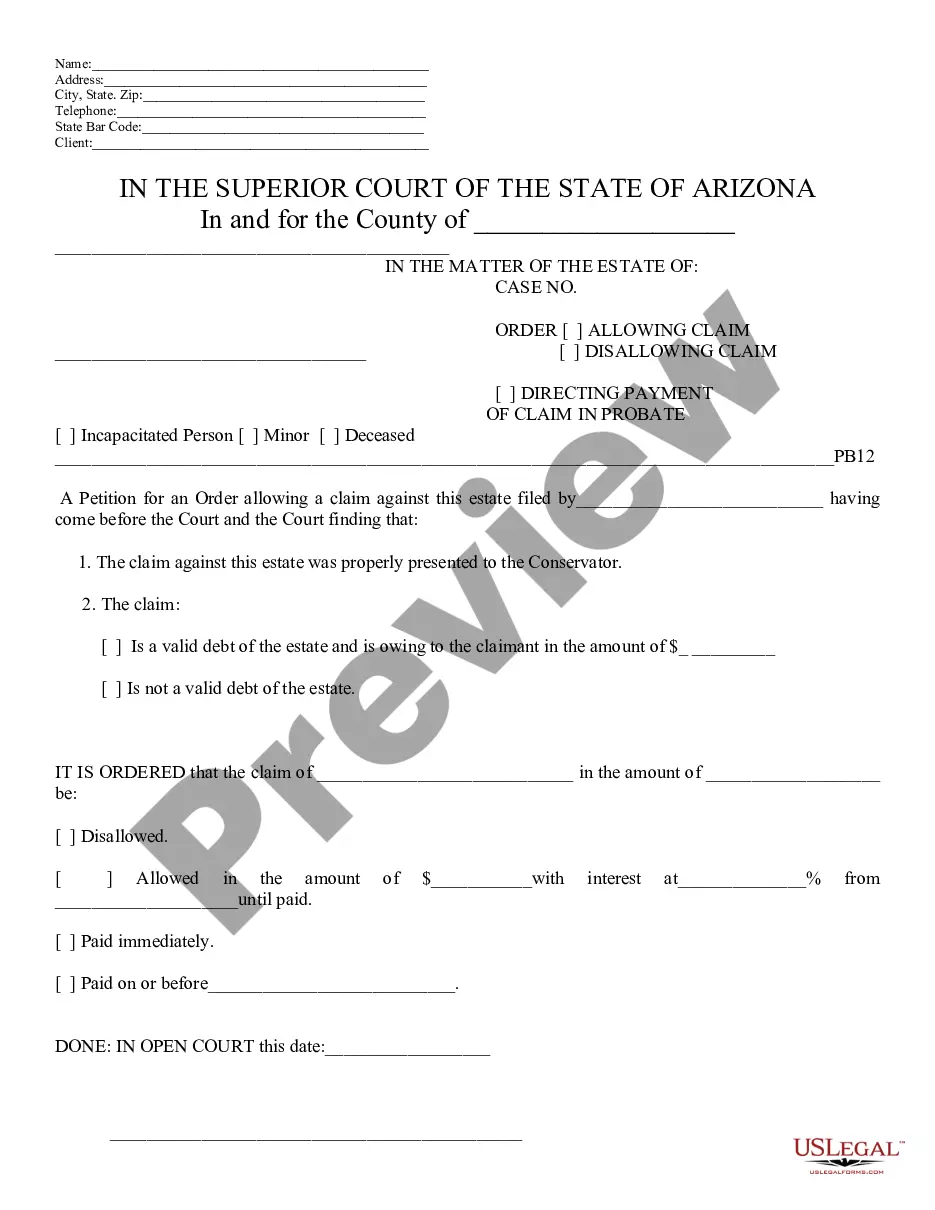
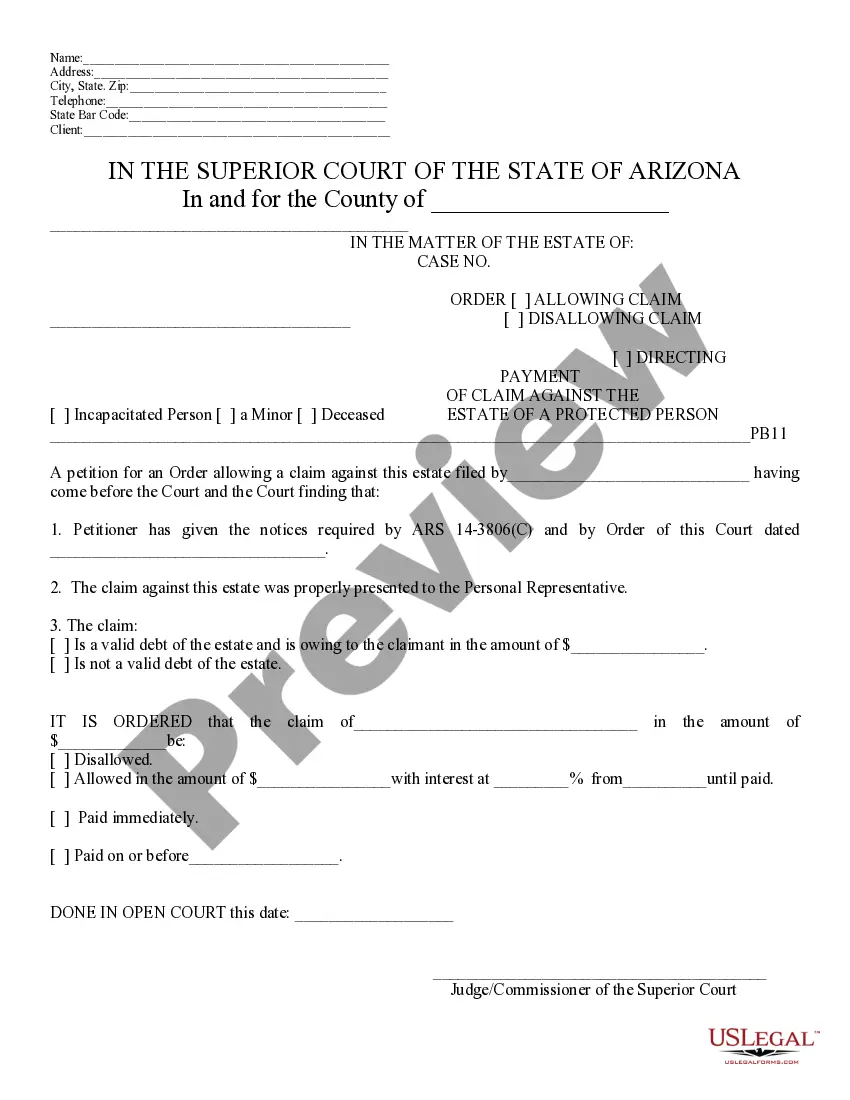
The Order Allowing or Disallowing Claim Directing Payment against the Protected Person is a legal document issued by a court to determine the validity of claims made against a protected person's estate. This order instructs whether a claim is accepted or rejected, and outlines any necessary payments that must be made. Unlike similar forms, this document specifically addresses claims made in probate matters, providing clear directions for parties involved in estate management.
Main sections of this form
- Addresses for involved parties and the estate.
- Identification of the protected person (incapacitated person, minor, deceased).
- A section for presenting the claim details and amounts.
- Findings of the court regarding the validity of the claim.
- Instructions on payment if the claim is allowed.
- Date and signature line for the judge or commissioner.

When to use this document
This form is necessary when a party seeks to have a claim against a protected person's estate validated or invalidated during probate proceedings. You should use this form if you are a claimant who wishes to receive payment from the estate or if you manage the estate and need court intervention to resolve claims.
Intended users of this form
- Claimants seeking to validate their claims against an estate.
- Conservators or guardians managing the estate of a protected person.
- Estate administrators handling probate matters.
- Attorneys representing clients in probate proceedings.
Completing this form step by step
- Fill in the addresses for the claimant and the estate involved.
- Specify the protected person's status (incapacitated, minor, or deceased).
- Present the claim details, including the claimant's name and the amount of the claim.
- Indicate the court's findings regarding the validity of the claim.
- State the payment terms if the claim is allowed, including the interest rate and payment due date.
- Sign and date the order before submission to the court.
Is notarization required?
This form does not typically require notarization unless specified by local law. It is advisable to consult local regulations or an attorney to ensure compliance with specific requirements.
Get your form ready online
Our built-in tools help you complete, sign, share, and store your documents in one place.
Make edits, fill in missing information, and update formatting in US Legal Forms—just like you would in MS Word.
Download a copy, print it, send it by email, or mail it via USPS—whatever works best for your next step.
Sign and collect signatures with our SignNow integration. Send to multiple recipients, set reminders, and more. Go Premium to unlock E-Sign.
If this form requires notarization, complete it online through a secure video call—no need to meet a notary in person or wait for an appointment.
We protect your documents and personal data by following strict security and privacy standards.

Make edits, fill in missing information, and update formatting in US Legal Forms—just like you would in MS Word.

Download a copy, print it, send it by email, or mail it via USPS—whatever works best for your next step.

Sign and collect signatures with our SignNow integration. Send to multiple recipients, set reminders, and more. Go Premium to unlock E-Sign.

If this form requires notarization, complete it online through a secure video call—no need to meet a notary in person or wait for an appointment.

We protect your documents and personal data by following strict security and privacy standards.
Common mistakes
- Failing to provide complete addresses for all parties involved.
- Not clearly stating the basis for the claim.
- Omitting the signature of the judge or commissioner, which is essential for validity.
- Forgetting to include relevant dates for payment or interest accrual.
Why complete this form online
- Convenient access to forms that can be downloaded anytime.
- Editability to tailor the document to your specific case requirements.
- Reliability in ensuring the form meets state legal standards.
- Ability to save and review your form before final submission.
Looking for another form?

Form popularity
FAQ
Civil Procedure Rule 34 in Arizona governs the discovery process, allowing parties to request documents and evidence from each other. It ensures that all relevant information is available for review, thereby promoting fair trial outcomes. Familiarity with this rule can aid individuals engaging in proceedings related to an Arizona Order Allowing or Disallowing Claim Directing Payment against the Protected Person.
Rule 33 in Arizona family law procedure pertains to the disclosure of evidence and witness lists prior to court proceedings. It establishes a framework for sharing information, which can enhance transparency in legal matters. This rule may intersect with cases involving Arizona Orders Allowing or Disallowing Claim Directing Payment against the Protected Person, where evidence is critical.
Rule 39 of the Arizona Rules of Protective Order Procedure outlines the process for serving an order of protection. It emphasizes the importance of properly notifying the involved parties of the order's existence and terms. This procedure plays a pivotal role in cases that involve an Arizona Order Allowing or Disallowing Claim Directing Payment against the Protected Person.
Rule 34 of the Federal Rules of Criminal Procedure regulates the dismissal of charges in criminal cases. This rule allows the court to dismiss an indictment if it lacks sufficient evidence. While it pertains to federal cases, understanding these rules can provide valuable insight for anyone dealing with an Arizona Order Allowing or Disallowing Claim Directing Payment against the Protected Person in related scenarios.
To modify an Order of Protection in Arizona, you must file a petition with the court detailing the reasons for modification. This process involves demonstrating a change in circumstances since the order was issued. Successfully modifying the order is essential, particularly when dealing with an Arizona Order Allowing or Disallowing Claim Directing Payment against the Protected Person.
Responding to an Order of Protection in Arizona requires understanding the specifics of the order and taking prompt action. Typically, you must file a written response and attend a court hearing to present your side of the story. By addressing the order appropriately, you may influence the outcome, especially in cases involving an Arizona Order Allowing or Disallowing Claim Directing Payment against the Protected Person.
Rule 34 of the Arizona Rules of Protective Order Procedure outlines the process for obtaining protective orders, including the requirements for filing and the rights of both parties involved. It emphasizes the need for timely hearings and fair treatment throughout the proceedings. Comprehending this rule can significantly impact cases involving an Arizona Order Allowing or Disallowing Claim Directing Payment against the Protected Person.
In Arizona, a protective order is issued to prevent specific acts of domestic violence, while a restraining order typically applies in civil cases, often to maintain distance between parties. Both aim to protect individuals, but they serve different legal purposes. Understanding these differences is crucial when navigating an Arizona Order Allowing or Disallowing Claim Directing Payment against the Protected Person.
In Arizona, grounds for an order of protection can include threats, acts of domestic violence, harassment, or any behavior that causes significant emotional distress. The court evaluates the evidence provided to ensure that your claims are valid. If you believe you need protection based on these grounds, it's wise to refer to the Arizona Order Allowing or Disallowing Claim Directing Payment against the Protected Person for further clarity on procedures.
To appeal an Order of Protection in Arizona, you need to submit a notice of appeal to the appellate court within the time frame specified by law. In your appeal, you must outline the errors made during the original hearing and include supporting documentation. It’s important to act quickly, as delays can affect your case's outcome. Resources like the Arizona Order Allowing or Disallowing Claim Directing Payment against the Protected Person can provide useful templates and guidance.