Arizona Offer of Judgment to
Overview of this form
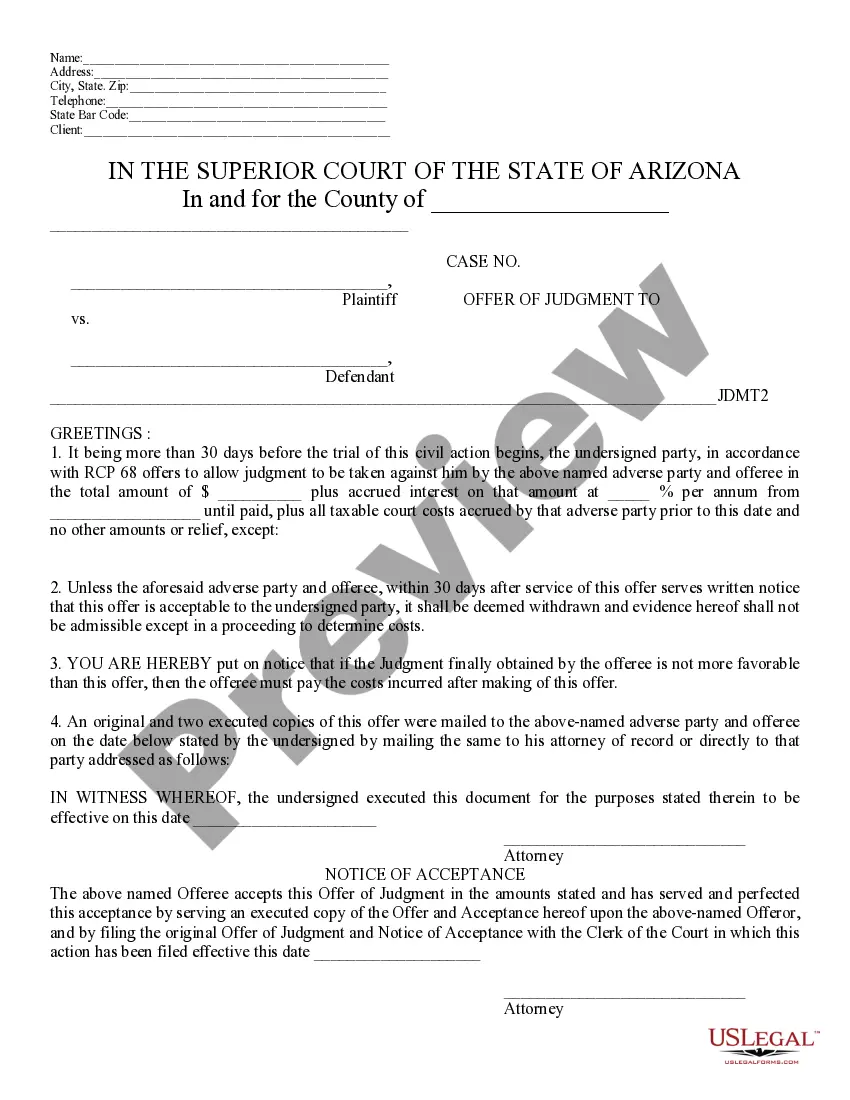
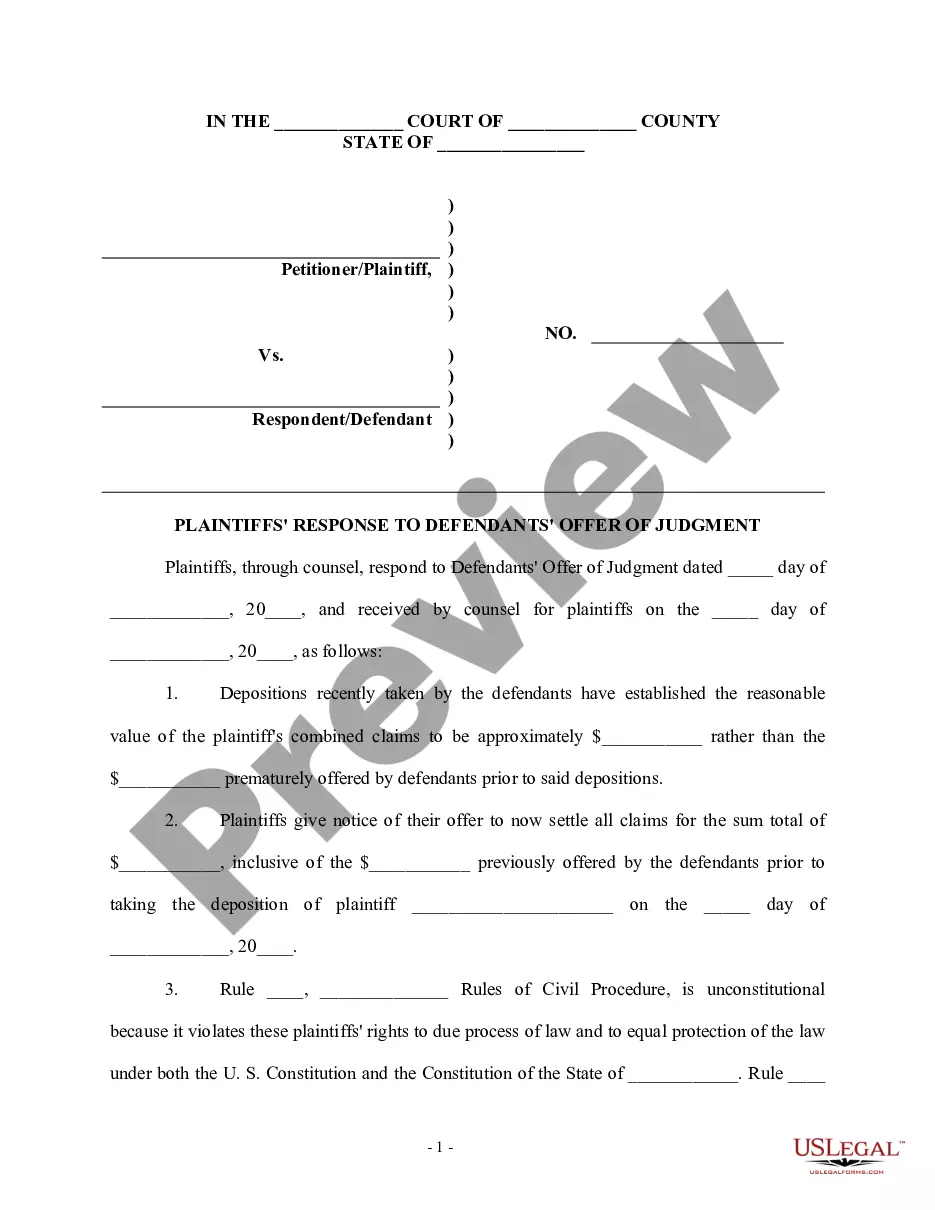
The Offer of Judgment is a legal document that allows a defendant to propose a settlement to the plaintiff before a trial begins. This form outlines the terms under which the defendant offers to allow judgment against them, which can help avoid the uncertainties and expenses of going to trial. By accepting this offer, the plaintiff agrees to the stated amount without further legal proceedings. The Offer of Judgment is particularly useful in civil cases where the defendant wishes to resolve the matter efficiently.
Main sections of this form
- Defendant's details, including contact information and attorney information.
- Case identification, including the court and case number.
- Specific terms of the offer, including the total judgment amount and any accrued interest.
- Notification of acceptance timeframe and consequences of refusal.
- Signature lines for the defendant's attorney and notice of acceptance by the plaintiff's attorney.

When to use this document
This form should be used when a defendant seeks to make a formal offer to settle a lawsuit before the trial date. It is particularly relevant in cases where a clear settlement amount is preferred to the unpredictability of a trial outcome. Utilizing this form can help streamline the resolution process and potentially save on legal costs.
Who should use this form
- Defendants in civil litigation who are looking to settle a case amicably.
- Attorneys representing defendants who wish to formalize a settlement offer.
- Legal professionals involved in the negotiation of civil disputes.
Instructions for completing this form
- Enter the defendant's name, address, and attorney information at the top of the form.
- Specify the court and case number where the legal action is filed.
- Fill in the total amount offered for judgment and any applicable interest details.
- State the acceptance period of thirty days clearly in the appropriate section.
- Require the signatures of the defendant's attorney for validation of the offer.
Does this form need to be notarized?
Notarization is not commonly needed for this form. However, certain documents or local rules may make it necessary. Our notarization service, powered by Notarize, allows you to finalize it securely online anytime, day or night.
Get your form ready online
Our built-in tools help you complete, sign, share, and store your documents in one place.
Make edits, fill in missing information, and update formatting in US Legal Forms—just like you would in MS Word.
Download a copy, print it, send it by email, or mail it via USPS—whatever works best for your next step.
Sign and collect signatures with our SignNow integration. Send to multiple recipients, set reminders, and more. Go Premium to unlock E-Sign.
If this form requires notarization, complete it online through a secure video call—no need to meet a notary in person or wait for an appointment.
We protect your documents and personal data by following strict security and privacy standards.

Make edits, fill in missing information, and update formatting in US Legal Forms—just like you would in MS Word.

Download a copy, print it, send it by email, or mail it via USPS—whatever works best for your next step.

Sign and collect signatures with our SignNow integration. Send to multiple recipients, set reminders, and more. Go Premium to unlock E-Sign.

If this form requires notarization, complete it online through a secure video call—no need to meet a notary in person or wait for an appointment.

We protect your documents and personal data by following strict security and privacy standards.
Avoid these common issues
- Failing to specify a clear amount for the judgment.
- Not including the proper case number or court details.
- Missing the signature of the defendant's attorney.
- Overlooking the thirty-day time frame for acceptance.
- Not providing a comprehensive description of the offer terms.
Benefits of using this form online
- Convenient access and immediate download options for the Offer of Judgment.
- Editability ensures that you can tailor the form to your specific case needs.
- Reliable templates drafted by licensed attorneys help ensure compliance with legal standards.
Legal use & context
- This form is used in civil litigation to propose a judgment before trial.
- It can help expedite dispute resolution and reduce legal costs.
- Acceptance of the offer can limit the potential costs the offeree may incur in case of an unfavorable trial outcome.
What to keep in mind
- The Offer of Judgment provides a strategic option for defendants in civil cases.
- Timeliness in responding to the offer is crucial to avoid automatic rejection.
- Understanding state-specific requirements is key to valid use of the form.
Looking for another form?

Form popularity
FAQ
Rule 34 of the Arizona Rules of Civil Procedure governs the discovery process, specifically regarding the production of documents. This rule allows a party to request relevant documents, electronically stored information, and tangible items from another party. Understanding this rule is essential, especially when dealing with an Arizona Offer of Judgment to, as it helps gather important evidence during the litigation process. By leveraging platforms like US Legal Forms, you can easily access the necessary forms and details to assist in your legal preparations.
In Arizona, the respondent typically has 20 days to answer a complaint after being served. This time frame is crucial for ensuring that your rights are protected under the Arizona Offer of Judgment to. If the respondent fails to answer within this period, the court may issue a default judgment against them. Therefore, it's important to be aware of these timelines to effectively respond and protect your legal interests.
The 85% law in Arizona mandates that certain offenders must serve at least 85% of their sentence before becoming eligible for parole. This law aims to balance public safety with rehabilitation efforts for inmates. Understanding this law can help individuals navigate the legal expectations and consequences associated with their sentences. For anyone dealing with legal matters in Arizona, resources like USLegalForms can provide valuable guidance.
An offer of proof in Arizona is a legal mechanism used during a trial to indicate what evidence a party intends to present. This allows the judge to evaluate the admissibility of that evidence, which can significantly influence the case’s outcome. By submitting an offer of proof, parties can clarify their position and strengthen their arguments. Familiarity with this process enhances your ability to build a strong case.
The Rule 69 agreement in Arizona refers to a legal provision that lays out how parties can settle a case before trial. This rule allows the defendant to make an Offer of Judgment to the plaintiff, offering a specified amount to resolve the dispute. If the plaintiff accepts the offer within a designated timeframe, the case resolves without going to court. Understanding this agreement can help you navigate your options effectively.
Yes, judgments in Arizona do expire, typically after five years if not enforced. However, you may renew a judgment before it expires to maintain its enforceability. Staying updated about the status of your judgment is essential. Leveraging resources such as Arizona Offer of Judgment to can help you keep track and manage your judgments better.
Enforcing a judgment in Arizona typically involves filing a certificate of judgment with the county recorder. You could also request a writ of execution, which allows for the seizure and sale of the debtor's assets. It's important to stay informed about your rights and obligations; using resources like UsLegalForms can guide you through the enforcement process. Understanding Arizona Offer of Judgment to can help you assess your options effectively.
In Arizona, the court may authorize the seizure of personal property as part of a judgment. This can include items like bank accounts, vehicles, and certain types of personal belongings. However, certain exemptions protect essential items, including household goods and necessary clothing. Learning how Arizona Offer of Judgment to can affect your situation can help you navigate these complex issues.
Rule 55a in Arizona governs default judgments and outlines the process for obtaining them. This rule is critical for parties who win by default due to non-response from the other side. Understanding this rule can safeguard your legal rights. Using an Arizona Offer of Judgment to can also help prevent defaults by promoting timely responses.
Rule 16d in Arizona allows courts to manage pretrial procedures effectively. This rule helps set schedules and ensures timely progress in cases. Compliance with this rule is essential for avoiding delays. Incorporating the Arizona Offer of Judgment to can be a proactive approach within this framework.