Arizona Notice of Hearing
What this document covers
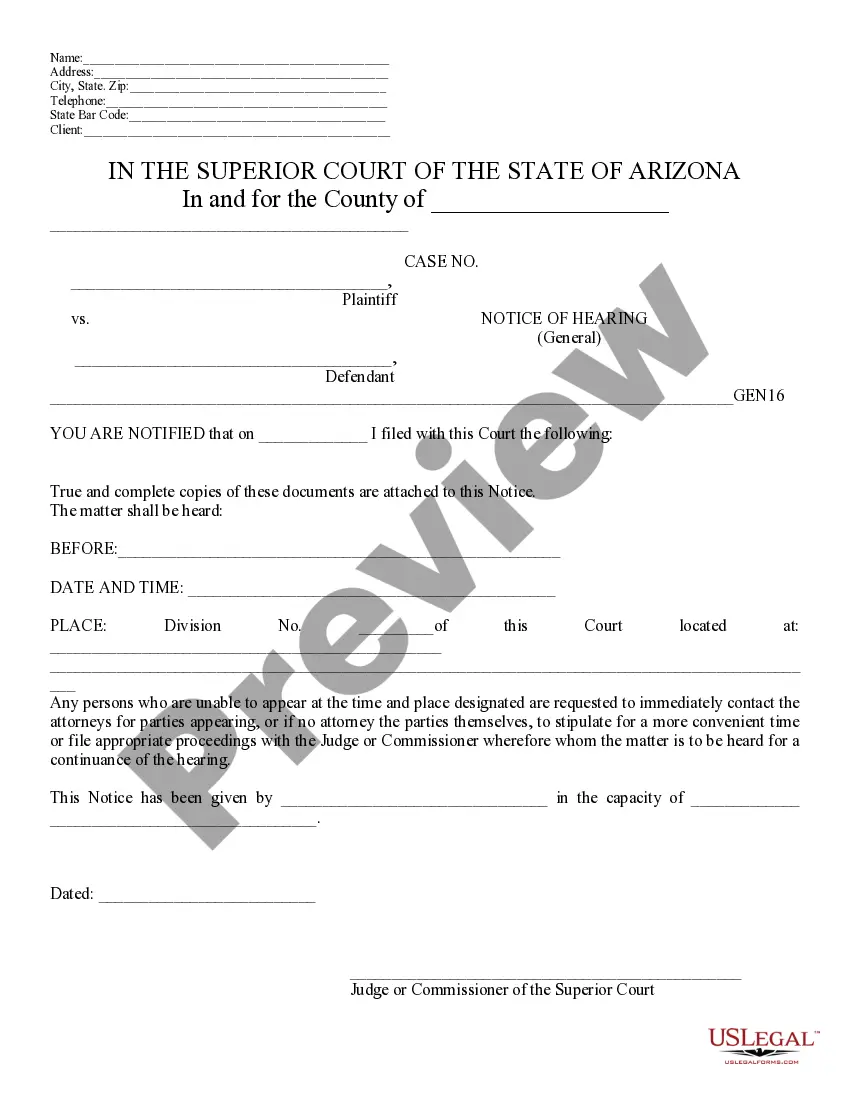
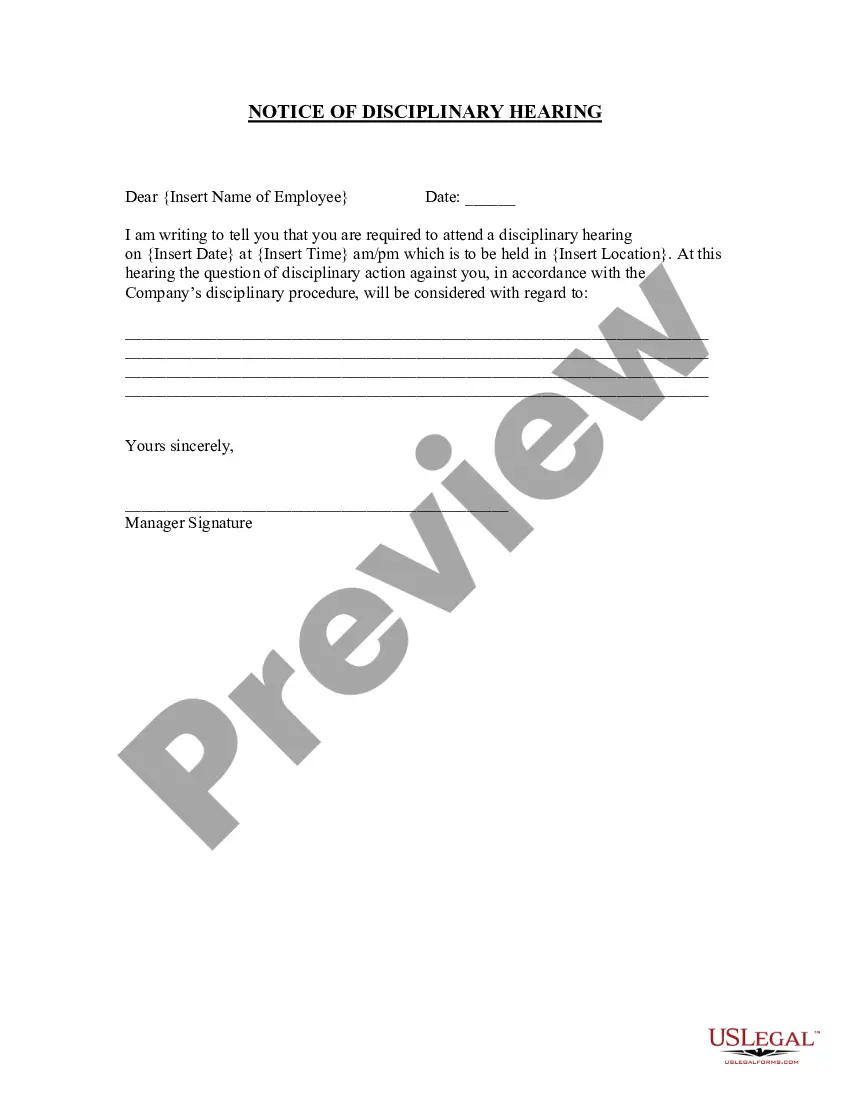
A Notice of Hearing is a legal document that serves to inform parties involved in a legal case about an upcoming court hearing. This form is critical, as failing to provide proper notice can lead to delays and complications in legal proceedings. Unlike other notices, the Notice of Hearing specifically addresses the date, time, and location of the hearing, as well as any attached documents. Download this essential form to ensure compliance with legal notification requirements.
Form components explained
- Recipient's address: Details of the person being notified.
- Case information: Includes the names of the parties involved and the case number.
- Hearing details: Specifies the date, time, and location of the hearing.
- Attachments: Lists the documents being filed with the court.
- Contact information: Provides details for communication regarding rescheduling if necessary.
- Signature line: For the judge or commissioner validating the notice.
When to use this document
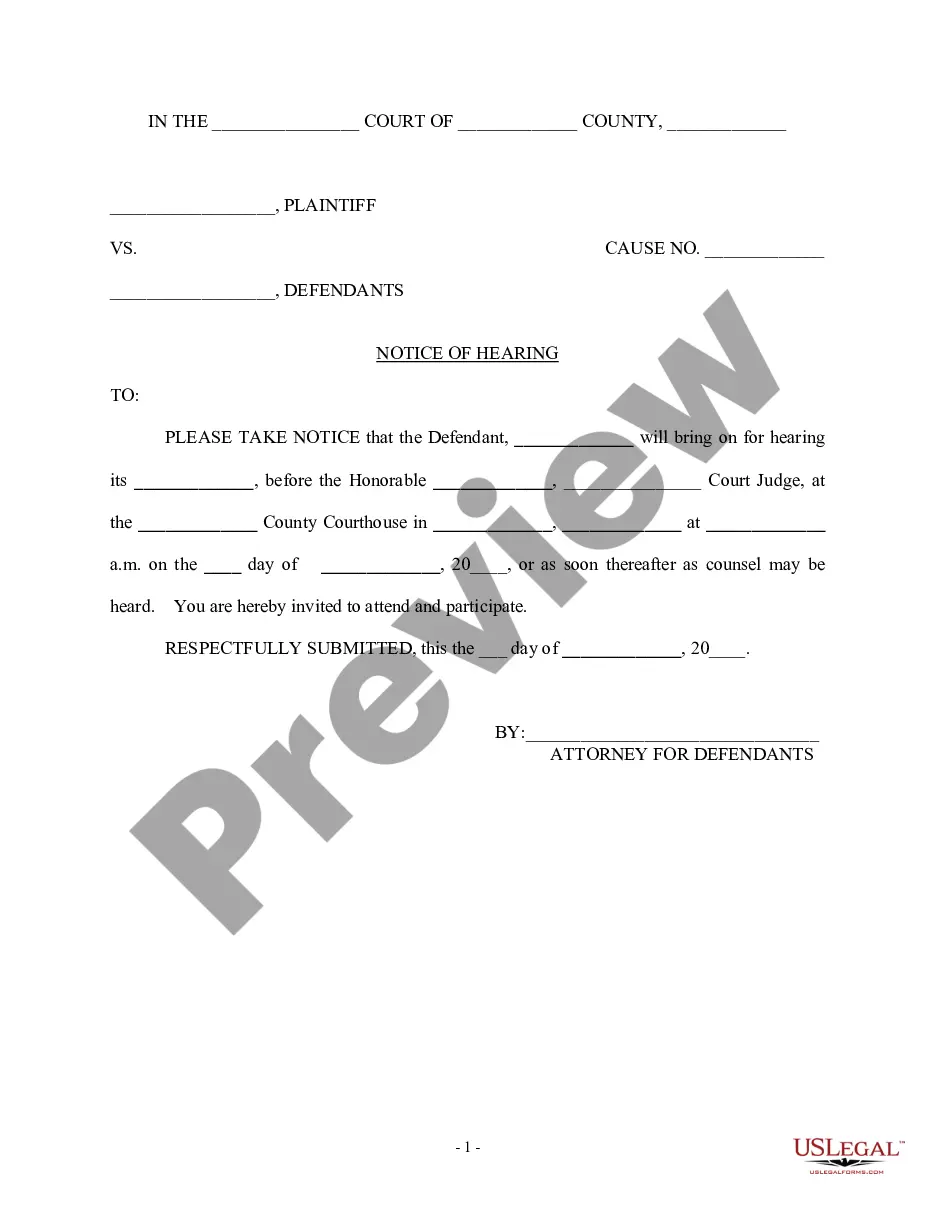
This form should be used when a court hearing is scheduled, and its purpose is to notify all involved parties of the details. Scenarios for using this form include civil disputes, family law matters, or other legal actions where a hearing is necessary to resolve issues. It is crucial to provide this notice to ensure all parties have an opportunity to participate.
Intended users of this form
This form is intended for:
- Individuals representing themselves in court (pro se).
- Attorneys involved in legal cases who need to provide notice to other parties.
- Parties in a legal dispute who want to ensure compliance with court notification requirements.
Steps to complete this form
Follow these steps to complete your Notice of Hearing:
- Fill in the address of the party being notified.
- Insert the case number and relevant parties in the case caption.
- Specify the date, time, and location of the hearing.
- List any documents being filed with the court and attached to the notice.
- Provide your contact information or that of your attorney for questions or rescheduling.
- Sign the form as required by the judge or commissioner.
Notarization guidance
This form usually doesn’t need to be notarized. However, local laws or specific transactions may require it. Our online notarization service, powered by Notarize, lets you complete it remotely through a secure video session, available 24/7.
Get your form ready online
Our built-in tools help you complete, sign, share, and store your documents in one place.
Make edits, fill in missing information, and update formatting in US Legal Forms—just like you would in MS Word.
Download a copy, print it, send it by email, or mail it via USPS—whatever works best for your next step.
Sign and collect signatures with our SignNow integration. Send to multiple recipients, set reminders, and more. Go Premium to unlock E-Sign.
If this form requires notarization, complete it online through a secure video call—no need to meet a notary in person or wait for an appointment.
We protect your documents and personal data by following strict security and privacy standards.

Make edits, fill in missing information, and update formatting in US Legal Forms—just like you would in MS Word.

Download a copy, print it, send it by email, or mail it via USPS—whatever works best for your next step.

Sign and collect signatures with our SignNow integration. Send to multiple recipients, set reminders, and more. Go Premium to unlock E-Sign.

If this form requires notarization, complete it online through a secure video call—no need to meet a notary in person or wait for an appointment.

We protect your documents and personal data by following strict security and privacy standards.
Avoid these common issues
- Failing to provide accurate time and date for the hearing.
- Not including all necessary attachments with the notice.
- Overlooking the proper format or requirements stipulated by the court.
- Neglecting to notify all parties involved in the case.
Benefits of using this form online
- Convenience of downloading and completing the form from anywhere.
- Editable fields to customize the notice according to your specific case.
- Instant access to legally compliant templates drafted by licensed professionals.
Looking for another form?
Form popularity
FAQ
Filing an answer to a summons in Arizona requires you to submit a written response to the court within the specified timeframe. Your answer must address each allegation made in the complaint and include your defenses. This response often includes serving a copy to the opposing party and filing with the appropriate court. US Legal Forms provides straightforward templates that can help you create an effective answer.
To establish guardianship in Arizona, you begin by filing a petition with the probate court, accompanied by a Notice of Hearing. You will need to provide evidence supporting your request and demonstrate that guardianship is in the best interest of the individual involved. After filing, a court hearing will be set, where you can present your case. For comprehensive guidance and forms, US Legal Forms can be an excellent resource.
The time it takes to establish guardianship in Arizona varies depending on several factors, including court schedules and complexity of the case. Generally, after filing your petition, you may expect a hearing to occur within a few weeks. From initiation to final approval, the entire process could take several months. For a smoother experience, consider using the US Legal Forms resources to prepare your documents efficiently.
To obtain temporary guardianship in Arizona, you must file a petition with the court that includes a Notice of Hearing. This petition should detail your reasons for seeking temporary guardianship and explain why it's necessary. Once the court reviews your petition, a hearing will be scheduled, during which you can present your case. Utilizing the US Legal Forms site can simplify the process by providing the necessary paperwork.
Rule 76 in Arizona outlines the process for issuing a Notice of Hearing for various legal proceedings. This rule ensures that all parties involved receive proper notification, allowing them to prepare for the court hearing. Understanding Rule 76 is vital for anyone navigating the legal system, especially if you are dealing with matters like guardianship. For assistance with your legal documents, consider using the US Legal Forms platform.
A hearing notice is an official document that informs individuals about an upcoming hearing in a legal matter. It typically includes vital information such as the date, time, and location of the hearing, ensuring that all parties are adequately informed. Understanding the details in a hearing notice is important for anyone involved in the legal process. The Arizona Notice of Hearing serves this important role, making it clear what to expect during legal proceedings.
At a sentencing hearing in Arizona, the court determines the appropriate punishment for a convicted individual. Both the prosecution and defense can present statements, evidence, and character witnesses to influence the judge's decision. The outcome of this hearing can significantly impact the convicted individual's future and is formalized through the Arizona Notice of Hearing issued prior to the event.
The hearing of the case refers to the judicial process where parties present evidence and arguments related to the matter at hand. This process allows the judge to consider all relevant facts before making a ruling. The hearing is structured to facilitate an organized discussion between the involved parties. The Arizona Notice of Hearing is crucial in these matters, helping participants prepare for this significant event.
A hearing letter typically serves as a formal notification that outlines the details of an upcoming court hearing. It provides essential information such as the time, date, and location of the hearing. For those involved, receiving a hearing letter is important, as it ensures they understand their rights and responsibilities in the context of the Arizona Notice of Hearing.
The purpose of a hearing is to allow both parties to present their arguments, evidence, and witness testimonies. It ensures that everyone involved has the opportunity to advocate for their position. In legal matters, a hearing often leads to a decision by a judge or a determination of the next steps. The Arizona Notice of Hearing informs participants about the time and place for these essential discussions.