Arizona OSC
About this form
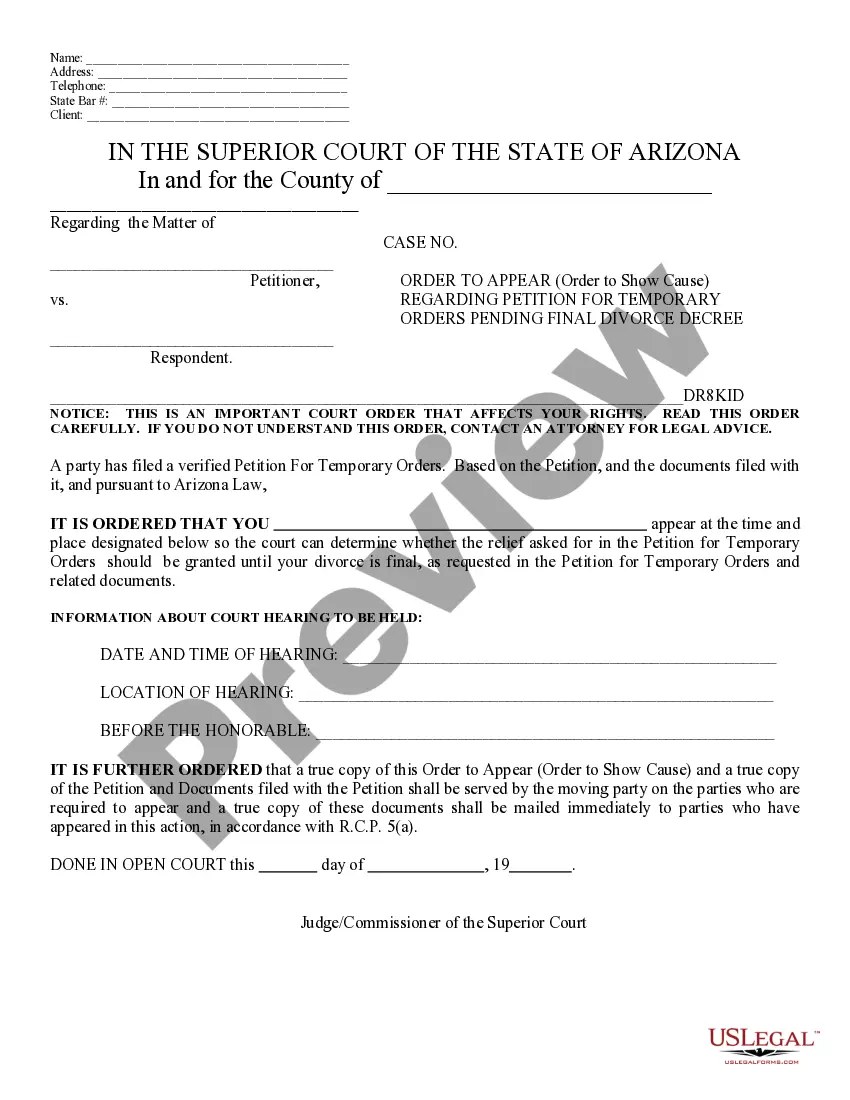
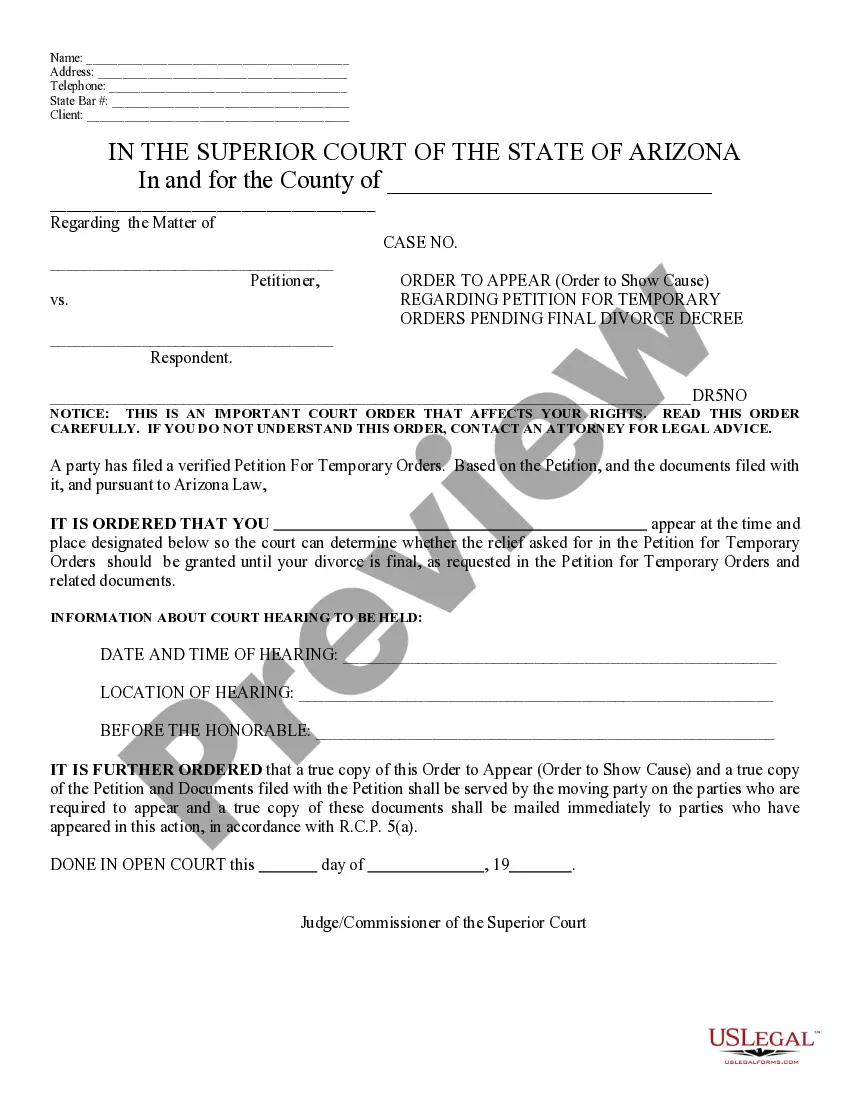
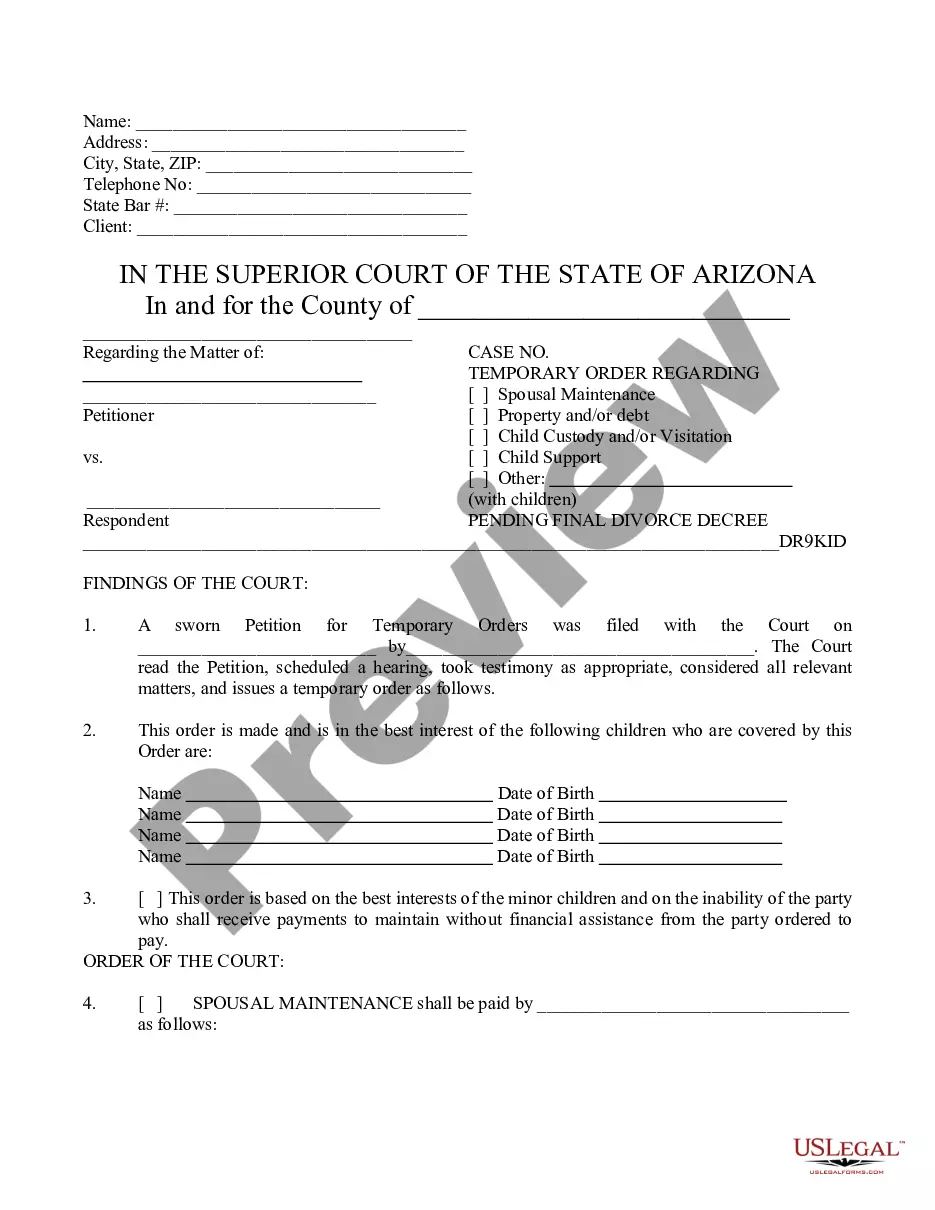
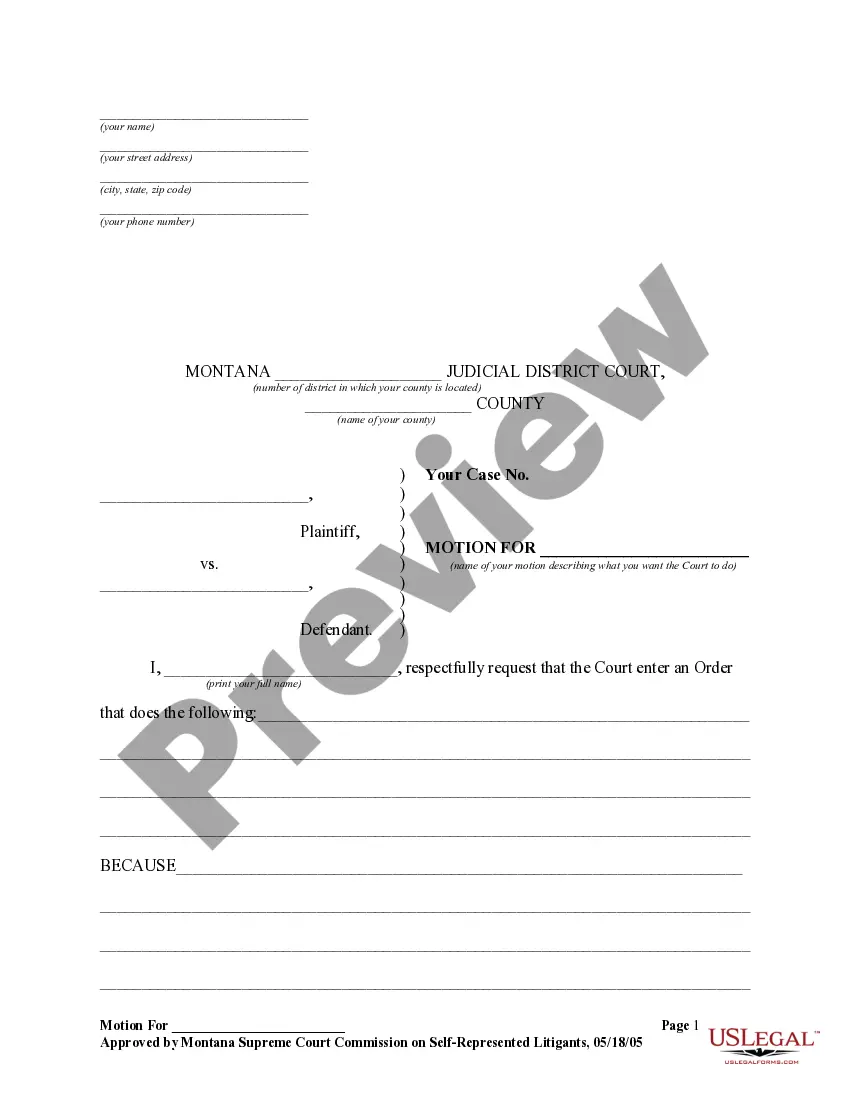
The OSC, or Order to Show Cause, is a legal document used in conjunction with Temporary Orders during a divorce proceeding. This form outlines the specifics of a court hearing related to Temporary Orders pending the finalization of a divorce decree. It is essential for ensuring that both parties have the opportunity to present their cases regarding temporary custody, support, and other urgent matters, differentiating it from other divorce-related forms that may not specify a hearing date or context.
Main sections of this form
- Address and telephone number fields for the parties involved.
- CASE NO. for referencing the specific court case.
- Date, time, and location of the court hearing.
- Judge's name who will preside over the hearing.
- Notice outlining the importance of the order and the need for legal advice if needed.
- Instructions for serving the order and the associated documents on relevant parties.

When this form is needed
This form is used when one party has filed a verified Petition for Temporary Orders in a divorce case. It is typically necessary when immediate decisions about custody, child support, alimony, or other significant issues must be resolved before the divorce is finalized. If you are facing urgent needs that require legal intervention, the OSC is the appropriate form to ensure a court date is scheduled to address these matters.
Who should use this form
- Individuals engaged in divorce proceedings who require temporary court orders.
- Petitioners needing to affirm their requests in front of a judge.
- Respondents who have been served and need to prepare for a court appearance.
- Anyone seeking legal clarity and resolution on pressing matters during a divorce.
How to prepare this document
- Identify the parties involved by entering their addresses and telephone numbers.
- Fill in the CASE NO. to clearly reference your specific court case.
- Provide the date, time, and location of the scheduled court hearing.
- Enter the name of the judge who will preside over the hearing.
- Ensure all parties who need to appear are properly notified as per the mailing instructions.
Does this form need to be notarized?
This form does not typically require notarization unless specified by local law. However, it is essential to follow all local regulations and practices to ensure the document is valid and enforceable.
Get your form ready online
Our built-in tools help you complete, sign, share, and store your documents in one place.
Make edits, fill in missing information, and update formatting in US Legal Forms—just like you would in MS Word.
Download a copy, print it, send it by email, or mail it via USPS—whatever works best for your next step.
Sign and collect signatures with our SignNow integration. Send to multiple recipients, set reminders, and more. Go Premium to unlock E-Sign.
If this form requires notarization, complete it online through a secure video call—no need to meet a notary in person or wait for an appointment.
We protect your documents and personal data by following strict security and privacy standards.

Make edits, fill in missing information, and update formatting in US Legal Forms—just like you would in MS Word.

Download a copy, print it, send it by email, or mail it via USPS—whatever works best for your next step.

Sign and collect signatures with our SignNow integration. Send to multiple recipients, set reminders, and more. Go Premium to unlock E-Sign.

If this form requires notarization, complete it online through a secure video call—no need to meet a notary in person or wait for an appointment.

We protect your documents and personal data by following strict security and privacy standards.
Typical mistakes to avoid
- Failing to serve all parties with the Order to Show Cause and other documents.
- Not including the correct date, time, or location of the hearing.
- Omitting the CASE NO., which can cause confusion in the court system.
- Ignoring the need for legal advice if the order is not understood.
Why use this form online
- Convenience of downloading the form instantly from home.
- Editability allows for adaptations to fit specific needs before printing.
- Access to professionally drafted templates ensures legal accuracy.
- Quick access to legal information relevant to the form.
Looking for another form?

Form popularity
FAQ
The Registrar of Contractors (ROC) in Arizona oversees the licensing of contractors and ensures that they comply with state regulations. The ROC handles complaints against licensed contractors and investigates misconduct. Their goal is to protect consumers by maintaining high industry standards and ensuring that contractors meet their obligations. Engaging with the Arizona OSC gives you access to resources for resolving contractor-related issues.
To file a complaint with the Arizona Department of Corrections, access their official website and locate the complaint section. Fill out the prescribed complaint form, clearly outlining your concerns. Be thorough, as providing comprehensive details will aid in a more efficient investigation. If needed, the Arizona OSC can assist you in navigating this process effectively.
Filing a complaint with the Arizona Registrar of Contractors starts with visiting their official website. You will find a complaint form that needs to be filled out, detailing your issues with the contractor. Make sure to include all relevant information and documents to support your case. Submitting your complaint to the AZ OSC will initiate an investigation into the contractor's actions.
To sue a contractor in Arizona, begin by collecting all relevant documentation, such as contracts and communication records. Decide whether you will represent yourself or hire an attorney, then file a complaint in the appropriate court. Be sure to include details of the contractor’s breach and specify the compensation you are seeking. The Arizona OSC can help you understand your rights and outline the necessary steps to proceed with your case.
Filing a lawsuit in Arizona requires you to first determine the appropriate court for your case. Prepare the necessary documents, including a complaint that outlines your claims. You can file electronically or in person at the court. It’s essential to follow all procedures to ensure that your lawsuit is processed by the court, and resources like the Arizona OSC can provide additional support throughout this journey.
Filing a complaint against a US government contractor involves addressing the issue to the appropriate federal agency that oversees the contract. You should compile evidence supporting your concerns and submit a formal complaint through their designated channels. The agency will review your submission, investigate the matter, and respond accordingly. Utilizing the Arizona OSC can provide you with guidance on how to navigate this process efficiently.
To file a complaint against a contractor in Arizona, start by gathering all relevant documents related to your project. Visit the Arizona Registrar of Contractors (AZ ROC) website, where you will find the complaint form. Complete the form and submit it along with your supporting documents. The AZ OSC will review your complaint and determine the appropriate course of action.
While policies vary greatly, some states allow residency to be established within as little as 30 days for certain situations. However, Arizona offers a straightforward residency process with clear guidelines. For a more comprehensive understanding, consider consulting the Arizona OSC, which can simplify residency requirements across states.
Acquiring residency status in Arizona usually requires a minimum of 12 months of physical presence in the state. During this time, you should take actions that demonstrate your intent to stay, such as acquiring a job or housing. For a detailed breakdown of the process, the Arizona OSC can provide necessary guidance.
Establishing residency in Arizona requires you to take certain steps, such as obtaining an Arizona driver's license, registering to vote, and securing a permanent address. It is also beneficial to have an employment record or enroll in a local educational institution. The Arizona OSC is a helpful resource for understanding these requirements thoroughly.