Arizona Preliminary Injunction
Overview of this form
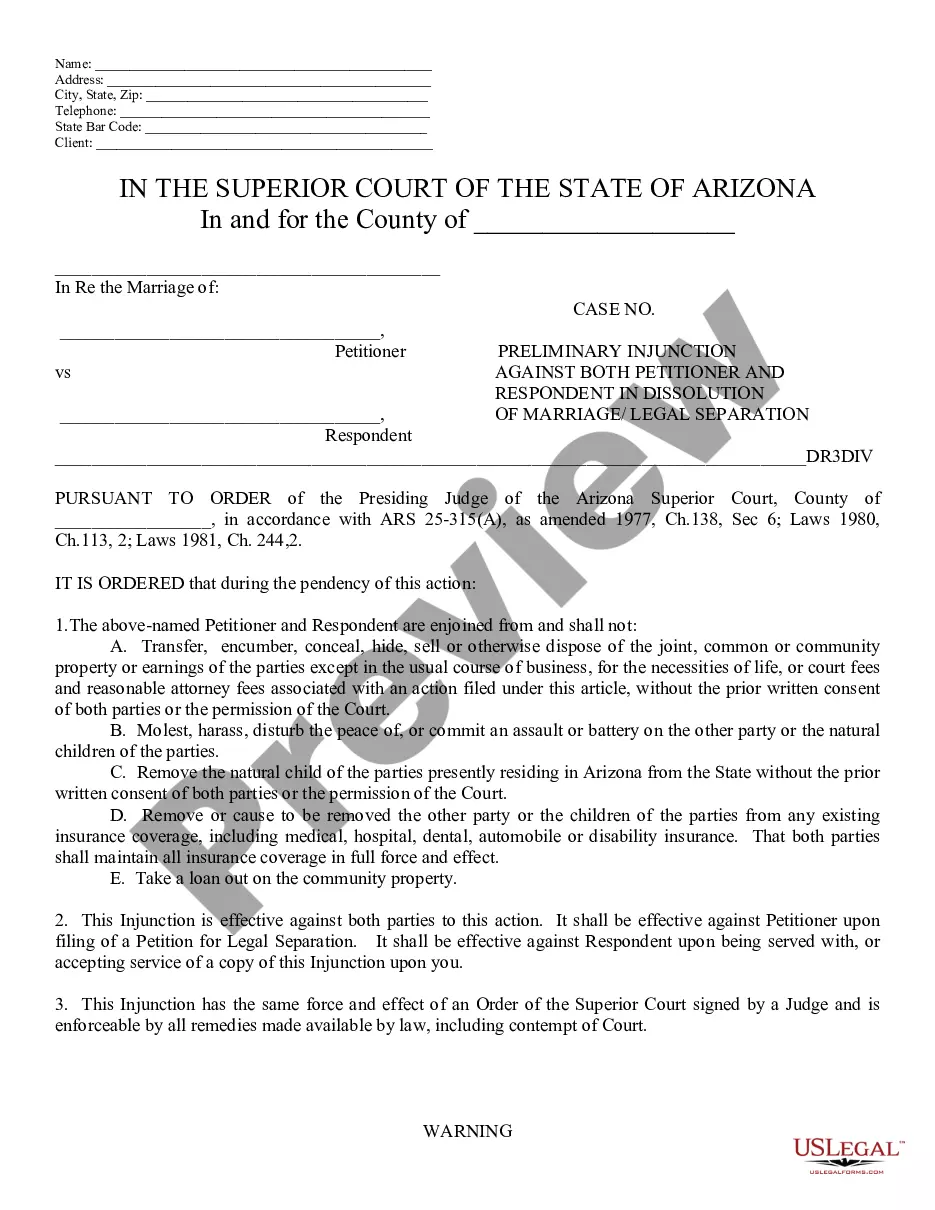
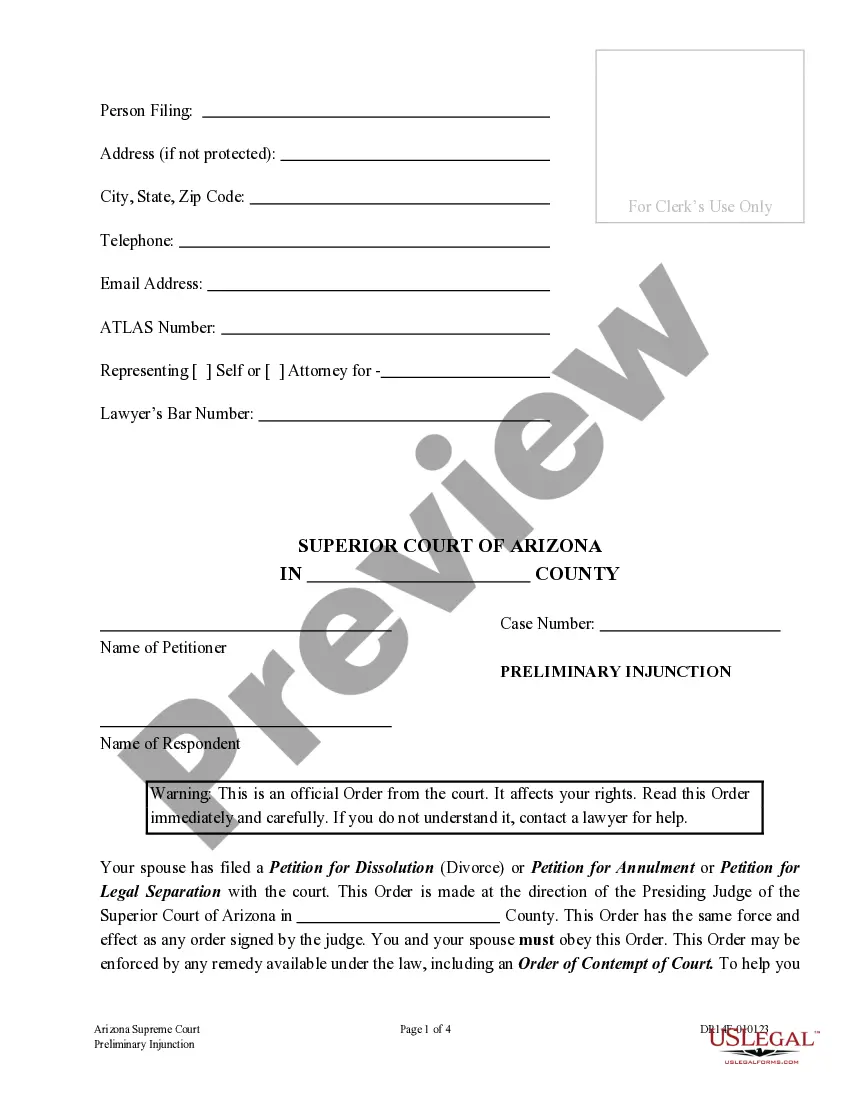
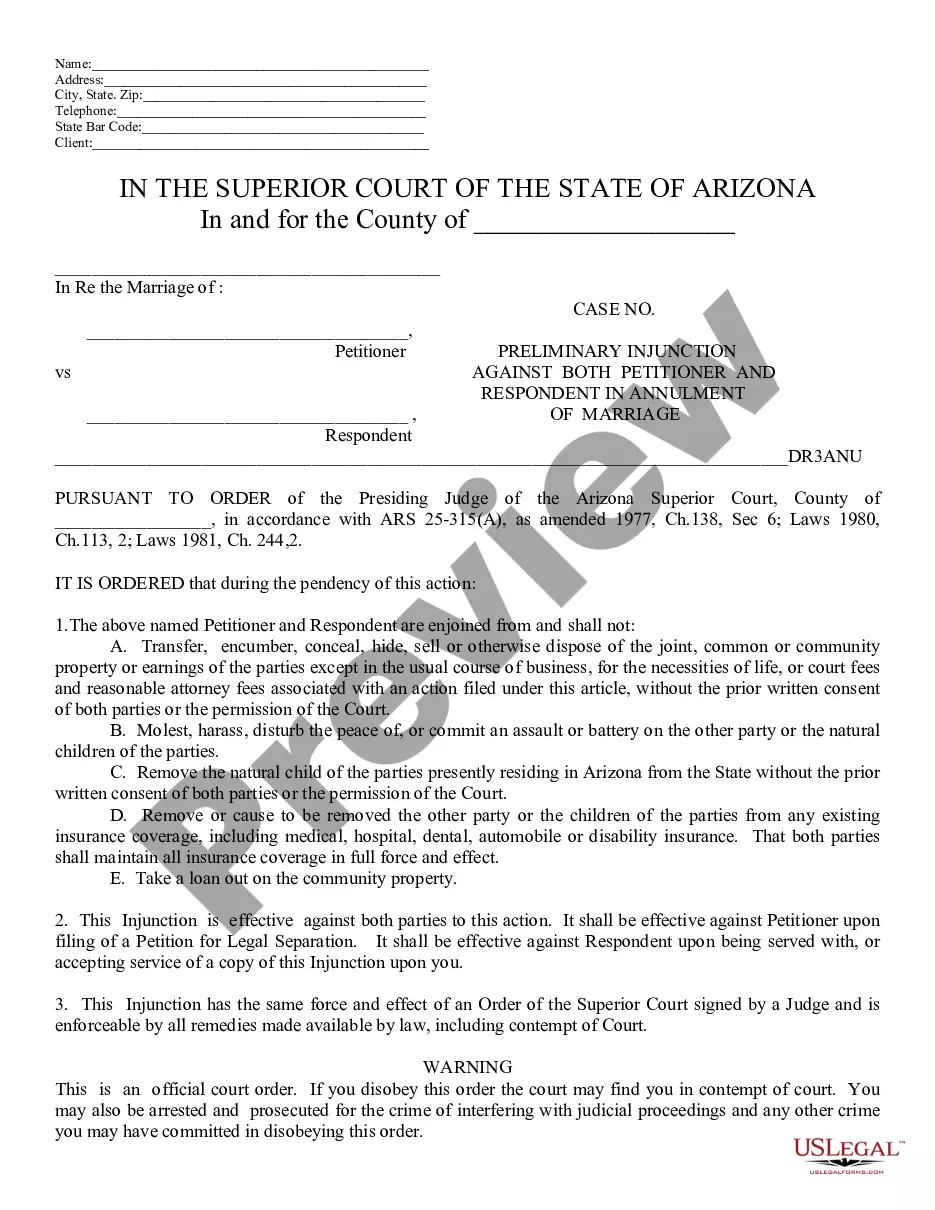
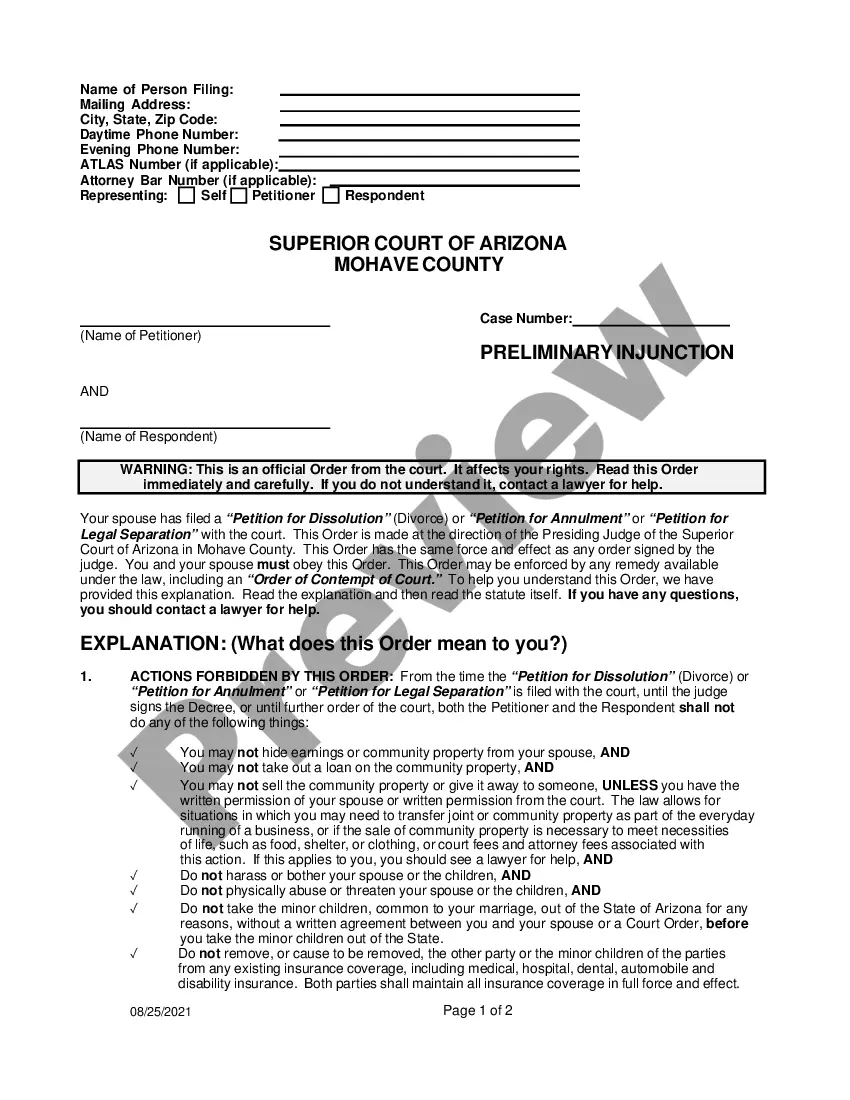
A Preliminary Injunction is a legal order issued by a court to temporarily prevent parties from taking specific actions during a legal proceeding, particularly in family law cases like divorce or legal separation. This injunction prohibits a couple from disposing of joint property and protecting the welfare of children involved in the separation. It is essential for maintaining the status quo until a resolution is reached, differing from other forms of injunctions due to its focus on marital property and family matters.
What’s included in this form
- Addresses of both parties involved in the legal action.
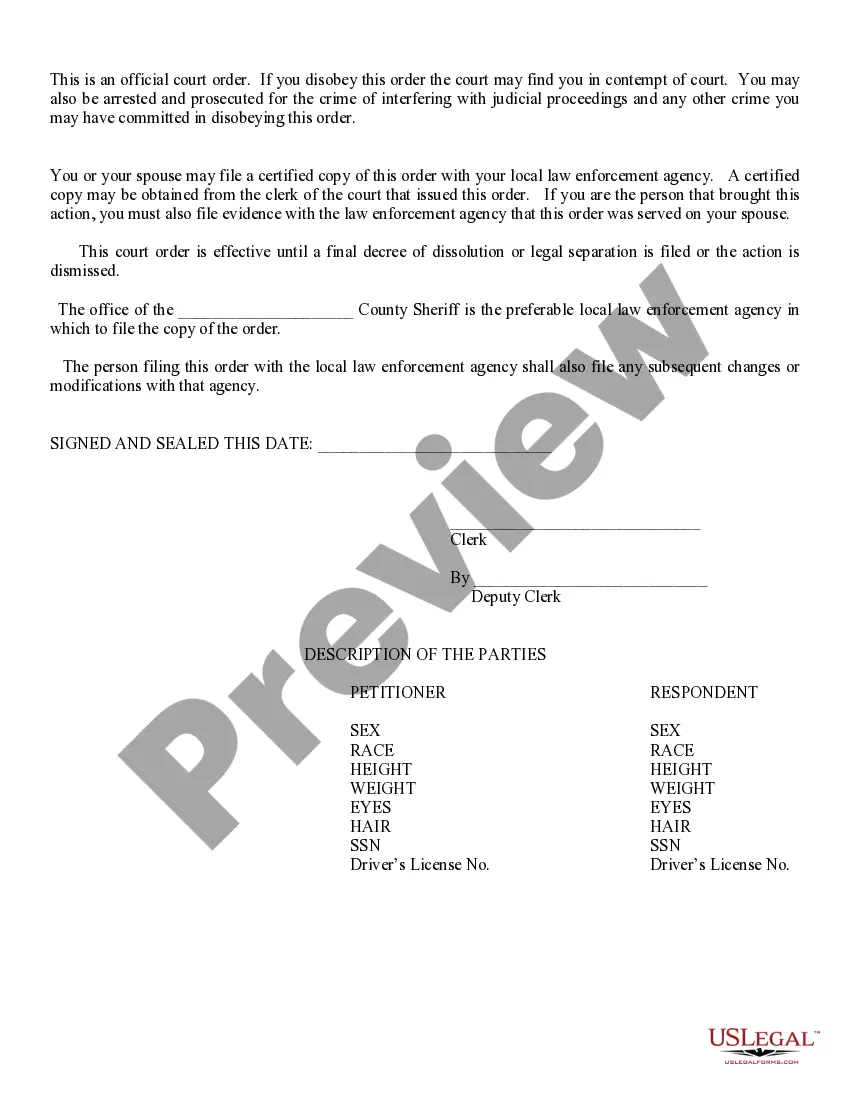
- Details of the petitioner and respondent, including personal identifiers.
- Specific restrictions on property and financial dealings, including community property.
- Prohibitions against harassment or removal of children from the jurisdiction.
- Consequences of violating the injunction, including potential contempt of court.
- Duration of the injunction until the case is resolved or dismissed.
When to use this document
This form is used during divorce or legal separation proceedings. It is particularly relevant when there is a need to prevent either spouse from selling or hiding assets, or when there are concerns about domestic violence or the safety of children. It is suitable for situations where immediate legal intervention is required to protect rights and interests before the court makes a final ruling.
Who needs this form
- Individuals currently going through a divorce or legal separation.
- Spouses who need to secure joint property or ensure the safety of children.
- Parties involved in disputes related to family law where immediate judicial protection is necessary.
Completing this form step by step
- Identify and enter the addresses of both parties involved.
- Fill in the case number assigned by the court.
- Include personal information for both parties, such as full names, sex, race, and driverâs license numbers.
- Specify the joint property and assets that are protected under the injunction.
- Sign and date the form as required, and ensure it is properly filed with the court.
Notarization requirements for this form
This form does not typically require notarization unless specified by local law. Ensure that all signatories are present when filing to avoid any legal complications.
Get your form ready online
Our built-in tools help you complete, sign, share, and store your documents in one place.
Make edits, fill in missing information, and update formatting in US Legal Forms—just like you would in MS Word.
Download a copy, print it, send it by email, or mail it via USPS—whatever works best for your next step.
Sign and collect signatures with our SignNow integration. Send to multiple recipients, set reminders, and more. Go Premium to unlock E-Sign.
If this form requires notarization, complete it online through a secure video call—no need to meet a notary in person or wait for an appointment.
We protect your documents and personal data by following strict security and privacy standards.

Make edits, fill in missing information, and update formatting in US Legal Forms—just like you would in MS Word.

Download a copy, print it, send it by email, or mail it via USPS—whatever works best for your next step.

Sign and collect signatures with our SignNow integration. Send to multiple recipients, set reminders, and more. Go Premium to unlock E-Sign.

If this form requires notarization, complete it online through a secure video call—no need to meet a notary in person or wait for an appointment.

We protect your documents and personal data by following strict security and privacy standards.
Typical mistakes to avoid
- Failing to provide complete and accurate information for both parties.
- Not serving the injunction to the respondent properly.
- Ignoring the need for court approval before taking any actions prohibited by the injunction.
Benefits of using this form online
- Convenience of completing the form at your own pace.
- Editability allows for easy updates to personal information.
- Access to forms drafted by licensed attorneys for legal accuracy and compliance.
Looking for another form?
Form popularity
FAQ
To prove harassment in Arizona, you need to demonstrate a pattern of behavior that causes emotional distress or fear for your safety. This may include showing evidence of unwanted communications, threats, or other intimidating actions. Gather as much documentation as possible to support your claim. On our US Legal Forms platform, you can find specific resources tailored to help you effectively compile and present this proof.
Rule 65 in Arizona governs the issuance of injunctions and restraining orders. It outlines the requirements and processes for obtaining such legal remedies, ensuring that the rights of all parties involved are respected. Understanding this rule is crucial for anyone considering legal action related to an Arizona Preliminary Injunction. Our platform can help clarify these legal concepts and provide the necessary forms.
To secure a restraining order in Arizona, you must provide evidence of harassment or threats against you. This may include records of incidents, witness statements, or any relevant documentation. The clearer and more convincing your proof, the stronger your case will be in front of the judge. You can access helpful resources and templates on our platform to assist you in gathering this evidence.
To obtain an injunction in Arizona, you need to file a petition with the court, stating your reasons for seeking the order. The court will schedule a hearing, where both parties can present evidence. Following the hearing, if the judge finds merit in your claim, you will receive the injunction. Our US Legal Forms platform provides all the required documents and instructions for a smooth filing process.
In Arizona, an injunction against harassment typically lasts for one year. However, the court may extend this duration for additional periods if necessary. It's essential to understand that the person requesting the injunction must actively participate in the legal process to maintain its effectiveness. Using our platform, you can find the necessary forms and guidance to navigate this situation.
In Arizona, a protective order is generally broader, often addressing issues like domestic violence, while a restraining order may apply to harassment or other specific threats. Both orders aim to provide safety, yet the differences in scope and application are significant. Utilizing resources like US Legal Forms can assist you in understanding and obtaining the right type of order, including an Arizona Preliminary Injunction for more nuanced legal needs.
A restraining order in Arizona typically lasts for one year but can be longer if the court deems it necessary. After the expiration, you have the option to petition the court for an extension. Understanding the duration and implications of these orders can help you navigate your legal options, including obtaining an Arizona Preliminary Injunction for more extended protection.
In Arizona, a restraining order can last for a set period of time determined by the court, which could be up to 12 months. However, individuals can request a renewal if they still feel threatened or unsafe. It’s worth considering both a restraining order and an Arizona Preliminary Injunction to address ongoing safety concerns effectively.
Yes, in Arizona, a restraining order does appear on your criminal record. This could have implications for future employment and interactions with law enforcement. If privacy is a concern, exploring options like an Arizona Preliminary Injunction might be beneficial, as it may also provide a more discreet approach.
In Arizona, a temporary restraining order typically lasts until the court holds a hearing on the matter. This hearing usually occurs within 10 days, allowing the judge to assess the situation. Therefore, it can be in effect for a short period while you seek a more permanent solution, like an Arizona Preliminary Injunction.