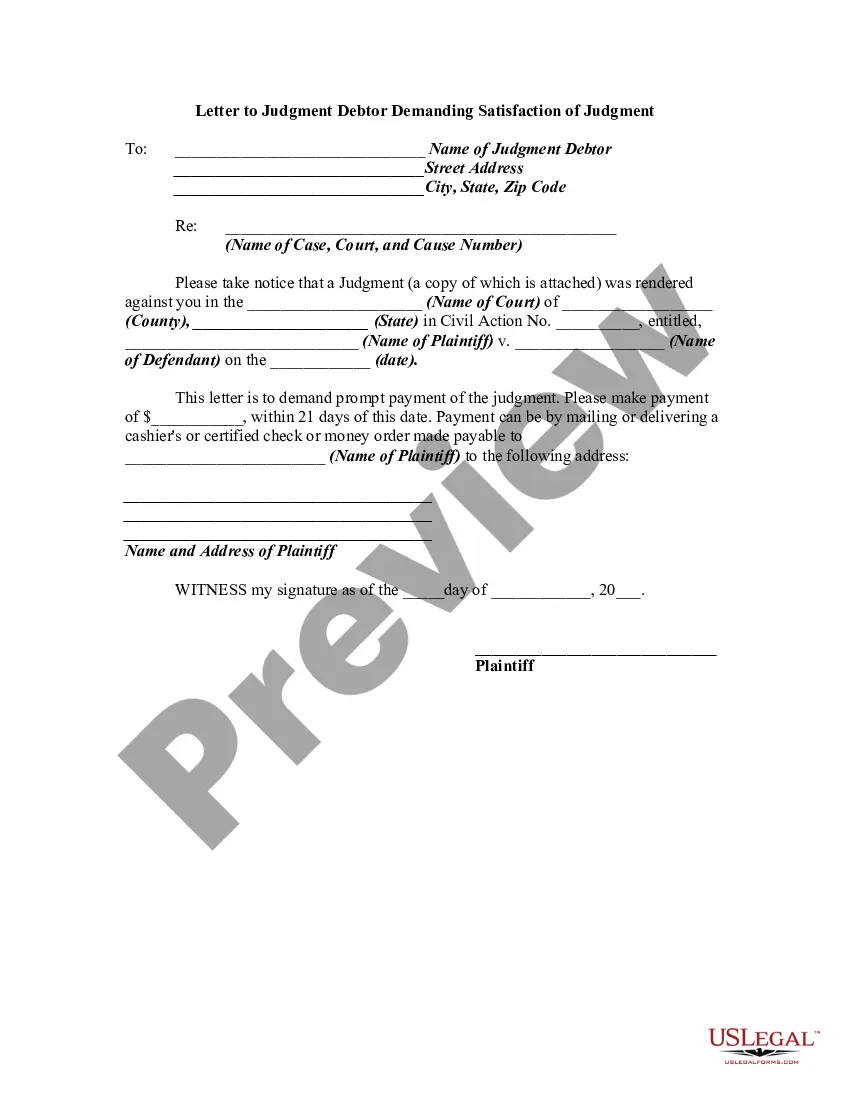
Pursuant to this form, a plaintiff who obtained a judgment against a defendant is demanding satisfaction of the judgment by payment of a sum of money sent to a specified address. If the parties are represented by an attorney, it would be preferable for the attorney representing the plaintiff to send such a letter to the attorney representing the defendant.
Arkansas Letter to Judgment Debtor Demanding Satisfaction of Judgment
Category:
State:
Multi-State
Control #:
US-00760BG
Format:
Word;
Rich Text
Instant download
Description





Get your form ready online
Our built-in tools help you complete, sign, share, and store your documents in one place.
Built-in online Word editor
Make edits, fill in missing information, and update formatting in US Legal Forms—just like you would in MS Word.
Export easily
Download a copy, print it, send it by email, or mail it via USPS—whatever works best for your next step.
E-sign your document
Sign and collect signatures with our SignNow integration. Send to multiple recipients, set reminders, and more. Go Premium to unlock E-Sign.
Notarize online 24/7
If this form requires notarization, complete it online through a secure video call—no need to meet a notary in person or wait for an appointment.
Store your document securely
We protect your documents and personal data by following strict security and privacy standards.

Make edits, fill in missing information, and update formatting in US Legal Forms—just like you would in MS Word.

Download a copy, print it, send it by email, or mail it via USPS—whatever works best for your next step.

Sign and collect signatures with our SignNow integration. Send to multiple recipients, set reminders, and more. Go Premium to unlock E-Sign.

If this form requires notarization, complete it online through a secure video call—no need to meet a notary in person or wait for an appointment.

We protect your documents and personal data by following strict security and privacy standards.
Looking for another form?


How to fill out Letter To Judgment Debtor Demanding Satisfaction Of Judgment?
Are you in a circumstance where you require documents for various company or personal activities almost every time.
There are numerous lawful document templates accessible online, but finding forms you can rely on is not simple.
US Legal Forms provides thousands of form templates, such as the Arkansas Letter to Judgment Debtor Demanding Satisfaction of Judgment, which can be designed to meet federal and state standards.
Once you locate the appropriate form, click Purchase now.
Choose the pricing plan you wish, fill out the required information to process your payment, and pay for your order using PayPal or Visa or Mastercard.
- If you are already familiar with the US Legal Forms website and have an account, simply Log In.
- Then, you can download the Arkansas Letter to Judgment Debtor Demanding Satisfaction of Judgment template.
- If you do not have an account and wish to start using US Legal Forms, follow these steps.
- Find the form you need and ensure it is for your correct city/region.
- Use the Preview button to view the form.
- Review the description to confirm that you have selected the correct form.
- If the form is not what you’re looking for, utilize the Search box to find the form that fits your needs and preferences.
Form popularity
FAQ
A satisfaction of judgment is a document signed by a judgment creditor and generally filed with the court, indicating that a judgment has been paid in full.
Print. You Release a Mortgage or Charge when the property charged has been released from the charge or no longer forms part of the company's property. You Satisfy a Mortgage or Charge when the debt of the charge has been paid or satisfied in full or part.
Rule 68 ? Offer of judgment. At any time more than 10 days before the trial begins, a party defending against a claim may serve upon the adverse party an offer to allow judgment to be taken against him for the money or property or to the effect specified in his offer, with costs then accrued.
Rule 64 - Addition and Withdrawal of Counsel (a) When additional counsel is employed to represent any party in a case, said counsel shall immediately cause the clerk to enter his or her name as an attorney of record in the case and shall also immediately notify the court and opposing counsel that he or she has been ...
Tells the court and others that a judgment has been paid in full or in part. Can be recorded with a county to release a lien against the judgment debtor's land or filed with the Secretary of State to release a lien against the debtor's personal property.
A satisfaction of judgment is a document signed by a judgment creditor and generally filed with the court, indicating that a judgment has been paid in full.
Pay directly to the creditor Mail or deliver a check or money order to the Judgment Creditor. Make sure to keep proof of payment, such as your canceled check. Once the Judgment Creditor receives your payment, ask them to file the form Acknowledgment of Satisfaction of Judgment with the court within 14 days.
If a judgment has been issued against you, the creditor can satisfy its judgment by freezing your bank account and taking a portion of your wages. Procedures differ from state to state.
When one party's liability to another has been determined but the extent of liability remains to be determined by further proceedings, the party held liable may make an offer of judgment.
Once the debtor has paid the judgment debt in full, the judgment creditor must file a satisfaction of judgment. The satisfaction can be used by the debtor to prove to any future creditors that the judgment has been paid and collection has ceased.