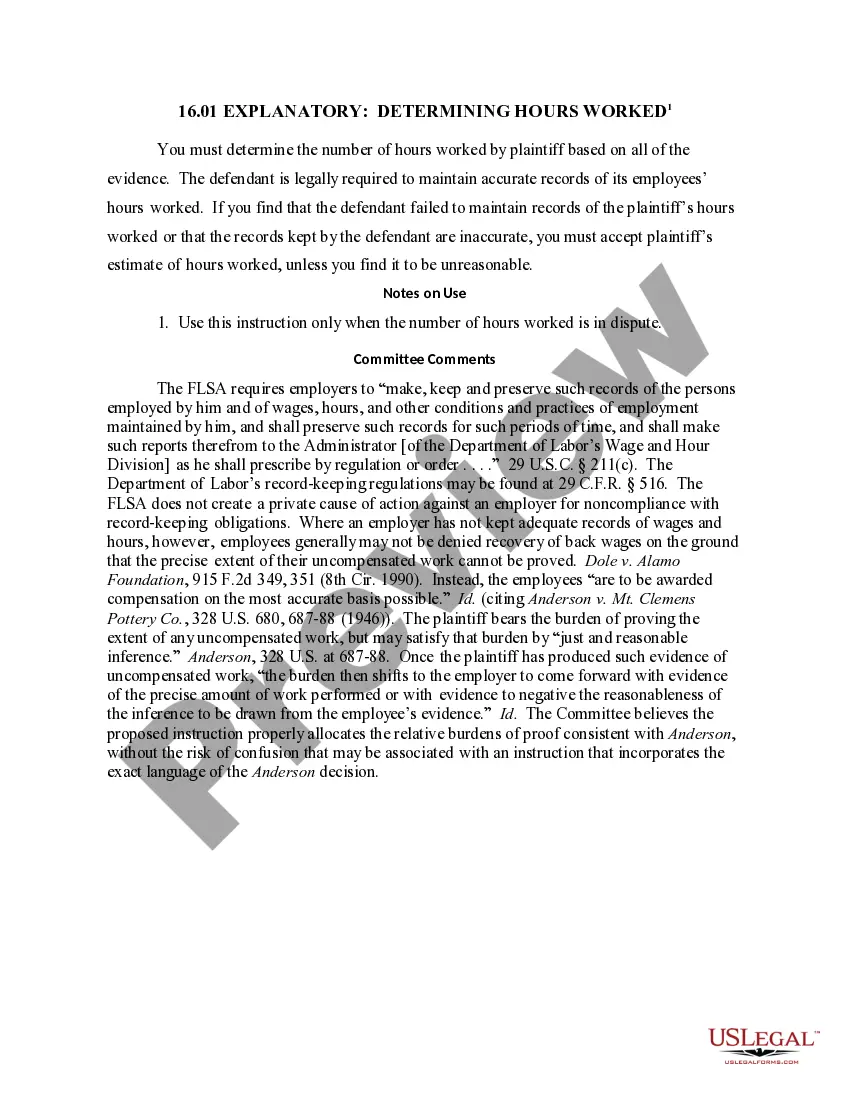
16.01 EXPLANATORY: DETERMINING HOURS WORKED
What is this form?
The 16.01 Explanatory: Determining Hours Worked form is a legal instruction designed for determining the number of hours worked by an employee (the plaintiff) in cases where the hours are disputed. This form helps juries assess the sufficiency of the employer's (the defendant's) records and assists in leveraging an employee's estimations if the employer fails to maintain accurate documentation. Using this instruction ensures a more equitable approach when addressing discrepancies in employee hours compared to other forms that may solely address payroll matters.
Key parts of this document
- Definition of the plaintiff's hours worked based on evidence.
- Legal requirement for defendants to keep accurate records of employee hours.
- Guidance for juries on accepting employee estimates if records are lacking or inaccurate.
- References to relevant laws, such as the Fair Labor Standards Act (FLSA).
- Clarification of the burden of proof between plaintiff and defendant.
When this form is needed
This form should be utilized in legal scenarios where the number of hours worked by an employee is contested, such as in wage disputes, unpaid overtime claims, or other cases involving claims against employers regarding hours. It is particularly relevant when an employee believes that their recorded hours do not accurately reflect the actual time worked.
Who should use this form
- Employees who are involved in disputes regarding their recorded hours.
- Attorneys representing plaintiffs in cases against employers for unpaid wages.
- Jurors needing to understand the legal standards for determining hours worked.
- Employers seeking to understand their obligations regarding record keeping.
Completing this form step by step
- Gather all available evidence regarding the hours worked by the plaintiff.
- Review the defendant's records for accuracy and completeness.
- Determine if the records are inadequate or inaccurate; if so, consider the plaintiff's estimates.
- Assess the reasonableness of the plaintiff's estimated hours worked.
- Prepare the findings based on the evidence aligned with the legal standards provided in the form.
Notarization guidance
Notarization is not commonly needed for this form. However, certain documents or local rules may make it necessary. Our notarization service, powered by Notarize, allows you to finalize it securely online anytime, day or night.
Get your form ready online
Our built-in tools help you complete, sign, share, and store your documents in one place.
Make edits, fill in missing information, and update formatting in US Legal Forms—just like you would in MS Word.
Download a copy, print it, send it by email, or mail it via USPS—whatever works best for your next step.
Sign and collect signatures with our SignNow integration. Send to multiple recipients, set reminders, and more. Go Premium to unlock E-Sign.
If this form requires notarization, complete it online through a secure video call—no need to meet a notary in person or wait for an appointment.
We protect your documents and personal data by following strict security and privacy standards.

Make edits, fill in missing information, and update formatting in US Legal Forms—just like you would in MS Word.

Download a copy, print it, send it by email, or mail it via USPS—whatever works best for your next step.

Sign and collect signatures with our SignNow integration. Send to multiple recipients, set reminders, and more. Go Premium to unlock E-Sign.

If this form requires notarization, complete it online through a secure video call—no need to meet a notary in person or wait for an appointment.

We protect your documents and personal data by following strict security and privacy standards.
Mistakes to watch out for
- Neglecting to review all evidence before making a determination.
- Failing to properly assess the sufficiency of the employer's records.
- Overlooking the burden of proof requirements laid out in legal precedents.
- Accepting plaintiff estimates without evaluating their reasonableness.
Legal use & context
- This instruction is a standard part of civil jury instructions in disputes involving hours worked.
- It helps ensure fair assessments when employers fail to meet record-keeping obligations.
- The burden of proof relies initially on the plaintiff to demonstrate the extent of work done.
- If employers can't provide evidence, reasonable estimates from employees are accepted.
Key takeaways
- The 16.01 form helps juries determine hours worked when records are disputed.
- Employers are obligated to maintain accurate records under the FLSA.
- Discrepancies in records may allow for the acceptance of employee estimates.
- Understanding the burden of proof is crucial for both plaintiffs and jurors in these cases.
Looking for another form?

Form popularity
FAQ
Once you know the number of hours you typically work in a week, you can then take that number and multiply it by 52 (the number of weeks in the year) to see the average number of hours you worked over the course of the year. Keep in mind that this number doesn't account for holidays or vacation days.
The four main components or elements covered by the FLSA are: payment of a minimum wage. overtime pay for working 40+ hours in a week. recordkeeping by the employer on employees: accurate information identifying the worker and the hours worked and the wages earned. child labor standards and restrictions.
Generally, no, there are no federal laws that limit how many hours you can work in a single day.
What About Timekeeping: Employers may use any timekeeping method they choose. For example, they may use a time clock, have a timekeeper keep track of employee's work hours, or tell their workers to write their own times on the records. Any timekeeping plan is acceptable as long as it is complete and accurate.
Under the FLSA, overtime pay is determined by multiplying the employee's ?straight time rate of pay? by all overtime hours worked PLUS one-half of the employee's ?hourly regular rate of pay? times all overtime hours worked. All overtime work that is ordered or approved must be compensated.
The easiest and the best way is to retain copies of your paystub, which should show the total number of hours you worked each day and each week during the pay period.
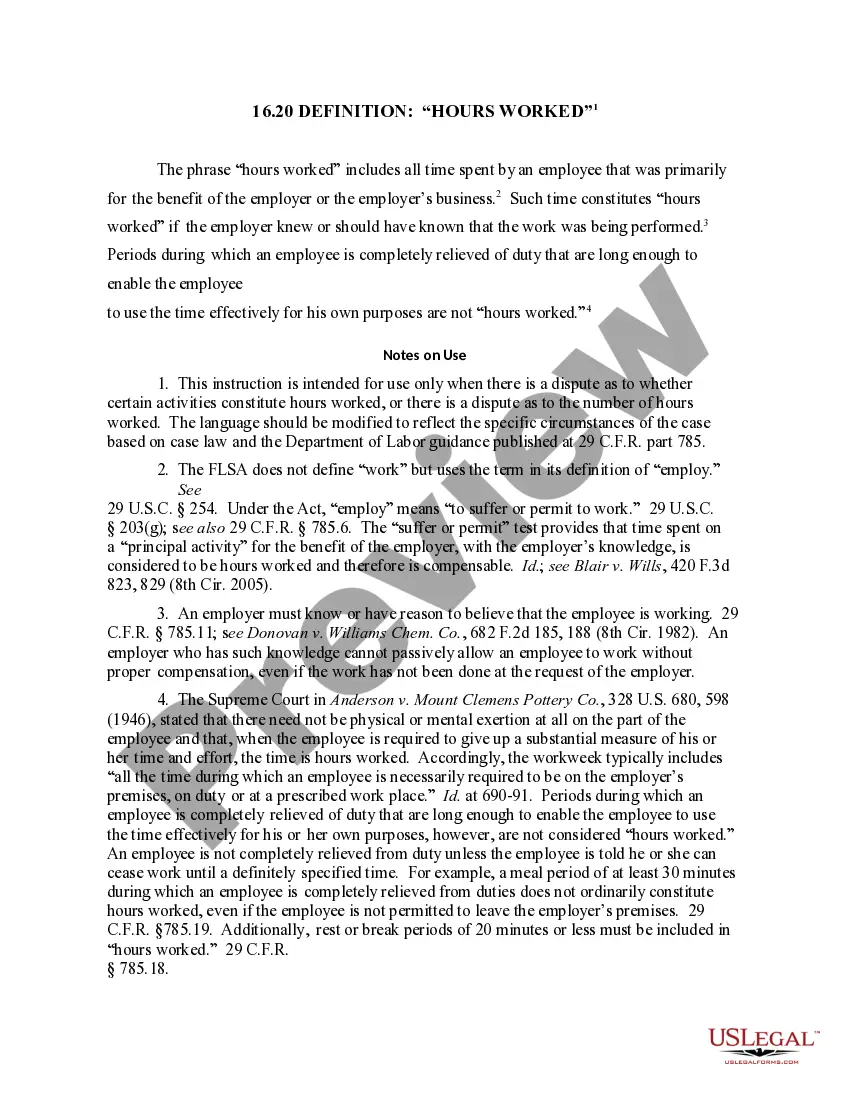
The United States Department of Labor says, ?In general, ?hours worked? includes all time an employee must be on duty, or on the employer's premises or at any other prescribed place of work. Also included is any additional time the employee is allowed (i.e., suffered or permitted) to work.?
The Fair Labor Standards Act (FLSA) is a federal employment law that defines employer obligations relating to employee wages, hours, overtime, and child labor.