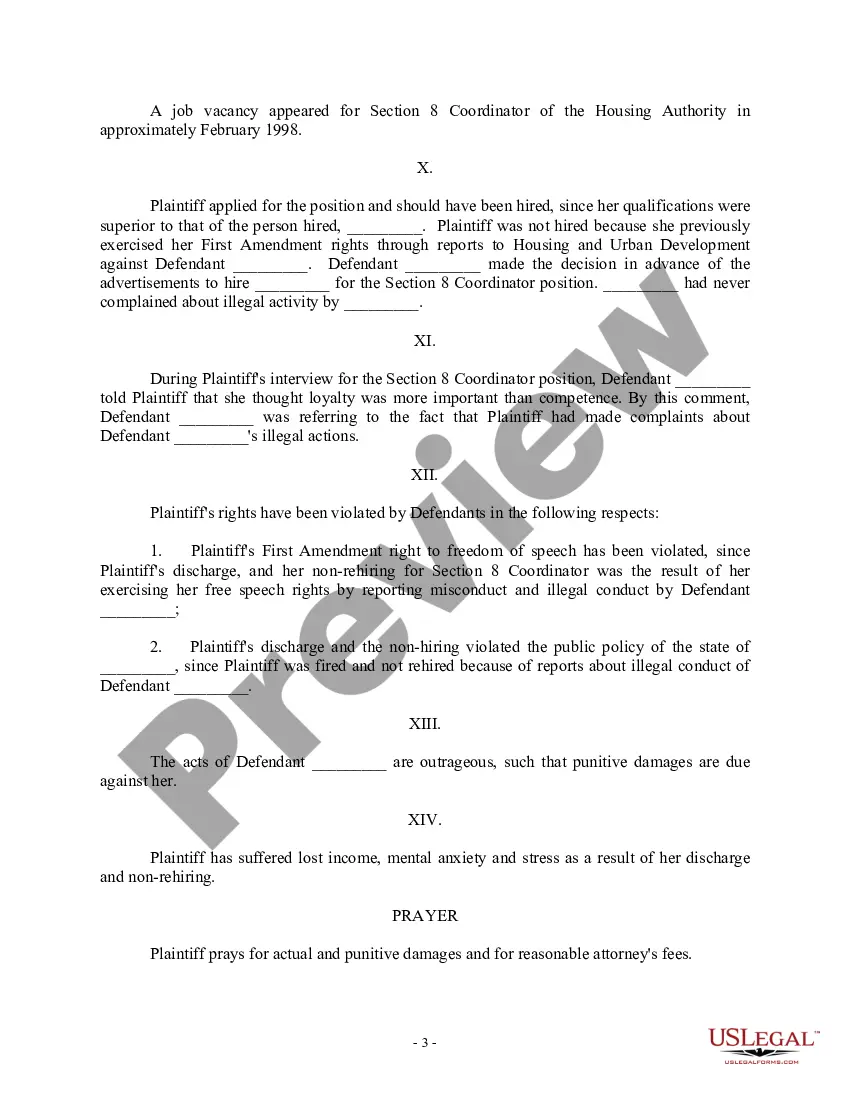
This form is a Complaint. This action is to recover damages for a violation of the First Amendment of the United States Constitution. The plaintiff is seeking punitive damages and reasonable attorney's fees.
Arkansas Complaint for Violation of Civil Rights and for Wrongful Discharge and Failure To Rehire - 1st, 14th Amendments, US Constitution - Jury Trial Demand
Category:
State:
Multi-State
Control #:
US-000285
Format:
Word;
Rich Text
Instant download
Description
Free preview





How to fill out Complaint For Violation Of Civil Rights And For Wrongful Discharge And Failure To Rehire - 1st, 14th Amendments, US Constitution - Jury Trial Demand?
If you need to gather, acquire, or print authorized document templates, utilize US Legal Forms, the largest collection of legal forms available online. Employ the site’s straightforward and user-friendly search to find the documents you require. Numerous templates for business and personal purposes are organized by categories and states, or keywords. Use US Legal Forms to obtain the Arkansas Complaint for Violation of Civil Rights and for Wrongful Discharge and Failure To Rehire - 1st, 14th Amendments, US Constitution - Jury Trial Demand within a few clicks.
If you are already a US Legal Forms user, Log In to your account and click on the Download button to retrieve the Arkansas Complaint for Violation of Civil Rights and for Wrongful Discharge and Failure To Rehire - 1st, 14th Amendments, US Constitution - Jury Trial Demand. You can also access forms you previously downloaded from the My documents section of your account.
If you are using US Legal Forms for the first time, follow the instructions below: Step 1. Ensure you have selected the form for the correct city/state. Step 2. Use the Review option to check the form’s details. Don't forget to read the description. Step 3. If you are not satisfied with the form, use the Search field at the top of the screen to find other forms in the legal format category. Step 4. Once you have located the form you need, select the Get now button. Choose the pricing plan you prefer and enter your information to register for an account. Step 5. Complete the transaction. You can use your Visa or Mastercard or PayPal account to finalize the transaction. Step 6. Choose the format of the legal form and download it to your device. Step 7. Complete, edit, and print or sign the Arkansas Complaint for Violation of Civil Rights and for Wrongful Discharge and Failure To Rehire - 1st, 14th Amendments, US Constitution - Jury Trial Demand.
- Each legal document template you purchase is yours for a long time.
- You have access to every form you downloaded in your account.
- Visit the My documents section and select a form to print or download again.
- Be proactive and download, and print the Arkansas Complaint for Violation of Civil Rights and for Wrongful Discharge and Failure To Rehire - 1st, 14th Amendments, US Constitution - Jury Trial Demand with US Legal Forms.
- There are numerous professional and state-specific forms available for your business or personal needs.
Form popularity
FAQ
A civil rights violation occurs when an individual's rights, as protected by the Constitution, are infringed upon by the government or other entities. For instance, if someone faces discrimination based on race, gender, or religion, it may be categorized as a civil rights violation. Additionally, wrongful discharge from employment or failure to rehire can also fall under this umbrella, especially if it violates the 1st and 14th Amendments. If you believe you have a case, you can file an Arkansas Complaint for Violation of Civil Rights and for Wrongful Discharge and Failure To Rehire - 1st, 14th Amendments, US Constitution - Jury Trial Demand for redress.
Governmental actors violate due process when they frustrate the fairness of proceedings, such as when a prosecutor fails to disclose evidence to a criminal defendant that suggests they may be innocent of the crime, or when a judge is biased against a criminal defendant or a party in a civil action.
They are, theoretically, entitled to good nutrition, healthcare, and education. Children are entitled to a safe place to live and come of age. Parents have the right to raise their children as they see fit. If a child's caregivers cannot parent the child, courts take this very seriously.
No State shall make or enforce any law which shall abridge the privileges or immunities of citizens of the United States; nor shall any State deprive any person of life, liberty, or property, without due process of law; nor deny to any person within its jurisdiction the equal protection of the laws.
Passed by the Senate on June 8, 1866, and ratified two years later, on July 9, 1868, the Fourteenth Amendment granted citizenship to all persons "born or naturalized in the United States," including formerly enslaved people, and provided all citizens with ?equal protection under the laws,? extending the provisions of ...
More recently, this Court declared in Washington v. Glucksberg, 521 U.S. 702 (1997), that the Constitution, and specifically the Due Process Clause of the Fourteenth Amendment, protects the fundamental right of parents to direct the care, upbringing, and education of their children.
Making room for these innovations, the Court has determined that due process requires, at a minimum: (1) notice; (2) an opportunity to be heard; and (3) an impartial tribunal.
Removing a child from a parent's custody violates the Fourteenth Amendment unless the removal (1) is authorized by a court order (typically a warrant); or (2) is supported by ?reasonable cause to believe that the child is in imminent danger of serious bodily injury,? and the scope of intrusion does not extend beyond ...
United States law allows an individual who believes that his or her constitutional rights have been violated to bring a civil action against the government to recover the damages sustained as a result of that violation.