Arkansas Limited Warranty Deed For Forfeited Property Sold
Overview of this form
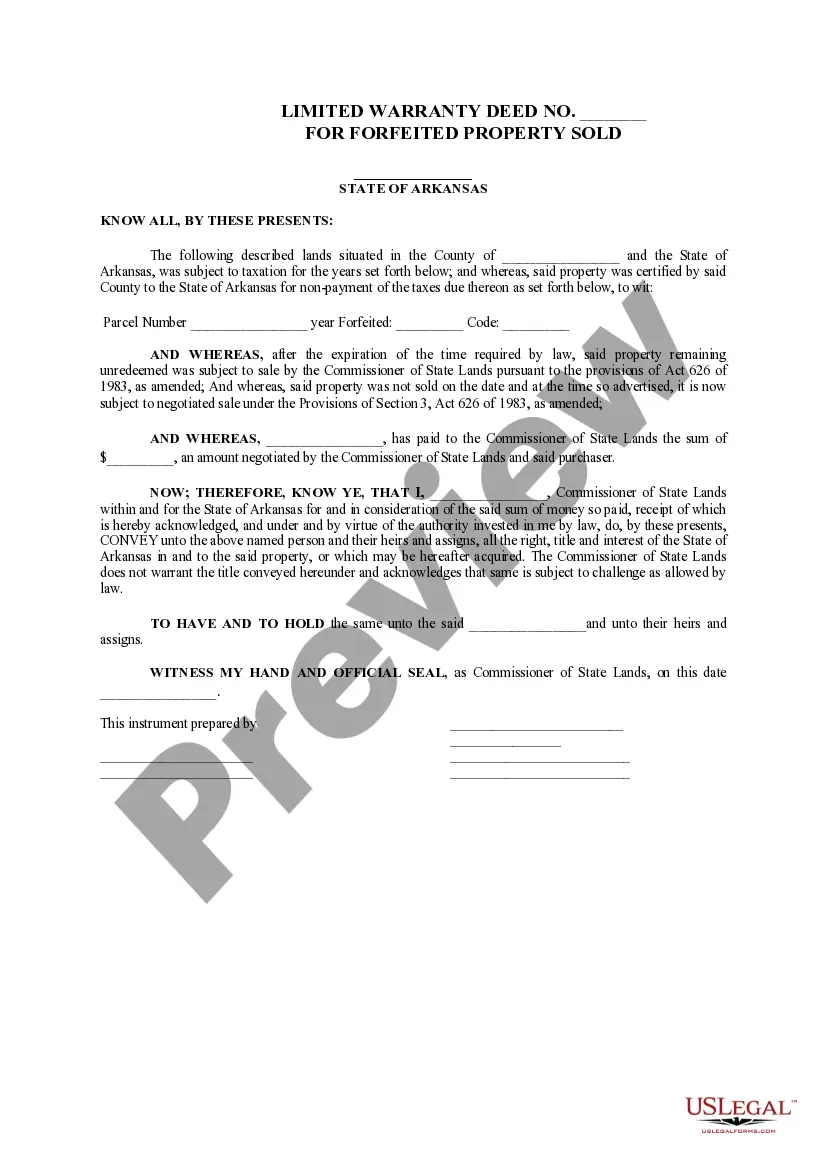
The Limited Warranty Deed for Forfeited Property Sold is a legal document used in the State of Arkansas to convey ownership of property that has been forfeited due to unpaid taxes. Unlike a standard warranty deed, this form provides limited guarantees regarding the title of the property, meaning the seller does not warrant against any future challenges to the title. This form is essential for individuals or entities purchasing forfeited properties sold by the Commissioner of State Lands in Arkansas.
Form components explained
- Identification of the parties involved, including the Commissioner of State Lands and the purchaser.
- Details about the property, including the parcel number and years of taxes owed.
- Statement regarding the sale process and acknowledgment of payment made by the buyer.
- Conveyance clause, which transfers available rights, title, and interest in the property to the buyer.
- Signature and seal of the Commissioner of State Lands to authenticate the document.
Common use cases
This form should be used when purchasing property that was previously forfeited for unpaid taxes in Arkansas. It is particularly relevant in cases where the property was not sold at a public auction and is now being sold through negotiated terms. This deed is essential to ensure the legal transfer of ownership and provide documentation for future property transactions.
Who can use this document
- Individuals or companies looking to acquire forfeited property in Arkansas.
- Real estate investors interested in purchasing properties at negotiated sales.
- Property buyers aiming to establish a legal claim to land that has been forfeited due to tax non-payment.
How to complete this form
- Enter the title and pertinent identifiers such as the deed number.
- Fill in the parties' names, including the purchaser and the Commissioner of State Lands.
- Specify the property details including the parcel number and the year(s) of foreclosure.
- Indicate the negotiated sale amount paid for the property.
- Include the date of signature and any requisite identifying marks or official seals.
Notarization requirements for this form
This form does not typically require notarization unless specified by local law. Ensure to check local regulations before submission to confirm if notarization is necessary for your specific situation.
Get your form ready online
Our built-in tools help you complete, sign, share, and store your documents in one place.
Make edits, fill in missing information, and update formatting in US Legal Forms—just like you would in MS Word.
Download a copy, print it, send it by email, or mail it via USPS—whatever works best for your next step.
Sign and collect signatures with our SignNow integration. Send to multiple recipients, set reminders, and more. Go Premium to unlock E-Sign.
If this form requires notarization, complete it online through a secure video call—no need to meet a notary in person or wait for an appointment.
We protect your documents and personal data by following strict security and privacy standards.

Make edits, fill in missing information, and update formatting in US Legal Forms—just like you would in MS Word.

Download a copy, print it, send it by email, or mail it via USPS—whatever works best for your next step.

Sign and collect signatures with our SignNow integration. Send to multiple recipients, set reminders, and more. Go Premium to unlock E-Sign.

If this form requires notarization, complete it online through a secure video call—no need to meet a notary in person or wait for an appointment.

We protect your documents and personal data by following strict security and privacy standards.
Avoid these common issues
- Failing to accurately enter the parcel number or property details.
- Not including the negotiated sale amount or the correct date.
- Leaving the signature and seal sections incomplete or unclear.
Benefits of completing this form online
- Immediate access to downloadable and customizable legal documentation.
- Convenient editing options that allow you to tailor the form to your specific needs.
- Reliability of attorney-drafted templates that adhere to Arkansas state laws.
Looking for another form?

Form popularity
FAQ
Paying property taxes is a crucial element of maintaining ownership in Arkansas. While regular payments can solidify your claim, they are not the sole determinant of ownership. An Arkansas Limited Warranty Deed for Forfeited Property Sold emphasizes the importance of staying up to date with your tax obligations. If you are unsure about your status or need assistance navigating the deed process, consider using platforms like US Legal Forms for guidance.
In Arkansas, property owners can be delinquent on property taxes for several years, but after a specific period, the state can auction the property for unpaid taxes. Typically, once you’ve missed multiple payments, the risk of an Arkansas Limited Warranty Deed for Forfeited Property Sold arises. It’s wise to address delinquency as soon as possible to avoid complications. Regularly check your tax status to stay informed and maintain ownership.
Yes, Arkansas does have a redemption period. Typically, property owners have a window of 2 years to redeem their property after a tax sale. Understanding this period is crucial, especially if you're looking to recover a property associated with an Arkansas Limited Warranty Deed for Forfeited Property Sold. Failing to redeem within this time can result in losing ownership, so be vigilant.
The primary difference between a warranty deed and a quitclaim deed in Arkansas is the level of protection provided to the grantee. A warranty deed guarantees that the grantor holds clear title and is responsible for any claims against it. In contrast, a quitclaim deed transfers ownership without warranty, meaning you take the property 'as is.' Understanding these differences is essential when considering an Arkansas Limited Warranty Deed for Forfeited Property Sold.
To validly create a warranty deed in Arkansas, it must contain the names of the grantor and grantee, a legal description of the property, and the grantor's signature. Additionally, the deed must be notarized and filed with the appropriate county office. Ensuring compliance with these requirements is crucial, especially when dealing with Arkansas Limited Warranty Deed for Forfeited Property Sold.
A limited warranty deed in Arkansas guarantees that the grantor holds title to the property and has the right to convey it. However, it only covers claims that arose during the grantor's ownership, offering limited protection to the grantee. This type of deed is often relevant when dealing with Arkansas Limited Warranty Deed for Forfeited Property Sold.
To obtain a warranty deed in Arkansas, you need to draft the deed and ensure it meets the state’s legal requirements. After completing the document, you must sign it and notarize it before filing it with the county clerk’s office. An Arkansas Limited Warranty Deed for Forfeited Property Sold can also be easily acquired using reputable legal platforms like USLegalForms.
The process of obtaining a land deed in Arkansas can vary, typically taking anywhere from a few weeks to several months. Factors like county processing times and the complexity of the deed can influence the duration. To expedite the process, it helps to work with professionals who are familiar with the Arkansas Limited Warranty Deed for Forfeited Property Sold.
In Arkansas, if a property is not redeemed during the two-year redemption period, it becomes forfeited to the state. The owner loses all rights to the property, and it may be sold at a tax sale. This sale often involves obtaining an Arkansas Limited Warranty Deed for Forfeited Property Sold, which provides new ownership while ensuring the new owner has limited liability for previous claims.
Tax deed states include Arkansas, alongside others like Florida and Georgia. Each state has different rules and processes governing tax deeds. If you wish to explore the Arkansas Limited Warranty Deed For Forfeited Property Sold, understanding the broader context of tax deed states can be beneficial. This knowledge can improve your investment strategy in tax-related real estate transactions.