Arkansas Trainer's Facility Use Agreement - Horse Equine Forms
Understanding this form
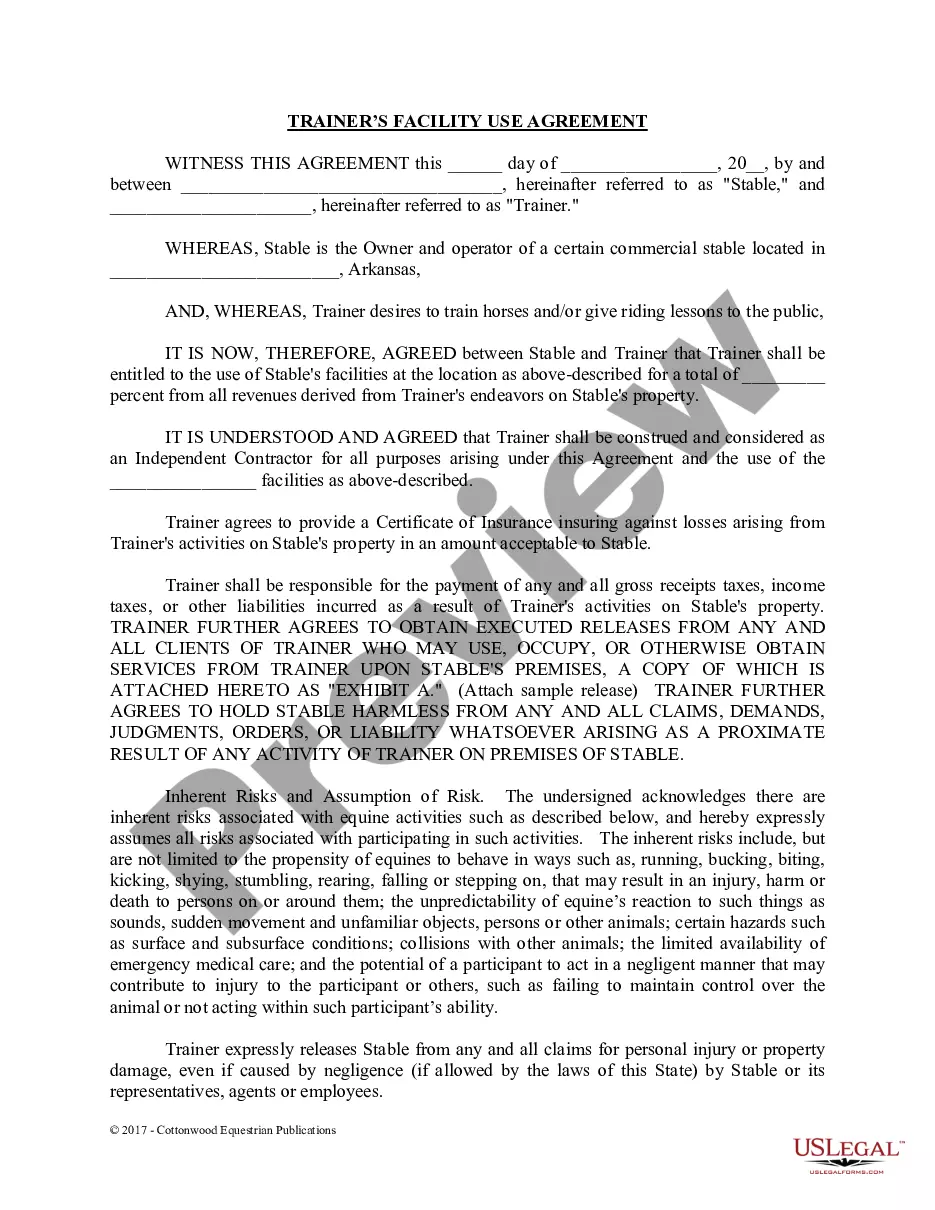
The Trainer's Facility Use Agreement, also known as a horse facility use agreement, is a legal document that outlines the terms under which a trainer can use a stable's facilities to train horses or conduct riding lessons. This agreement distinctly defines the responsibilities of both the trainer and the stable owner regarding revenue sharing, liability, and risk management associated with equine activities. It serves to protect both parties while facilitating the trainer's work within the stable environment.
Key parts of this document
- The date and effective term of the agreement.
- The names and roles of the parties involved: the Stable owner and the Trainer.
- The percentage of revenue that the Trainer agrees to pay to the Stable in exchange for facility use.
- The requirement for the Trainer to provide a Certificate of Insurance.
- Clauses regarding the release of liability for the Stable from injuries related to equine activities.
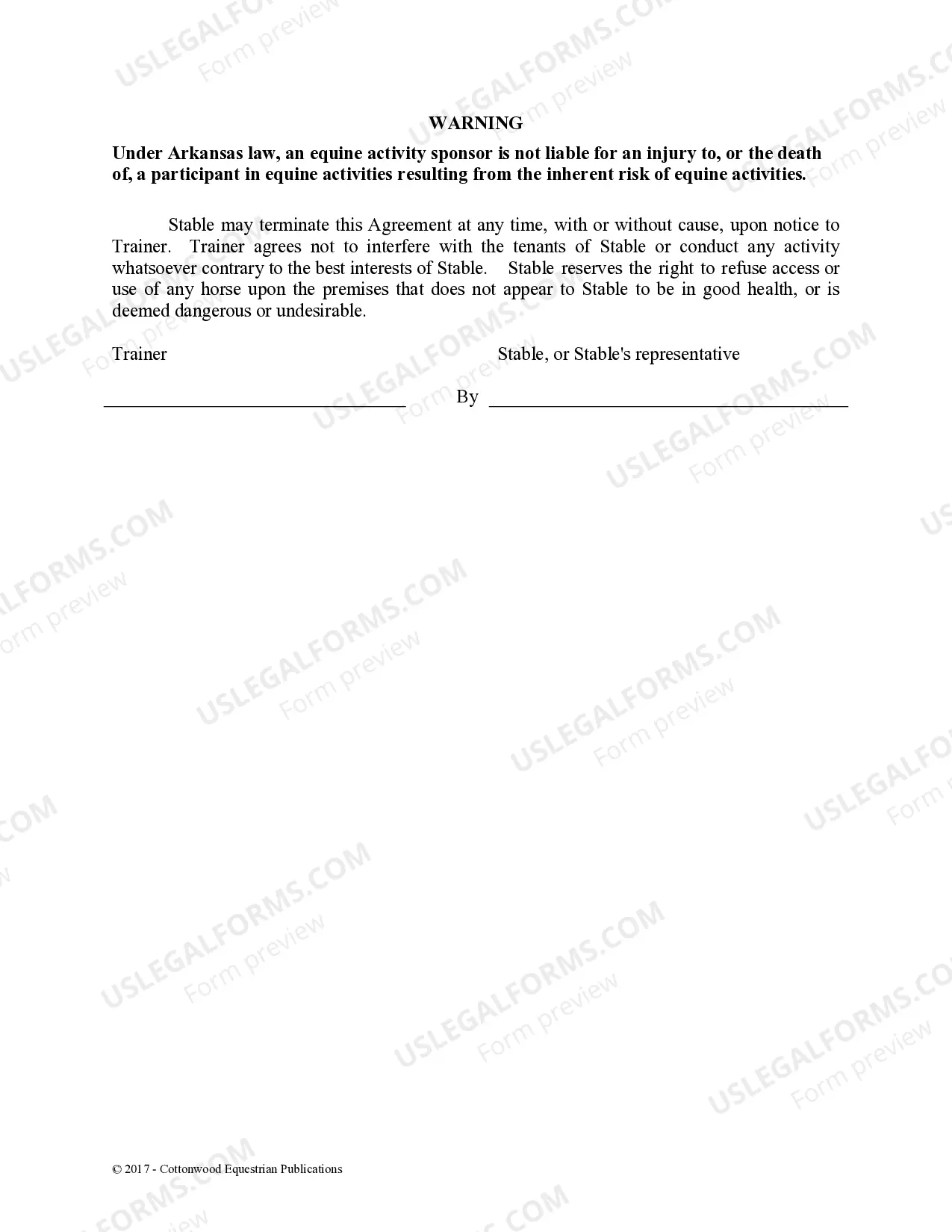
- Conditions under which the Stable may terminate the agreement.
Common use cases
This Trainer's Facility Use Agreement should be used when a horse trainer intends to utilize a stable's facilities for training horses or offering riding lessons. It is crucial when the trainer is generating revenue from these services and needs to formalize the relationship with the stable owner, ensuring both parties understand their obligations and rights. This form is particularly beneficial in commercial settings where liability and revenue sharing are significant concerns.
Who this form is for
This form is intended for:
- Horse trainers who provide training or riding lessons to clients.
- Stable owners who wish to formalize agreements with trainers.
- Equine businesses seeking clarity on revenue sharing and liability management.
Steps to complete this form
- Identify the parties: Enter the names of both the Stable owner and the Trainer.
- Specify the date of the agreement and the percentage of revenue to be shared.
- Provide the location of the stable where the training will occur.
- Attach a Certificate of Insurance from the Trainer.
- Include any necessary releases from clients as referenced in Exhibit A.
- Both parties should sign and date the agreement to finalize it.
Does this document require notarization?
This form usually doesn’t need to be notarized. However, local laws or specific transactions may require it. Our online notarization service, powered by Notarize, lets you complete it remotely through a secure video session, available 24/7.
Get your form ready online
Our built-in tools help you complete, sign, share, and store your documents in one place.
Make edits, fill in missing information, and update formatting in US Legal Forms—just like you would in MS Word.
Download a copy, print it, send it by email, or mail it via USPS—whatever works best for your next step.
Sign and collect signatures with our SignNow integration. Send to multiple recipients, set reminders, and more. Go Premium to unlock E-Sign.
If this form requires notarization, complete it online through a secure video call—no need to meet a notary in person or wait for an appointment.
We protect your documents and personal data by following strict security and privacy standards.

Make edits, fill in missing information, and update formatting in US Legal Forms—just like you would in MS Word.

Download a copy, print it, send it by email, or mail it via USPS—whatever works best for your next step.

Sign and collect signatures with our SignNow integration. Send to multiple recipients, set reminders, and more. Go Premium to unlock E-Sign.

If this form requires notarization, complete it online through a secure video call—no need to meet a notary in person or wait for an appointment.

We protect your documents and personal data by following strict security and privacy standards.
Mistakes to watch out for
- Failing to complete all fields, especially names and percentages.
- Neglecting to attach the Certificate of Insurance.
- Not obtaining necessary client releases as indicated in the agreement.
- Use of unclear or ambiguous language that may lead to misunderstandings.
Why complete this form online
- Ease of access: Download and complete the form at your convenience.
- Editable format: Customize the agreement to meet specific needs.
- Security: Store and retrieve your documents easily and securely.
- Legal compliance: Forms are created by licensed attorneys, ensuring adherence to legal standards.
Looking for another form?

Form popularity
FAQ
Generally, with excellent management, one horse can be kept on as little as 0.4 hectares (one acre). Life will be a lot easier at one horse on 0.8 hectares (two acres). If running horses together, an owner would be doing exceptionally well to maintain a ratio of one horse per 0.4 hectares (one acre).
If you are attempting to figure the carrying capacity of land for a horse, then a good rule of thumb is 1-1/2 to 2 acres of open intensely managed land per horse. Two acres, if managed properly, should provide adequate forage in the form of pasture and/or hay ground.
It is very common for 10+ horses to be kept on 5 acres because the soil is sandy and the grass provides little more than entertainment value.
Ten horses per acre on five to ten acres up to 100 horses; Ten horses per acre on more than ten acres or more than 100 horses.
Glue. Violin Bows. Paintbrushes. Jello. Fabrics. Fishing Line. Jewelry. Meat.
Other equines aren't the only possible companions for horses, although donkeys, minis, and ponies are quite common. You can find horses being comforted by all sorts of species, including dogs, cats, cows, sheep, goats, and camelids, like alpacas and llamas.