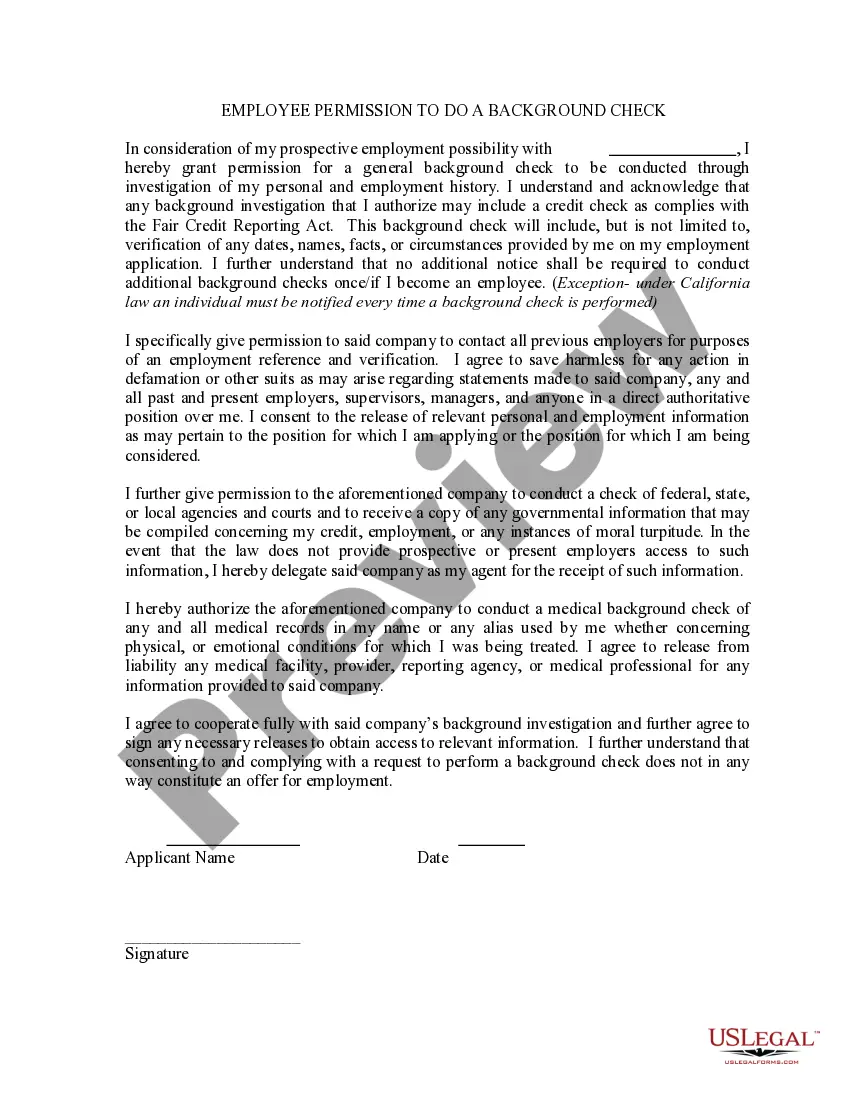
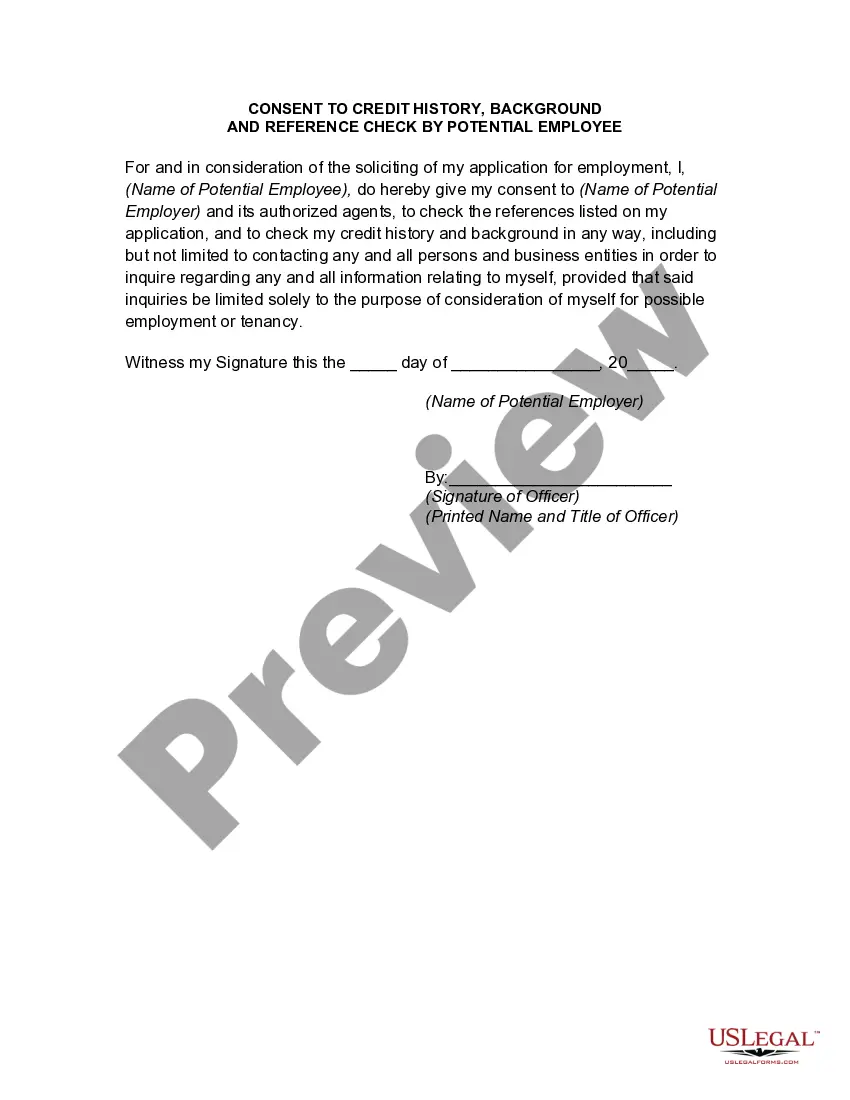
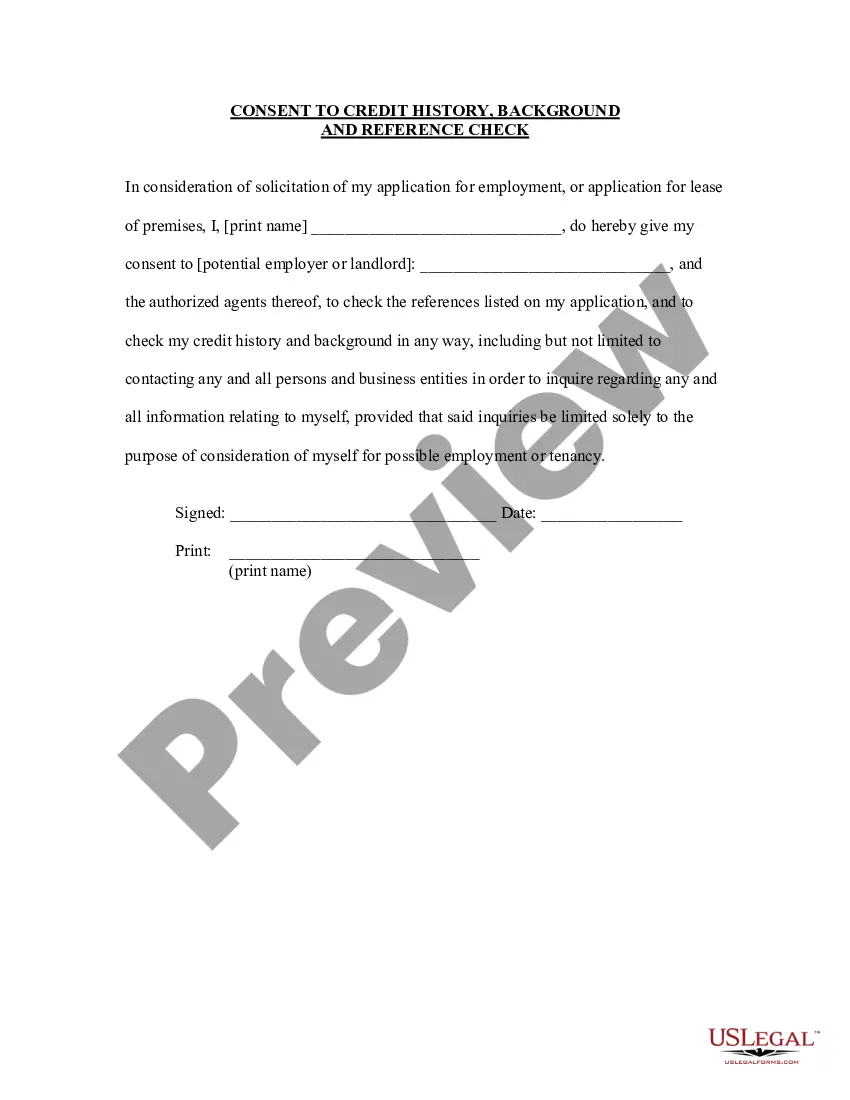
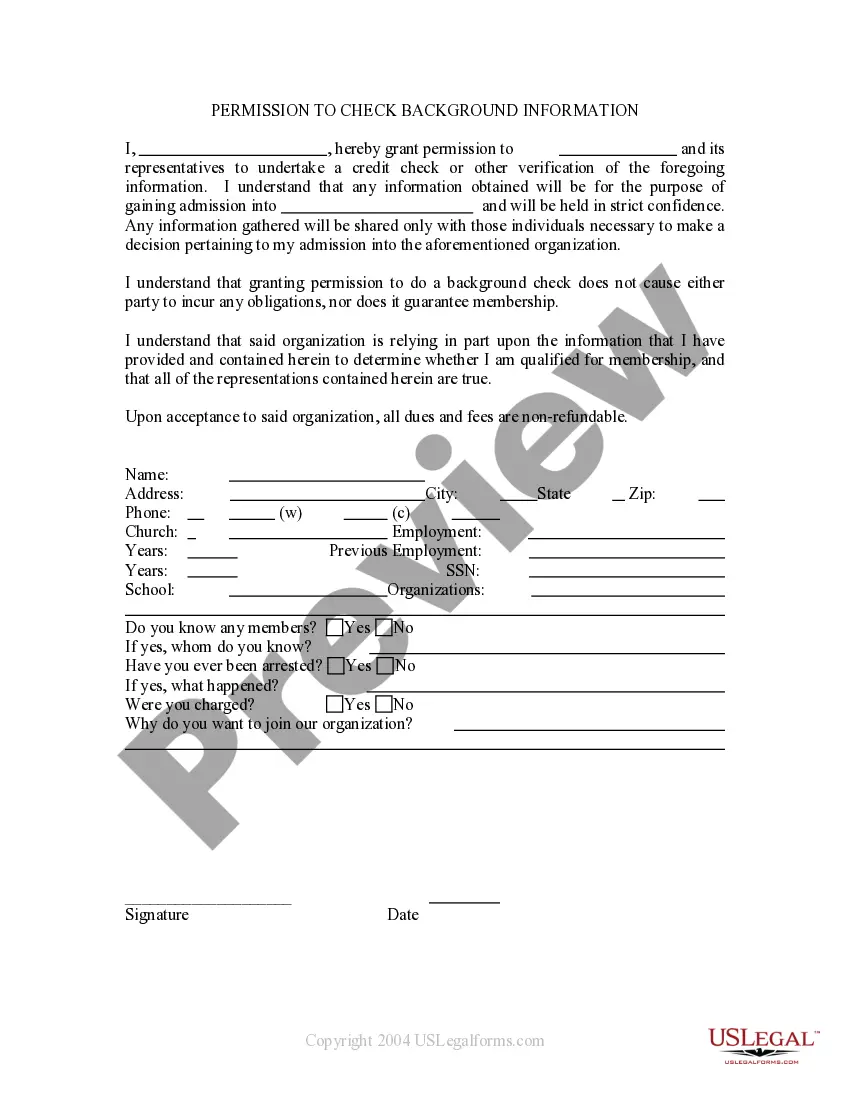
This is a form signed by an employee or prospective employee granting an employer permission to do a background check.
Alabama Employee Permission to Do a Background Check
State:
Multi-State
Control #:
US-PRM-10
Format:
Word;
Rich Text
Instant download
Description

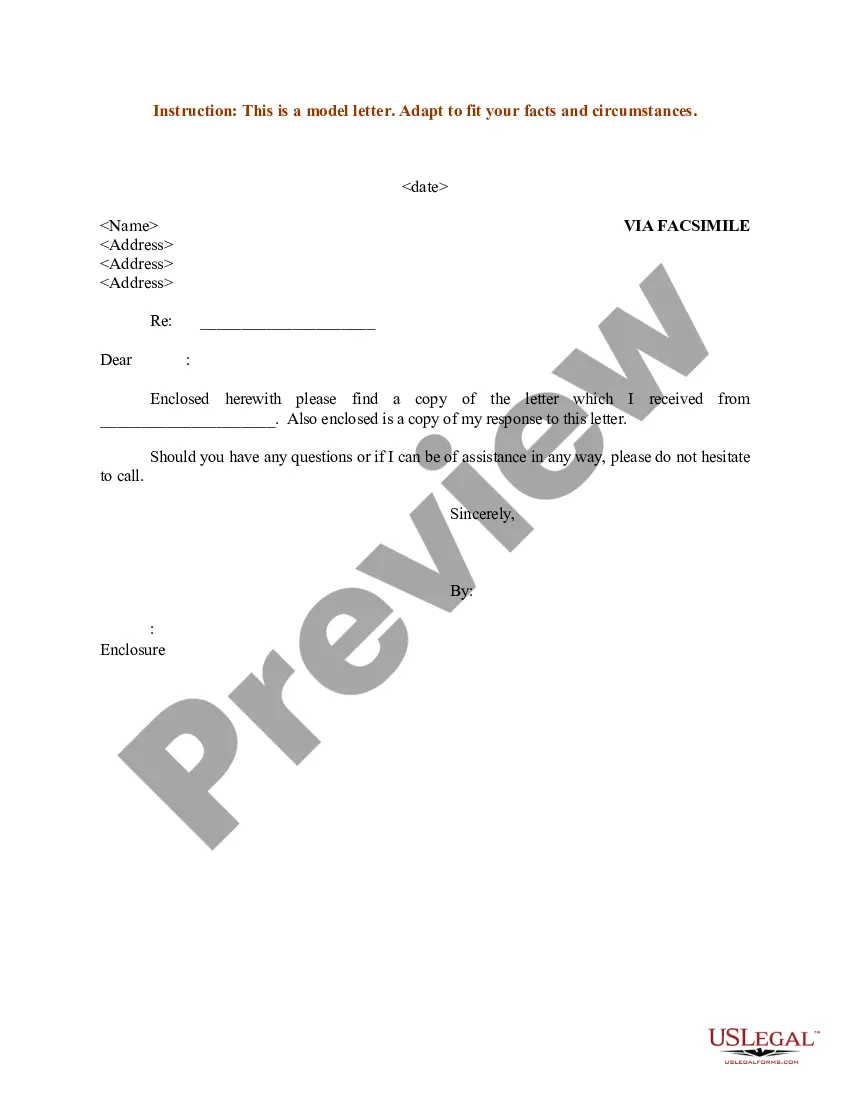
How to fill out Employee Permission To Do A Background Check?
US Legal Forms - one of the largest collections of legal documents in the United States - offers a broad selection of legal document templates that you can download or print.
By using the website, you can find thousands of forms for both business and personal use, organized by categories, states, or keywords. You can quickly access the latest versions of forms such as the Alabama Employee Authorization for Background Check.
If you already have an account, Log In and download the Alabama Employee Authorization for Background Check from the US Legal Forms library. The Download button will be visible on every form you view. You can access all previously downloaded forms in the My documents section of your profile.
Access the Alabama Employee Authorization for Background Check through US Legal Forms, the most extensive collection of legal document templates. Utilize thousands of professional and state-specific templates that cater to your business or personal needs and requirements.
- If you are using US Legal Forms for the first time, here are simple instructions to get you started:
- Make sure you have chosen the correct form for your city/state.
- Click on the Preview button to review the form's details.
- Read the form description to ensure you have chosen the right document.
- If the form does not meet your needs, use the Search box at the top of the page to find the one that does.
- If you are satisfied with the form, confirm your choice by clicking the Get now button. Then, select the payment plan you prefer and provide your details to create an account.
- Complete the transaction. Use your Visa, Mastercard, or PayPal account to finalize the payment.
- Choose the format and download the form to your device.
- Make modifications. Fill out, edit, and print or sign the downloaded Alabama Employee Authorization for Background Check.
- Each template you added to your account does not expire and is yours indefinitely. Therefore, if you need to download or print another copy, just go to the My documents section and click on the form you require.
Form popularity
FAQ
To conduct a background check in Alabama, first, obtain written permission from the employee, as required by law. Next, gather the necessary information, such as the employee's name, Social Security number, and date of birth. You can then use various resources, including state and national databases, to perform the check. Platforms like USLegalForms streamline this process by providing access to forms and guides tailored specifically for Alabama background checks.
To write a consent letter for a background check, start by clearly stating the purpose of the letter. Include information about what the background check will entail and the employee's rights. Make sure to provide a section for the employee to sign, confirming their permission. USLegalForms offers templates that simplify this process, ensuring that your consent letters meet legal requirements in Alabama.
A background authorization form is a document that allows an employer to conduct a background check on a prospective or current employee. It outlines the scope of the check and requires the employee's signature to confirm their permission. This form is crucial in ensuring compliance with laws regarding employee privacy. You can easily obtain a customizable background authorization form through USLegalForms.
Yes, under Alabama law, you must obtain employee consent to run a background check. This means that you need to inform the employee about the background check and get their permission before proceeding. Not only is this a legal requirement, but it also builds trust between you and your employees. Using a reliable platform like USLegalForms can help you create the necessary consent forms efficiently.
Filling out a background check form requires careful attention to detail. Begin by providing your personal information, including your name, address, and social security number. Next, indicate your consent for the Alabama Employee Permission to Do a Background Check by signing the form, ensuring you understand the process involved. If you need assistance, US Legal Forms offers user-friendly templates that guide you through each step, making the process easier and more efficient.
Yes, under Alabama law, a company must obtain your consent before conducting a background check. This requirement ensures that you are aware of the process and can make an informed decision. The Alabama Employee Permission to Do a Background Check is a crucial step for employers to maintain transparency and build trust with their employees. By using platforms like US Legal Forms, companies can easily access the necessary forms and streamline the consent process.
When do employers conduct background checks? Employers often perform background checks before extending job offers. A brief period in between a background check and a job offer is common because the results of a background check can result in an employer choosing to hire a different applicant.
Federal law does not prohibit employers from conducting background checks before an offer of employment is made. State laws, however, may have restrictions. Although in most states a standard background check can be conducted prior to an offer, a small number of states do not allow it.
MONTGOMERY, Ala. -- Alabama will become the latest state to allow people to carry concealed handguns without first undergoing a background check and getting a state permit. Alabama Gov. Kay Ivey signed the measure into law Thursday shortly after it was approved by state lawmakers.
You must first notify them of your intent to run a background check and get their permission in writing. If you consider not hiring the candidate, you must allow them to review their background check results. They can file a dispute with the background check company to resolve any inaccuracies.