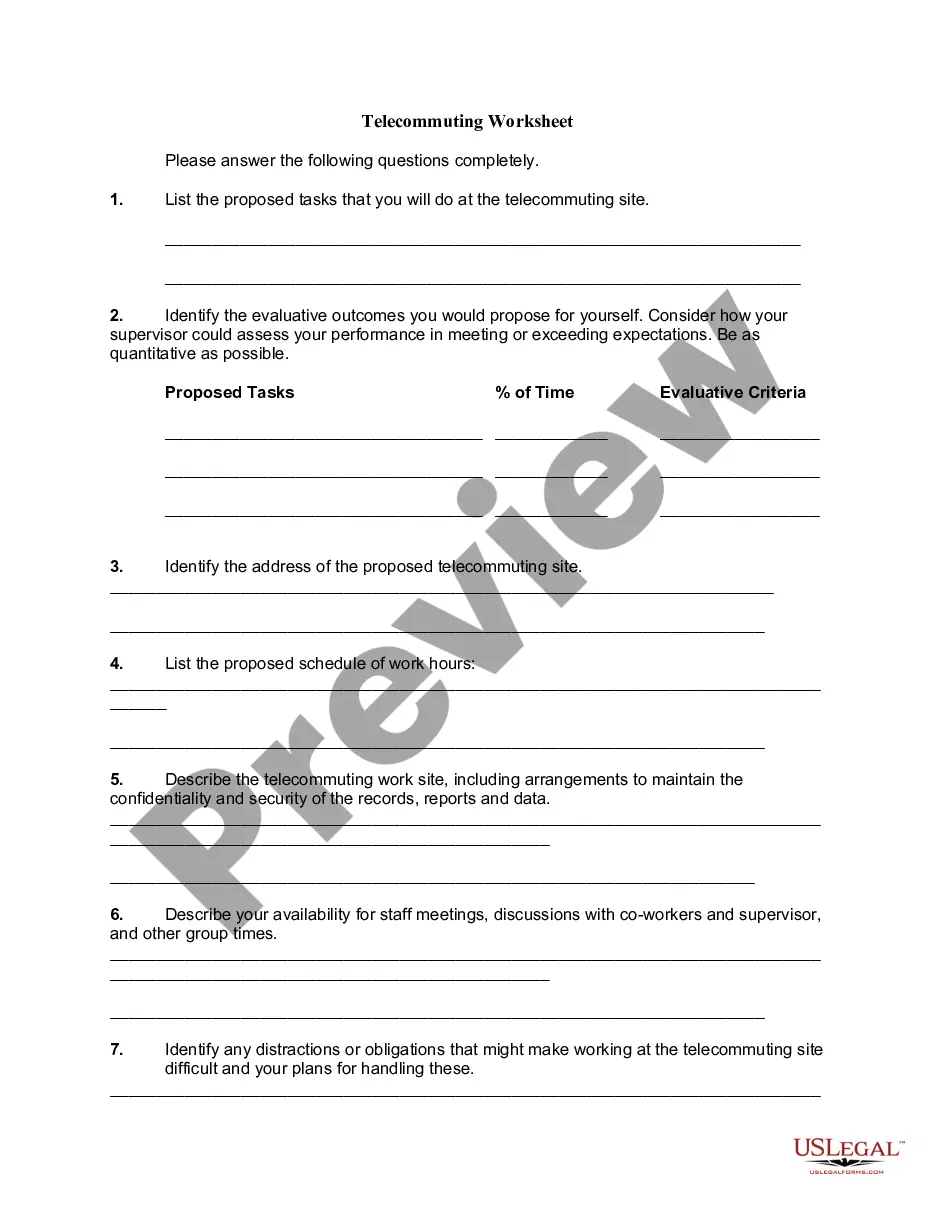
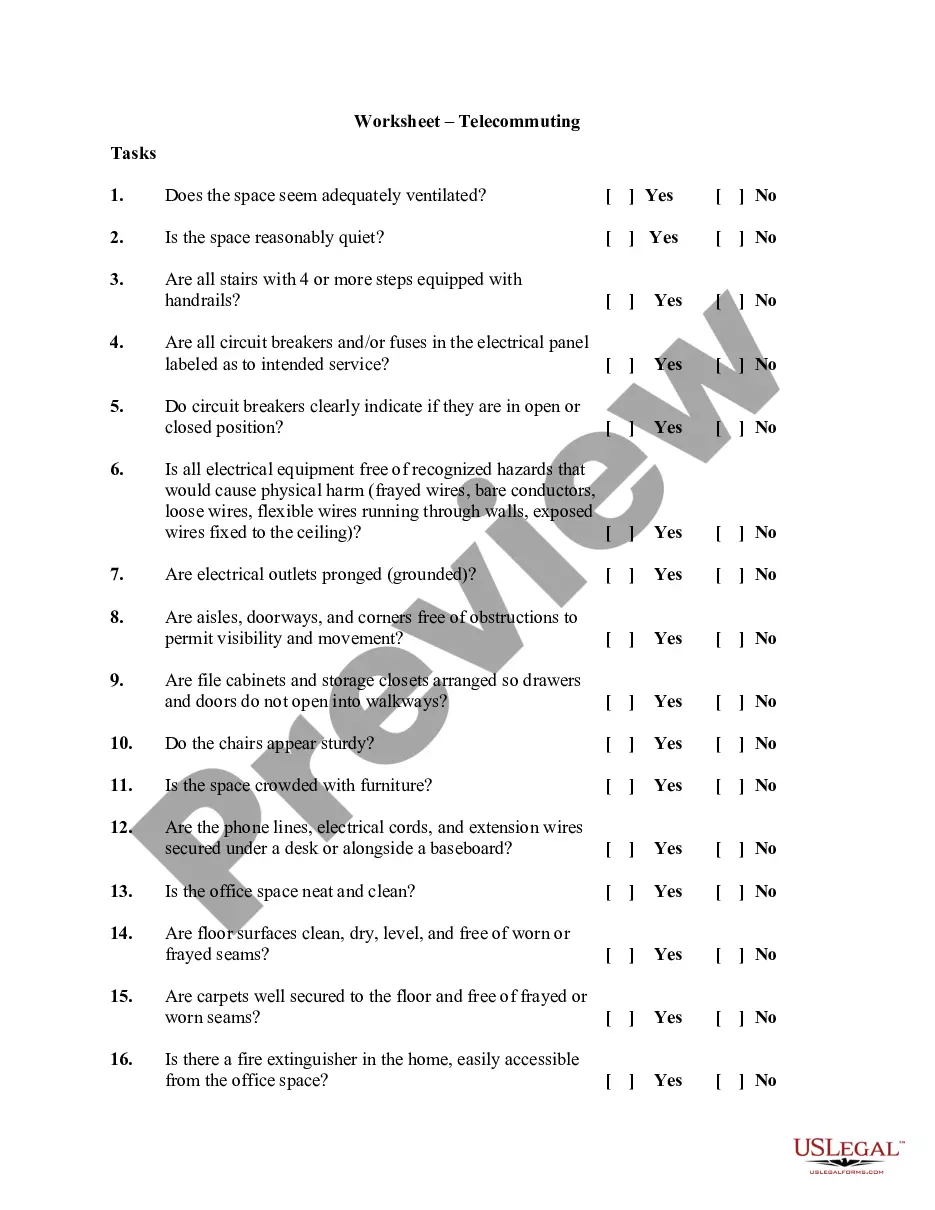
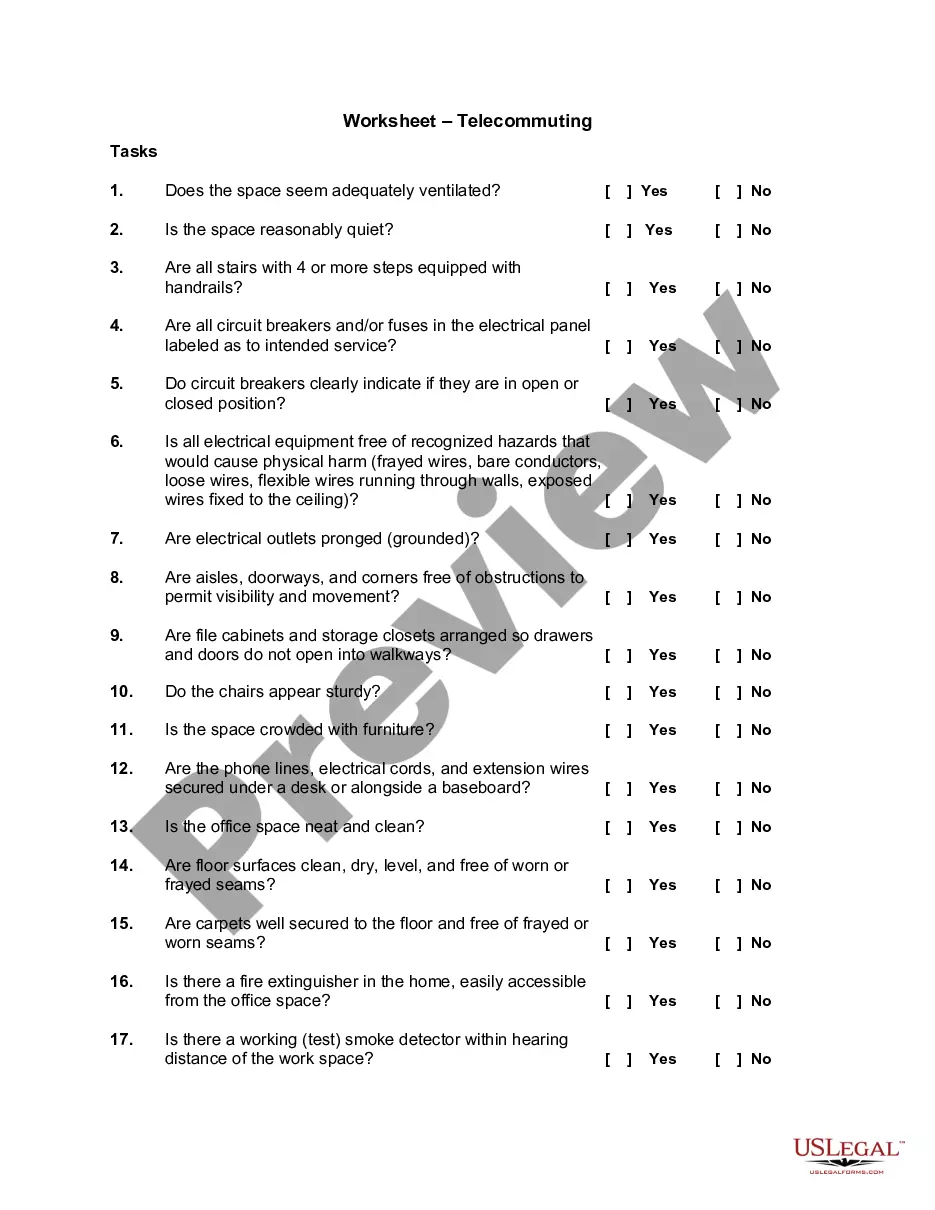
Alabama Worksheet - Telecommuting

State:
Multi-State
Control #:
US-04022BG
Format:
Word; 
Rich Text
Instant download

Description

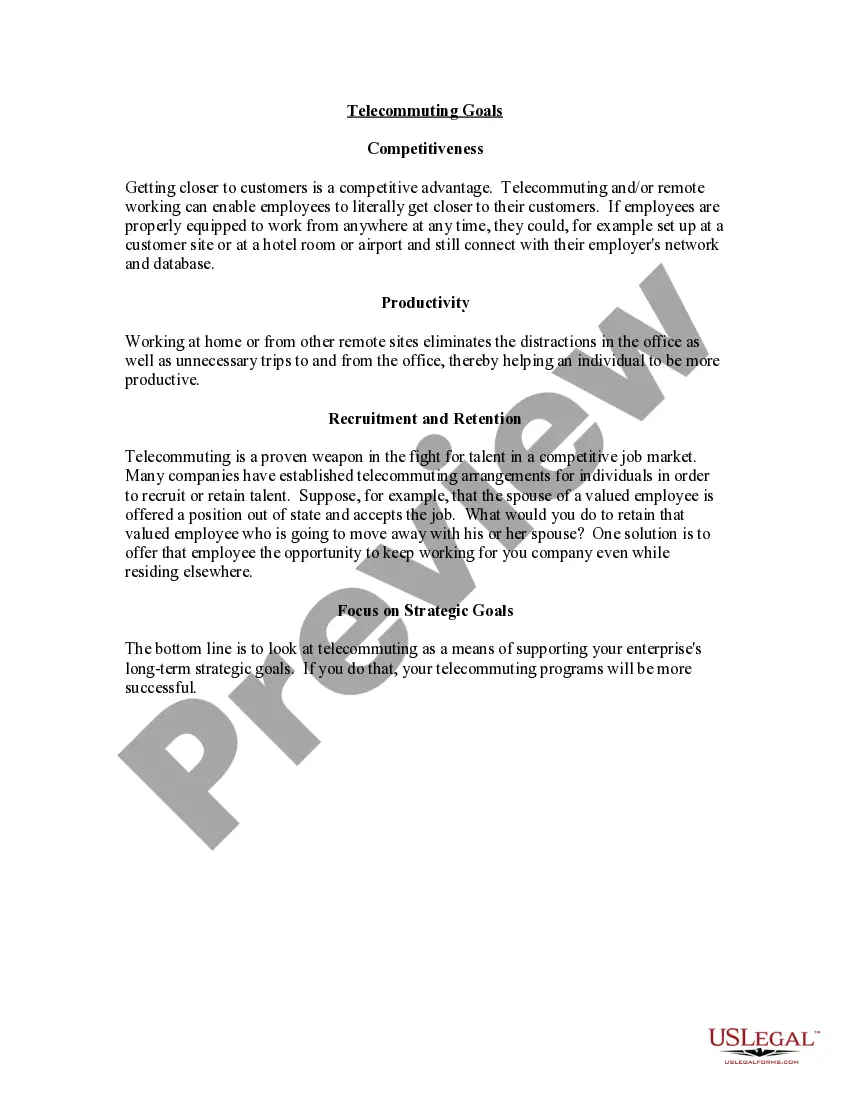
Telecommuting is a cooperative agreement between an employee and the State involving work that an employee performs on a routine basis, independent of others, and can be accomplished by the employee outside of the office environment. Anticipated benefits may include:


" Trip Reduction;

" Energy Conservation;

" Better Employee Morale;

" Increased Productivity; and

" Increased Employee Retention.


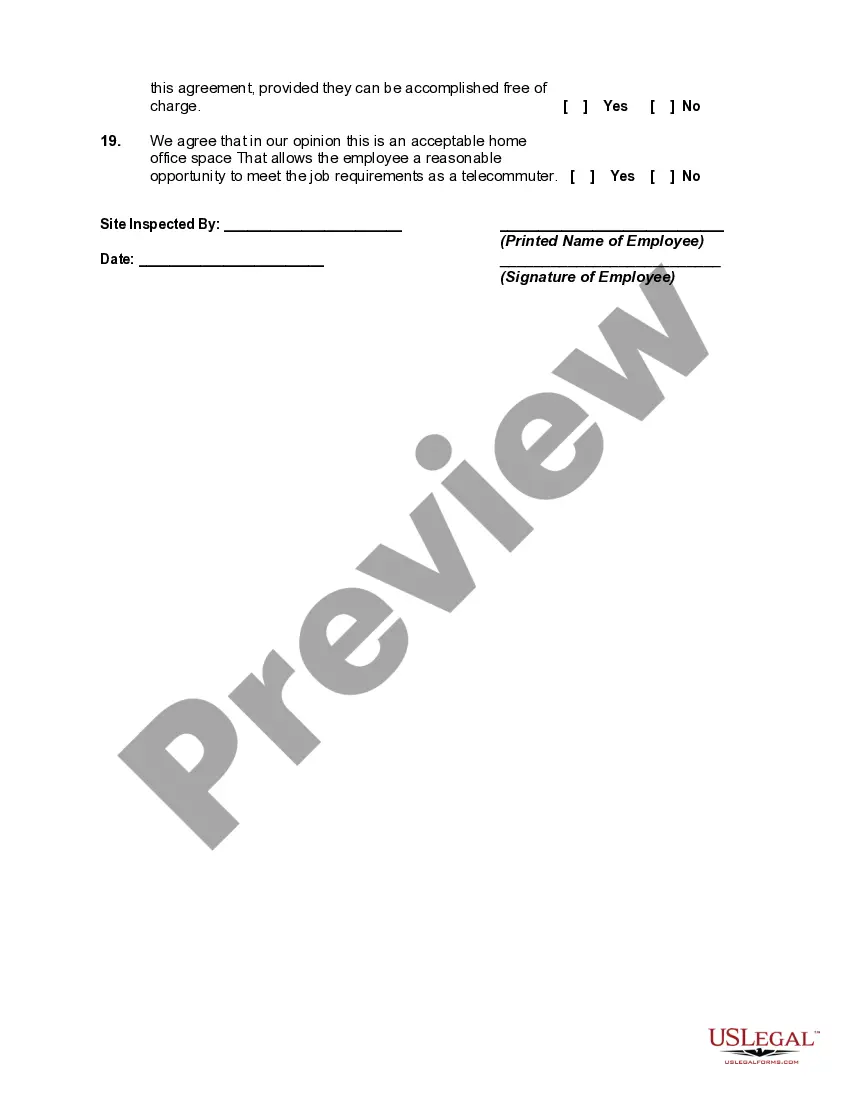
This worksheet should be completed before setting up your employees' office space. The success of the telecommuting arrangement depends on the assessment of the work space and the ability of the employees to successfully complete the required work in this environment.
Free preview
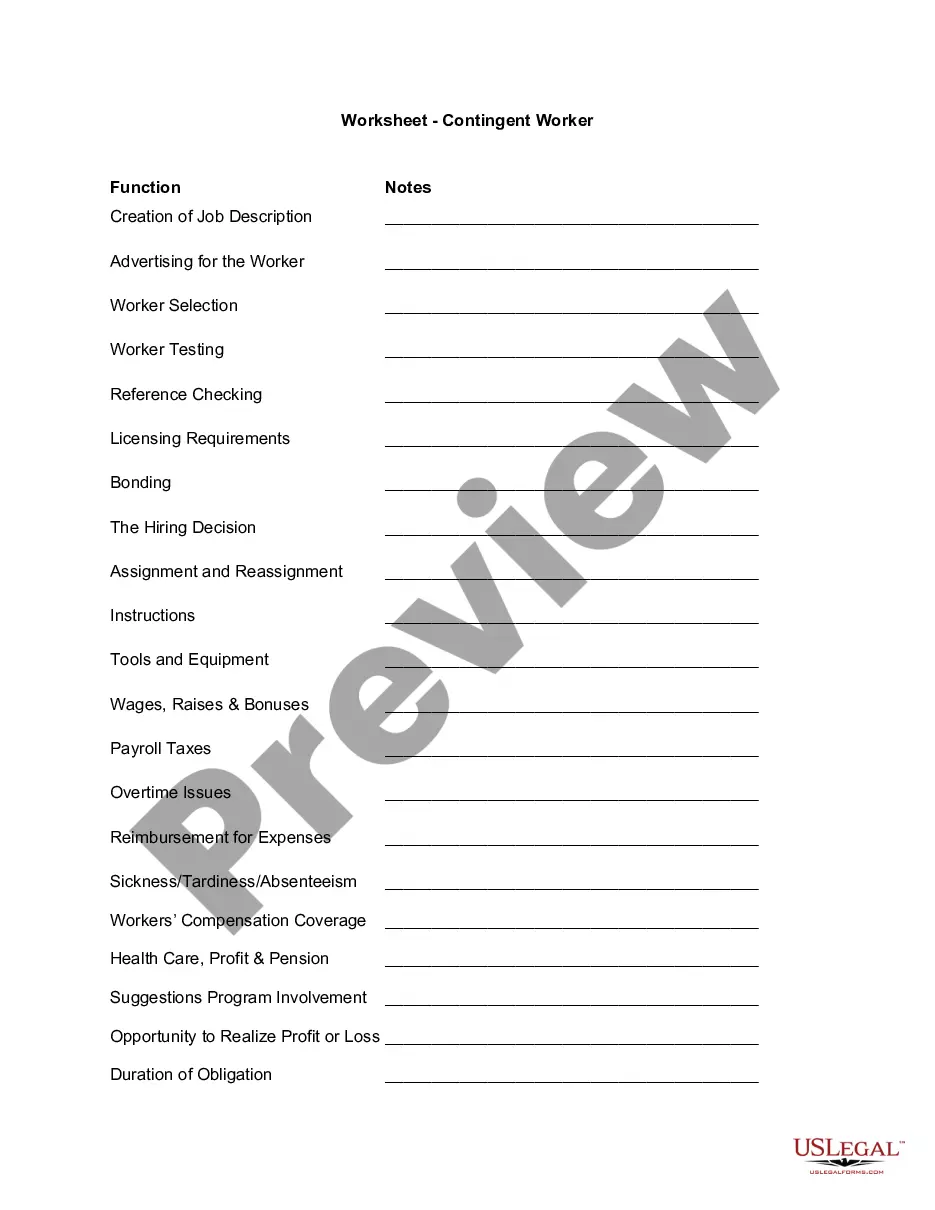
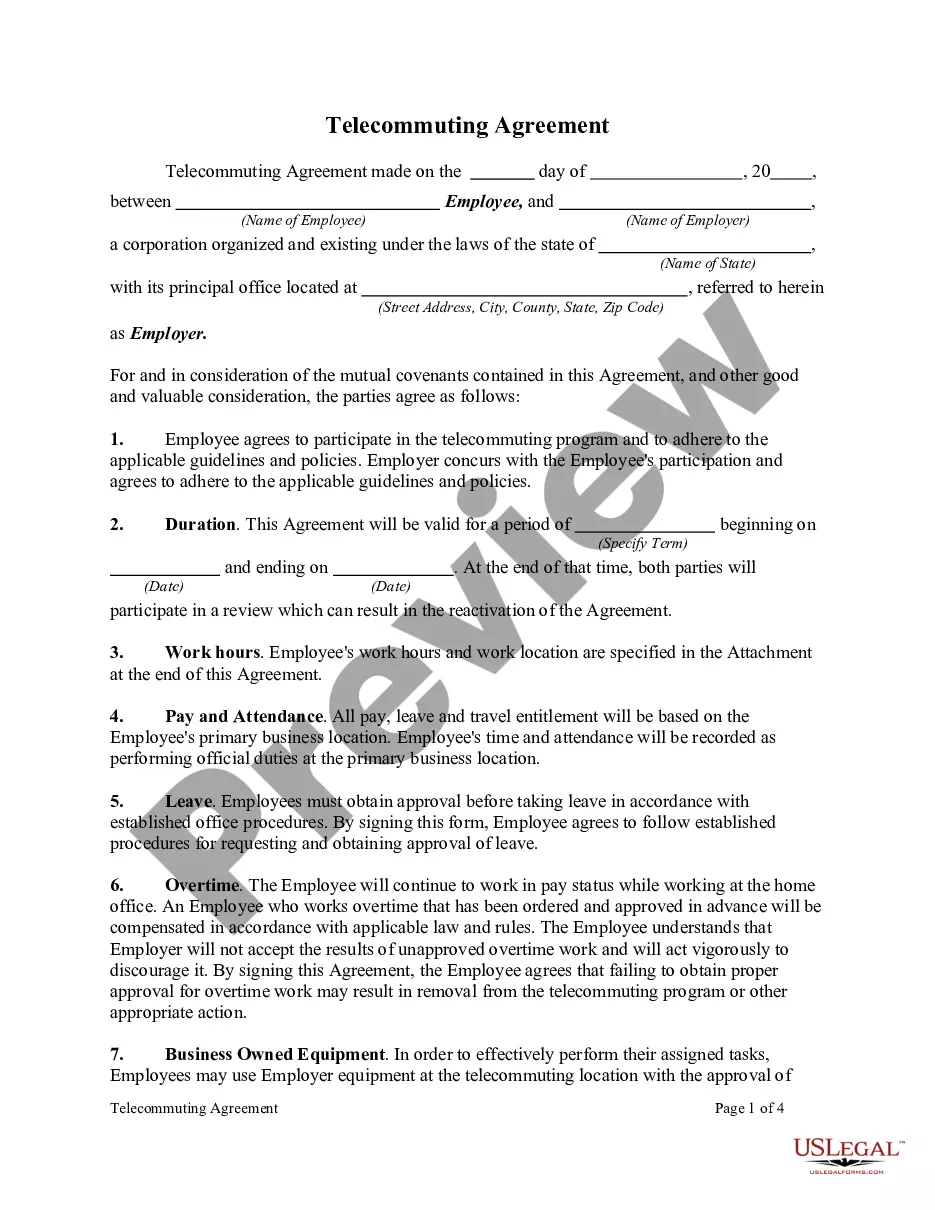
  • Preview Worksheet - Telecommuting
  • Preview Worksheet - Telecommuting

How to fill out Worksheet - Telecommuting?

Are you presently in a location where you need documentation for business or personal purposes almost all the time.

There are numerous legal document templates available online, but finding ones you can trust isn’t simple.

US Legal Forms offers thousands of template options, including the Alabama Worksheet - Telecommuting, which can be tailored to meet federal and state requirements.

Once you find the appropriate form, click Buy now.

Select the pricing plan you prefer, enter the required information to set up your account, and pay for the order using your PayPal or credit card.

  1. If you are already familiar with the US Legal Forms website and have an account, simply sign in.
  2. After that, you can download the Alabama Worksheet - Telecommuting template.
  3. If you do not have an account and wish to start using US Legal Forms, follow these steps.
  4. Obtain the form you need and make sure it is for the correct city/state.
  5. Utilize the Preview feature to review the form.
  6. Check the description to confirm you have selected the correct form.
  7. If the form isn’t what you are looking for, use the Search box to find the form that meets your needs.

Form popularity

FAQ

When you telecommute, you work outside of an organization's brick-and-mortar location, and you usually use technology to help you do your job and connect with your employer or employees. Many industriesincluding sales, publishing, customer service, and marketingoffer telecommuting jobs.

It should include:Days and hours the employee is expected to be working in the department.Hours the employee is expected to be working and reachable at the telecommuting site.Methods of contact (such as dedicated phone line, voice mail, email, videoconference, etc.)Times and frequency of contact (in both directions)More items...

An employee living in a different state would normally not create nexus for the employer, but as a remote worker, that employee attributes presence to the employer through their performance of their employment duties at home.

5 Key Characteristics of Successful TelecommutersFocus.Collaborative attitude.Adaptabilty.While you may have established a routine that works well for your day-to-day work, it's vital that those working from home are flexible.Trust.Self-starter.

The self-employed do not qualify as telecommuters because they lack employee status.

Though often away from the office, a teleworker is different from a remote employee because there occasionally some in-person office attendance required though this is not always the case. Another key difference is that a teleworker is often geographically closer to the main office location than a remote worker.

Telecommuting is the ability for an employee to complete work assignments from outside the traditional workplace by using telecommunications tools such as email, phone, chat and video apps.

For example, teleworking employees must be able to take telephone calls and participate in online video meetings with minimal distraction and while maintaining appropriate confidentiality.

Telecommuting is an employment arrangement in which the employee works outside of the employer's office. Often this means working from home or at a location close to home, such as a coffee shop, library, or co-working space.

If the above circumstances describe your worker/employer relationships, the IRS and the DOL would likely determine that your remote workers are still your employees. However, if you define your relationship via contract and you no longer treat your worker as an employee, he may no longer be an employee.

Trusted and secure by over 3 million people of the world’s leading companies

Alabama Worksheet - Telecommuting