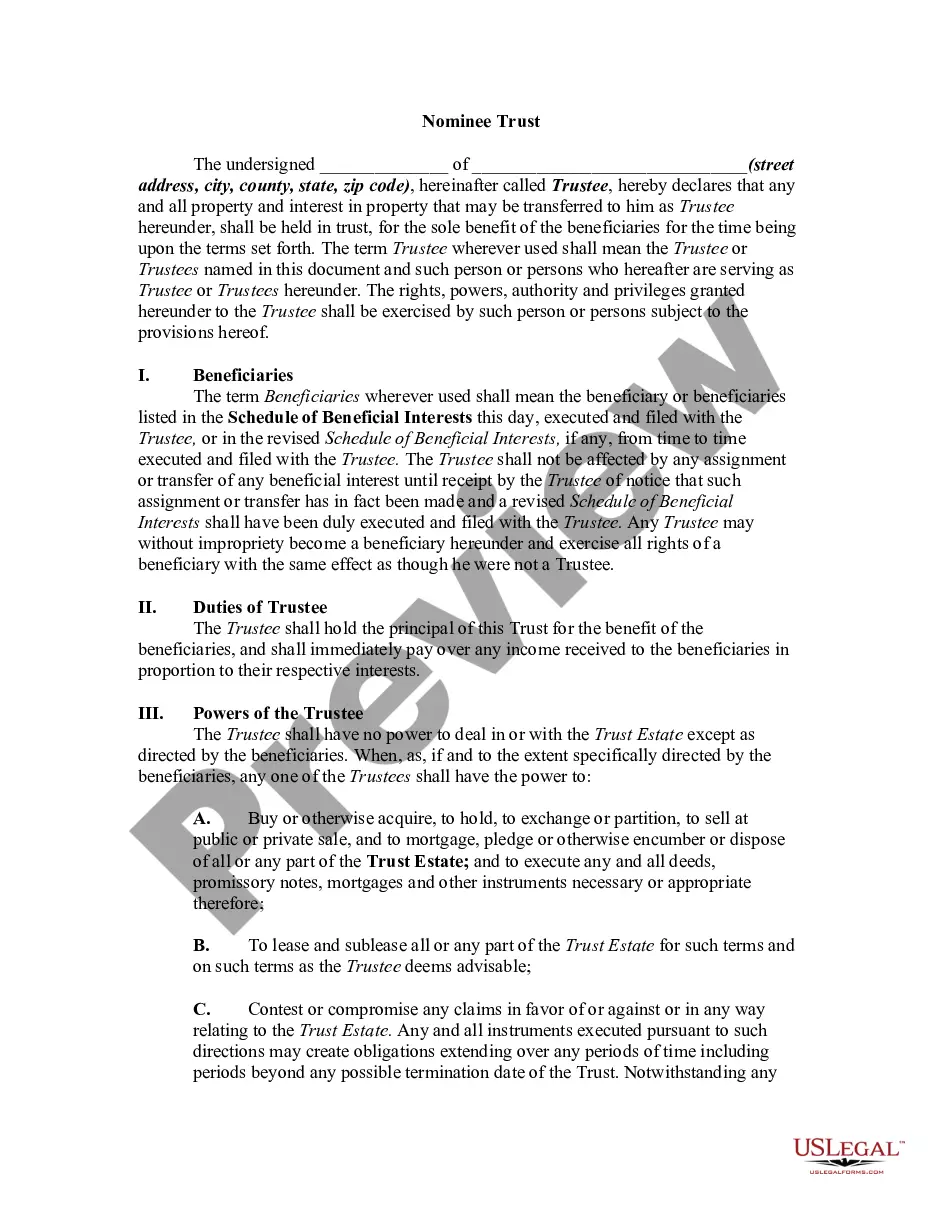
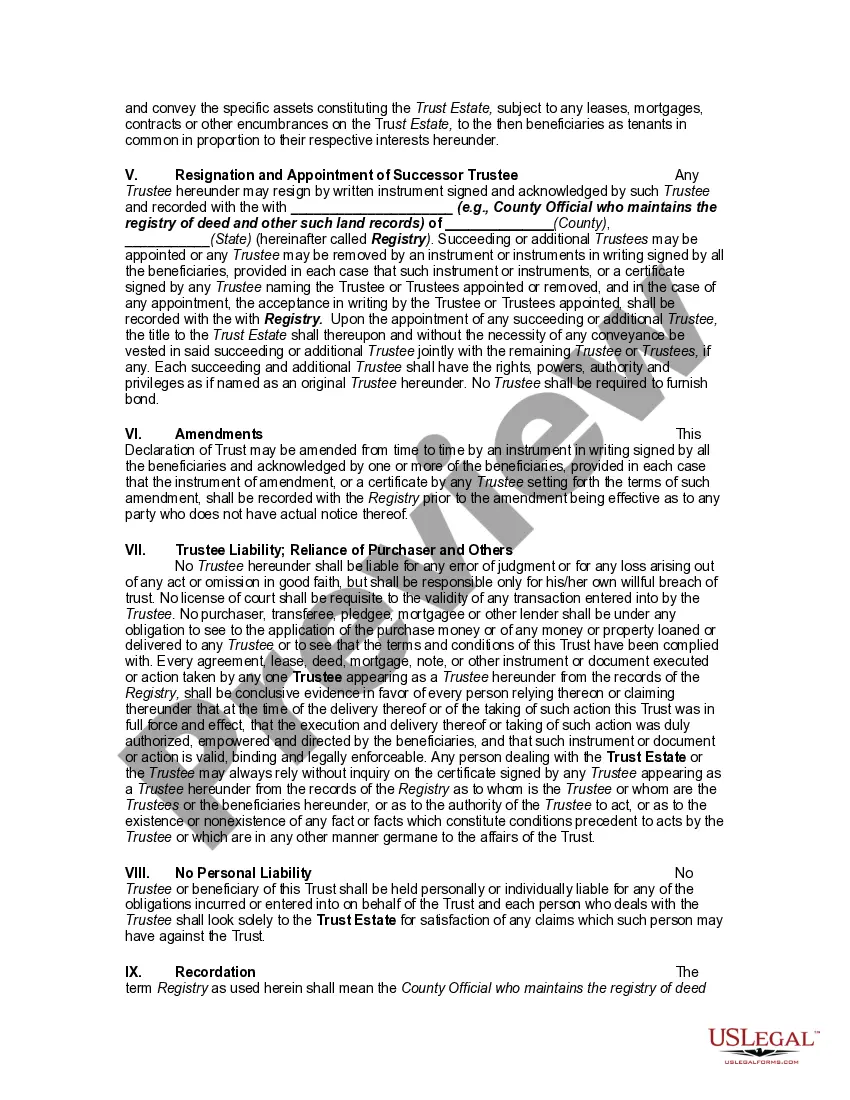
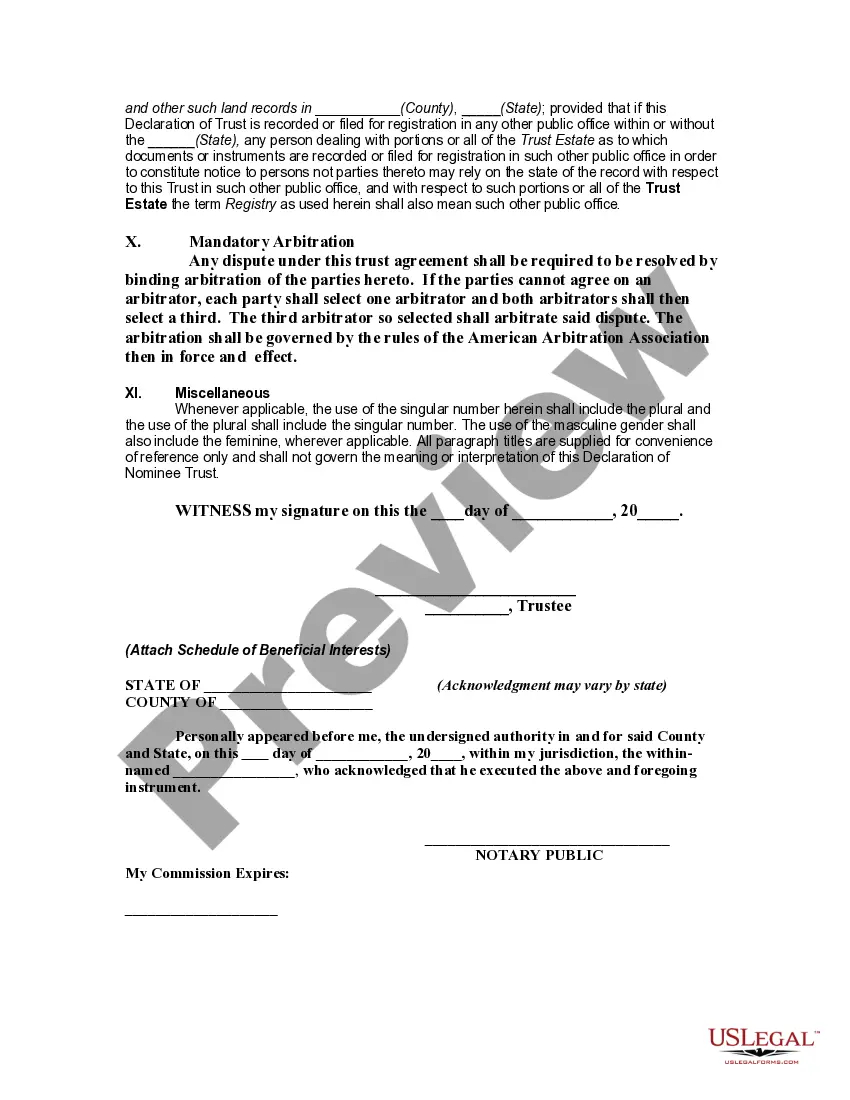
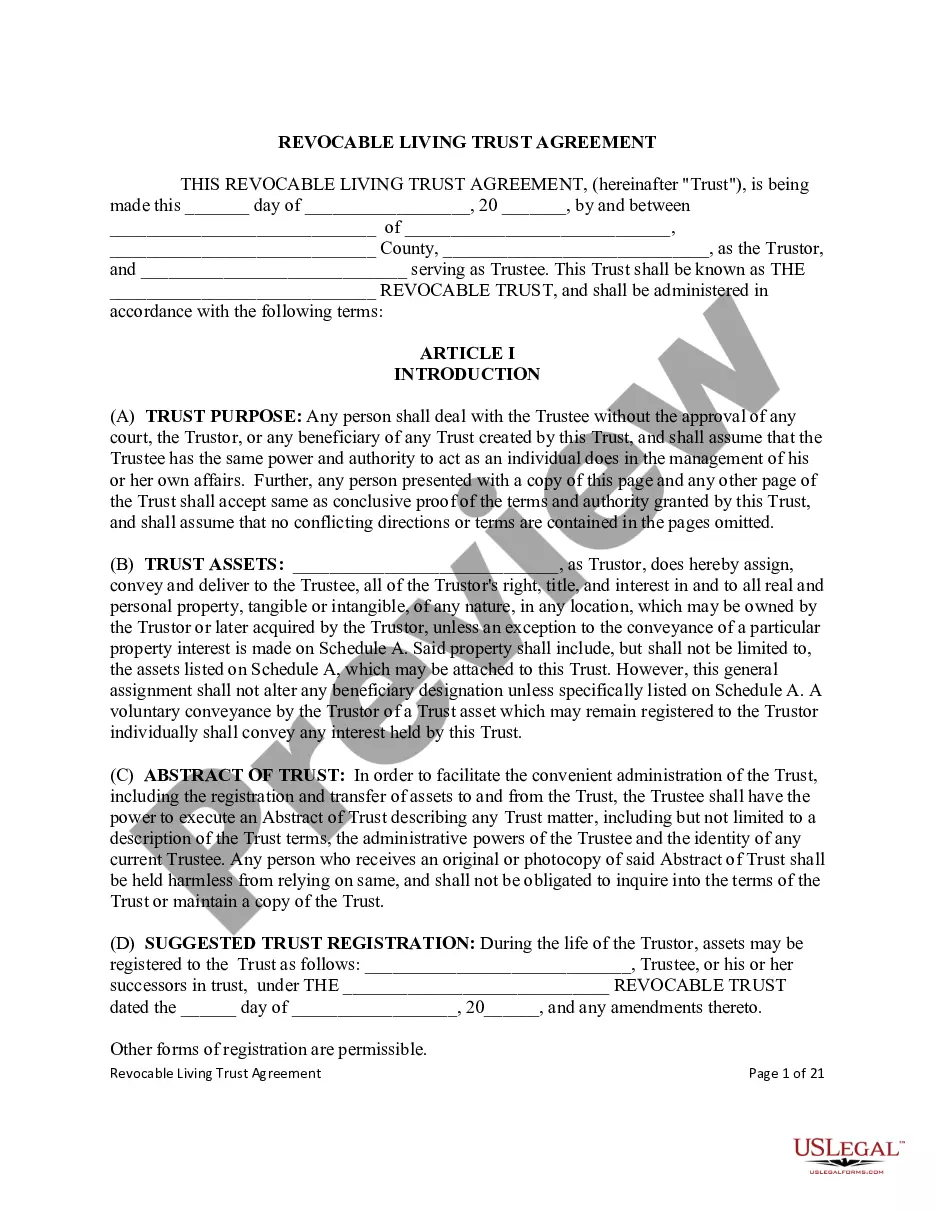
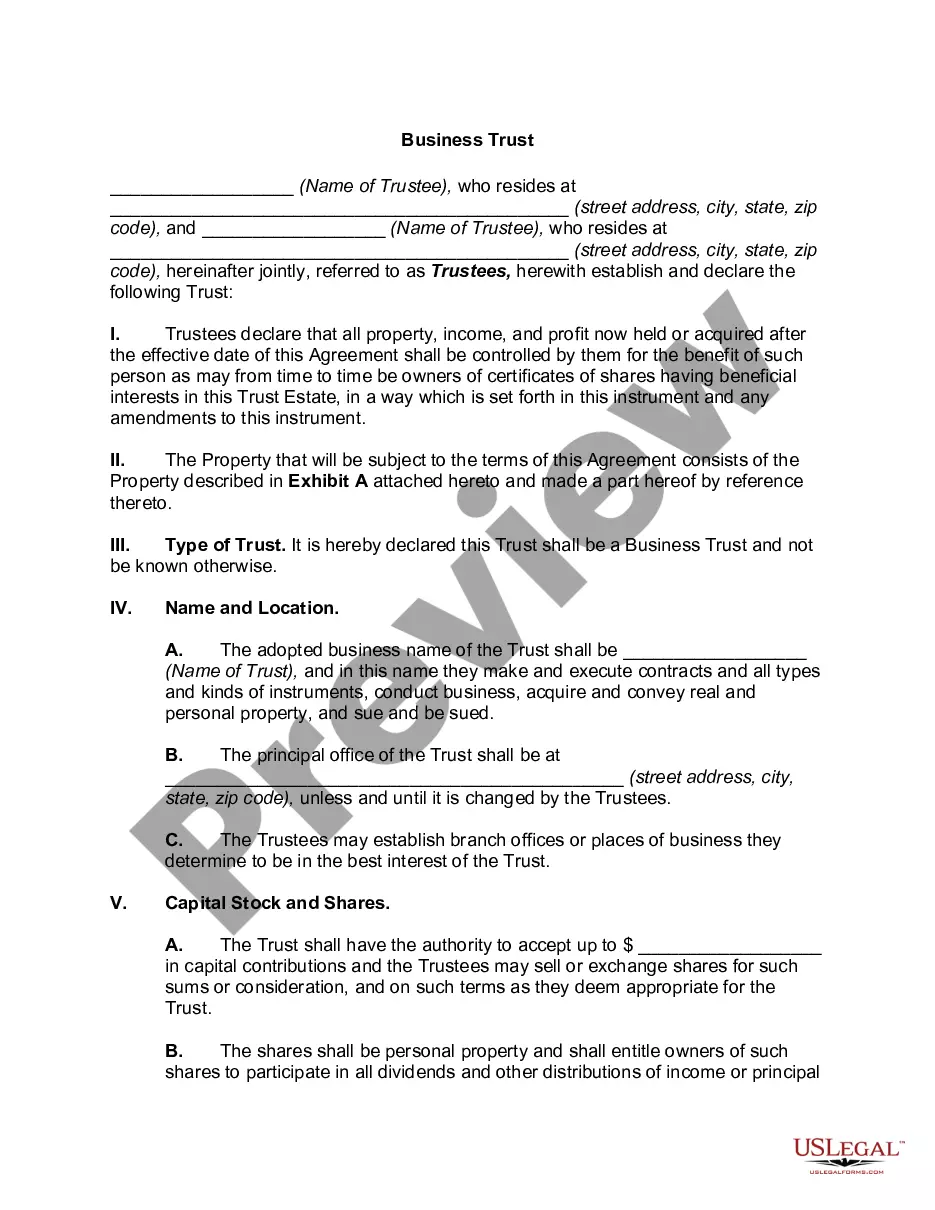
A nominee trust is a trust in which the trustee holds legal title to the trust property for the trust's beneficiaries, but the beneficiaries exercise the controlling powers, and the actions that the trustees may take on their own are very limited. Such trusts are a common device for holding title to real estate, and afford certain tax advantages. A nominee trust is not a trust in the strict classical sense, because of the trustee-beneficiary relationship. Despite a nominee trust's nontraditional relationship between trustee and beneficiary, such a trust must still adhere to the rule that no trust exists when the same individual is the sole settlor, sole trustee, and sole beneficiary. The trustees of a nominee trust act at the direction of the beneficiaries.
Alabama Nominee Trust
Description


Get your form ready online
Our built-in tools help you complete, sign, share, and store your documents in one place.
Make edits, fill in missing information, and update formatting in US Legal Forms—just like you would in MS Word.
Download a copy, print it, send it by email, or mail it via USPS—whatever works best for your next step.
Sign and collect signatures with our SignNow integration. Send to multiple recipients, set reminders, and more. Go Premium to unlock E-Sign.
If this form requires notarization, complete it online through a secure video call—no need to meet a notary in person or wait for an appointment.
We protect your documents and personal data by following strict security and privacy standards.

Make edits, fill in missing information, and update formatting in US Legal Forms—just like you would in MS Word.

Download a copy, print it, send it by email, or mail it via USPS—whatever works best for your next step.

Sign and collect signatures with our SignNow integration. Send to multiple recipients, set reminders, and more. Go Premium to unlock E-Sign.

If this form requires notarization, complete it online through a secure video call—no need to meet a notary in person or wait for an appointment.

We protect your documents and personal data by following strict security and privacy standards.
Looking for another form?





How to fill out Nominee Trust?
Selecting the appropriate legal document format can be a challenge. Naturally, there are numerous templates accessible online, but how do you locate the legal form you require? Utilize the US Legal Forms website. The service offers thousands of templates, such as the Alabama Nominee Trust, which you can employ for both business and personal purposes. All of the documents are reviewed by professionals and comply with state and federal regulations.
If you are already registered, Log In to your account and click the Download button to retrieve the Alabama Nominee Trust. Use your account to browse through the legal forms you have previously purchased. Visit the My documents section of your account and download another copy of the document you need.
If you are a new user of US Legal Forms, here are straightforward instructions you should adhere to: First, ensure you have chosen the right form for your area/region. You can review the form using the Preview button and read the form details to confirm it is suitable for you. If the form does not meet your needs, use the Search field to find the correct form. Once you are certain that the form is correct, click the Buy now button to obtain the form. Select the pricing plan you prefer and provide the necessary information. Create your account and pay for the order using your PayPal account or credit card. Choose the file format and download the legal document format to your device. Complete, edit, print, and sign the acquired Alabama Nominee Trust.
- US Legal Forms is the largest collection of legal documents where you can discover a variety of document templates.
- Utilize the service to obtain professionally crafted paperwork that adheres to state regulations.
Form popularity
FAQ
When trust beneficiaries receive distributions from the trust's principal balance, they don't have to pay taxes on this disbursement. The Internal Revenue Service (IRS) assumes this money was taxed before being placed into the trust. Gains on the trust are taxable as income to the beneficiary or the trust.
Limitations of Nominee Trusts It will do absolutely no good regarding MassHealth /Medicaid Planning, because it is not really a transfer in their eyes. Also, you cannot take a Homestead declaration on it, so creditors can attach it in a lawsuit, assuming liability.
A nominee trust is typically established to hold title to real estate and is disregarded for federal income tax purposes (i.e., a separate return, such as a 1041, is not required).
The securities are held in trust and the nominee is the legal owner, but you hold on to real ownership as the beneficiary. The broker can buy and sell on your behalf, but your funds are protected if the brokerage goes out of business or your broker tries to swindle you.
The trustee may have to file a return if the trust meets any of these: The trustee or beneficiary (non-contingent) is a California resident. The trust has income from a California source.
In a Nominee Trust the beneficiaries direct the trustee and may even serve as the trustee. Also, unlike an irrevocable trust, the beneficiaries of an NT may terminate the trust at any time and take full ownership of the trust property as tenants in common.
Bottom Line. Living trusts have to file tax returns in most cases if they have $600 or more in income for a given tax year. They may also have to file if the living trust is a grantor-controlled trust or a revocable marital trust and both spouses are still living. Trusts that file tax returns do so using Form 1041.
The nominee trust is not a trust - it is an agency arrangement in which the "trustees" are agents for undisclosed principals. A true trust is an arrangement under which a "grantor" or "donor" transfers property to a trustee to use for the benefit of one or more beneficiaries.