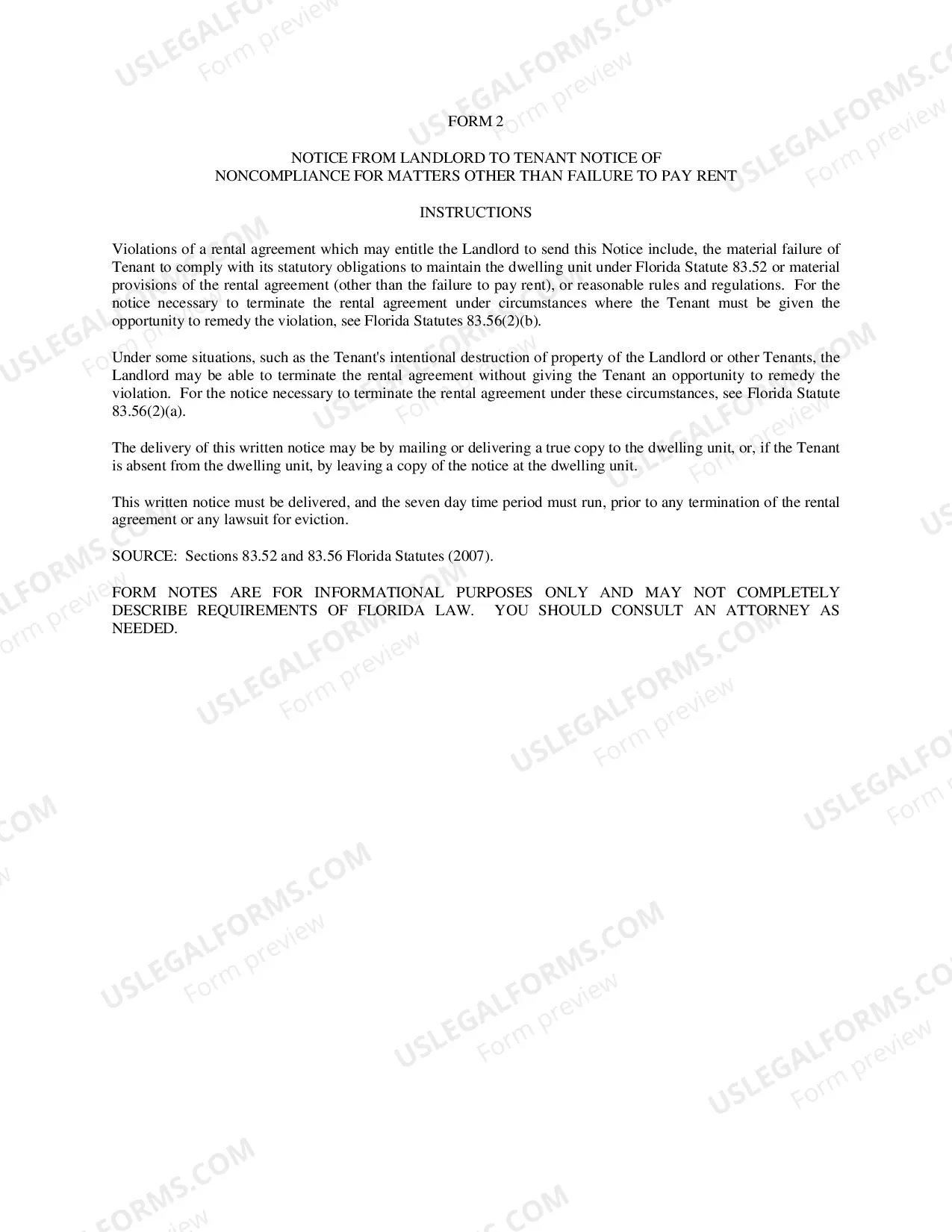
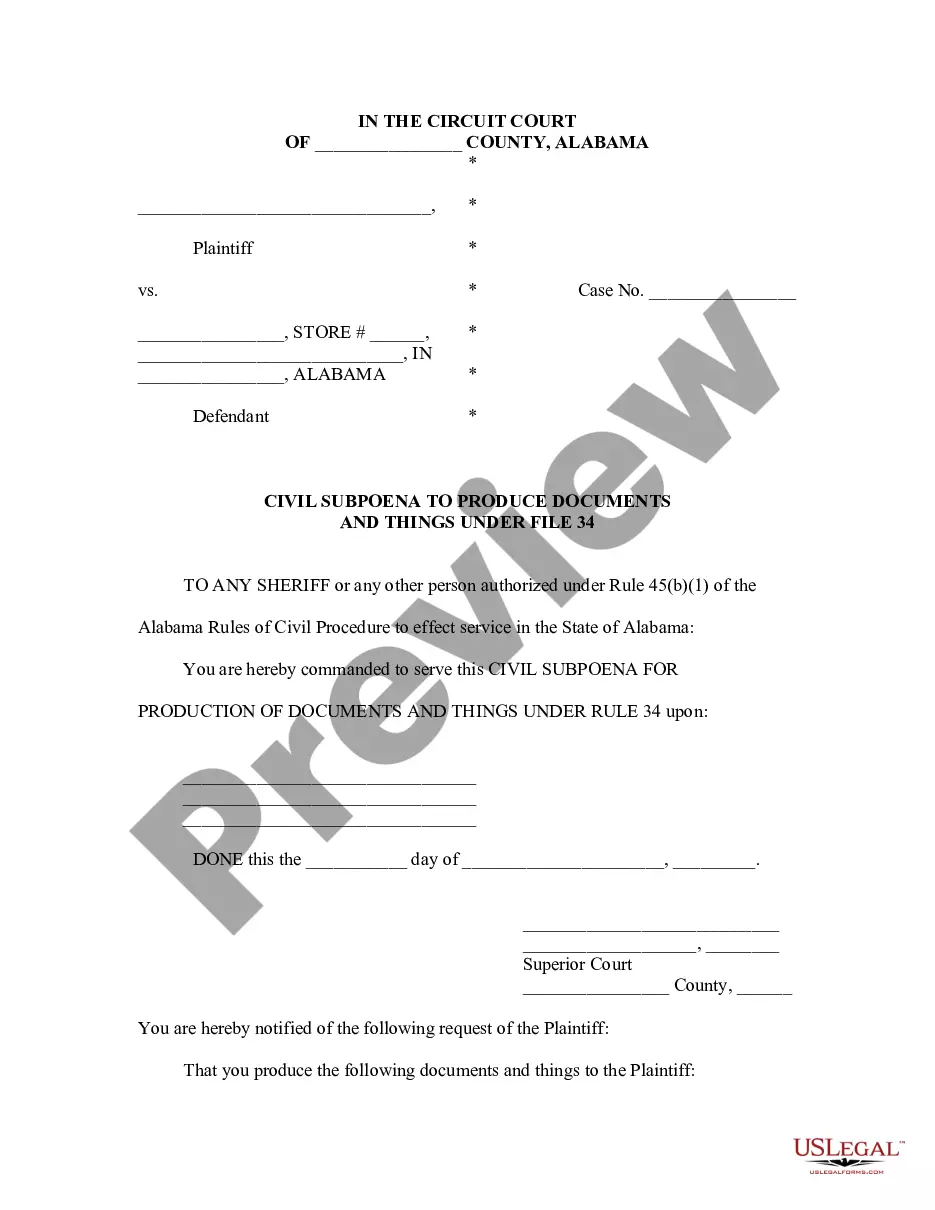
Alabama Civil Subpoena to Produce Documents and Things Under Rule 34
What this document covers
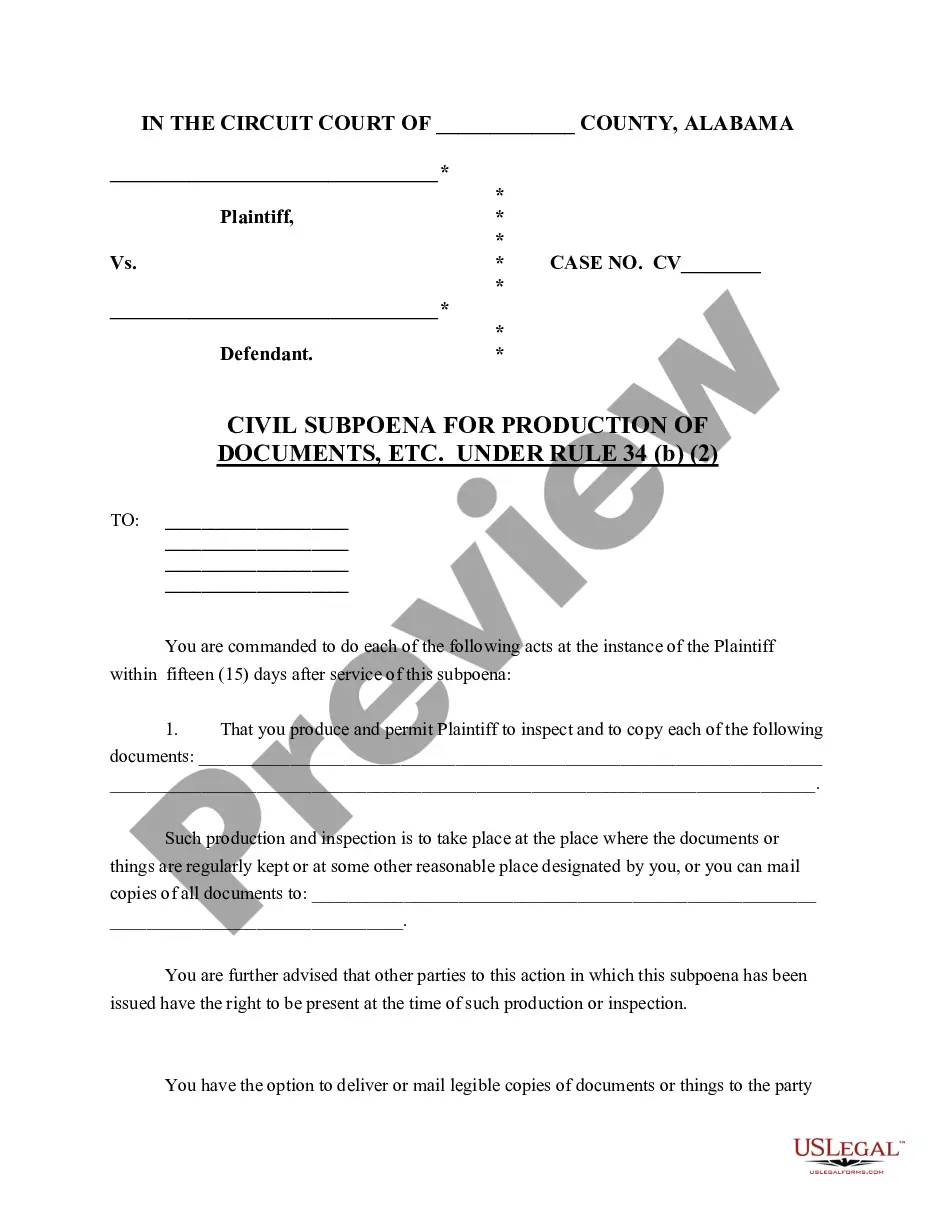
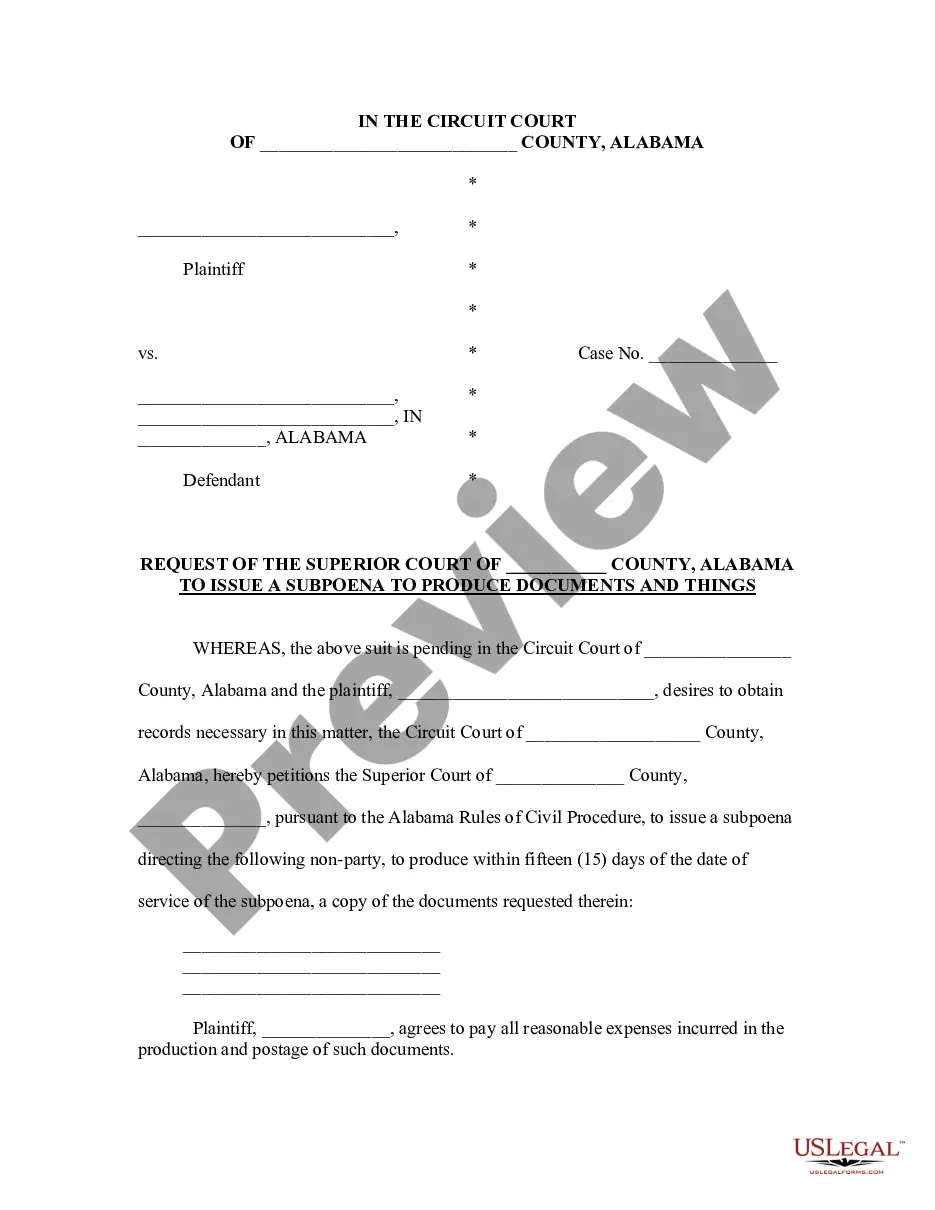
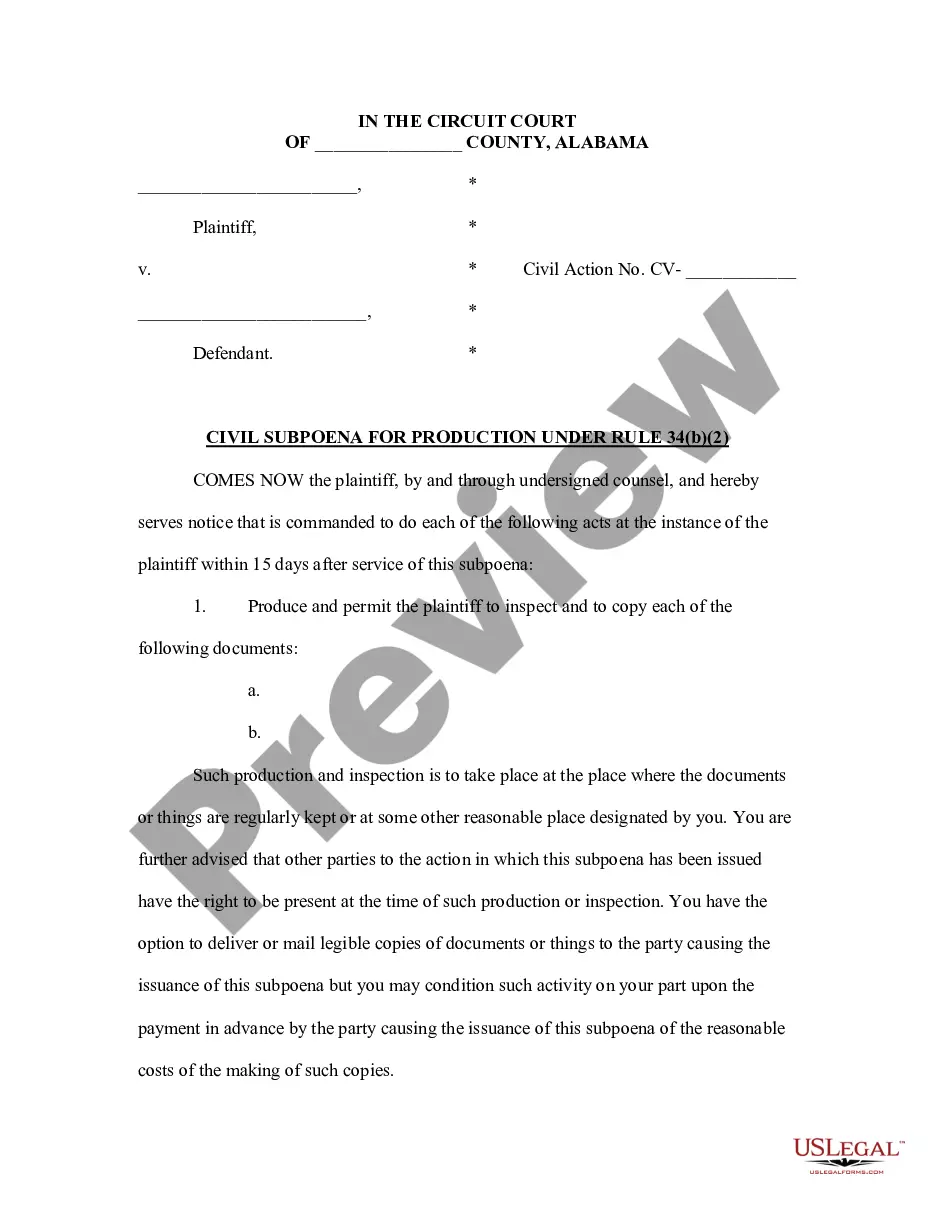
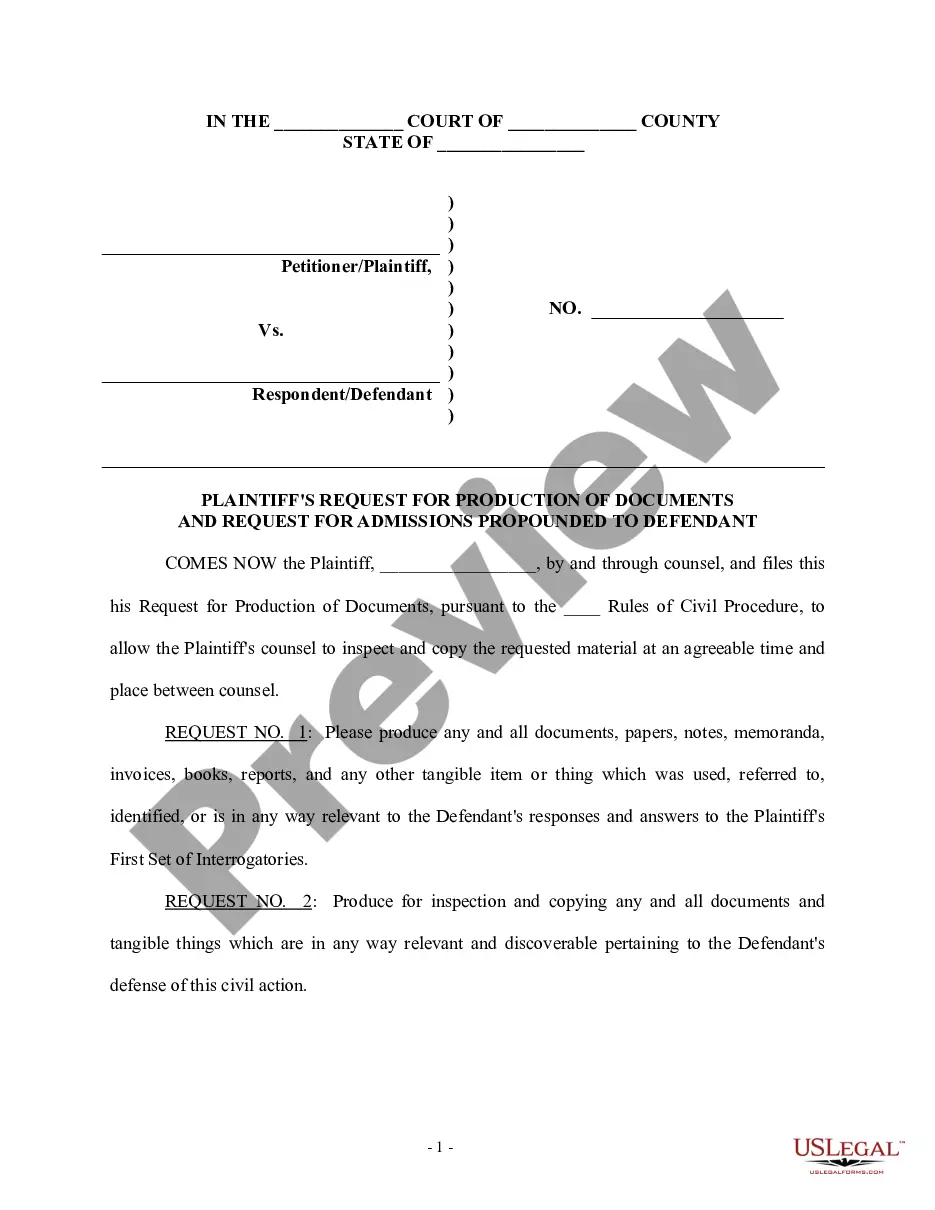
The Civil Subpoena to Produce Documents and Things Under Rule 34 is a legal document that allows a plaintiff to request specific documents and materials from a party that is not directly involved in the case. This subpoena is an essential tool in civil litigation, as it helps plaintiffs gather necessary information to build their case. Unlike other forms, this subpoena focuses specifically on the production of documents and tangible items pertinent to the dispute at hand.
Main sections of this form
- The title and case information at the top, which identifies the court and parties involved.
- A command to serve the subpoena on a designated individual or entity.
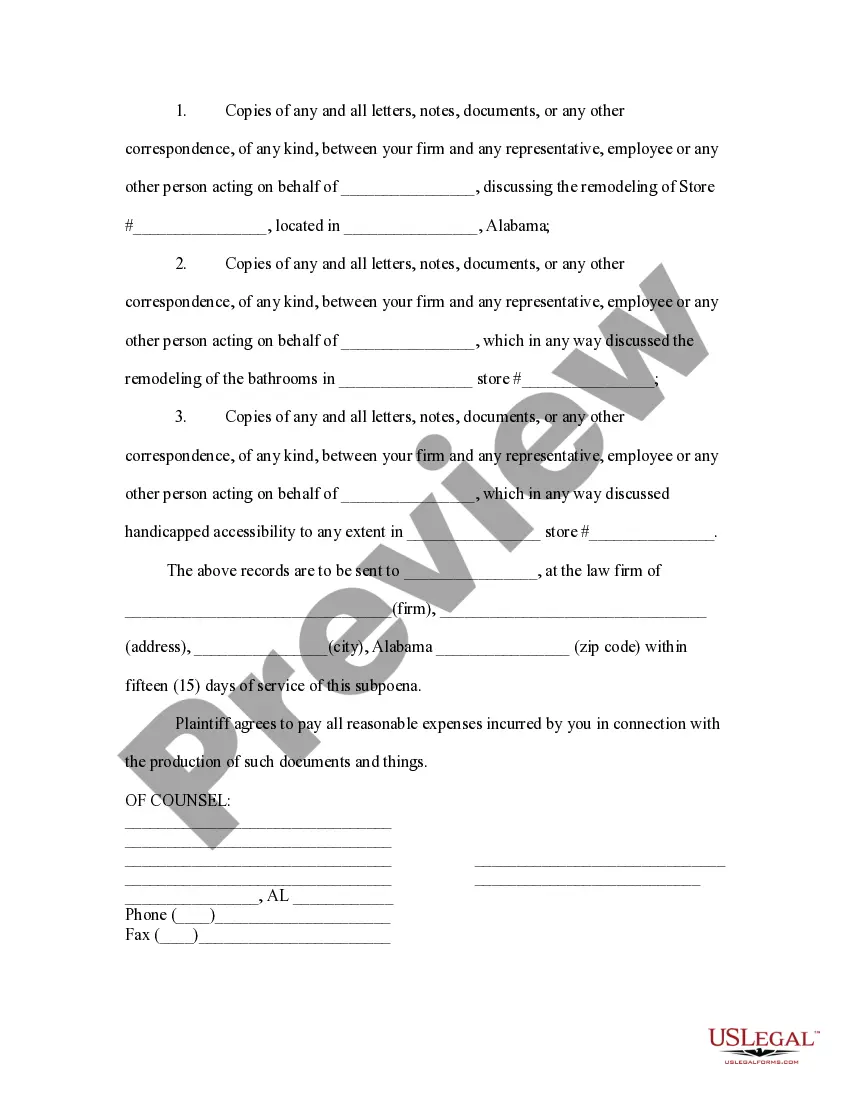
- A detailed description of the documents and items requested from the recipient.
- Instructions regarding where to send the documents and the timeline for compliance.
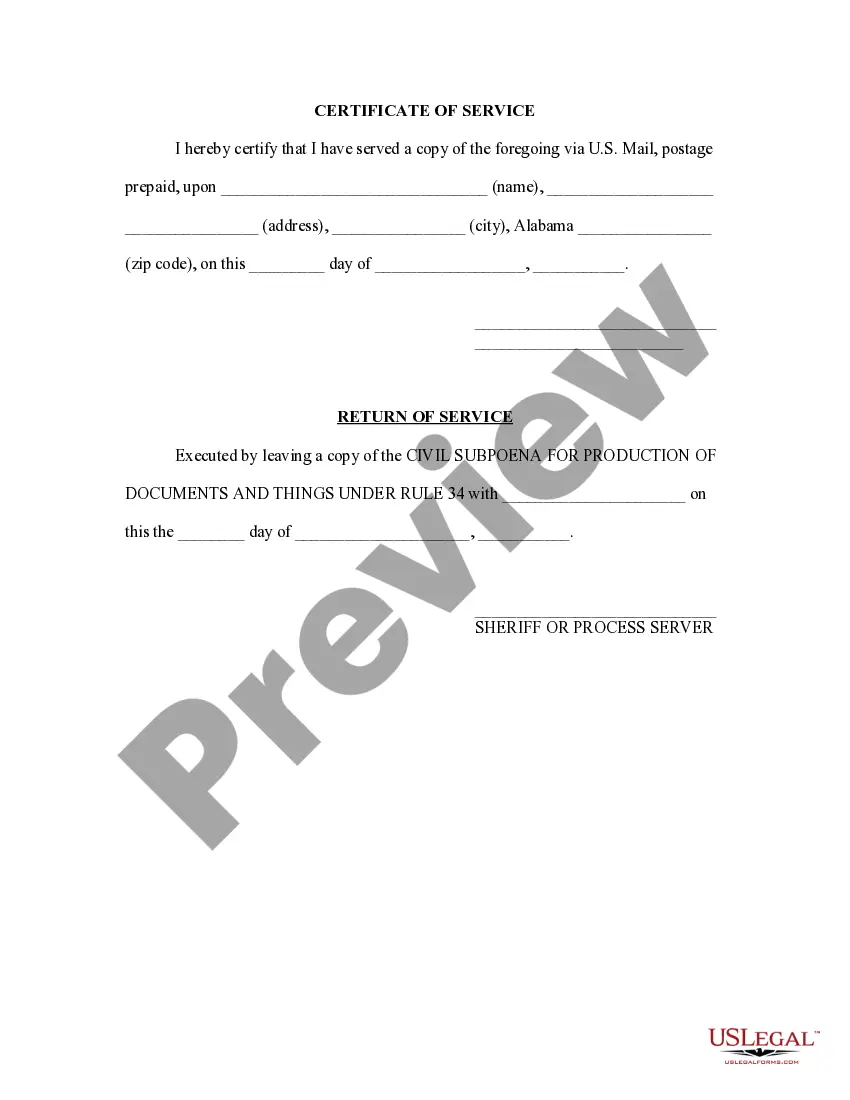
- A section for certification of service and acknowledgment of receipt.
When to use this document
This form should be used when a plaintiff needs to obtain documents, records, or other tangible items that are essential for their case. Common scenarios include cases where evidence is held by a third party, such as a contractor involved in a dispute or a business associated with the remodel of a location relevant to the case. This subpoena assists in uncovering crucial information that may not be readily available to the plaintiff.
Who can use this document
- Individuals or entities involved in a civil lawsuit as plaintiffs.
- Legal representatives seeking to gather evidence for their clients.
- Parties who need to request documentation from non-parties relevant to their case.
How to complete this form
- Enter the name of the court and the appropriate case number at the top of the form.
- Fill in the names of the plaintiff and defendant, along with their addresses.
- Specify the individual or entity to whom the subpoena is directed.
- Clearly detail the documents and items requested, ensuring all are relevant to your case.
- Provide your contact information and the details of your law firm, as applicable.
- Sign and date the form, and ensure you accurately complete the certificate of service section.
Is notarization required?
This form usually doesn’t need to be notarized. However, local laws or specific transactions may require it. Our online notarization service, powered by Notarize, lets you complete it remotely through a secure video session, available 24/7.
Get your form ready online
Our built-in tools help you complete, sign, share, and store your documents in one place.
Make edits, fill in missing information, and update formatting in US Legal Forms—just like you would in MS Word.
Download a copy, print it, send it by email, or mail it via USPS—whatever works best for your next step.
Sign and collect signatures with our SignNow integration. Send to multiple recipients, set reminders, and more. Go Premium to unlock E-Sign.
If this form requires notarization, complete it online through a secure video call—no need to meet a notary in person or wait for an appointment.
We protect your documents and personal data by following strict security and privacy standards.

Make edits, fill in missing information, and update formatting in US Legal Forms—just like you would in MS Word.

Download a copy, print it, send it by email, or mail it via USPS—whatever works best for your next step.

Sign and collect signatures with our SignNow integration. Send to multiple recipients, set reminders, and more. Go Premium to unlock E-Sign.

If this form requires notarization, complete it online through a secure video call—no need to meet a notary in person or wait for an appointment.

We protect your documents and personal data by following strict security and privacy standards.
Typical mistakes to avoid
- Failing to clearly identify the documents needed can lead to incomplete responses.
- Not specifying the timeframe for compliance may cause delays.
- Overlooking necessary signatures or dates can render the form invalid.
Benefits of completing this form online
- Instant access to a professionally drafted document tailored to meet legal standards.
- The convenience of downloading and customizing the form to your specific needs.
- Increased reliability, knowing your form is compliant with applicable laws.
Key takeaways
- The Civil Subpoena to Produce Documents is essential for gathering evidence in civil cases.
- It is crucial to complete the form accurately, detailing the necessary documents and parties.
- Using this form can streamline the legal process when collecting evidence.
Looking for another form?

Form popularity
FAQ
In Alabama, a request for production of documents is a legal request made in the context of a lawsuit, seeking specific documents relevant to the case. This request is governed by Rule 34 of the Alabama Rules of Civil Procedure, which sets forth guidelines for both parties. Familiarity with the Alabama Civil Subpoena to Produce Documents and Things Under Rule 34 can simplify the document production process substantially.
A subpoena duces tecum is the type of subpoena that specifically orders a party to produce documents at a legal proceeding. This form is often used to ensure compliance with discovery requests during litigation. Utilizing the Alabama Civil Subpoena to Produce Documents and Things Under Rule 34, parties can ensure the necessary documents are produced when required.
Common objections to a request for production of documents include claims that the request is overly broad, seeks irrelevant information, or is unduly burdensome. Parties may also object on grounds of privilege, such as attorney-client privilege or work product doctrine. A proper understanding of these objections can be beneficial in the context of the Alabama Civil Subpoena to Produce Documents and Things Under Rule 34.
A request for production of documents means that one party is formally asking another party to provide specific documents for review. This process is an integral part of the discovery phase in litigation. Understanding this request is essential to utilizing the Alabama Civil Subpoena to Produce Documents and Things Under Rule 34 effectively.
To respond to a request for production of documents, you should review the request carefully and determine whether you possess the requested documents. Your response may include producing the documents, objecting to the request, or stating that the documents are not within your control. Adhering to the guidelines of the Alabama Civil Subpoena to Produce Documents and Things Under Rule 34 will help you craft an appropriate response.
Rule 34 is part of the Alabama Rules of Civil Procedure, designed to facilitate the discovery process. It provides a structured approach to ensure that both parties can access relevant information and evidence. This rule plays a crucial role when using the Alabama Civil Subpoena to Produce Documents and Things Under Rule 34, as it outlines how requests should be made and managed in legal proceedings.
The rule 34 request for production of documents is a formal legal mechanism that allows a party in a lawsuit to request necessary documents from another party. This request is crucial in gathering evidence to support your case. Under the Alabama Civil Subpoena to Produce Documents and Things Under Rule 34, parties can compel the production of relevant documents that are in the possession of the opposing party.
The three types of subpoenas include subpoenas ad testificandum, subpoenas duces tecum, and subpoenas for deposition. The Alabama Civil Subpoena to Produce Documents and Things Under Rule 34 falls under the category of subpoenas duces tecum, demanding documents or evidence. Each type serves a distinct purpose in legal proceedings, providing a framework for gathering testimony and documents. For individuals or businesses, using US Legal Forms can streamline the process of issuing these subpoenas.
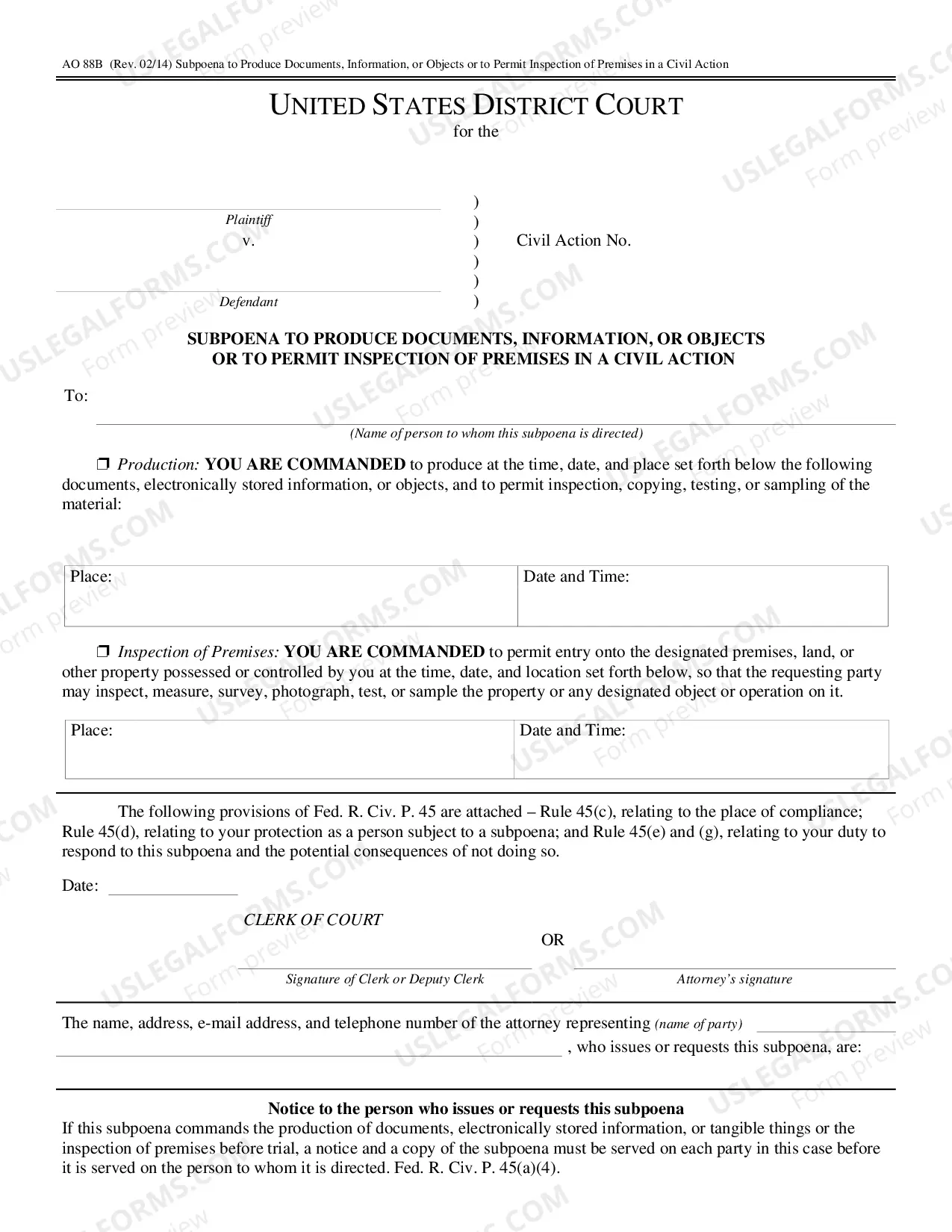
A federal subpoena for production of documents orders an individual or organization to produce specified documents for a case in federal court. Similar to the Alabama Civil Subpoena to Produce Documents and Things Under Rule 34, it seeks evidence to aid legal proceedings. This federal process ensures compliance and transparency, allowing parties to gather necessary information. Using resources like US Legal Forms can help navigate the complexities of obtaining federal subpoenas effectively.
A subpoena for the production of documents is called a civil subpoena to produce documents and things under Rule 34. This legal instrument compels a party to provide specific documents or evidence for a case. In Alabama, these subpoenas are crucial for gathering information during litigation. Utilizing platforms like US Legal Forms can simplify the process of creating and serving this type of subpoena.