Alabama Living Trust Property Record
What is this form?
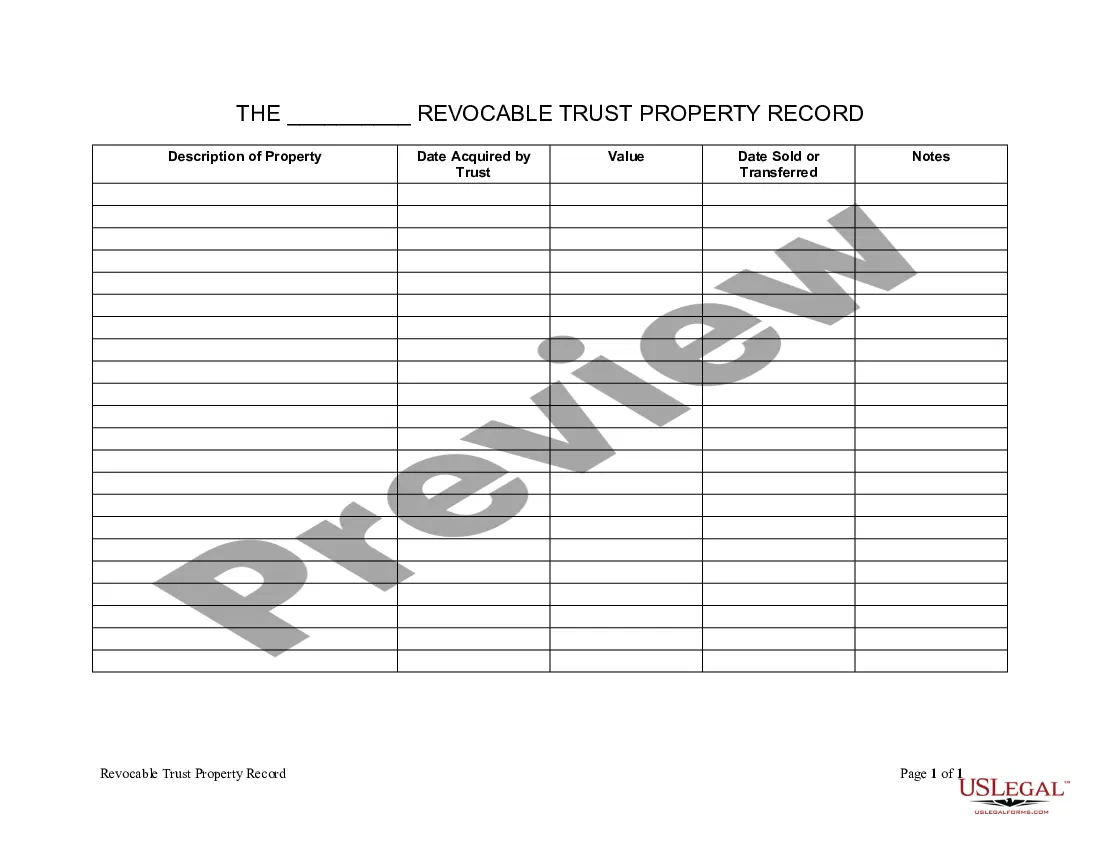
The Living Trust Property Record is a form used to inventory assets placed within a living trust. A living trust is established during a person's lifetime, allowing them to manage their assets for effective estate planning. This form is specifically designed for the Trustee to accurately document the property held in the trust, ensuring that all real, personal, and intellectual property is accounted for, which may differ from other estate planning documents.
Key parts of this document
- Description of property: Details the items or assets included in the trust.
- Date acquired by trust: Indicates when the property was placed in the trust.
- Value: Records the monetary value of each property item.
- Date sold or transferred: Notes when any property was sold or moved out of the trust.

When to use this document
This form should be used when creating a living trust to maintain an organized inventory of assets. It is beneficial during the initial establishment of the trust and for ongoing management of property, especially when assets are acquired or disposed of. It ensures clarity for the Trustee and beneficiaries regarding asset distribution.
Who should use this form
- Individuals establishing a living trust.
- Trustees managing a living trust.
- Beneficiaries seeking to understand the trust's assets.
Instructions for completing this form
- Gather all property information, including real and personal assets.
- For each item, provide a detailed description.
- Enter the date each property was acquired by the trust.
- Assign a value to each property item for reference.
- If applicable, note the date any property was sold or transferred.
Notarization guidance
Notarization is not commonly needed for this form. However, certain documents or local rules may make it necessary. Our notarization service, powered by Notarize, allows you to finalize it securely online anytime, day or night.
Get your form ready online
Our built-in tools help you complete, sign, share, and store your documents in one place.
Make edits, fill in missing information, and update formatting in US Legal Forms—just like you would in MS Word.
Download a copy, print it, send it by email, or mail it via USPS—whatever works best for your next step.
Sign and collect signatures with our SignNow integration. Send to multiple recipients, set reminders, and more. Go Premium to unlock E-Sign.
If this form requires notarization, complete it online through a secure video call—no need to meet a notary in person or wait for an appointment.
We protect your documents and personal data by following strict security and privacy standards.

Make edits, fill in missing information, and update formatting in US Legal Forms—just like you would in MS Word.

Download a copy, print it, send it by email, or mail it via USPS—whatever works best for your next step.

Sign and collect signatures with our SignNow integration. Send to multiple recipients, set reminders, and more. Go Premium to unlock E-Sign.

If this form requires notarization, complete it online through a secure video call—no need to meet a notary in person or wait for an appointment.

We protect your documents and personal data by following strict security and privacy standards.
Mistakes to watch out for
- Failing to update the inventory when assets change.
- Inaccurate descriptions leading to confusion during asset distribution.
- Omitting important dates and values, which may complicate trust management.
Benefits of completing this form online
- Convenience: Downloadable and easily accessible from anywhere.
- Editability: Modify the form as necessary for your specific property.
- Reliability: Templates are drafted by licensed attorneys to ensure legal compliance.
Quick recap
- The Living Trust Property Record is essential for inventorying trust assets.
- It should be used during trust establishment and management.
- Proper completion ensures clarity for Trustees and beneficiaries.
Looking for another form?
Form popularity
FAQ
To determine if you are a beneficiary, you should first communicate with the trustee or the individual who set up the trust. Additionally, you can review Alabama Living Trust Property Records, which may contain information about beneficiaries. If those options prove difficult, consider utilizing the uslegalforms platform for assistance in navigating this process.
One significant mistake parents often make is failing to properly fund the trust. Without transferring assets into the trust, it cannot serve its intended purpose. By maintaining a clear focus on asset placement and consulting resources concerning Alabama Living Trust Property Records, parents can avoid this common pitfall.
Searching online for trust documents can be challenging, as they are typically confidential. Nevertheless, you can look into Alabama Living Trust Property Records, as some information may be available depending on the public status of the trust. Additionally, using services like uslegalforms can assist you in finding more detailed records conveniently.
Generally, trust records are kept for the duration of the trust's existence. In Alabama, legal guidelines may dictate the retention period, often lasting until the trust is dissolved. For a comprehensive understanding of your trust, reference the Alabama Living Trust Property Record, as it may offer specific retention time frames.
In many cases, trust documents are not publicly available online due to privacy concerns. However, you might find relevant information through Alabama Living Trust Property Records if the trust has been registered. Checking with local probate courts or utilizing platforms like uslegalforms can help streamline your search for necessary documents.
To access the contents of a trust, you usually need to locate the trust document itself. Often, this document is held by the trustee or the attorney who prepared it. If you are unsure where to start, consider searching Alabama Living Trust Property Records, as these may provide insights into registered trusts and their beneficiaries.
Getting a copy of a property deed in Alabama involves visiting the county recorder's office where the property is located. You can request a copy in person, or sometimes online, by providing key details about the property. This allows you to update your Alabama Living Trust Property Record and keep your documents organized and accessible.
To secure a copy of your house deed, contact your local county recorder's office or probate court. Provide the necessary details, such as your property address and ownership information. An online request may also be available, making it easier for you to access your Alabama Living Trust Property Record anytime you need it.
A living trust in Alabama is a legal arrangement where you transfer ownership of your assets into a trust during your lifetime. You maintain control over the trust as the trustee, allowing you to manage property and make changes as needed. Upon your passing, the assets in your Alabama Living Trust Property Record can be passed to beneficiaries without going through probate, ensuring privacy and efficiency in estate settlement.
To look up property records in Alabama, you can visit the website of your county's property assessor or recorder's office. Many counties provide online databases where you can search by address, owner name, or parcel number. Accessing your Alabama Living Trust Property Record through these tools can give you essential information about property ownership and any related documents.