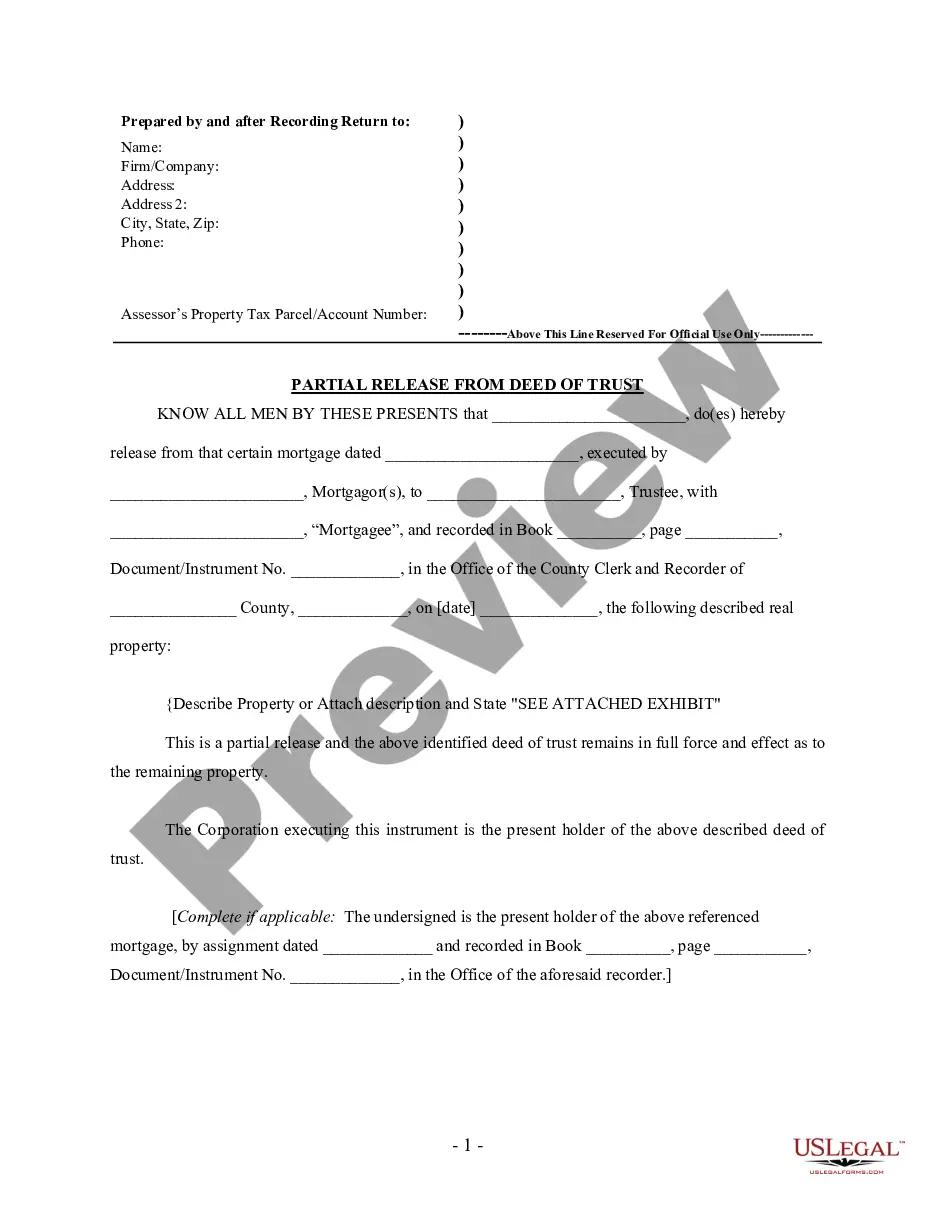
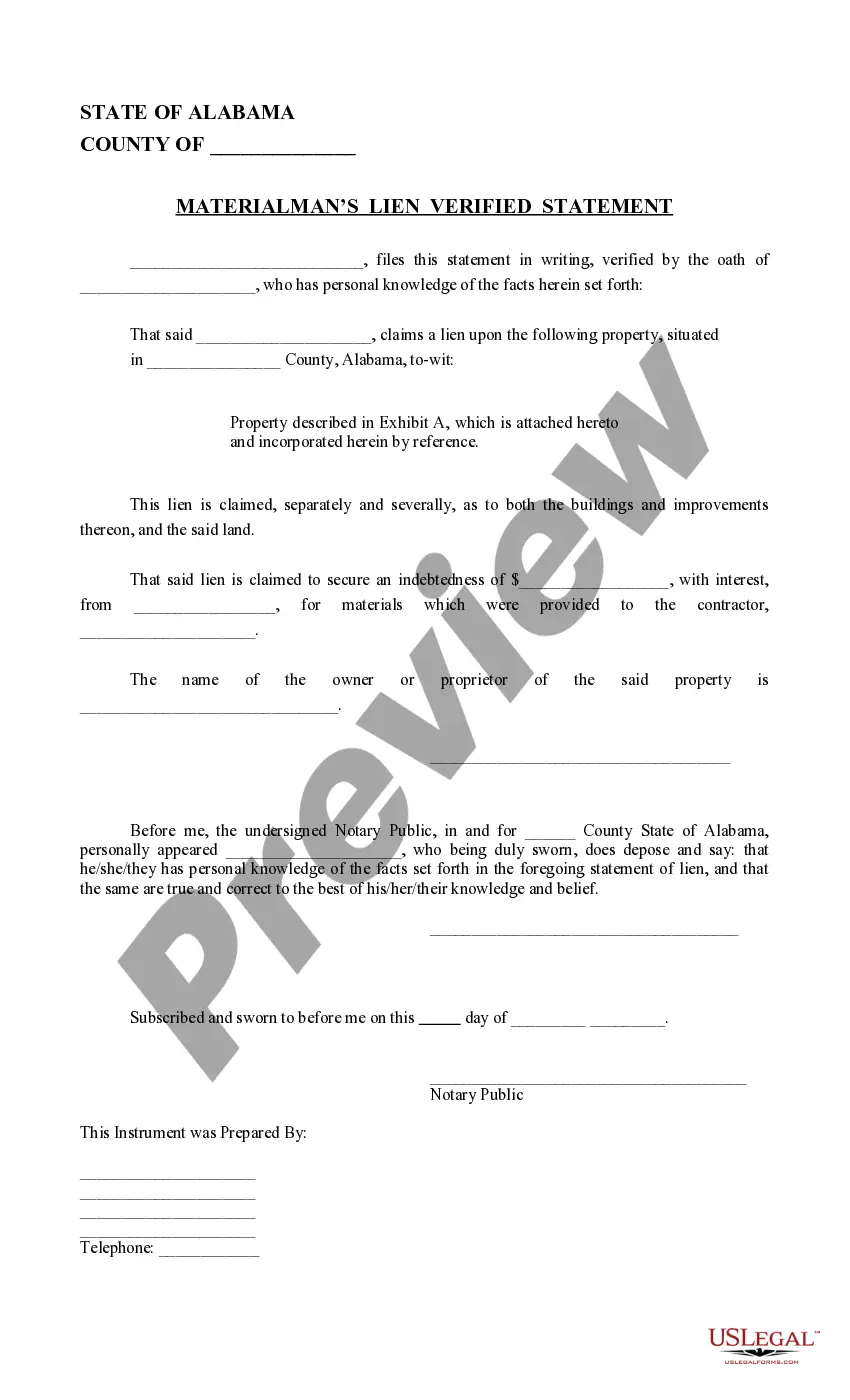
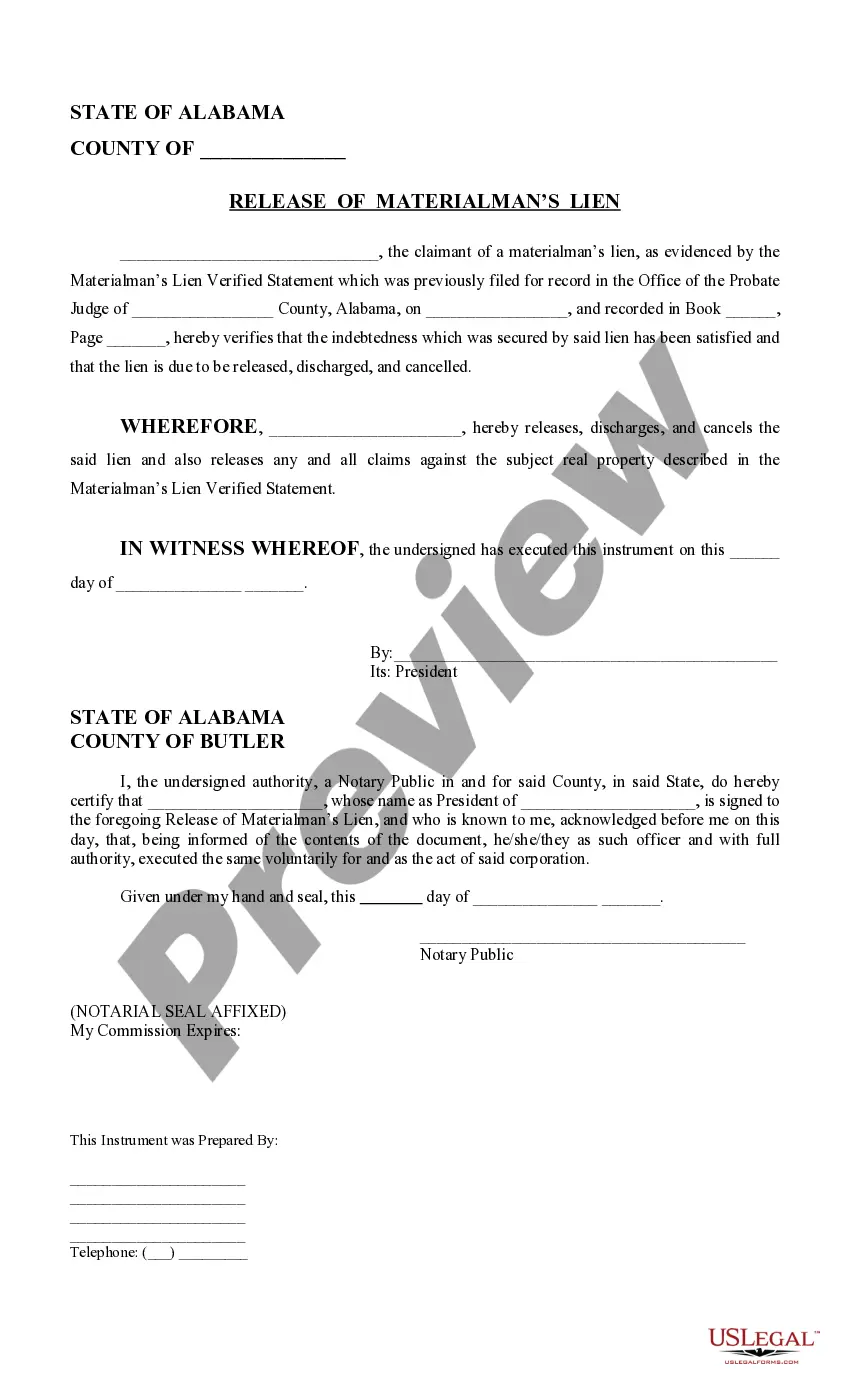
Alabama Materialman's Lien Verified Statement
What is this form?
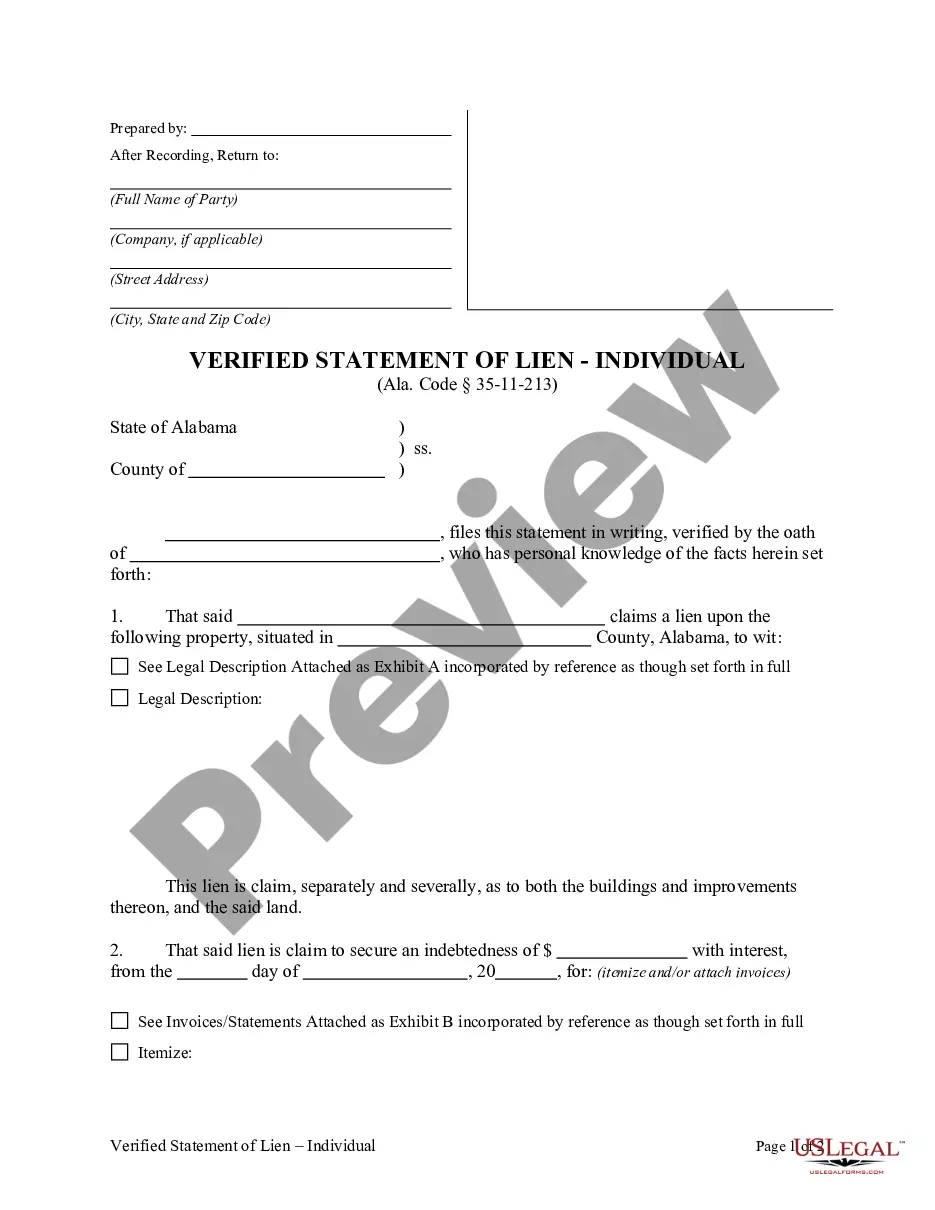
The Materialman's Lien Verified Statement is a legal document used to assert a claim against property for unpaid construction materials and services. This form is essential for mechanics, contractors, and material suppliers who need to secure payment for their work and materials, ensuring that property owners cannot easily sell or refinance until their debts are cleared. By using this verified statement, lien claimants can formally document their rights, distinguishing it from other types of liens that may not require such formal verification.
Main sections of this form
- Identification of the property subject to the lien.
- Details of the claimant, including name and business information.
- The amount owed for materials provided and the date of service.
- A notary section for verification of the claim.
- Exhibit A for detailed property descriptions.
Common use cases
This form is appropriate for use when a contractor, subcontractor, or supplier has not received payment for work done or materials supplied in the construction or renovation of a property. Using this verified statement helps secure the right to collect payment by placing a formal lien on the property, which may be necessary before initiating further legal action or pursuing debt collection.
Who should use this form
This form is intended for the following parties:
- Contractors who have provided labor or services on a property.
- Suppliers of materials used in construction or renovation projects.
- Subcontractors who have been hired by the primary contractor.
- Any individual or company seeking to assert a lien to secure unpaid debts related to construction.
Completing this form step by step
- Identify the property by providing its address and details in the designated section.
- Specify the name of the material supplier and the contractor, clearly indicating their roles.
- Enter the total amount owed for the materials provided.
- Sign the document in the presence of a notary public.
- Attach Exhibit A, including a detailed description of the property affected by the lien.
Does this form need to be notarized?
Yes, this form must be notarized to be legally valid. A notary public will verify the identity of the signer and witness the signing of the document, which is a critical step in establishing the legal authenticity of the claim. US Legal Forms offers integrated online notarization services, ensuring a secure and convenient option.
Get your form ready online
Our built-in tools help you complete, sign, share, and store your documents in one place.
Make edits, fill in missing information, and update formatting in US Legal Forms—just like you would in MS Word.
Download a copy, print it, send it by email, or mail it via USPS—whatever works best for your next step.
Sign and collect signatures with our SignNow integration. Send to multiple recipients, set reminders, and more. Go Premium to unlock E-Sign.
If this form requires notarization, complete it online through a secure video call—no need to meet a notary in person or wait for an appointment.
We protect your documents and personal data by following strict security and privacy standards.

Make edits, fill in missing information, and update formatting in US Legal Forms—just like you would in MS Word.

Download a copy, print it, send it by email, or mail it via USPS—whatever works best for your next step.

Sign and collect signatures with our SignNow integration. Send to multiple recipients, set reminders, and more. Go Premium to unlock E-Sign.

If this form requires notarization, complete it online through a secure video call—no need to meet a notary in person or wait for an appointment.

We protect your documents and personal data by following strict security and privacy standards.
Mistakes to watch out for
- Failing to accurately describe the property may invalidate the lien.
- Not notarizing the document, which is essential for legal enforceability.
- Missing the deadline for filing the lien after materials or services were provided.
- Neglecting to include all parties involved, such as subcontractors or other suppliers.
Why complete this form online
- Convenience of immediate access to legal templates without needing to visit a lawyer's office.
- Editability allows users to modify the document to fit specific circumstances easily.
- Assurance of compliance with the latest legal standards and requirements.
Quick recap
- The Materialman's Lien Verified Statement is vital for securing payment for unpaid construction work or materials.
- It is necessary to complete and notarize the form properly to establish a lien on the property.
- Timeliness and accurate property description are crucial to enforceability.
Looking for another form?
Form popularity
FAQ
To enforce the lien, the contractor must file a lawsuit within 90 days from the date of recording the lien. If this deadline is passed, the contractor may not be able to enforce the lien and may be required to remove the lien.
Where do I file and record an Alabama mechanics lien? Alabama mechanics liens are filed in the office of the judge of probate in the county where the property is located.
In Texas, a mechanics lien expires after 1 or 2 years, depending on the type of project. A lien claimant will need to enforce their mechanics lien before the deadline. 1 year after termination, completion, or abandonment or the project.
A statutory lien that exists to secure payment for services, labor, and material related to improvements performed on real property.State statutes creating mechanics' liens vary from state to state. These statutes provide for the criteria and circumstances required for a mechanic's lien to be deemed a super lien.
How long does a judgment lien last in Alabama? A judgment lien in Alabama will remain attached to the debtor's property (even if the property changes hands) for ten years.
Mechanic's liens are legal documents that essentially reserve the rights of the filer to seek unpaid compensation. They are usually filed by contractors, subcontractors, or suppliers that never received payment for work that they performed or materials that they provided on the property.
Mechanic's liens create a cloud on title, meaning that they appear in public property records. Liens are sometimes said to travel with the land, meaning that anyone who buys your house would take the property subject to the contractor's lien (or, more likely, demand that you pay it off first).
Mechanics Liens must be recorded by a "subcontractor" within 90 days of "completion" or "cessation of work" and a general contractor who has a direct contract with the owner must record within 90 days of completion or of cessation of labor, unless completion or cessation of labor has occurred.
When a contractor files a mechanics' (construction) lien on your home, the lien makes your home into what's called security for an outstanding debt, which the contractor claims is due and unpaid for services or materials.