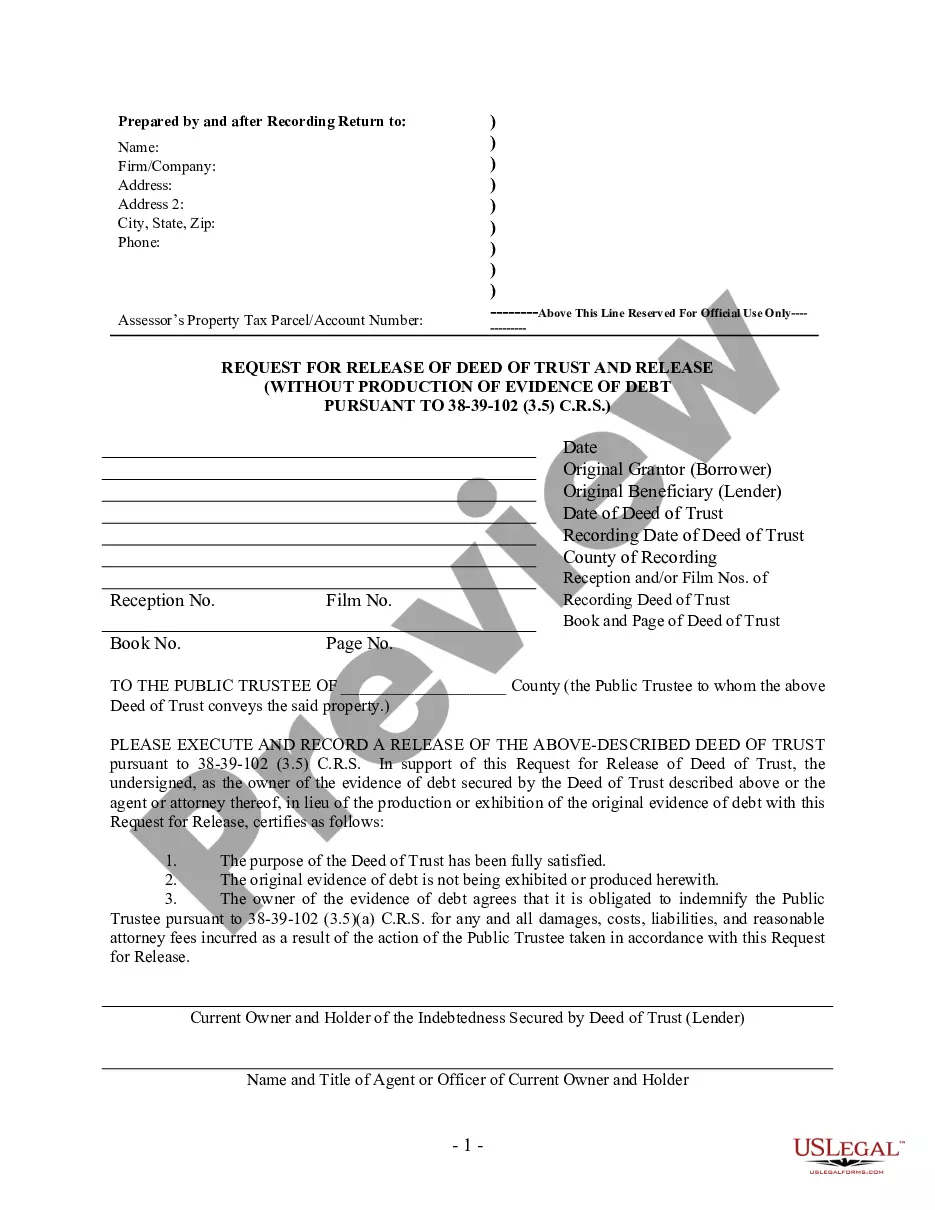
Satisfaction, Release or Cancellation of Deed of Trust by Corporation
Assignments Generally: Lenders, or holders of mortgages or deeds of trust, often assign mortgages or deeds of trust to other lenders, or third parties. When this is done the assignee (person who received the assignment) steps into the place of the original lender or assignor. To effectuate an assignment, the general rules is that the assignment must be in proper written format and recorded to provide notice of the assignment.
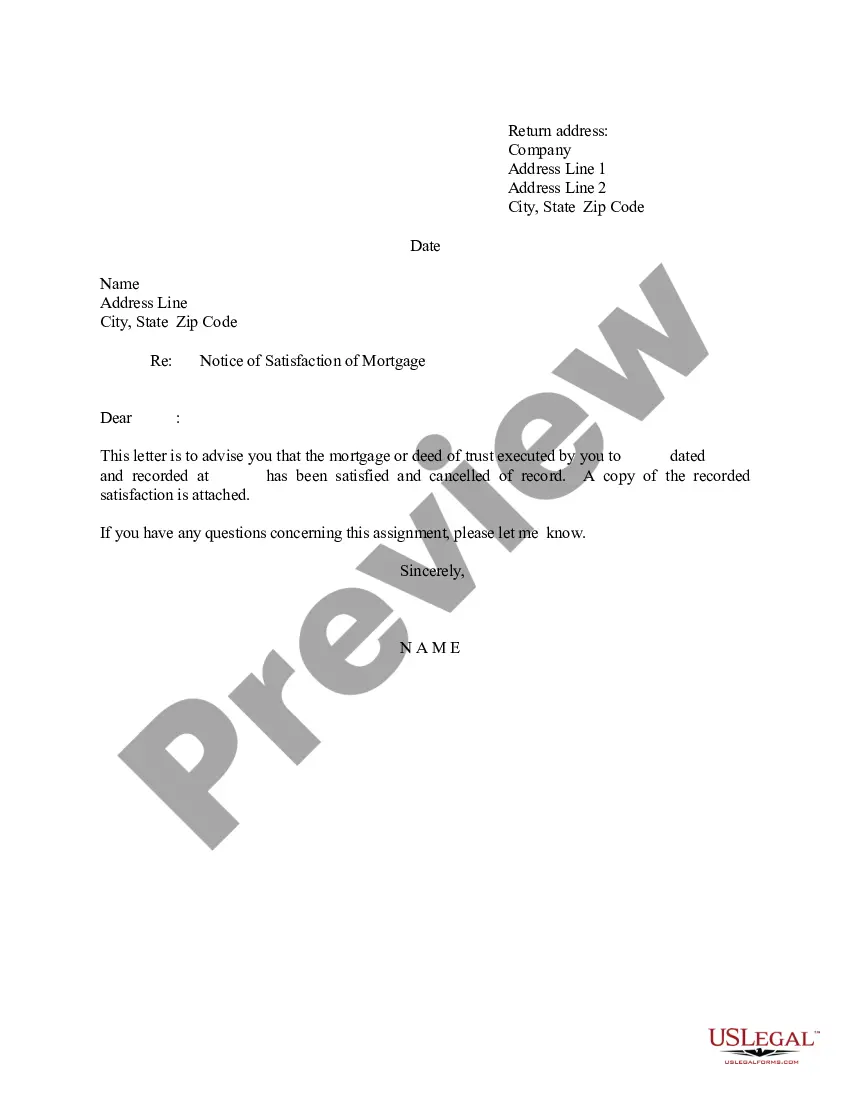
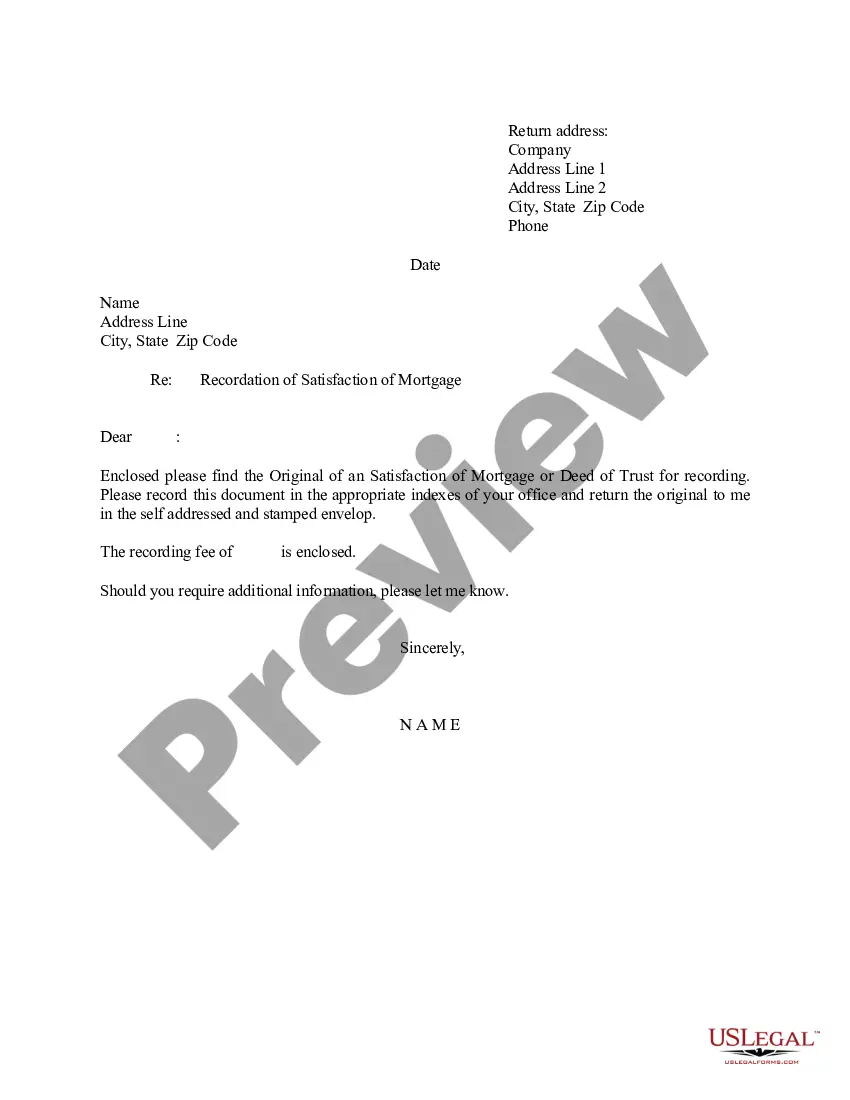
Satisfactions Generally: Once a mortgage or deed of trust is paid, the holder of the mortgage is required to satisfy the mortgage or deed of trust of record to show that the mortgage or deed of trust is no longer a lien on the property. The general rule is that the satisfaction must be in proper written format and recorded to provide notice of the satisfaction. If the lender fails to record a satisfaction within set time limits, the lender may be responsible for damages set by statute for failure to timely cancel the lien. Depending on your state, a satisfaction may be called a Satisfaction, Cancellation, or Reconveyance. Some states still recognize marginal satisfaction but this is slowly being phased out. A marginal satisfaction is where the holder of the mortgage physically goes to the recording office and enters a satisfaction on the face of the the recorded mortgage, which is attested by the clerk.
Colorado Law
Assignment: It is recommended that an assignment be in writing and recorded.
Demand to Satisfy: None required.
Recording Satisfaction: Upon full payoff and receipt from debtor of the reasonable costs of recording (and within 90 days thereof), the creditor or holder of the debt shall record with the appropriate clerk and recorder the documents necessary to release or satisfy the lien of record or, in the case of an indebtedness secured by a deed of trust to a public trustee, file with the public trustee the documents required for a release as prescribed by section 38-39-102, whereupon immediately upon execution of the release of the lien of deed of trust by the public trustee, the public trustee shall cause such release to be recorded in the office of the county clerk and recorder of the county in which the property described in such release is located.
Marginal Satisfaction: Not allowed.
Penalty: Any creditor who fails to timely comply with the obligations of recording satisfaction shall be liable to the owner of the real property encumbered by such indebtedness.
Acknowledgment: An assignment or satisfaction must contain a proper Colorado acknowledgment, or other acknowledgment approved by Statute.
Colorado Statutes
38-35-124--Requirements upon satisfaction of indebtedness.
Except as provided in articles 22 and 23 of this title, when all indebtedness, whether absolute or contingent, secured by a lien on real property has been satisfied, unless the debtor requests in writing that the lien not be released, the creditor or holder of the indebtedness shall, within ninety days after the satisfaction of the indebtedness and receipt from the debtor of the reasonable costs of procuring and recording the release documents, record with the appropriate clerk and recorder the documents necessary to release or satisfy the lien of record or, in the case of an indebtedness secured by a deed of trust to a public trustee, file with the public trustee the documents required for a release as prescribed by section 38-39-102. If the debtor requests in writing that the lien be released, or fails to request in writing that the lien not be released, then the debtor's request or the actual release shall cancel any obligations on the part of the creditor or holder to make any further loan or advance that would be secured by the lien. If the person satisfying the indebtedness requests in writing delivery to him or her of the cancelled instruments of indebtedness at the time of satisfaction, the creditor or holder shall be relieved of any further obligation or liability under this section after such delivery has been completed. Upon satisfaction of the indebtedness, the creditor or holder shall return to the person satisfying the indebtedness all papers and personal property of the debtor that have been held by the creditor or holder in connection with the indebtedness. Any creditor or holder who fails to comply with this section shall be liable to the owner of the real property encumbered by such indebtedness and to any other person liable on such indebtedness for all actual economic loss incurred enforcing the rights provided under this section, including reasonable attorney fees and costs.
38-39-102--When deed of trust shall be released - definitions.
(1) (a) Except as otherwise provided in paragraph (a) of subsection (3) of this section, a deed of trust to the public trustee, upon compliance with the provisions of the deed of trust, shall be released by the public trustee upon the:
(I) Receipt of a written request from the holder of the evidence of debt secured by the deed of trust, the holder's agent or attorney, or a title insurance company providing an indemnification agreement and affidavit described in paragraph (c) of subsection (3) of this section, which request shall be duly executed and acknowledged;
(II) Production of the original cancelled evidence of debt such as a note or bond as evidence that the indebtedness secured by such deed of trust has been paid; except that such production may be omitted in the circumstances contemplated in subsection (3) of this section;
(III) Receipt by the public trustee of the fee prescribed by section 38-37-104 (1) (a) and the fee for recording the release;
(IV) Receipt by the public trustee of a current address for the original grantor, assuming party, or current owner or either a notation on the request for release of the deed of trust or a written statement from the holder of the evidence of debt secured by the deed of trust, the title insurance company licensed and qualified in Colorado, or the holder of the original evidence of debt that is a qualified holder, as defined in section 38-38-100.3 (20), that they have no record of a current address that is different from the address of the property encumbered by the deed of trust being released; except that it shall be within the public trustee's discretion to release a deed of trust, upon compliance with the provisions of the deed of trust, if the public trustee has not received the information required pursuant to this subpparagraph (IV); and
(V) Production of the original recorded deed of trust securing the evidence of debt or a legible copy thereof.
(b) Immediately upon execution of the release of the deed of trust by the public trustee, the public trustee shall cause the release to be recorded in the records of the county clerk and recorder.
(2) If the purpose of the deed of trust has been fully or partially satisfied and the indebtedness secured by such deed of trust has not been paid, the public trustee shall release the deed of trust as to all or portions of the property encumbered by the deed of trust pursuant to the provisions of subsection (1) of this section if the request to release certifies that the purpose of the deed of trust has been fully or partially satisfied and if either the original evidence of debt is exhibited or the holder of the evidence of debt is a qualified holder.
(3) (a) (I) Subject to the provisions of subparagraph (II) of this paragraph (a), with respect to either subsection (1) or (2) of this section, a holder of the original evidence of debt that is a qualified holder, as defined in section 38-38-100.3 (20), may request the release of a deed of trust without producing or exhibiting the original evidence of debt. A holder that requests the release of a deed of trust pursuant to this paragraph (a) shall be deemed to have agreed to indemnify and defend the public trustee against any claim made within the period described in subsection (7) of this section for damages resulting from the action of the public trustee taken in accordance with the request. The indemnity granted by this paragraph (a) is limited to actual economic loss suffered and any court costs and reasonable attorney fees and costs incurred in defending a claim brought as a direct and proximate result of the failure to produce the original evidence of debt, but the indemnity does not include and no claimant is entitled to any special, incidental, consequential, reliance, expectation, or punitive damages. No separate indemnification agreement shall be necessary for the agreement to indemnify to be effective.
(II) A holder of the original evidence of debt that is a qualified holder, as defined in section 38-38-100.3 (20), shall provide the public trustee with a current address for the original grantor, assuming party, or current owner when requesting a release of a deed of trust pursuant to this paragraph (a).
(b) (I) Subject to the provisions of subparagraph (II) of this paragraph (b), with respect to either subsection (1) or (2) of this section, the holder of the evidence of debt may request the release of a deed of trust without producing or exhibiting the original evidence of debt. A holder that requests the release of a deed of trust pursuant to this paragraph (b) shall deliver to the public trustee a corporate surety bond in an amount equal to one and one-half times the original principal amount recited in the deed of trust, which corporate surety bond shall remain in full force and effect for the period described in subsection (7) of this section.
(II) A holder of the evidence of debt shall provide the public trustee with a current address for the original grantor, assuming party, or current owner when requesting a release of a deed of trust pursuant to this paragraph (b).
(c) (I) Subject to the provisions of subparagraph (II) of this paragraph (c), with respect to either subsection (1) or (2) of this section, a title insurance company licensed and qualified in Colorado may request the release of a deed of trust without producing or exhibiting the original evidence of debt. A company that requests the release of a deed of trust pursuant to this paragraph (c) shall be deemed to have agreed to indemnify and defend the public trustee against any claim made within the period described in subsection (7) of this section for damages resulting from the action taken by the public trustee in accordance with the request. The indemnity granted by this paragraph (c) is limited to actual economic loss suffered and any court costs and reasonable attorney fees and costs incurred in defending a claim brought as a direct and proximate result of the failure to produce the original evidence of debt, but the indemnity does not include and no claimant is entitled to any special, incidental, consequential, reliance, expectation, or punitive damages. No separate indemnification agreement shall be necessary for the agreement to indemnify to be effective; however, the company shall provide to the public trustee an affidavit executed by an officer of the company stating that the company has caused the indebtedness secured by the deed of trust to be satisfied in full or, in the case of a partial release, to the extent required by the holder of the indebtedness.
(II) A title insurance company licensed and qualified in Colorado shall provide the public trustee with a current address for the original grantor, assuming party, or current owner when requesting a release of a deed of trust pursuant to this paragraph (c).
(3.5) Venue for any action based upon the indemnification agreement specified in paragraph (a) of subsection (3) of this section shall be proper only in the county in which the public trustee receiving the certification is located.
(4) A public trustee shall have no duty to retain the original cancelled evidence of debt or deed of trust upon a release granted pursuant to this section.
(5) The lien represented by a deed of trust to the public trustee that secures an obligation other than an evidence of debt shall be released by the public trustee pursuant to the provisions of subsection (1) of this section as to all or portions of the property encumbered by the deed of trust upon the:
(a) Receipt of a written request of the beneficiary or assignee of such deed of trust, which request shall be duly executed and acknowledged;
(b) Presentation to the public trustee of an affidavit of such beneficiary or assignee stating that the purpose of the deed of trust has been fully or partially satisfied; and
(c) Receipt by the public trustee of the fee prescribed by section 38-37-104 (1) (a) and the fee for recording the release.
(6) The public trustee shall have no liability to any person, and no action may be commenced against the public trustee, as a result of issuing a release or partial release of a deed of trust under subsection (3) of this section, unless such action is commenced within six years from the date of the recording of such release or partial release or within the period of time prescribed by any statute of limitation of this state in which a suit to enforce payment of the indebtedness or performance of the obligation secured by said deed of trust may be commenced, whichever is less. Nothing in this article shall be construed to waive immunity of a public trustee that is provided in sections 24-10-101 to 24-10-120, C.R.S.
(7) The indemnification agreements or the corporate surety bond described in this section shall, in each case, remain effective for the time period described in subsection (6) of this section or until such time as any claim made against the public trustee within such time period has been finally resolved, whichever is longer.
(8) If the written request to release the lien of any deed of trust is a fraudulent request, the release by the public trustee based upon such request shall be void.
(8.5) If a deed of trust is improperly recorded in the office of the clerk and recorder of a county other than the county in which the real property is located, the deed of trust must be recorded in the correct county before the public trustee may release the deed of trust. The public trustee of a county other than the county wherein the real property is located shall not release the deed of trust.
(9) For purposes of this section, unless the context otherwise requires:
(a) Assuming party means a person other than the original grantor who paid off the indebtedness on behalf of the original grantor.
(b) Current address means the most recent address reflected in the records of a holder of the evidence of debt, a title insurance company licensed and qualified in Colorado, or a holder of the original evidence of debt that is a qualified holder, as defined in section 38-38-100.3 (20). If a holder of the evidence of debt, a title insurance company licensed and qualified in Colorado, or a holder of the original evidence of debt that is a qualified holder, as defined in section 38-38-100.3 (20), has no record of a current address, any requirement that a current address be provided shall be deemed satisfied by indicating that fact.
(c) Current owner means a person other than the original grantor who currently owns the property and has either paid off or taken over the indebtedness on behalf of the original grantor.
38-39-104 Satisfaction of mortgage.
The lien of any mortgage encumbering property within the state of Colorado can be released only by the mortgagee executing a separate instrument of release executed under the formalities prescribed by the law regulating conveyances. All releases made prior to July 1, 1973, either on the mortgage or on the record of the mortgage, and signed by the mortgagee, shall have the same effect as a separate instrument of release legally executed by the mortgagee.