Alabama Informant Agreement
What this document covers
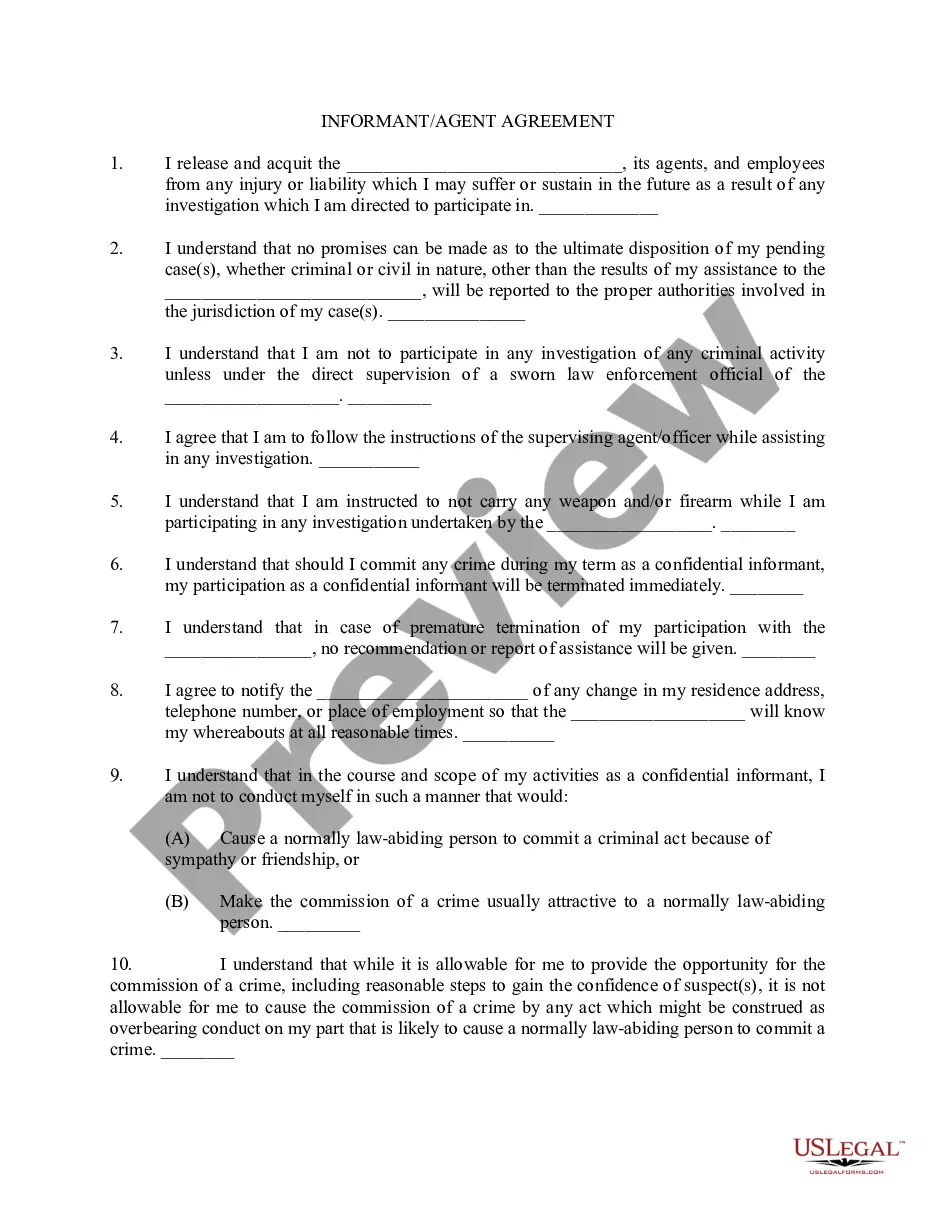
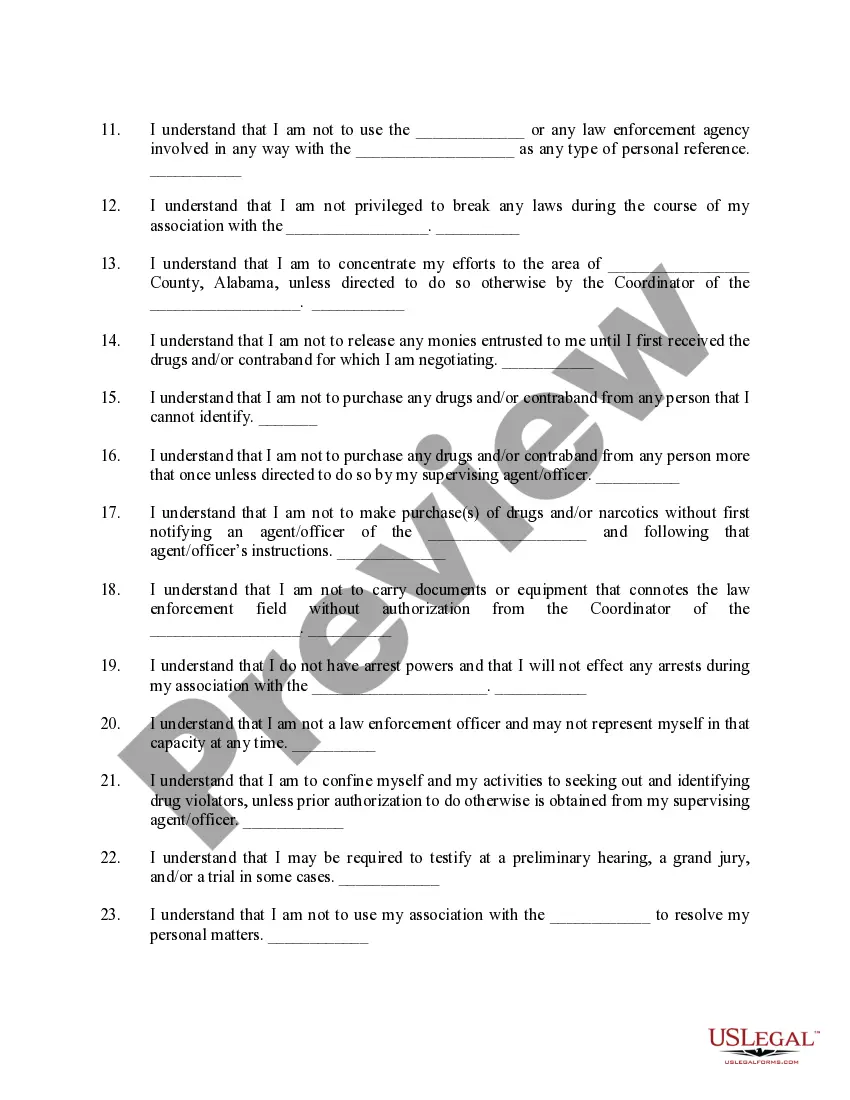
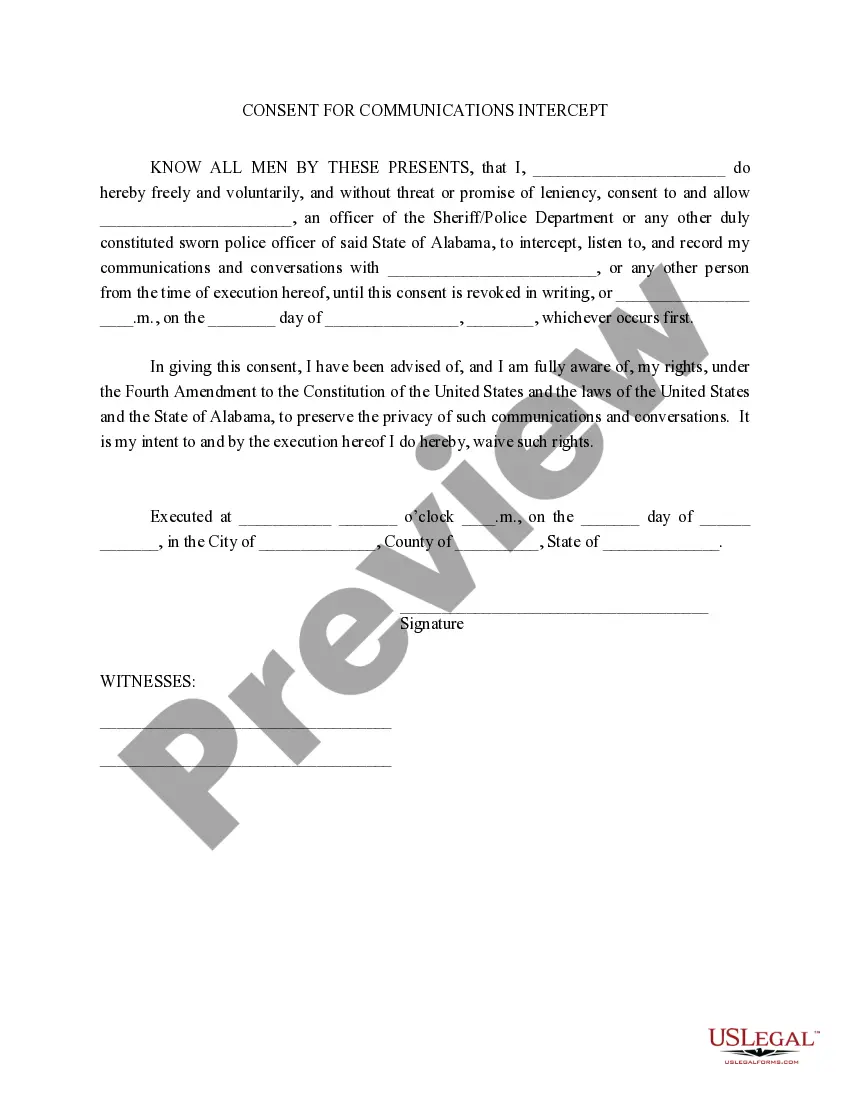
The Informant Agreement is a legal document that formalizes a relationship between an informant and law enforcement agencies. This form details the roles, responsibilities, and consent of the informant to assist in investigations by providing confidential information about criminal activities. Unlike other legal forms, this agreement specifically addresses the unique dynamics of informant participation in undercover work and outlines the guidelines to ensure safety and compliance with law enforcement protocols.
Form components explained
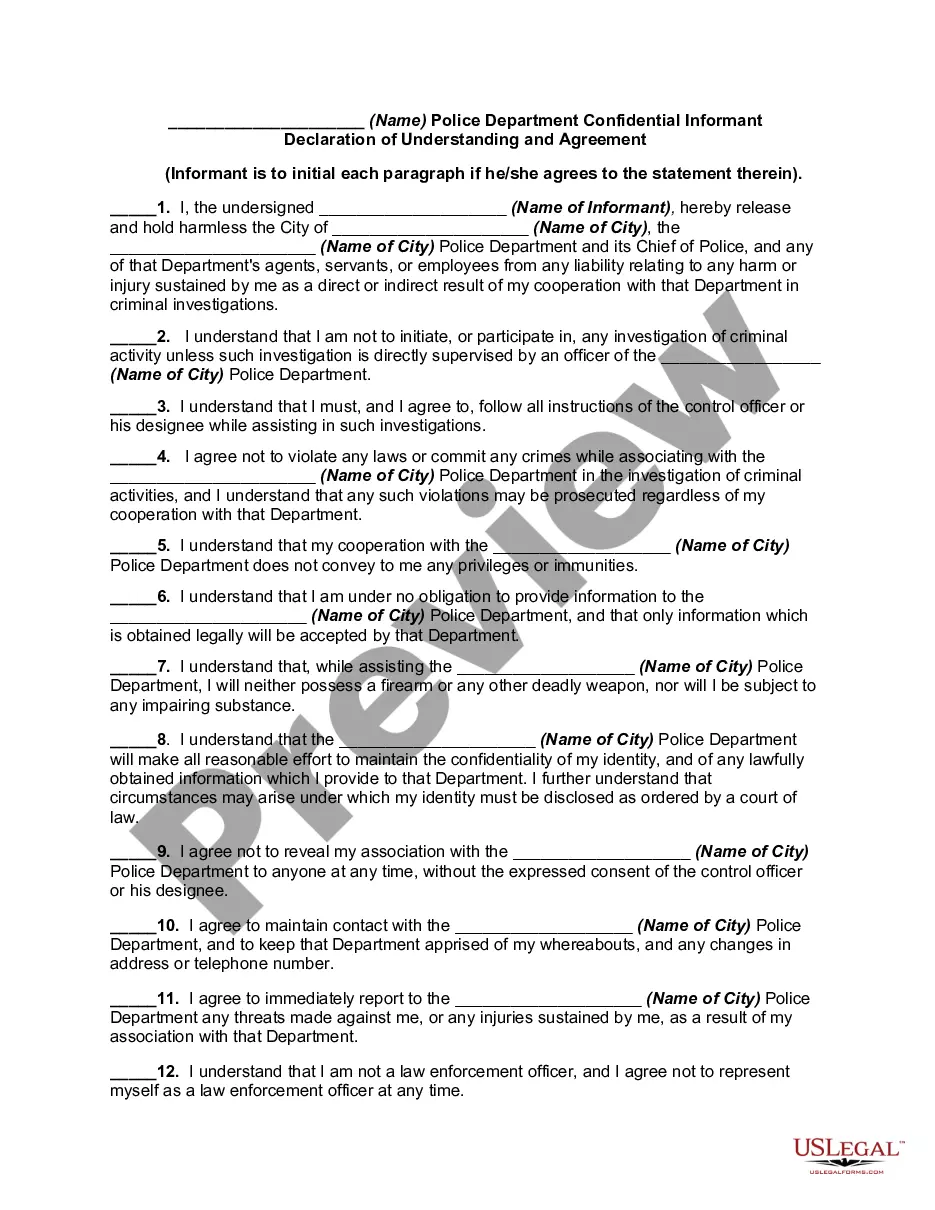
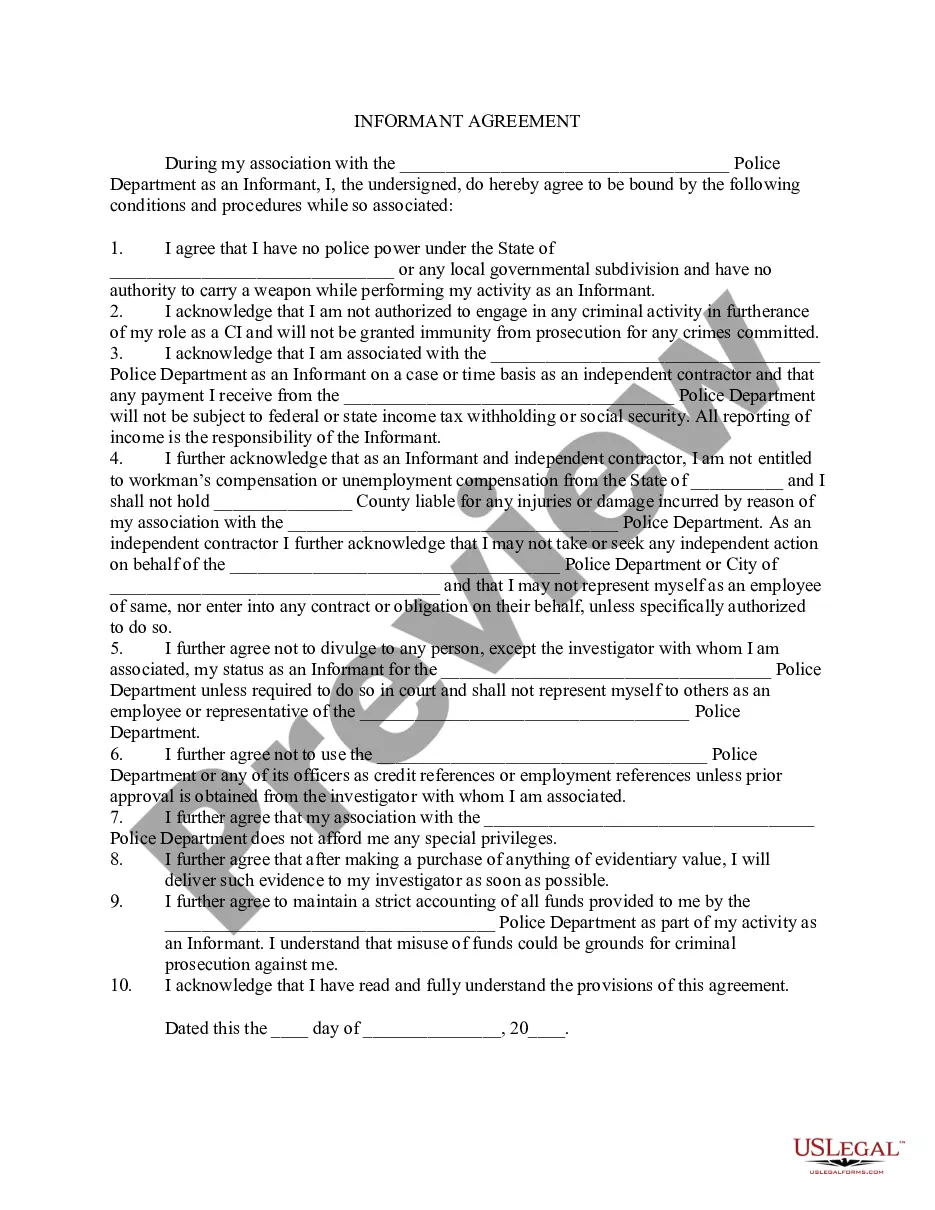
- Release of liability for law enforcement agencies.
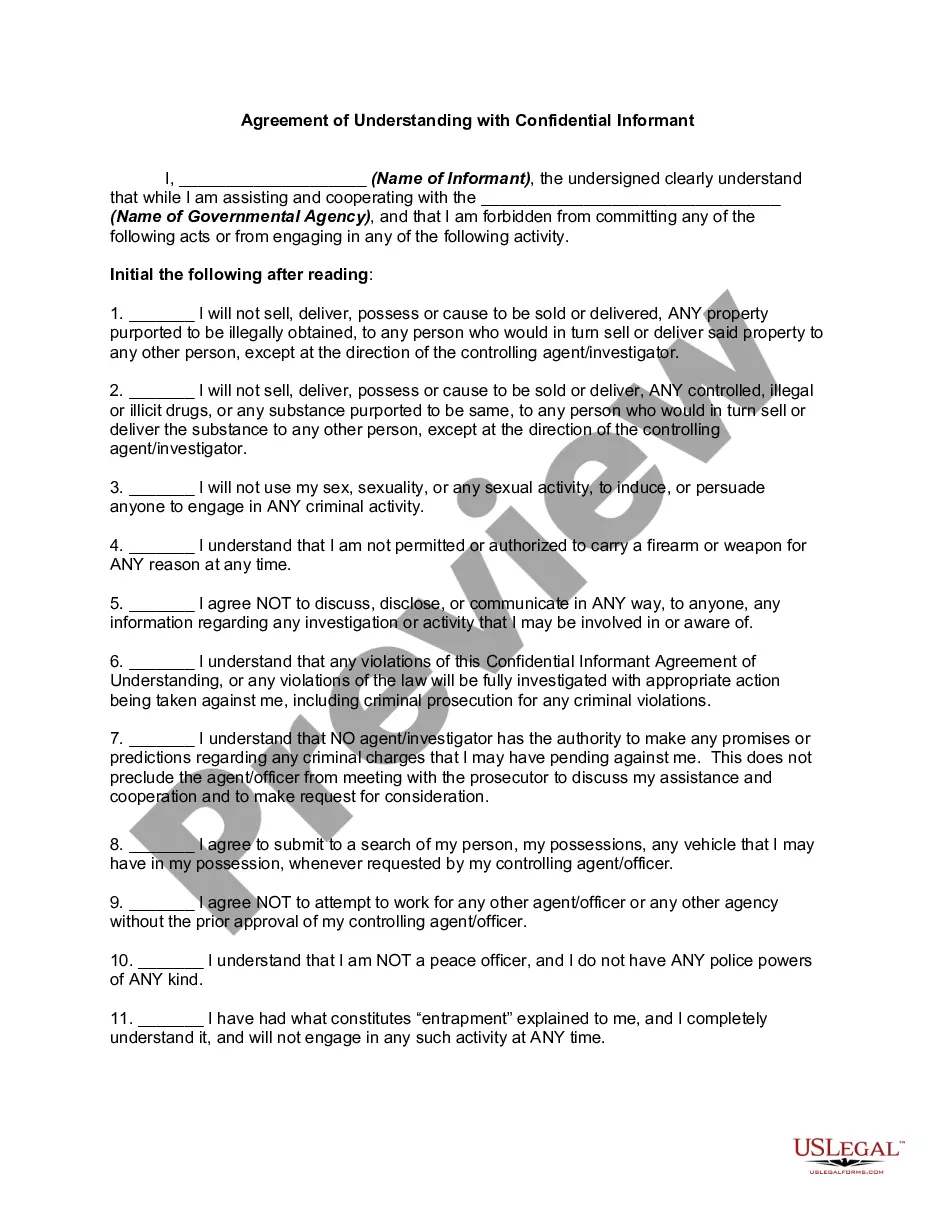
- Clarification of the informant's responsibilities and conduct.
- Conditions under which the informant must operate, including supervision and restrictions.
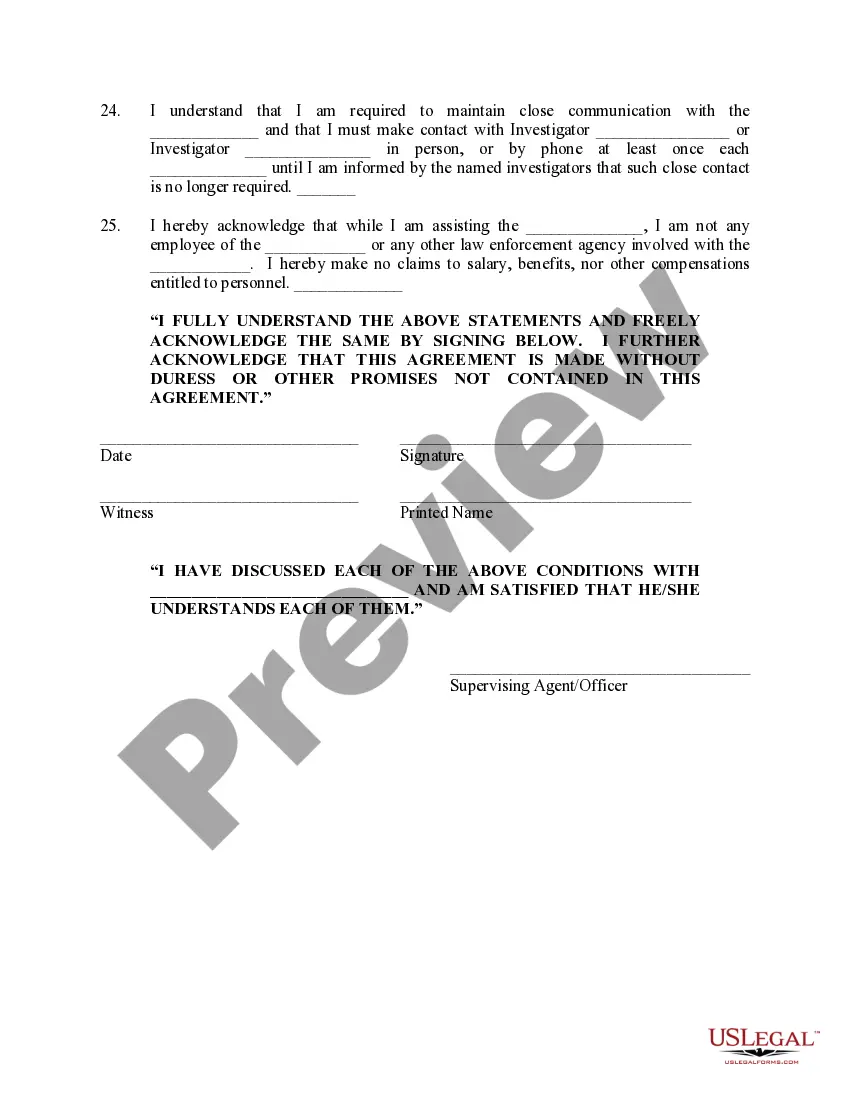
- Notification requirements for any changes in contact information.
- Stipulations regarding the informant's non-employment status with law enforcement.
When to use this form
This form should be used in situations where an individual agrees to act as an informant and provide confidential information about criminal activities to law enforcement. Common scenarios include drug investigations, intelligence gathering on criminal organizations, or other crime-related activities where law enforcement needs insider insight to build cases or carry out investigations effectively.
Who should use this form
This agreement is intended for:
- Individuals who have been approached by law enforcement to provide information.
- Those willing to assist law enforcement in collecting information about criminal activities.
- Any person needing to formalize their role as a confidential informant.
Steps to complete this form
- Begin by entering the name of the law enforcement agency you will be working with.
- Provide your personal details, including full name, address, and contact information.
- Review and acknowledge each responsibility and condition outlined in the agreement.
- Sign and date the form to confirm your agreement and understanding.
- Ensure that the supervising agent or officer also signs the document to validate the agreement.
Does this form need to be notarized?
Notarization is generally not required for this form. However, certain states or situations might demand it. You can complete notarization online through US Legal Forms, powered by Notarize, using a verified video call available anytime.
Get your form ready online
Our built-in tools help you complete, sign, share, and store your documents in one place.
Make edits, fill in missing information, and update formatting in US Legal Forms—just like you would in MS Word.
Download a copy, print it, send it by email, or mail it via USPS—whatever works best for your next step.
Sign and collect signatures with our SignNow integration. Send to multiple recipients, set reminders, and more. Go Premium to unlock E-Sign.
If this form requires notarization, complete it online through a secure video call—no need to meet a notary in person or wait for an appointment.
We protect your documents and personal data by following strict security and privacy standards.

Make edits, fill in missing information, and update formatting in US Legal Forms—just like you would in MS Word.

Download a copy, print it, send it by email, or mail it via USPS—whatever works best for your next step.

Sign and collect signatures with our SignNow integration. Send to multiple recipients, set reminders, and more. Go Premium to unlock E-Sign.

If this form requires notarization, complete it online through a secure video call—no need to meet a notary in person or wait for an appointment.

We protect your documents and personal data by following strict security and privacy standards.
Mistakes to watch out for
- Failing to read the agreement thoroughly, leading to misunderstandings of responsibilities.
- Not providing accurate contact information, which can jeopardize communication with law enforcement.
- Signing without ensuring that a supervising agent's signature is also present.
Benefits of using this form online
- Convenient access to a legally vetted template created by licensed attorneys.
- The form can be easily customized to fit individual needs and specific situations.
- Secure download ensures that your sensitive information is protected.
Looking for another form?
Form popularity
FAQ
They become CIs for the monetary reasons. Many confidential informants are paid, based on the case. Pay can range anywhere from $20 to thousands of dollars.Confidential informants' charges are not usually dismissed.
The general rule is that the prosecution doesn't have to disclose the identity of a confidential informant. However, this rule has many exceptions; if a criminal defendant can show the importance of the CI's identity to the case, it may be possible to find out who's been talking to the cops.
The Confidential Informant may be a drug dealer, a significant other, someone you are friends with, someone that works for you, someone that you work for, etc. The CI may be charged with a serious drug (or other) criminal offense.The CI knows he/she is working as a snitch, but you do not. You order drugs from the CI.
What do confidential informants do? CI's are regular folks that provide law enforcement with confidential, possibly damning, information against you.The CI may be charged with a serious drug (or other) criminal offense. The CI is assigned a CI number and agrees to provide information about your case to the police.
If you become a confidential informant for a local, state, or federal law enforcement agency, you could have your charges dropped, or more likely, have them and the potential punishment reduced. Being a confidential information can be helpful to your case. However, it is not always the best arrangement.
Yes: confidential informants can and do sell drugs and then their buyers may be arrested and charged with drug possession.
An informant may be considered anyone who is used through law enforcement agencies to provide information about criminal activity. This could be the illegal acts themselves, the criminals and their actions, where and when crimes may take place or similar activity.
Something feels off. Something about them just doesn't line up. Despite the misgivings of some members, the individual quickly rises to a leadership position. S/he photographs actions, meetings, and people that should not be photographed. S/he is a liar.
A. 2. Privileged confidential informants, defined as individuals who are under the obligation of a legal privilege of confidentiality (such as doctors, lawyers, and clergy) or individuals who are affiliated with the news media.