Alabama Probate Judge's Letter to Doctor
What this document covers
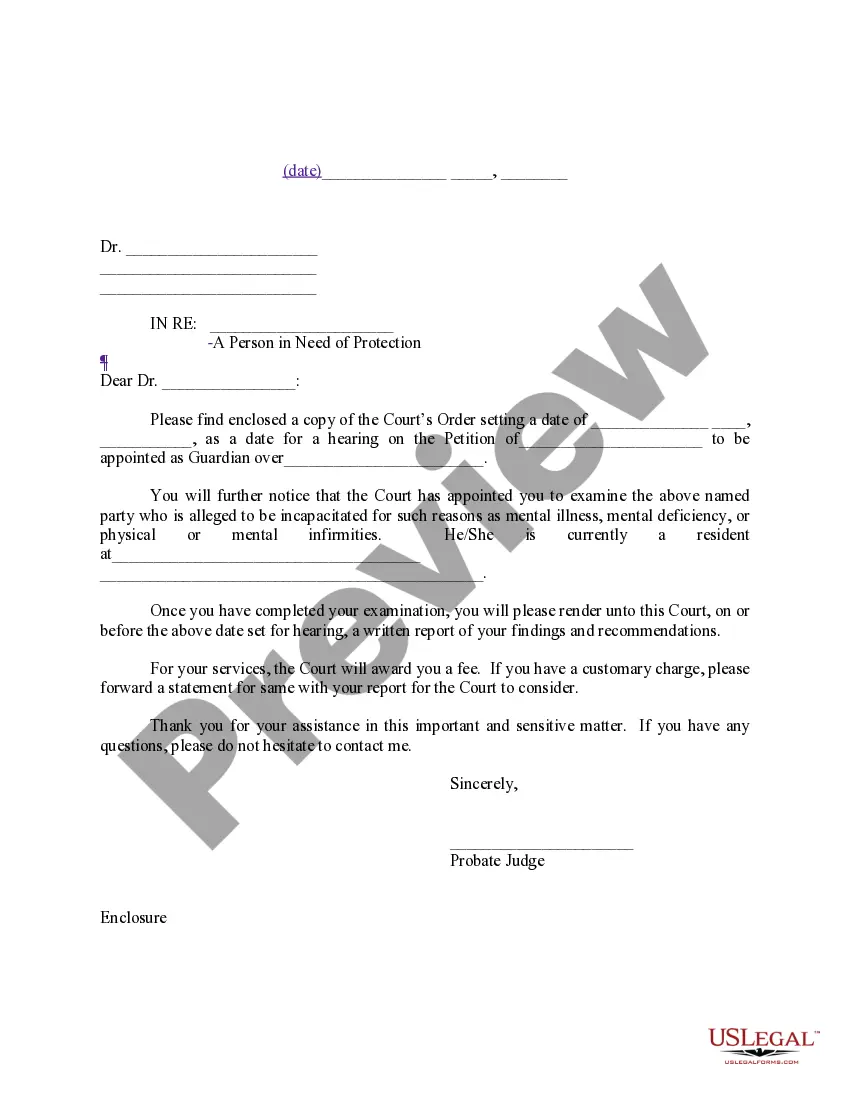
The Probate Judge's Letter to Doctor is a formal communication from a probate judge to a doctor assigned to evaluate an individual alleged to be incapacitated. This letter serves to request a detailed report from the doctor regarding their findings and recommendations prior to the court hearing. Unlike general medical requests, this form specifically ties the doctor's evaluation to legal proceedings concerning guardianship and mental health issues, making it essential for probate court matters.
Key components of this form
- Judicial order date: Indicates the scheduled date for the court hearing.
- Doctor's contact information: Specifies the recipient's details for clarity.
- Details of the individual under examination: Includes the name and reasons for the evaluation, such as mental illness or deficiencies.
- Instructions for report submission: Outlines the requirement for a written report by a specific deadline.
- Fee structure: Addresses the payment for the doctor's services associated with the examination.
When this form is needed
This form is used when a probate judge needs a professional medical evaluation of a party alleged to be incapacitated. It may be employed in scenarios such as determining guardianship for an individual unable to manage their personal and financial affairs due to mental or physical conditions. The letter is crucial in cases involving legal findings related to an individual's capacity.
Who should use this form
- Probate judges who are overseeing guardianship cases.
- Doctors tasked with evaluating individuals for incapacity.
- Legal representatives or guardians preparing for court hearings regarding a person's mental health or capacity.
- Family members seeking a legal diagnosis to assist in guardianship applications.
Completing this form step by step
- Fill in the date of the court hearing at the top of the letter.
- Enter the doctor's name and contact details at the beginning of the letter.
- Provide the name of the individual under examination and the reasons for their alleged incapacity.
- Specify the location where the individual resides, if relevant.
- State the deadline by which the doctor needs to submit their written report.
- Sign the letter as the Probate Judge before sending it to the doctor.
Notarization requirements for this form
This form does not typically require notarization unless specified by local law. However, it is advisable to verify local court regulations regarding submission procedures for legal documents.
Get your form ready online
Our built-in tools help you complete, sign, share, and store your documents in one place.
Make edits, fill in missing information, and update formatting in US Legal Forms—just like you would in MS Word.
Download a copy, print it, send it by email, or mail it via USPS—whatever works best for your next step.
Sign and collect signatures with our SignNow integration. Send to multiple recipients, set reminders, and more. Go Premium to unlock E-Sign.
If this form requires notarization, complete it online through a secure video call—no need to meet a notary in person or wait for an appointment.
We protect your documents and personal data by following strict security and privacy standards.

Make edits, fill in missing information, and update formatting in US Legal Forms—just like you would in MS Word.

Download a copy, print it, send it by email, or mail it via USPS—whatever works best for your next step.

Sign and collect signatures with our SignNow integration. Send to multiple recipients, set reminders, and more. Go Premium to unlock E-Sign.

If this form requires notarization, complete it online through a secure video call—no need to meet a notary in person or wait for an appointment.

We protect your documents and personal data by following strict security and privacy standards.
Common mistakes
- Failing to provide the correct court date, resulting in possible delays.
- Not including all necessary recipient information for the doctor.
- Omitting specific instructions regarding the report submission.
- Neglecting to sign the letter before sending.
Why complete this form online
- Easy to download and customize for individual cases.
- Accessible format in both Word and WordPerfect for maximum compatibility.
- Efficient and quick preparation to streamline court processes.
- Allows for secure storage and retrieval for future reference.
Legal use & context
- This form assists in establishing a medical basis for guardianship proceedings.
- It provides necessary documentation to support judicial decisions regarding incapacity.
- Timely submission of this letter can influence the court's perception of the case's urgency.
Quick recap
- The Probate Judge's Letter to Doctor is essential for guardianship assessments.
- Accurate completion ensures compliance and facilitates court processes.
- Utilizing this form can streamline the evaluation of an individual's capacity.
Looking for another form?
Form popularity
FAQ
If there is no Will, the Court will appoint someone to serve as the Personal Representative of the estate. Notice must be given to all heirs and beneficiaries, as required by the court. Once the Peititon for Probate is filed, a notice must be published in a newspaper where the decedent lived.
Alabama has a simplified probate process for small estates.The court may authorize the inheritor to distribute the assets without having to jump through the hoops of regular probate. You can use the simplified small estate process in Alabama if the estate has no real estate and a value of no more than $25,000.
In Alabama, the estate executor is known as a "personal representative". Executors for Alabama estates are entitled to reasonable compensation of up to 2.5% of assets received, and 2.5% of disbursements.
The length of time an executor has to distribute assets from a will varies by state, but generally falls between one and three years.
1Speak to a probate specialist over the phone to discuss the value and details of your loved one's estate.2Your probate application and tax forms are then prepared and sent to you to be signed.3The application is then submitted to the probate registry for approval.What are letters of administration? Farewill\nfarewill.com > articles > what-are-letters-of-administration
Generally, an executor has 12 months from the date of death to distribute the estate. This is known as 'the executor's year'. However, for various reasons the executor may have been delayed and has not distributed the estate within this time frame.
By law, the probate of an estate in Alabama will take at least six months. This period gives creditors and others with a claim on the estate time to receive notice that the estate is being probated and to submit a claim.
To obtain Letters Testamentary or Letters of Administration, the lawyer files a Petition for Grant of Letters Testamentary (if there is a will) or Petition for Grant of Letters of Administration (if there is no will) with the Alabama probate court.
According to Alabama Probate Code, probate must be filed within five years after the death of the owner of the estate.