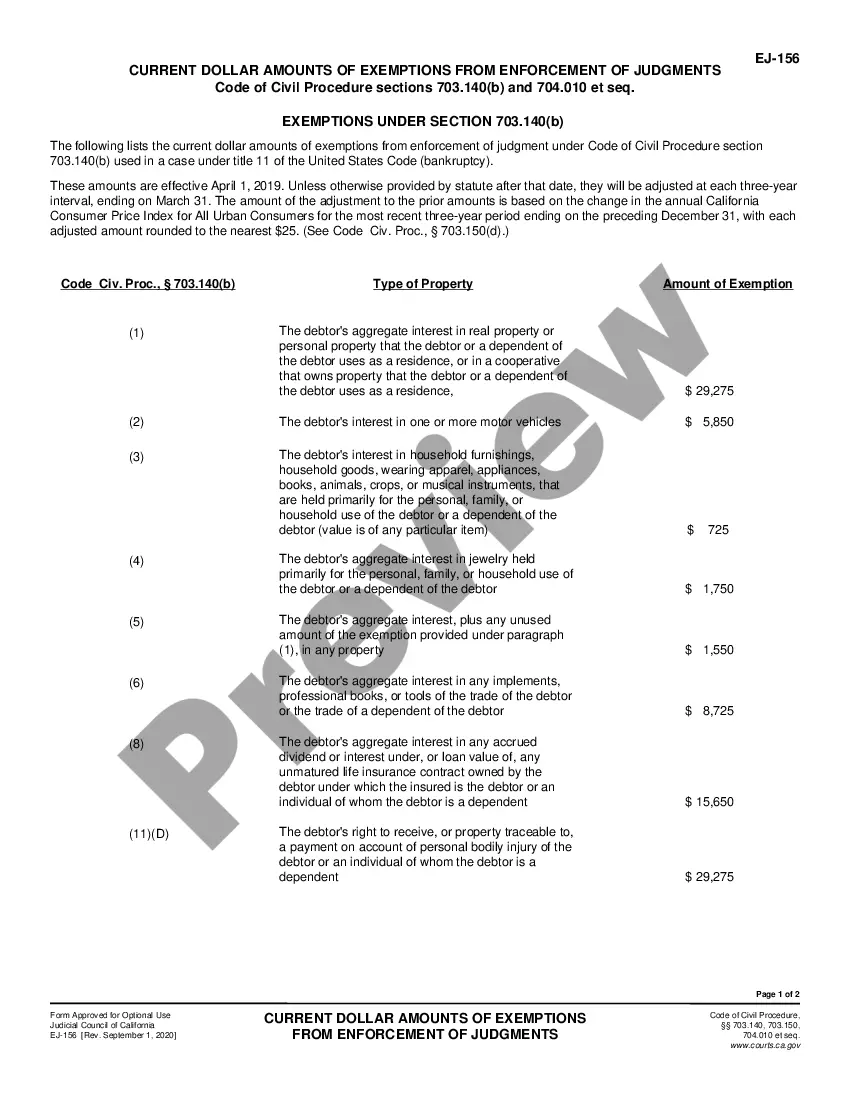
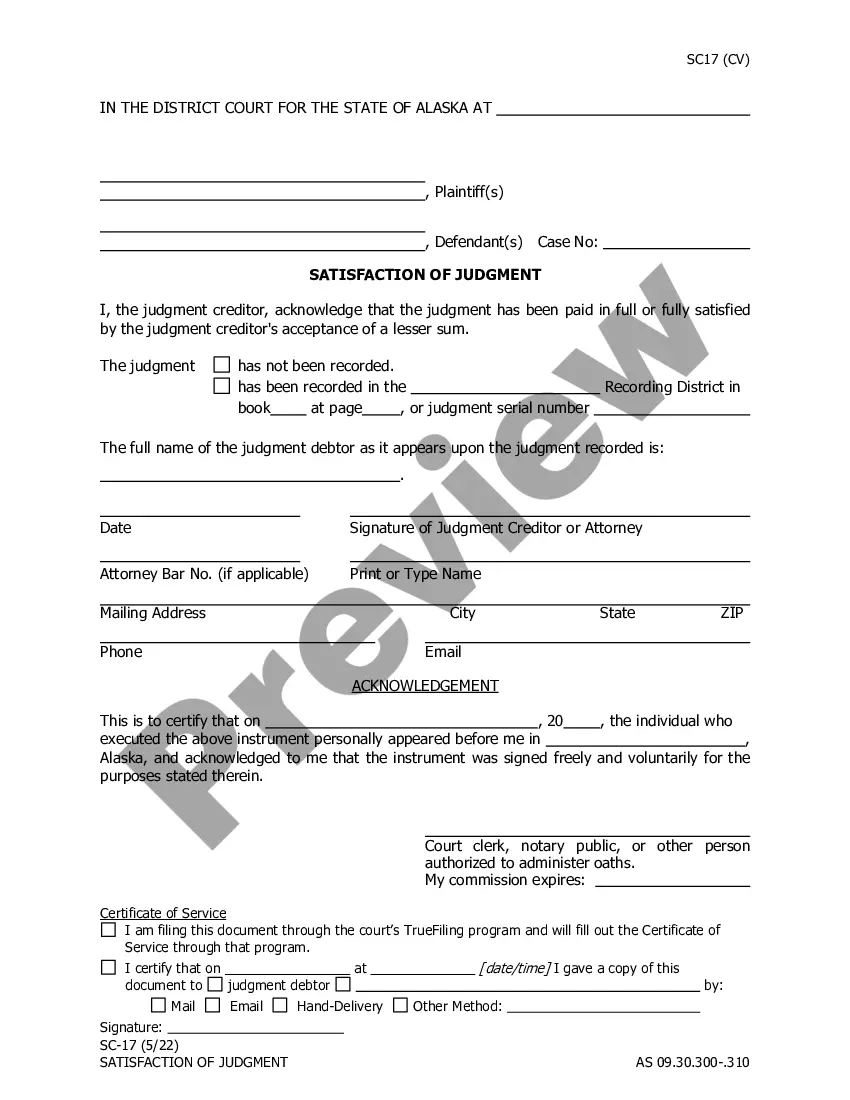
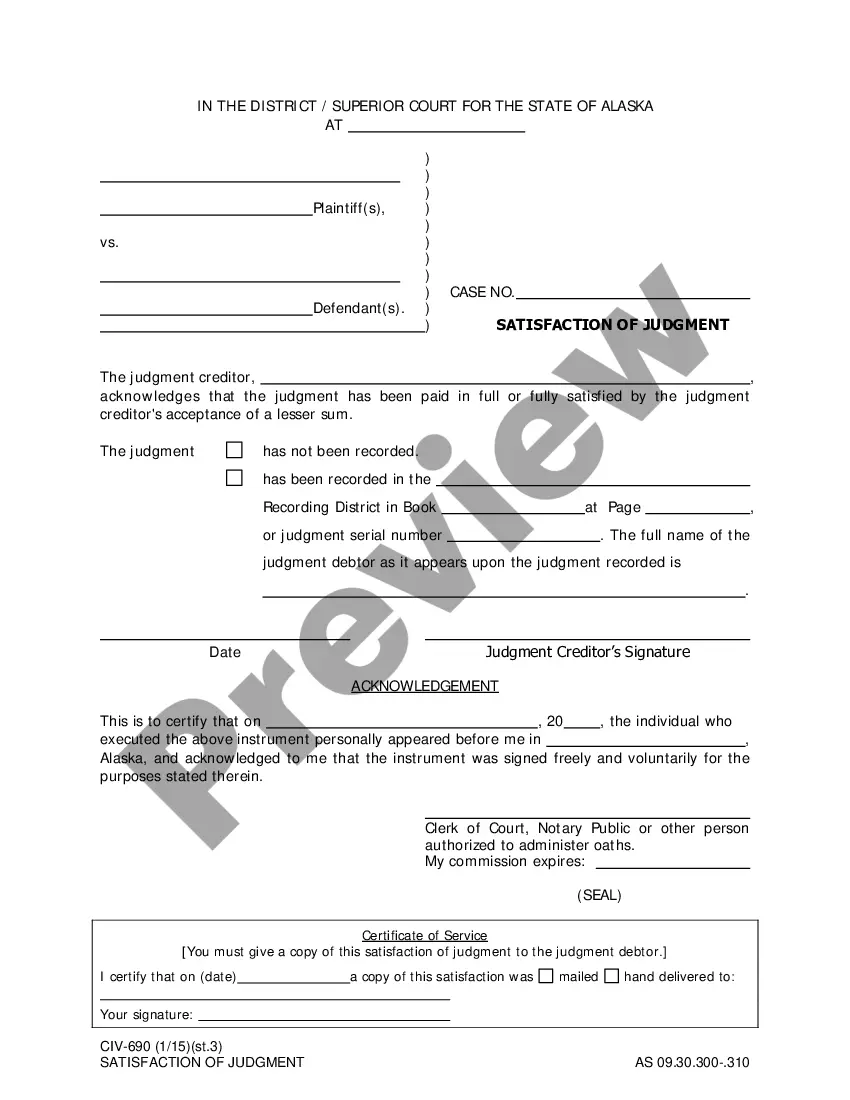
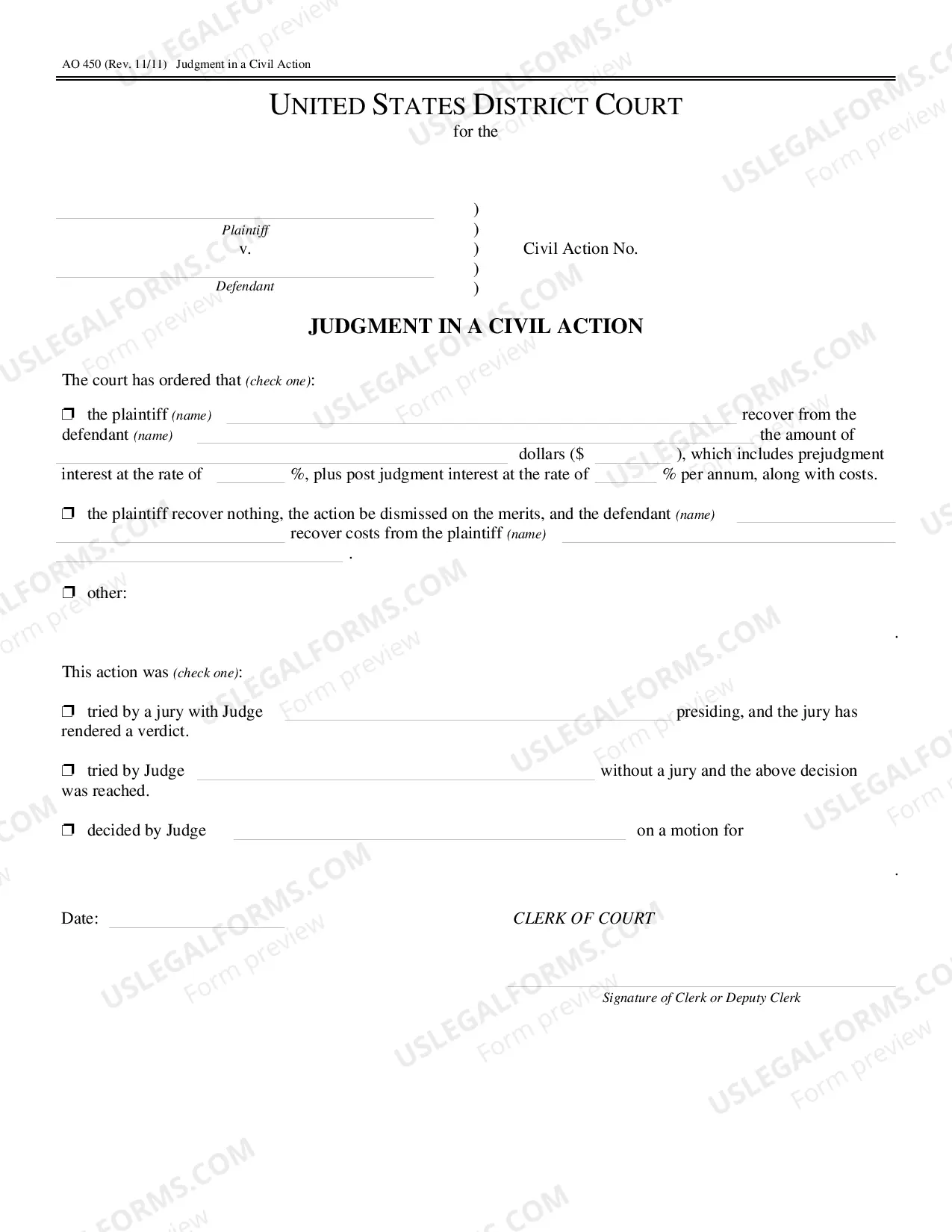
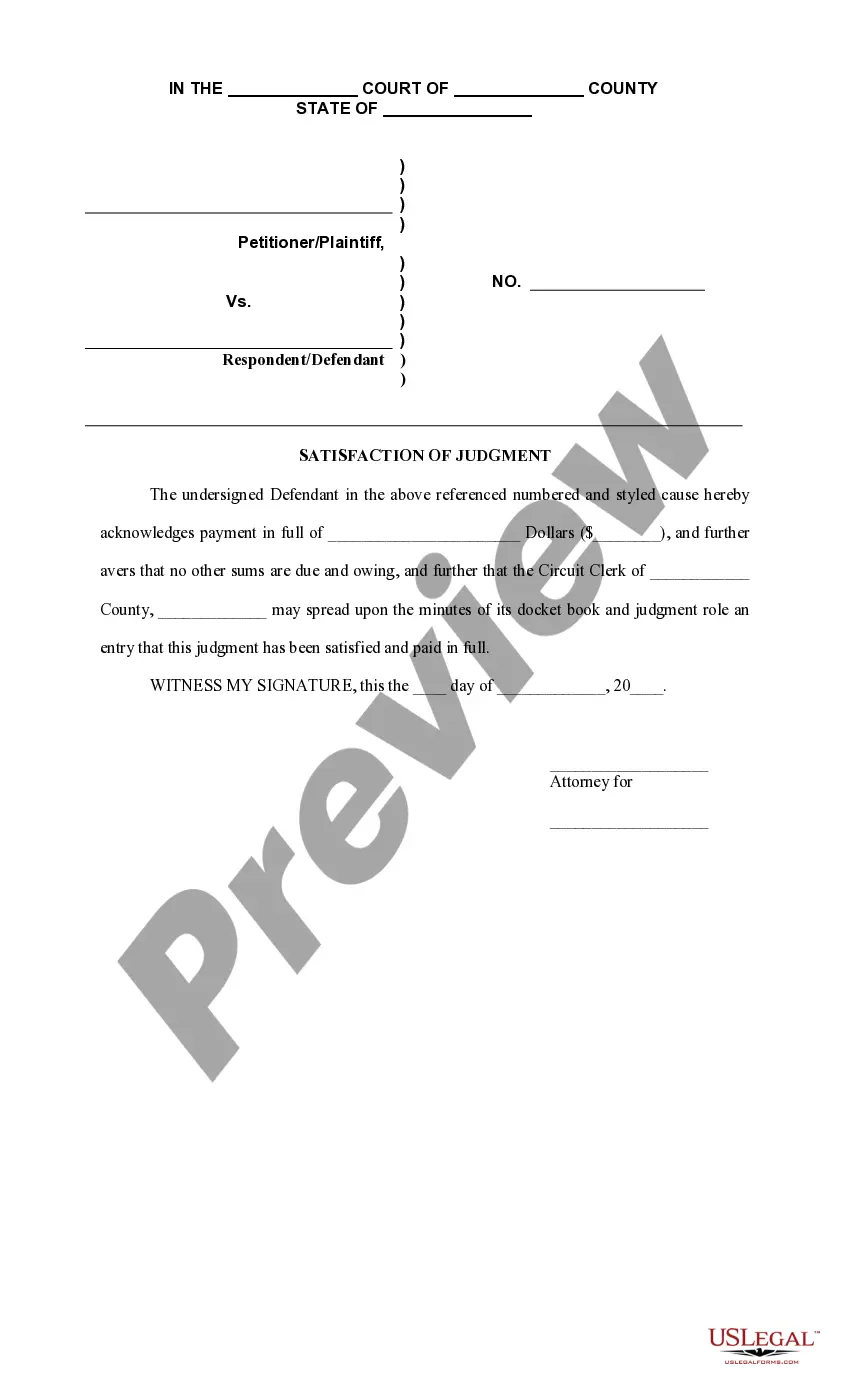
Satisfaction of Judgment, is an official form from the Alaska Court System, which complies with all applicable laws and statutes. USLF amends and updates the forms as is required by Alaska statutes and law.
Alaska Satisfaction of Judgment
Instant download
This website is not affiliated with any governmental entity
Public form
Description
Get your form ready online
Our built-in tools help you complete, sign, share, and store your documents in one place.
Built-in online Word editor
Make edits, fill in missing information, and update formatting in US Legal Forms—just like you would in MS Word.
Export easily
Download a copy, print it, send it by email, or mail it via USPS—whatever works best for your next step.
E-sign your document
Sign and collect signatures with our SignNow integration. Send to multiple recipients, set reminders, and more. Go Premium to unlock E-Sign.
Notarize online 24/7
If this form requires notarization, complete it online through a secure video call—no need to meet a notary in person or wait for an appointment.
Store your document securely
We protect your documents and personal data by following strict security and privacy standards.

Make edits, fill in missing information, and update formatting in US Legal Forms—just like you would in MS Word.

Download a copy, print it, send it by email, or mail it via USPS—whatever works best for your next step.

Sign and collect signatures with our SignNow integration. Send to multiple recipients, set reminders, and more. Go Premium to unlock E-Sign.

If this form requires notarization, complete it online through a secure video call—no need to meet a notary in person or wait for an appointment.

We protect your documents and personal data by following strict security and privacy standards.
Looking for another form?

How to fill out Alaska Satisfaction Of Judgment?
Leveraging Alaska Satisfaction of Judgment examples crafted by experienced attorneys allows you to bypass complications when preparing paperwork.
Simply download the example from our site, complete it, and ask a lawyer to review it.
This approach will save you significantly more time and effort than searching for an attorney to draft a document entirely from the beginning for you would.
Once you have completed all the steps above, you will be able to finish, print, and sign the Alaska Satisfaction of Judgment example. Remember to double-check all entered information for accuracy before submitting it or sending it out. Minimize the time you spend on document creation with US Legal Forms!
- Ensure that you are downloading the correct state-specific document.
- Use the Preview function and examine the description (if available) to determine if you need this particular example and if so, just click Buy Now.
- Look for another template using the Search bar if needed.
- Choose a subscription that fits your needs.
- Proceed using your credit card or PayPal.
- Pick a file format and download your file.
Form popularity
FAQ
The Satisfaction of Judgment form should be signed by the judgment creditor when the judgment is paid, and then filed with the court clerk. Don't forget to do this; otherwise, you may have to track down the other party later.
If the judgment creditor does not immediately file an Acknowledgement of Satisfaction of Judgment (EJ-100) when the judgment is satisfied, the judgment debtor may make a formal written demand for the creditor to do so. The judgment creditor has 15 days after receiving the debtor's request to serve the acknowledgement.
A Satisfaction of Judgment is a document signed by one party acknowledge receipt of the payment. The Satisfaction of Judgment is then filed with the court. This is beneficial to the paying party for multiple reasons. One, the court is put on notice that the debt has been satisfied.
Satisfaction of judgment. n. a document signed by a judgment creditor (the party owed the money judgment) stating that the full amount due on the judgment has been paid.
A document signed by the party who is owed money under a court judgment (called the judgment creditor) stating that the full amount due on the judgment has been paid.
Do not use illegal ways to collect your money. Encourage the debtor to pay you voluntarily. Be organized. Ask a lawyer or collection agency for help. Make sure you renew your judgment. Ask the court for help.
The defendant should ask for a letter confirming that the entire amount of the judgment has been paid. He or she may do so by sending a demand letter to the plaintiff. The release and satisfaction form is filed with the court clerk and entered into the case record.
A document signed by the party who is owed money under a court judgment (called the judgment creditor) stating that the full amount due on the judgment has been paid.