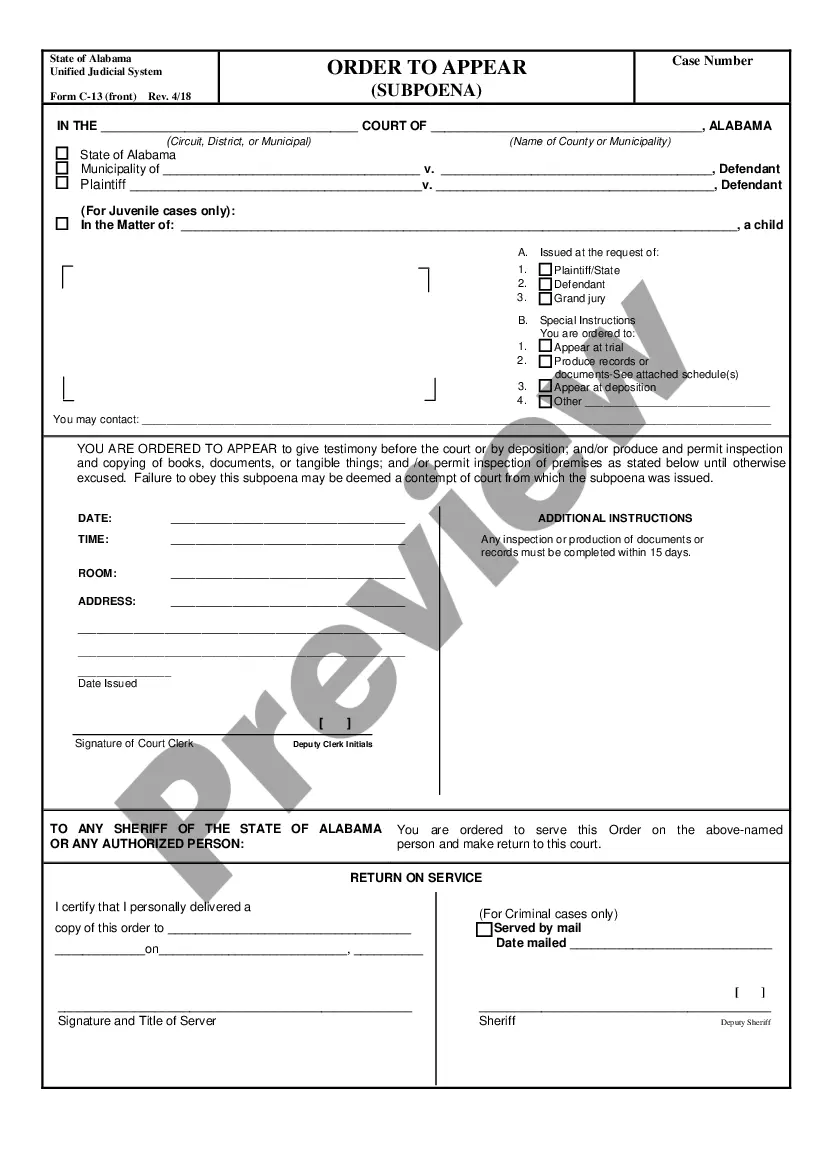
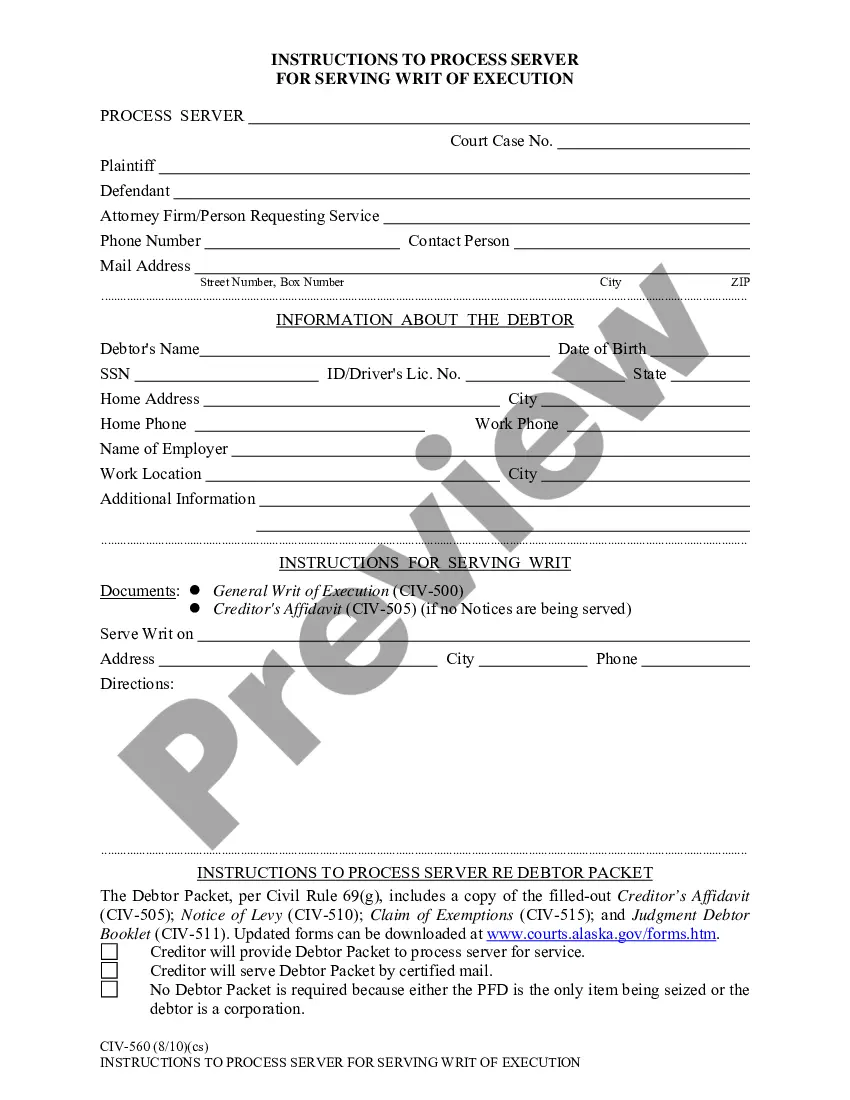
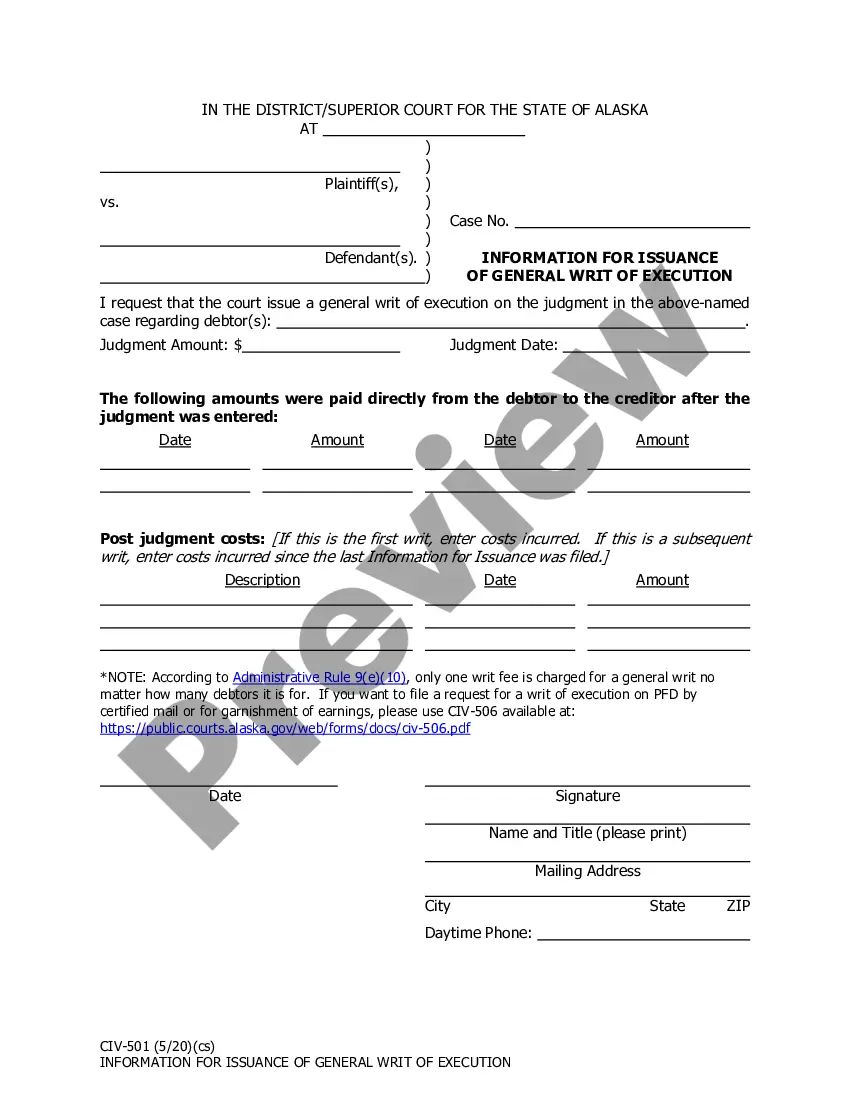
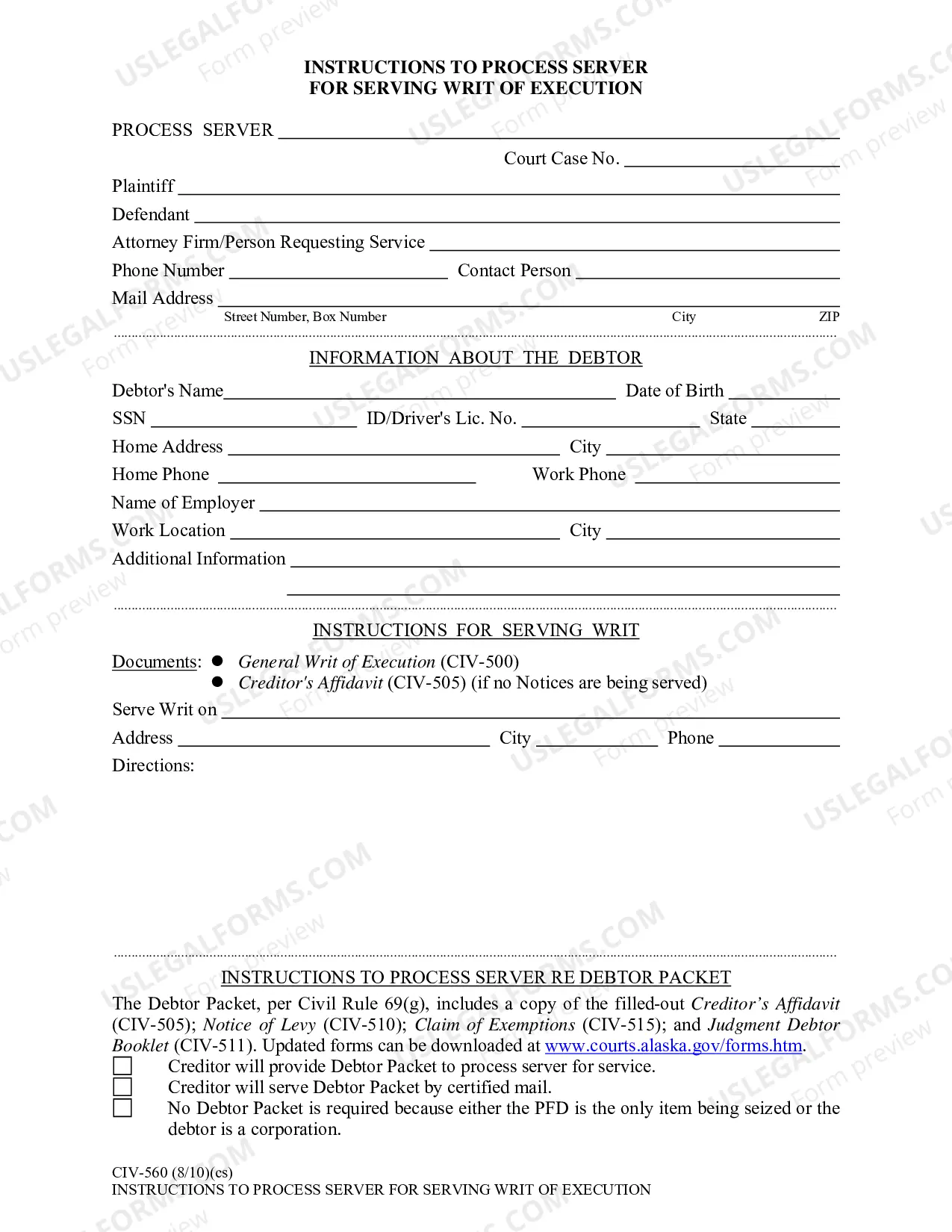
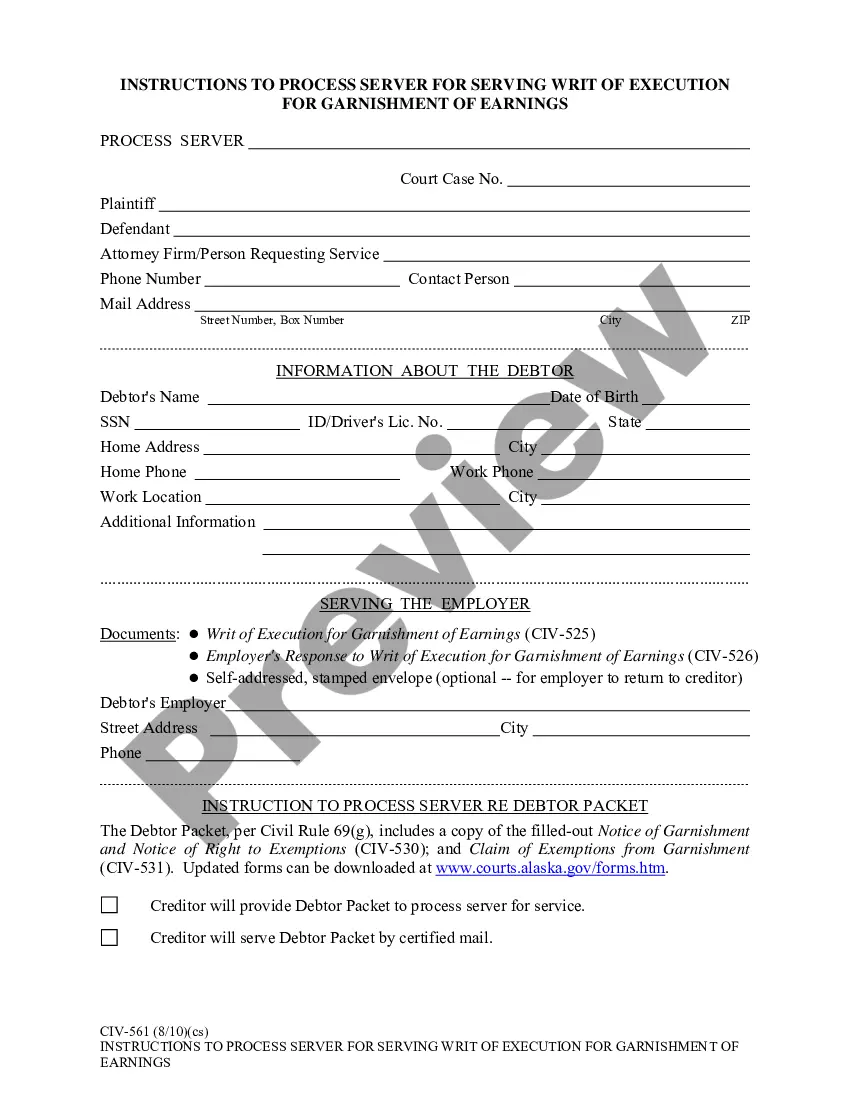
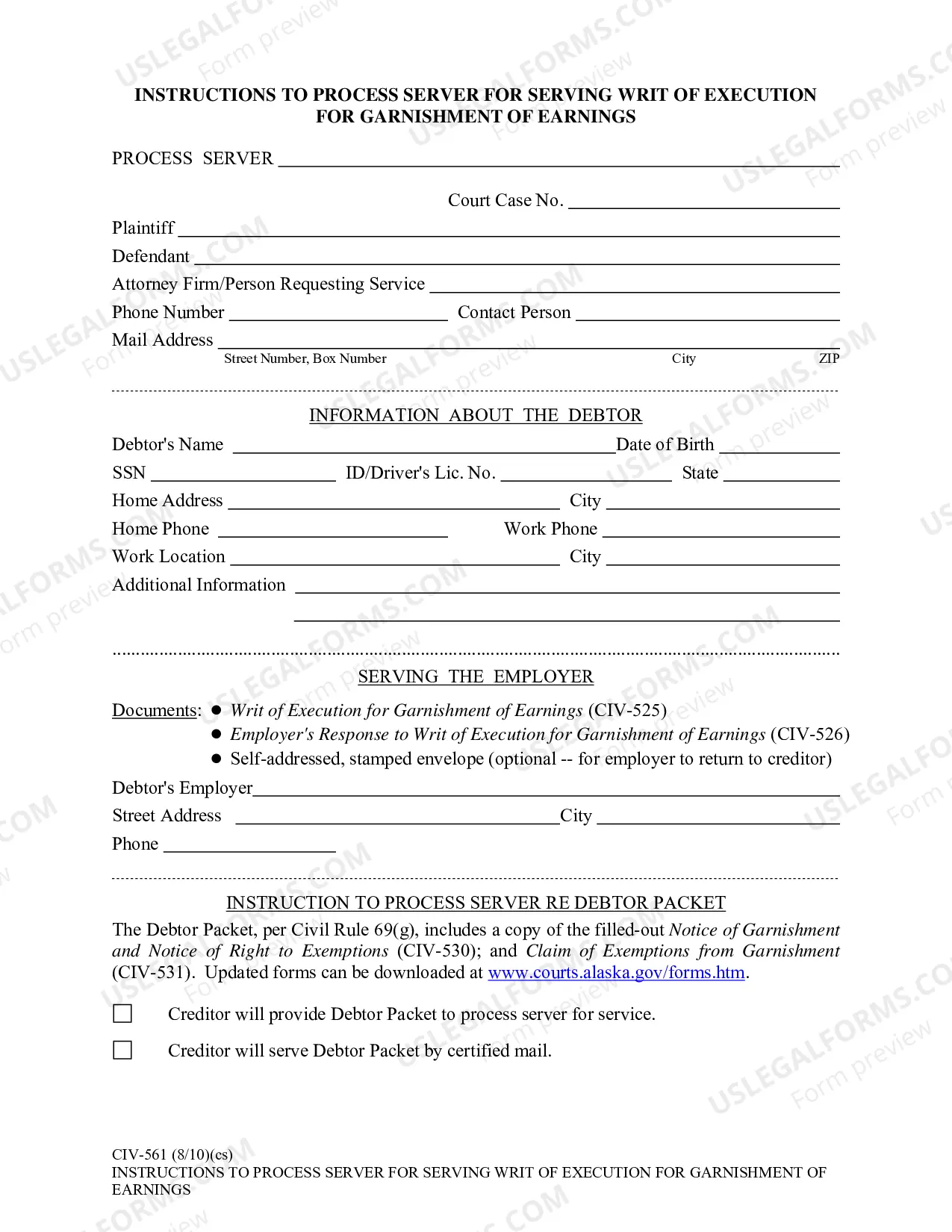
Instructions to Process Server for Serving Writ of Execution, is an official form from the Alaska Court System, which complies with all applicable laws and statutes. USLF amends and updates the forms as is required by Alaska statutes and law.
Alaska Instructions to Process Server for Serving Writ of Execution, CIV-560
State:
Alaska
Control #:
AK-CIV-560
Format:
PDF
Instant download
This website is not affiliated with any governmental entity
Public form
Description
Get your form ready online
Our built-in tools help you complete, sign, share, and store your documents in one place.
Built-in online Word editor
Make edits, fill in missing information, and update formatting in US Legal Forms—just like you would in MS Word.
Export easily
Download a copy, print it, send it by email, or mail it via USPS—whatever works best for your next step.
E-sign your document
Sign and collect signatures with our SignNow integration. Send to multiple recipients, set reminders, and more. Go Premium to unlock E-Sign.
Notarize online 24/7
If this form requires notarization, complete it online through a secure video call—no need to meet a notary in person or wait for an appointment.
Store your document securely
We protect your documents and personal data by following strict security and privacy standards.

Make edits, fill in missing information, and update formatting in US Legal Forms—just like you would in MS Word.

Download a copy, print it, send it by email, or mail it via USPS—whatever works best for your next step.

Sign and collect signatures with our SignNow integration. Send to multiple recipients, set reminders, and more. Go Premium to unlock E-Sign.

If this form requires notarization, complete it online through a secure video call—no need to meet a notary in person or wait for an appointment.

We protect your documents and personal data by following strict security and privacy standards.
Looking for another form?


How to fill out Alaska Instructions To Process Server For Serving Writ Of Execution, CIV-560?
Utilizing Alaska Guidelines for Process Server Regarding Serving Writ of Execution examples crafted by experienced lawyers allows you to avoid complications when completing forms.
Simply obtain the template from our site, fill it out, and ask a lawyer to review it.
Doing this can conserve significantly more time and effort compared to asking legal assistance to create a document for you.
Utilize the Preview option and review the description (if available) to ascertain if you require this particular example; if you do, click Buy Now.
- If you already possess a US Legal Forms subscription, just Log In to your account and return to the form webpage.
- Locate the Download button next to the template you are examining.
- After obtaining a document, you will find all of your saved templates in the My documents section.
- If you lack a subscription, that’s no issue.
- Simply follow the steps below to register for an account online, obtain, and complete your Alaska Guidelines for Process Server for Serving Writ of Execution template.
- Double-check to ensure that you are downloading the correct state-specific form.
Form popularity
FAQ
Can you refuse to accept court papers from a process server? If a process server comes to serve you (the respondent) with court papers and you refuse to accept them. The process server can leave the documents by your feet and that would considered as a successful Service of Process.
Generally, process servers make at least three attempts to serve somebody. These attempts are normally made at different times of day and on different days to maximize our chance of serving the papers.
No, the courts have said. Failure to answer the door does not constitute evasion of service. You don't have to answer the door when a door-to-door salesmen or a politician comes knocking, so you don't have to answer the door when the process server comes knocking.
Process servers will call you, but they won't threaten you over the phone. A process server is always paid by the party hiring them to deliver legal documents. Whether it's a divorce, child support, or debt collection case, the party being served will never pay the server directly.
Can Someone Refuse to Be Served Papers? No, in California a person cannot refuse to accept service. If we can identify a person on whom legal service can be made either personally or by sub-service and they refuse to accept the documents, we can absolutely still serve them.
If a Defendant Does Not Answer the Door A process server cannot compel a defendant to answer the door. In some cases, people who know a lawsuit has been filed against them will attempt to avoid service.He or she will have to come back on another date if the defendant refuses to open the door.
It's not illegal to avoid being served with a process, but it is rarely advantageous. In some cases, it can result in court orders and decisions being made without your knowledge, and it always results in longer and more expensive litigations.