Wyoming Notice of Lease for Recording
Understanding this form
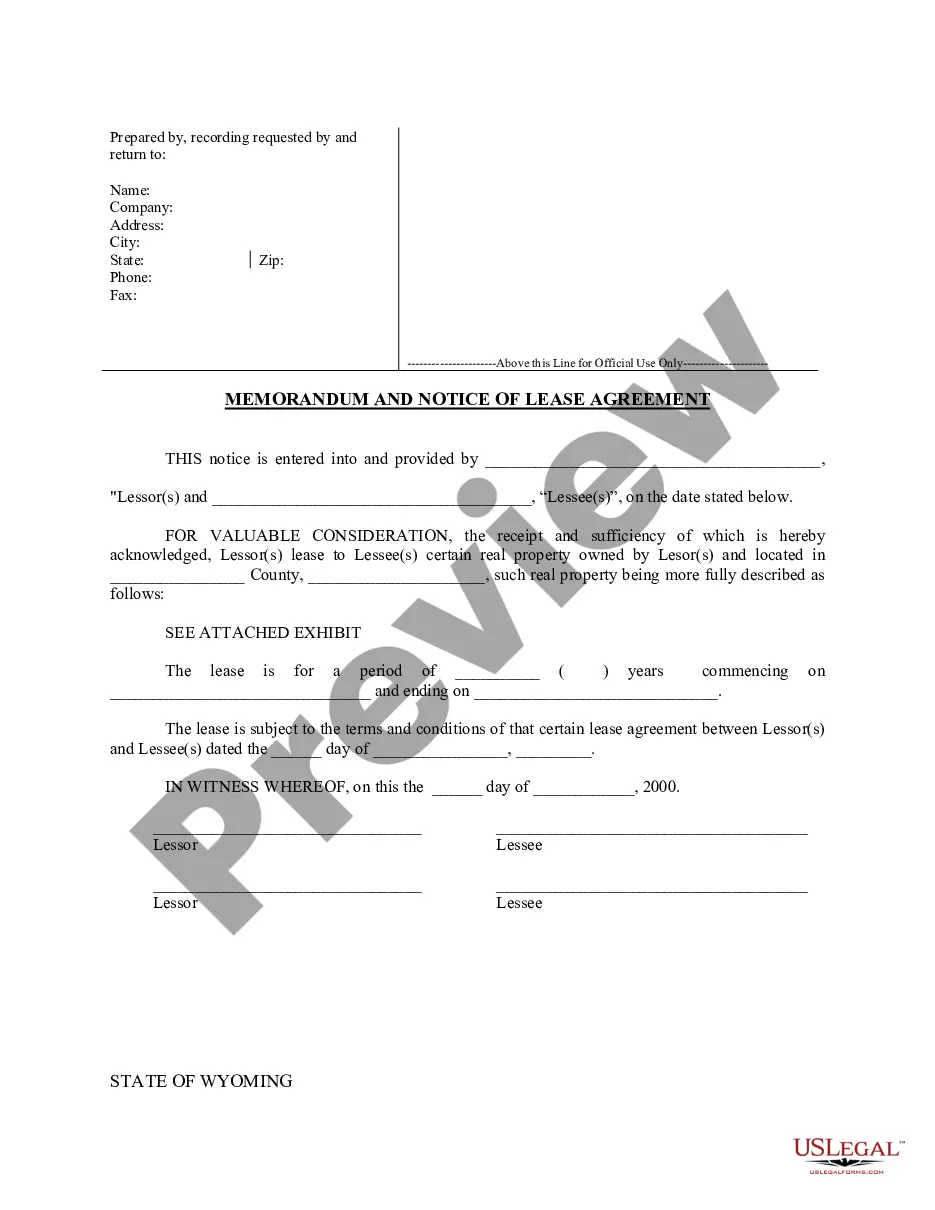
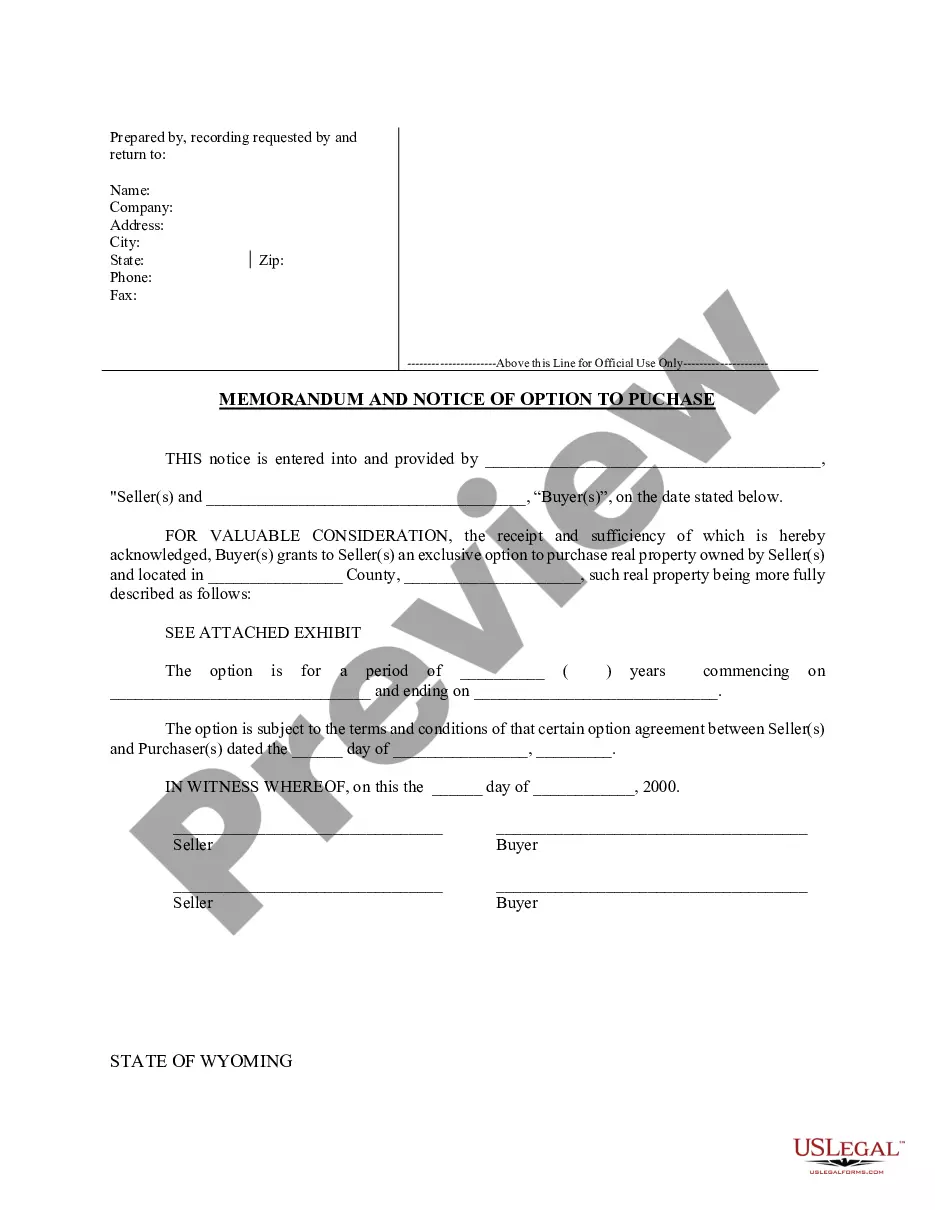
The Notice of Lease for Recording is a legal document that officially records the existence of a lease on a specific parcel of real estate. This form serves as a memorandum of the lease, allowing the parties involved to notify third parties without requiring the full lease agreement to be recorded. This provides a clear, legal acknowledgment of tenancy while protecting the property rights of the lessor.
Main sections of this form
- Prepared by and recording information including name, company, address, city, state, and zip code.
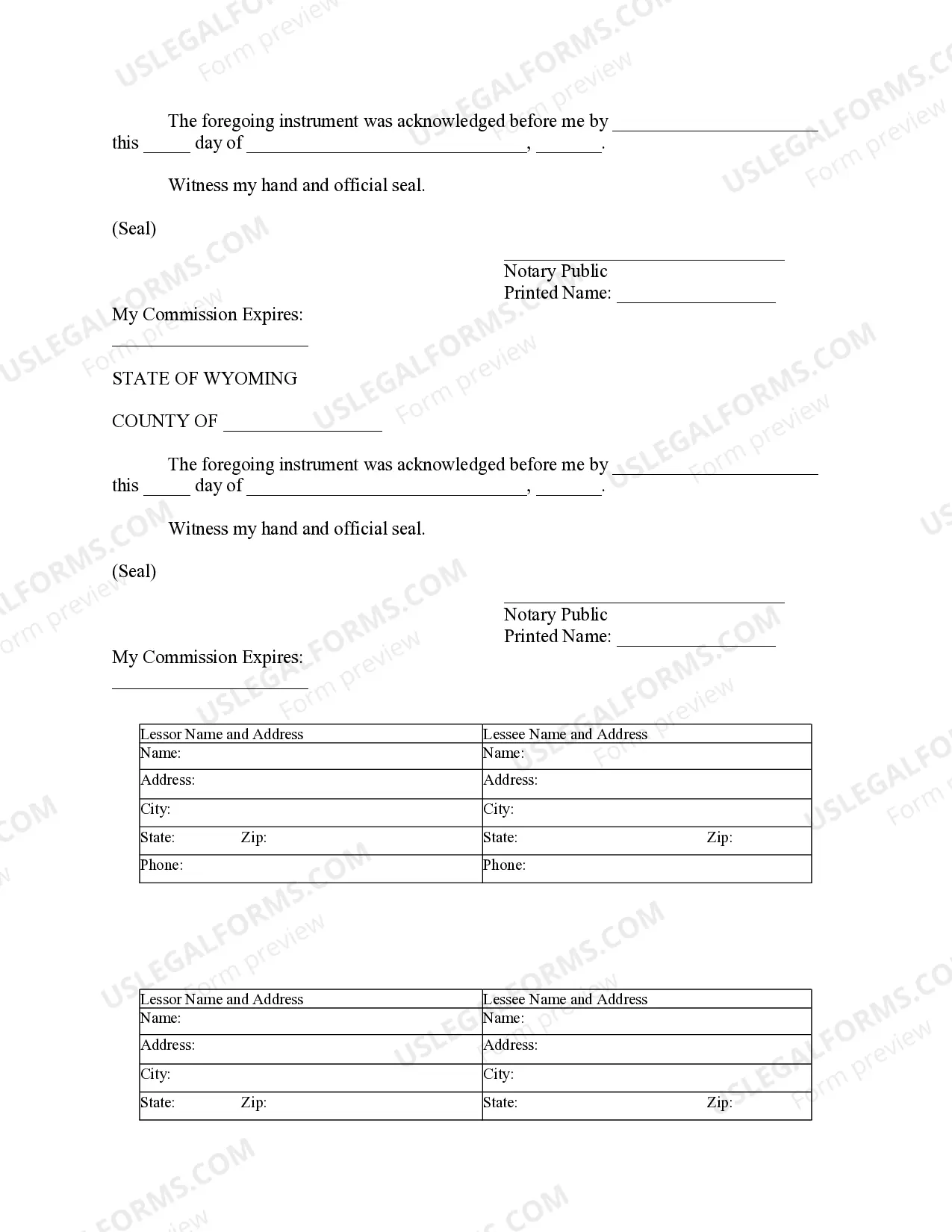
- Details about the lessor(s) and lessee(s) including names and signatures.
- Description of the leased property, specifying the county and particulars of the parcel.
- Timeframe of the lease, including the start and end dates.
- Signature section with notary acknowledgment to verify the agreement.

When to use this document
This form is used when a landlord or property owner wants to provide public notice of a lease agreement without recording the entire lease document. It is particularly useful when leasing commercial or residential property, allowing potential buyers or lenders to be aware of existing agreements that may affect property rights.
Intended users of this form
This form is intended for:
- Property owners or lessors who have entered into a lease agreement.
- Tenants or lessees who need to ensure that their lease is officially recognized in public records.
- Real estate professionals and attorneys managing property agreements.
Instructions for completing this form
- Identify the parties involved, including the lessor(s) and lessee(s).
- Specify the real property being leased, including complete address and legal description.
- Enter the lease term duration, noting both the start and end dates.
- Include the date of the lease agreement for reference.
- Gather signatures from all parties involved, and ensure the document is notarized as required.
Is notarization required?
This document requires notarization to meet legal standards. US Legal Forms provides secure online notarization powered by Notarize, allowing you to complete the process through a verified video call, available 24/7.
Get your form ready online
Our built-in tools help you complete, sign, share, and store your documents in one place.
Make edits, fill in missing information, and update formatting in US Legal Forms—just like you would in MS Word.
Download a copy, print it, send it by email, or mail it via USPS—whatever works best for your next step.
Sign and collect signatures with our SignNow integration. Send to multiple recipients, set reminders, and more. Go Premium to unlock E-Sign.
If this form requires notarization, complete it online through a secure video call—no need to meet a notary in person or wait for an appointment.
We protect your documents and personal data by following strict security and privacy standards.

Make edits, fill in missing information, and update formatting in US Legal Forms—just like you would in MS Word.

Download a copy, print it, send it by email, or mail it via USPS—whatever works best for your next step.

Sign and collect signatures with our SignNow integration. Send to multiple recipients, set reminders, and more. Go Premium to unlock E-Sign.

If this form requires notarization, complete it online through a secure video call—no need to meet a notary in person or wait for an appointment.

We protect your documents and personal data by following strict security and privacy standards.
Common mistakes
- Failing to include complete property descriptions, which can lead to confusion regarding the leased premises.
- Not obtaining proper signatures from all parties, making the document unenforceable.
- Neglecting to notarize the form when required, which may invalidate the recording.
Benefits of using this form online
- Convenient access: Download the form anytime, from anywhere.
- Editability: Easily fill out the form to meet specific needs.
- Reliable templates drafted by licensed attorneys, ensuring legal accuracy.
Key takeaways
- The Notice of Lease for Recording is vital for establishing a public record of a lease agreement.
- This form protects both lessors and lessees by documenting the existence of the lease.
- Accurate completion requires attention to detail, particularly in the property description and signatures.
Looking for another form?
Form popularity
FAQ
When you rent a property from a landlord it becomes your home. They should only enter the property without you being present, if you have given permission for them to do so, or in a genuine emergency.
Entry Allowed with Notice for Maintenance and Repairs (non-emergency): Yes. In general, tenants are prohibited from unreasonably denying access to the rental unit or refusing a landlord entry (Wyo. Stat. § 1-21-1205).
File for eviction with your local courthouse. Gather evidence. Come to the court hearing to prove your case. Win a writ of possession and have the tenant removed by the sheriff.
Step 1: Notice is Posted. Step 2: Complaint is Filed and Served. Step 3: Court Hearing and Judgment. Step 4: Writ of Restitution Is Issued. Step 5: Possession of Property is Returned.
WYOMING is considered a One-Party Consent State, in that at least one person involved in the recorded communication must give permission.
From the Wyoming State Code § 7-3-702: It is legal for a party to a wire, oral or electronic communication to record that communication, and it is legal for anyone to record with the consent of one of the parties to a communication, unless the communication is intercepted to further a criminal or tortious purpose.
Yes, your tenant is within their rights to refuse you access to the property. In a lot of cases, tenants will refuse because the date and time isn't convenient for them and will suggest an alternative date or ask you to rearrange. However, some tenants will persistently try to obstruct you from entering the property.
The big take-away is that in most circumstances a landlord cannot enter a property without agreement from the tenant. And If the landlord ignores the law and enters the property without permission, the tenant may be able to claim damages or gain an injunction to prevent the landlord doing it again.
A landlord cannot legally evict you without a court order, whether or not you have a lease.) How long does it take for a landlord to evict a tenant? A landlord can evict a tenant only by going through a formal eviction proceeding, which can take a few weeks from start to finish.