West Virginia Owner's Information Sheet - Horse Equine Forms
Overview of this form
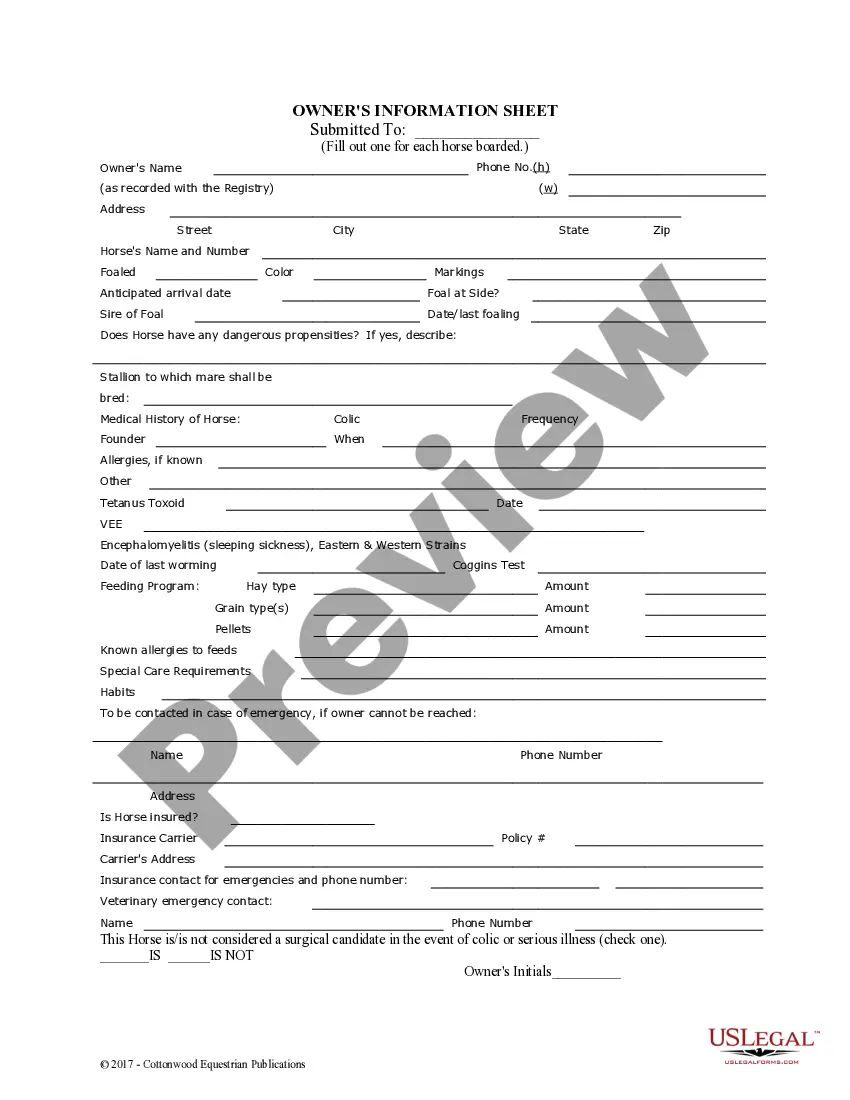
The Owner's Information Sheet is a specific legal document designed for horse owners. It serves to collect essential details about each horse that is boarded or receiving other services. By ensuring that all relevant information is documented, this form helps facilitate communication between the horse owner and the service provider, enhancing care and safety for the horse. This form is distinct from other general equine documents, as it focuses specifically on gathering comprehensive owner and horse information.
Key parts of this document
- Ownerâs contact information, including phone numbers and address.
- Details about each horse, such as name, number foaled, color, and markings.
- Medical history, including previous conditions and vaccinations.
- Your horse's feeding program and any known allergies.
- Emergency contact information for both the owner and veterinary assistance.
- Insurance details, including carrier information and policy numbers.
When to use this document
This form should be used whenever a horse is boarded at a facility or when services for the horse are requested. It is crucial for horse owners to provide this information well in advance of the horse's arrival to ensure proper care and safety measures are in place. The form helps service providers address specific needs and manage emergencies effectively.
Who can use this document
- Horse owners who plan to board their horses.
- Equine service providers that require detailed information from horse owners.
- Veterinarians or emergency services needing rapid access to a horseâs medical history.
Completing this form step by step
- Fill out the owner's name and contact information clearly at the top of the form.
- Provide details for each horse, including name, foaling year, color, and any unique markings.
- Document medical history, including any known medical conditions and vaccination dates.
- List emergency contact details and ensure that they can be reached if necessary.
- Complete insurance information, ensuring that all necessary policy details are included.
Does this form need to be notarized?
This form does not typically require notarization unless specified by local law. Always check your jurisdictionâs specific requirements for boarding agreements and equine services.
Get your form ready online
Our built-in tools help you complete, sign, share, and store your documents in one place.
Make edits, fill in missing information, and update formatting in US Legal Forms—just like you would in MS Word.
Download a copy, print it, send it by email, or mail it via USPS—whatever works best for your next step.
Sign and collect signatures with our SignNow integration. Send to multiple recipients, set reminders, and more. Go Premium to unlock E-Sign.
If this form requires notarization, complete it online through a secure video call—no need to meet a notary in person or wait for an appointment.
We protect your documents and personal data by following strict security and privacy standards.

Make edits, fill in missing information, and update formatting in US Legal Forms—just like you would in MS Word.

Download a copy, print it, send it by email, or mail it via USPS—whatever works best for your next step.

Sign and collect signatures with our SignNow integration. Send to multiple recipients, set reminders, and more. Go Premium to unlock E-Sign.

If this form requires notarization, complete it online through a secure video call—no need to meet a notary in person or wait for an appointment.

We protect your documents and personal data by following strict security and privacy standards.
Avoid these common issues
- Leaving out key medical history or vaccination details.
- Failing to update emergency contact information.
- Not specifying known allergies which could affect care.
Advantages of online completion
- Easy access and instant download for immediate use.
- Editable fields allow for customization according to individual needs.
- Reliable templates drafted by licensed attorneys, ensuring legal compliance.
Legal use & context
- Provides a clear record of care and emergency instructions for the horse
- Helps establish accountability for the horseâs well-being during boarding
- Can be useful in legal disputes regarding horse care or boarding agreements
Quick recap
- The Owner's Information Sheet is essential for horse boarding agreements.
- Providing accurate information helps ensure the safety and well-being of your horse.
- Keep emergency and medical information up-to-date for effective care.
Looking for another form?
Form popularity
FAQ
Livestock is most commonly considered to be animals kept or raised in a farm or ranch setting and used in a commercial enterprise.While most states already classify horses as livestock, to see this come from the federal level is a triumph, not only for horse owners, but for all animal owners alike.
Other equines aren't the only possible companions for horses, although donkeys, minis, and ponies are quite common. You can find horses being comforted by all sorts of species, including dogs, cats, cows, sheep, goats, and camelids, like alpacas and llamas.
You may be thinking, "West Virginia?" Yes.For those that may not know, in West Virginia and Kentucky (sometimes beyond), thousands of horses have been and continue to be turned out onto former and active mine sites. These are not wild horses. They are abandoned.
Theodore Roosevelt National Park, North Dakota. Pryor Mountain Mustangs, Wyoming and Montana. Virginia Range Herd, Nevada. Little Book Cliffs Wild Horse Area, Colorado. Oatman, Arizona.
Virginia Code Section 3.2-6500 defines agricultural animals to include all livestock and poultry. Livestock includes all domestic or domesticated: bovine animals; equine animals; ovine animals; porcine animals; cervidae animals; capridae animals; animals of the genus Lama; ratites; fish or shellfish in
In West Virginia, Creamer said most of the horses considered to be "wild horses" are actually abandoned by people who don't want to care for them anymore, or are looking to sell them, but let them go in the meantime to save costs on care. In short, they aren't native to the land.
They can be really dangerous. They can bite, kick. Nine times out of ten, they're pretty laid back and docile, but it doesn't take much. If a horse bit down at full power on your arm, it would snap it in a second.
Dogs, cats, and birds such as canaries and parakeets are kept as household pets.Paddock pets are those that must be stabled outdoors and include such animals as horses, ponies, donkeys, and mules. Several kinds of insects are also kept as pets.
Truly wild, feral horses should never be touched. Don't approach a horse that is visibly irritated or kicking. Do not try to pet the horse at all if you've seen it kick, as it might injure you.