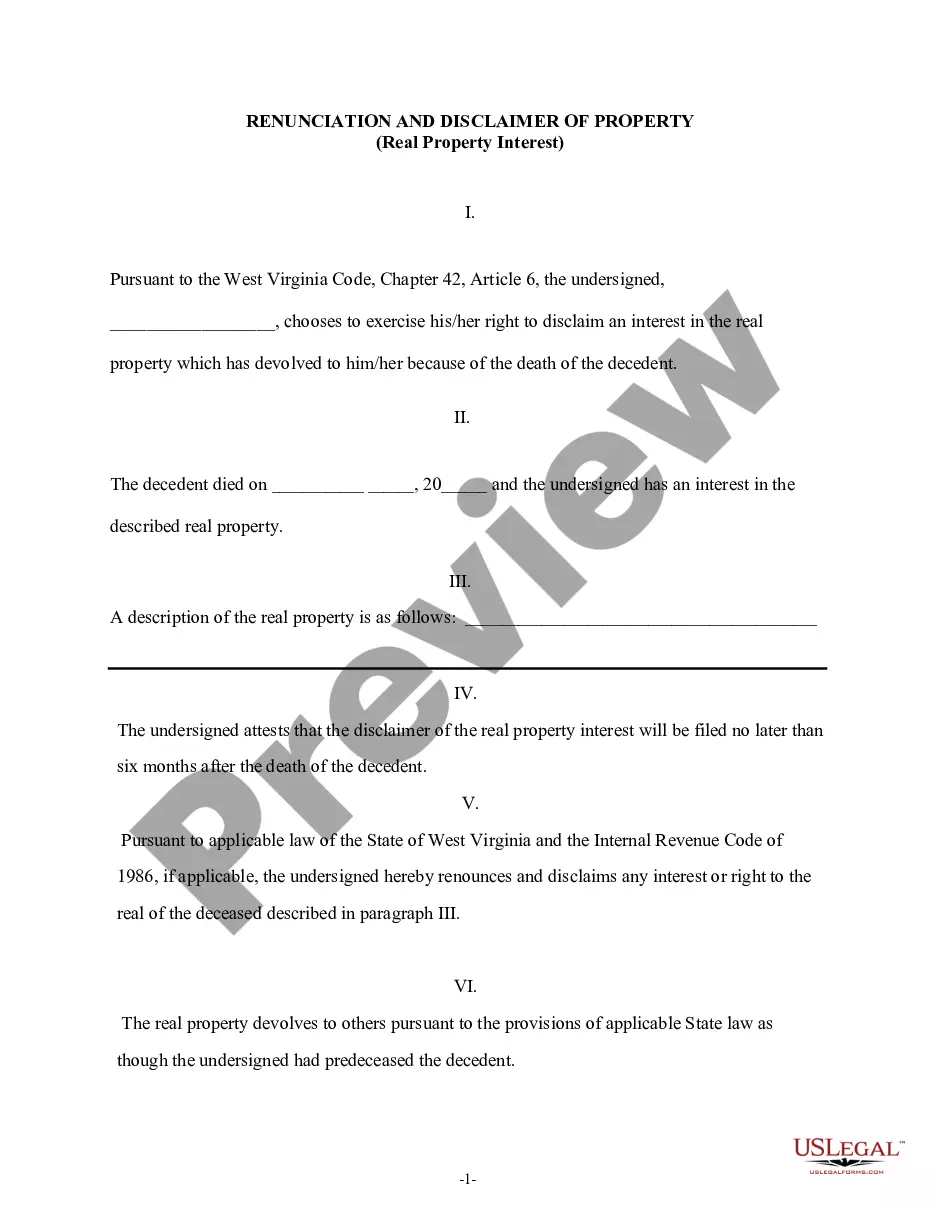
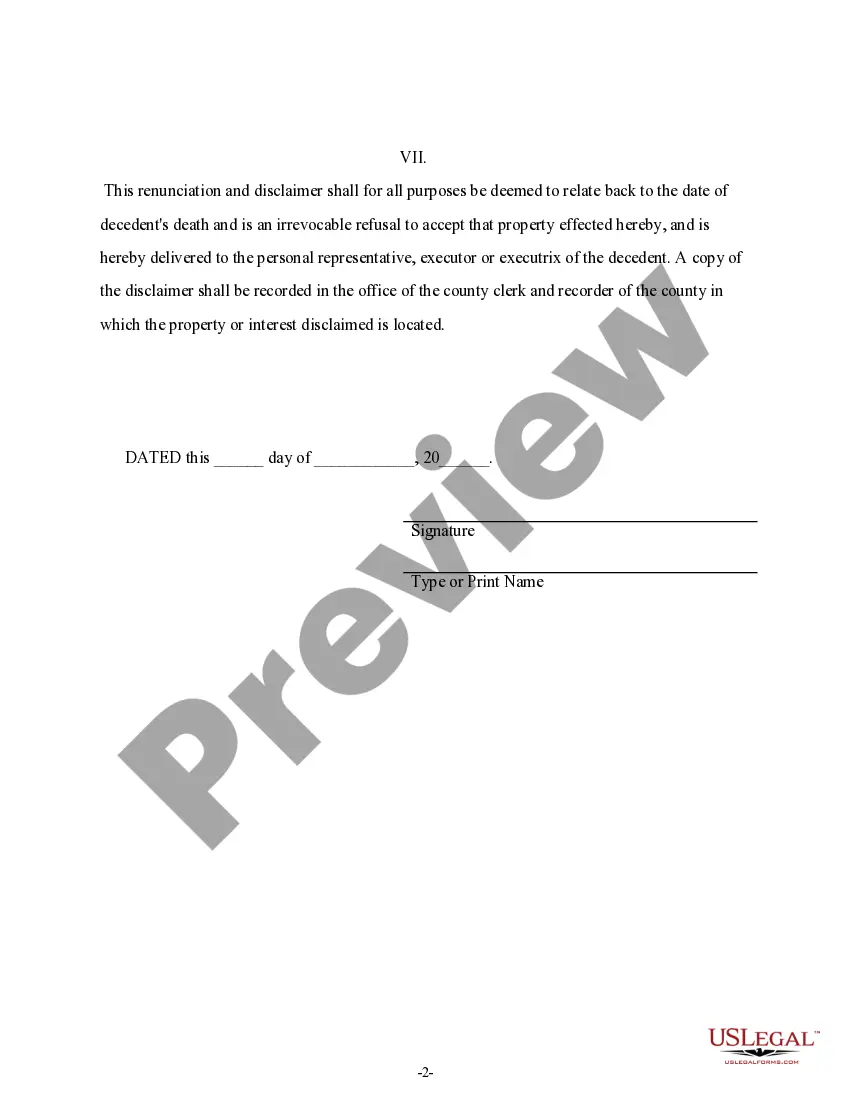
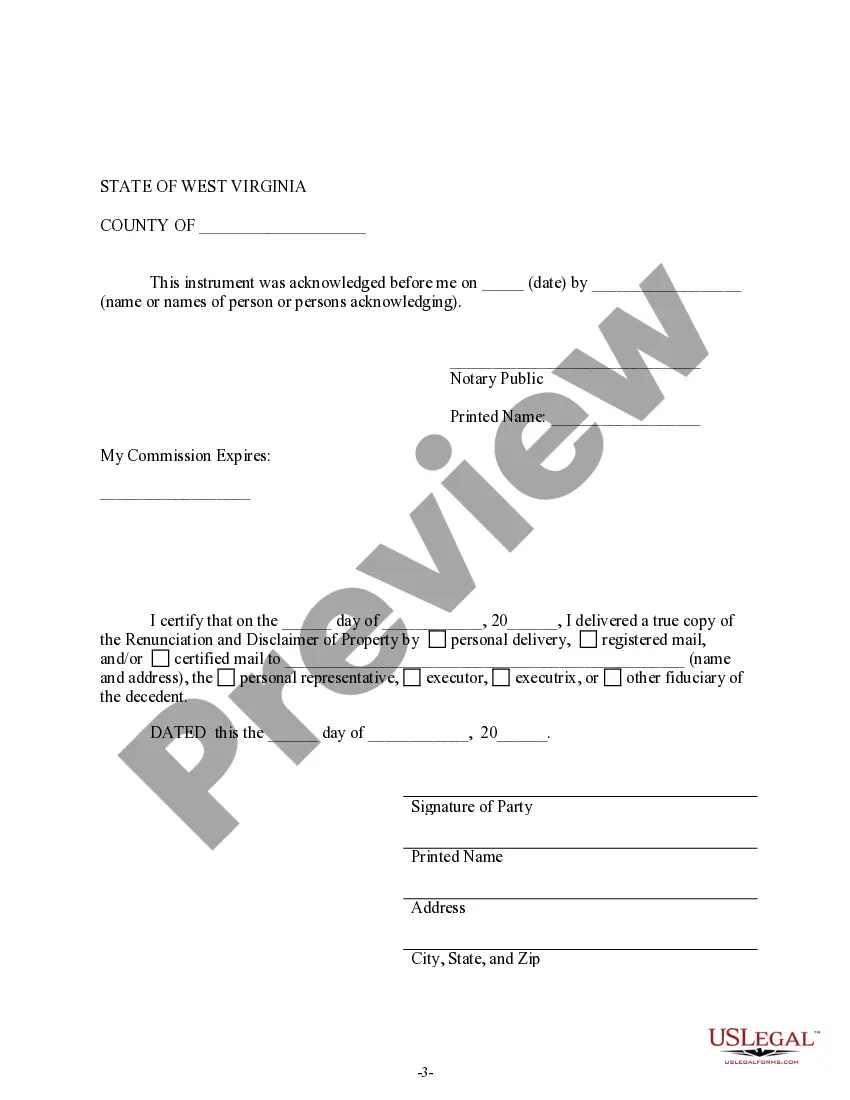
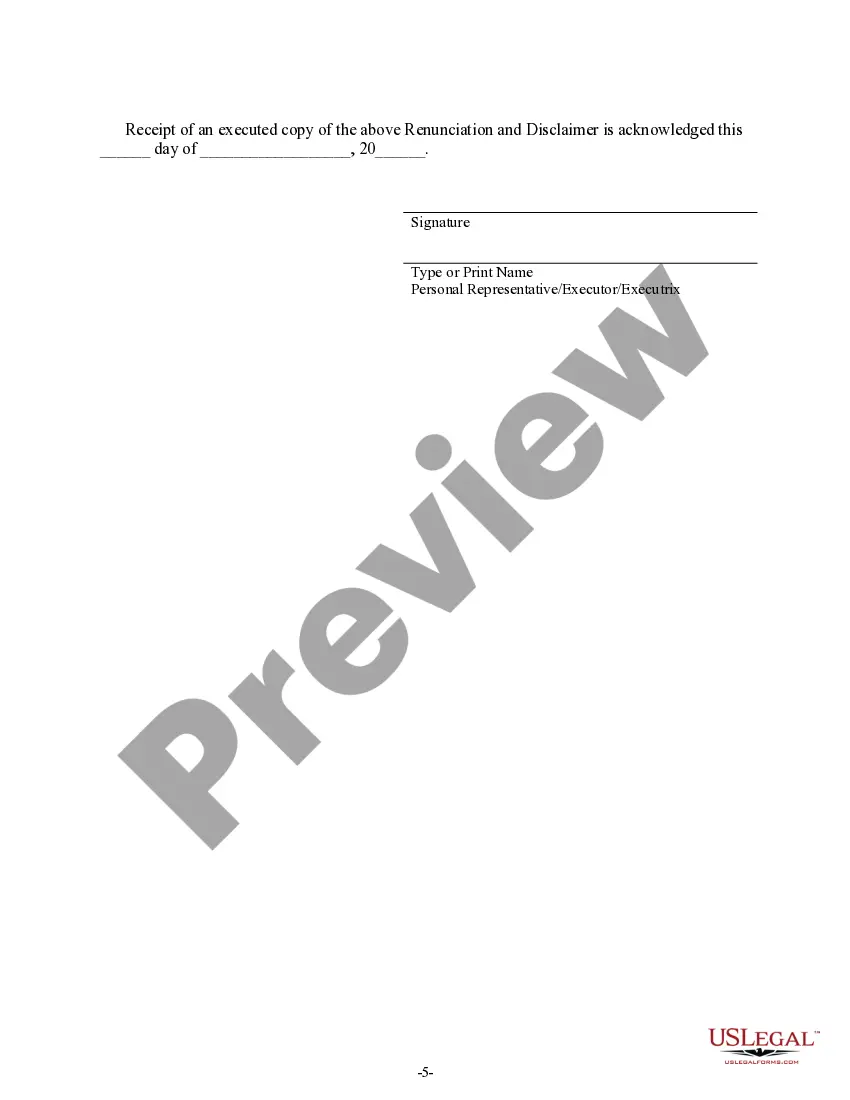
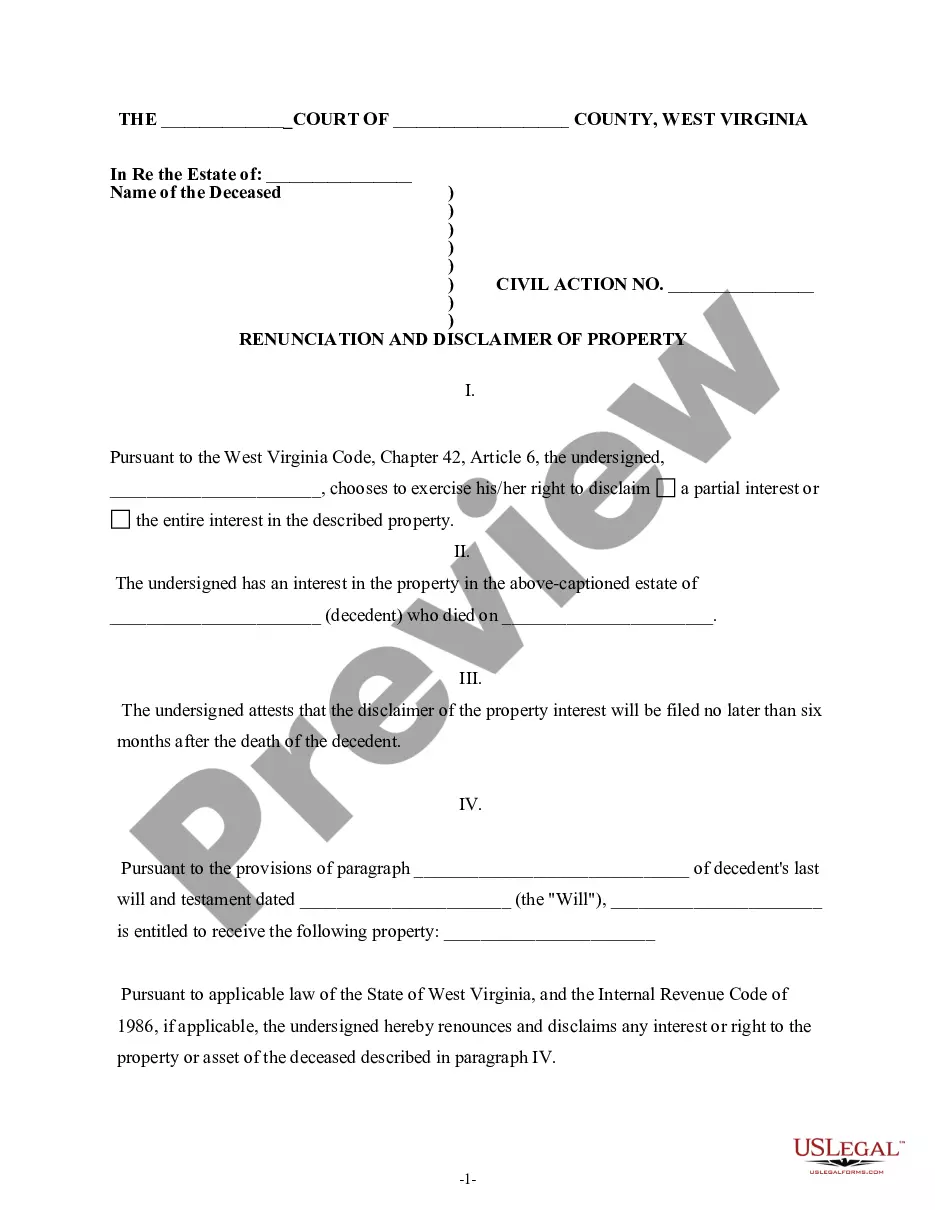
This is a Renunciation and Disclaimer of a Real Property Interest, where the beneficiary gained an interest in the real property upon the death of the decedent, but, pursuant to the West Virginia Code, Chapter 42, Article 6, has chosen to waive his/her interest in the real property. The beneficiary also attests that the disclaimer will be filed no later than six months in order to secure the validity of the disclaimer. The form also contains a state specific acknowledgment and a certificate to verify document delivery.
West Virginia Renunciation And Disclaimer of Real Property Interest
State:
West Virginia
Control #:
WV-04-03
Format:
Word;
Rich Text
Instant download
Description
Free preview

How to fill out West Virginia Renunciation And Disclaimer Of Real Property Interest?
Out of the large number of services that offer legal templates, US Legal Forms offers the most user-friendly experience and customer journey while previewing templates before buying them. Its complete catalogue of 85,000 templates is categorized by state and use for efficiency. All of the forms available on the platform have been drafted to meet individual state requirements by accredited legal professionals.
If you already have a US Legal Forms subscription, just log in, look for the template, press Download and obtain access to your Form name in the My Forms; the My Forms tab keeps your saved documents.
Follow the guidelines listed below to get the form:
- Once you see a Form name, make certain it’s the one for the state you really need it to file in.
- Preview the form and read the document description prior to downloading the sample.
- Look for a new sample using the Search field in case the one you have already found isn’t appropriate.
- Just click Buy Now and choose a subscription plan.
- Create your own account.
- Pay using a credit card or PayPal and download the document.
After you have downloaded your Form name, you can edit it, fill it out and sign it with an web-based editor that you pick. Any document you add to your My Forms tab might be reused many times, or for as long as it remains to be the most updated version in your state. Our platform provides quick and easy access to samples that fit both lawyers and their customers.
Form popularity
FAQ
Put the disclaimer in writing. Deliver the disclaimer to the person in control of the estate usually the executor or trustee. Complete the disclaimer within nine months of the death of the person leaving the property. Do not accept any benefit from the property you're disclaiming.
Any disclaimer of an interest in a trust by a trust beneficiary must be made to the trustee of that trust. For a disclaimer to be valid, it must be supported by some evidence that the beneficiary is disclaiming their interest. Silence or otherwise passive behaviour will not suffice.
In your disclaimer, cover any and all liabilities for the product or service that you provide. You should warn consumers of any dangers or hazards posed by your product. You should list specific risks while at the same time acknowledging that the list is not exhaustive. For example, you could write, NOTICE OF RISK.
The disclaimer must be in writing: A signed letter by the person doing the disclaiming, identifying the decedent, describing the asset to be disclaimed, and the extent and amount, percentage or dollar amount, to be disclaimed, must be delivered to the person in control of the estate or asset, such as an executor,
These documents can include the will, death certificate, transfer of ownership forms and letters from the estate executor or probate court.If you received the inheritance in the form of cash, request a copy of the bank statement that reflects the deposit.
Jointly owned property is treated as consisting of a both present and a future interest in the jointly owned property. Thus, a surviving spouse may disclaim the future interest in jointly owned property on the death of their spouse, including assets that were held by the spouses as tenants by the entirety.
When you relinquish property, you don't get any say in who inherits in your place. If you want to control who gets the inheritance, you must accept it and give it to that person. If you relinquish the property and the deceased didn't name a back-up heir, the court will apply state law to decide who inherits.
Disclaimer of interest, in the law of inheritance, wills and trusts, is a term that describes an attempt by a person to renounce their legal right to benefit from an inheritance (either under a will or through intestacy) or through a trust. A disclaimer of interest is irrevocable.
Disclaim, in a legal sense, refers to the renunciation of an interest in, or an acceptance of, inherited assets, such as property, by way of a legal instrument. A person disclaiming an interest, right, or obligation is known as a disclaimant.