Wisconsin Legal Documents for the Guardian of a Minor Package
What this form package covers
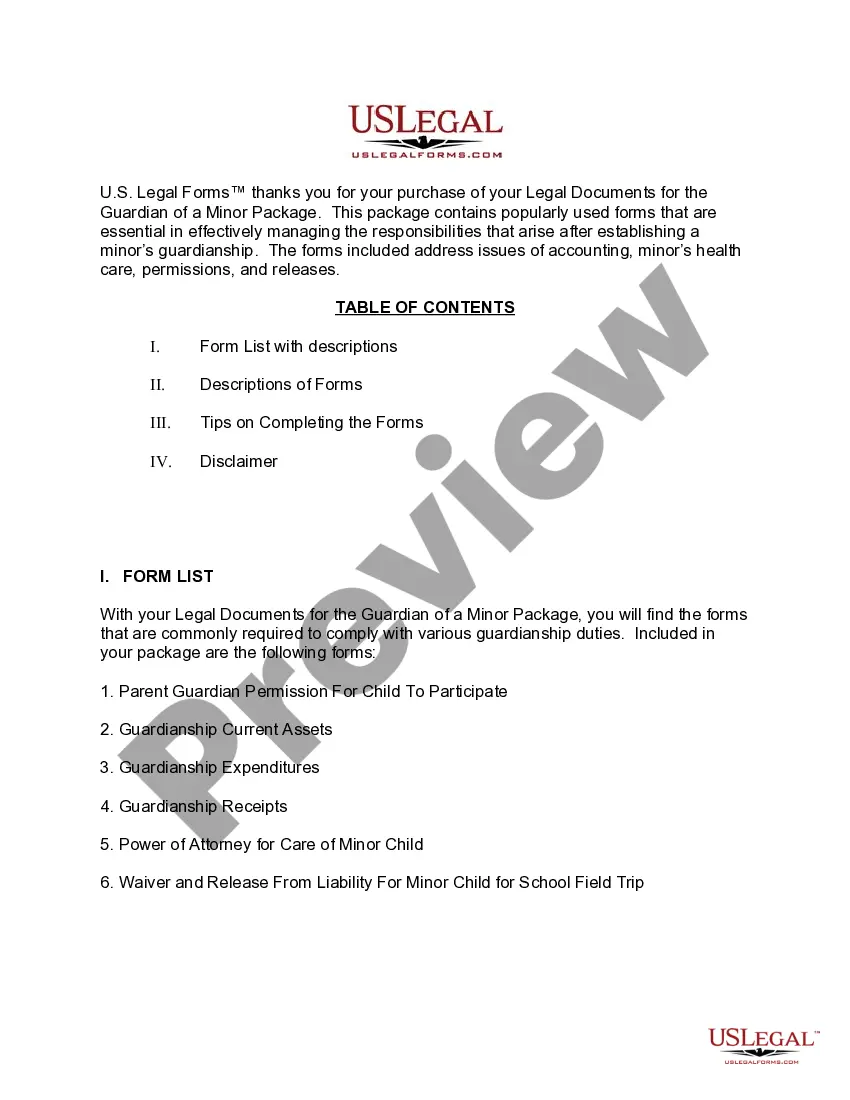
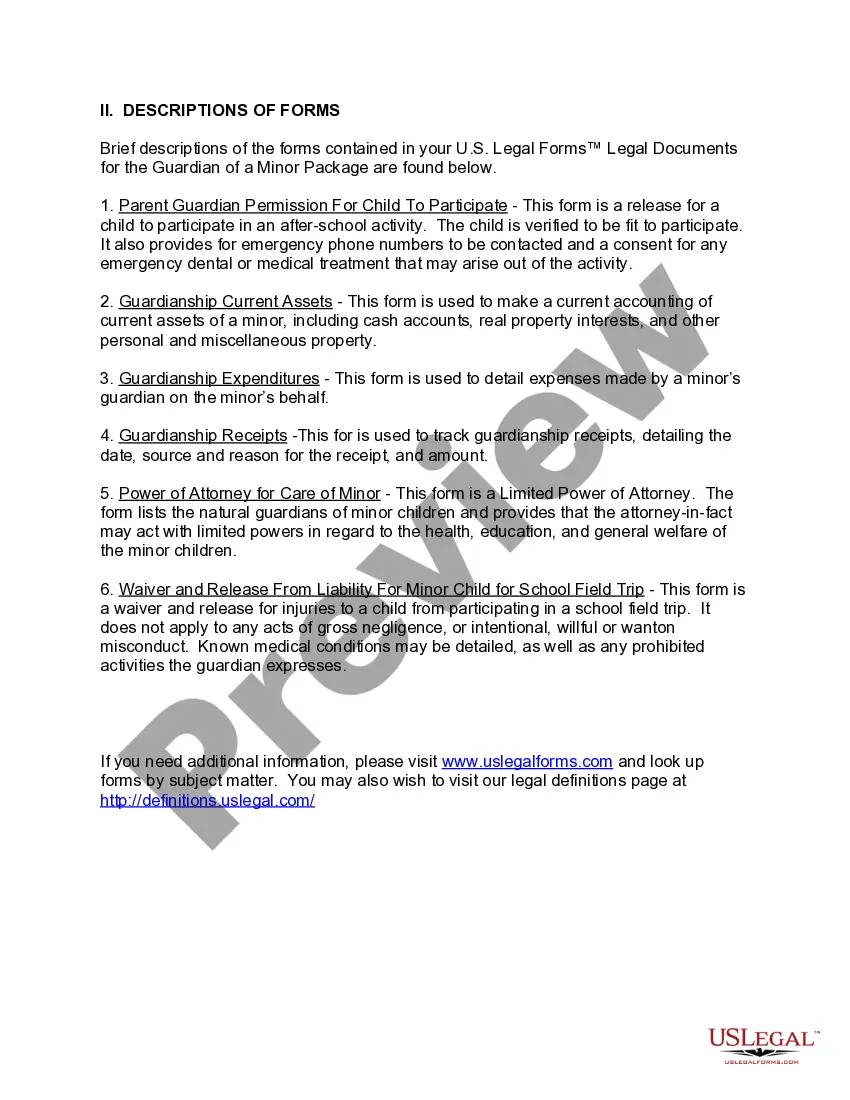
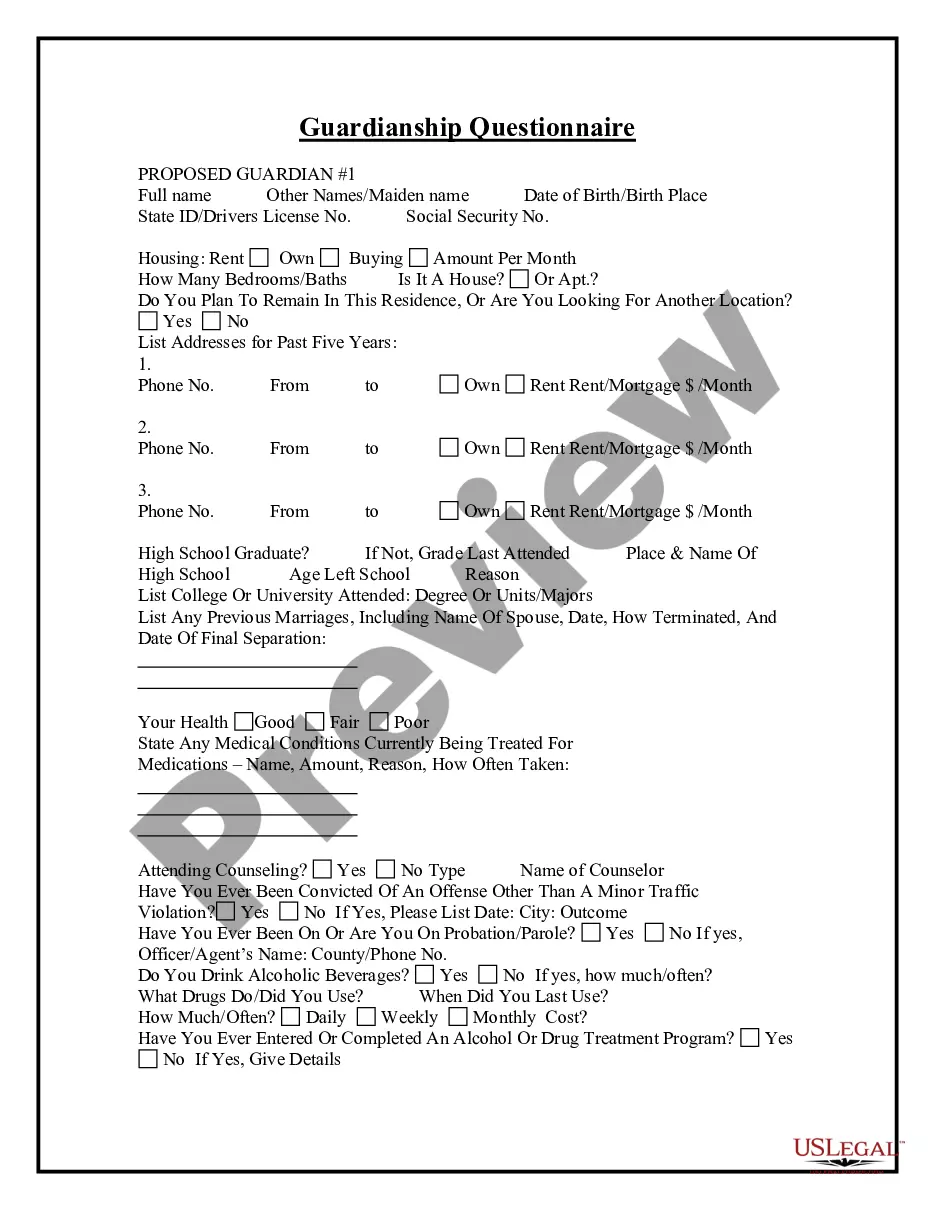
The Wisconsin Legal Documents for the Guardian of a Minor Package includes essential forms needed by guardians to fulfill their legal responsibilities. This package is specifically crafted to simplify the process of managing a minor's well-being, covering permissions, health care, financial accountings, and liability waivers. With these forms, guardians can ensure compliance with state regulations and effectively manage their duties without the need for extensive legal knowledge.
Forms included in this package


Situations where these forms applies
This package is useful in various situations where a guardian is appointed to care for a minor. You should consider using it in the following scenarios:
- When enrolling a child in activities that require parental permission.
- When managing a minor's financial assets or expenditures.
- When needing to authorize another adult to make health care decisions for the child.
- When participating in school field trips that require liability waivers.
Who needs this form package
- Guardians appointed by a court to look after a minor child.
- Parents seeking temporary guardianship arrangements.
- Legal representatives managing a minor's affairs.
- Individuals overseeing health and educational decisions for a minor.
How to prepare this document
- Review all forms included in the package to understand their purpose.
- Gather necessary information regarding the minor's current assets and expenditures.
- Fill out the Parent Guardian Permission and Power of Attorney forms accurately.
- Sign and date each completed form where indicated.
- Keep copies of all forms for your records and submit originals as required.
Notarization details for included forms
Some included forms must be notarized to ensure validity. US Legal Forms provides secure online notarization powered by Notarize, allowing you to complete the process through a verified video call anytime.
Get your form ready online
Our built-in tools help you complete, sign, share, and store your documents in one place.
Make edits, fill in missing information, and update formatting in US Legal Forms—just like you would in MS Word.
Download a copy, print it, send it by email, or mail it via USPS—whatever works best for your next step.
Sign and collect signatures with our SignNow integration. Send to multiple recipients, set reminders, and more. Go Premium to unlock E-Sign.
If this form requires notarization, complete it online through a secure video call—no need to meet a notary in person or wait for an appointment.
We protect your documents and personal data by following strict security and privacy standards.
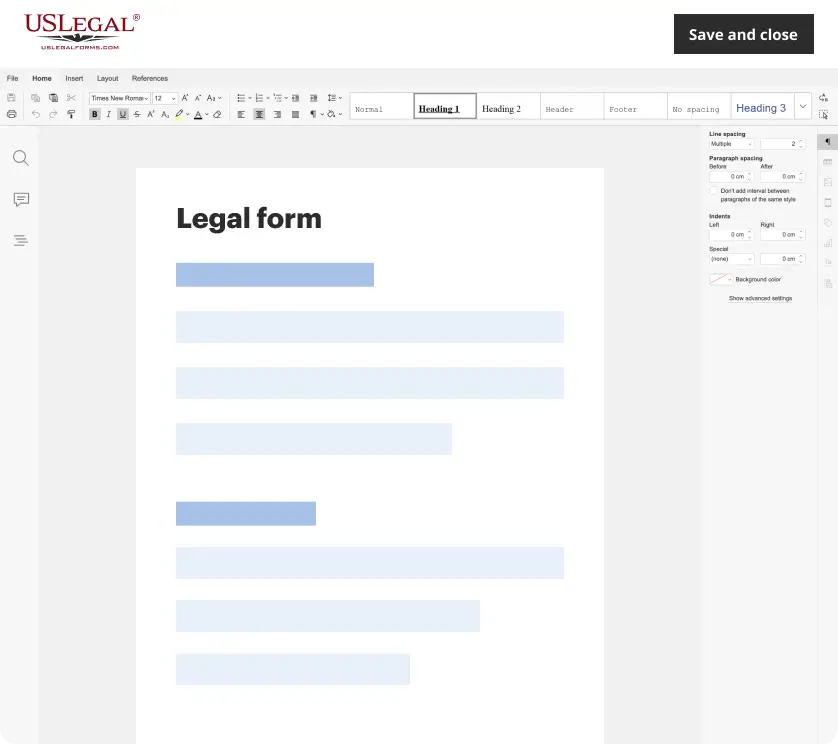
Make edits, fill in missing information, and update formatting in US Legal Forms—just like you would in MS Word.
Download a copy, print it, send it by email, or mail it via USPS—whatever works best for your next step.
Sign and collect signatures with our SignNow integration. Send to multiple recipients, set reminders, and more. Go Premium to unlock E-Sign.

If this form requires notarization, complete it online through a secure video call—no need to meet a notary in person or wait for an appointment.

We protect your documents and personal data by following strict security and privacy standards.
Mistakes to watch out for
- Not signing the forms where required, which may invalidate them.
- Failing to update asset information, leading to inaccuracies.
- Omitting critical details in the health care authorization form.
- Using the wrong form for the intended purpose (e.g., confusing permission forms with liability waivers).
Why complete this package online
- Convenience of downloading forms from home at any time.
- Editability allows you to fill in the forms accurately without the hassle of handwriting.
- Reliable, attorney-drafted content ensures compliance with legal requirements.
- Immediate access to forms tailored to your specific needs as a guardian.
Looking for another form?
Form popularity
FAQ
A legal guardian is a person who has been appointed by a court or otherwise has the legal authority (and the corresponding duty) to care for the personal and property interests of another person, called a ward.A parent of a child is normally not considered a guardian, though the responsibilities may be similar.
The names of the forms are usually: Petition for Appointment of Guardian (or Petition for Appointment of Guardian of Minor) Petition for Conservatorship (when dealing with an incompetent adult) Order Appointing Guardian.
The main difference between custody and guardianship is the child's parents - custody is provided to the child's biological parents while guardianship is given to a non-biological parent.
The legal guardianship document is a formal declaration to the court system that another party is responsible for the well-being of the minors. No one can predict when an accident or other disaster may occur. Some include a legal guardianship document in their wills to determine who will raise their children.
Two lines beneath the guardian's address, you should insert the subject heading of the letter. For example, type RE: Temporary Guardianship of Minor Child, Elizabeth Bennett. Draft the body of the letter. The first paragraph of the body of the letter should name your children and state that you have custody of them.
You can establish guardianship of a child by filing papers in court. Initially, file a petition stating your interest in obtaining guardianship along with a filing fee. You'll also want to file a letter of consent from the child's parents.
A legal guardian is someone who has the legal authority to take care of a child should anything happen to the parents. Guardians are responsible for taking all parental decisions and can also be responsible for managing a child's property and inheritance.
There are two types of guardianships, a full guardianship and a limited guardianship.