Virginia Seller's Disclosure of Financing Terms for Residential Property in connection with Contract or Agreement for Deed a/k/a Land Contract
Overview of this form
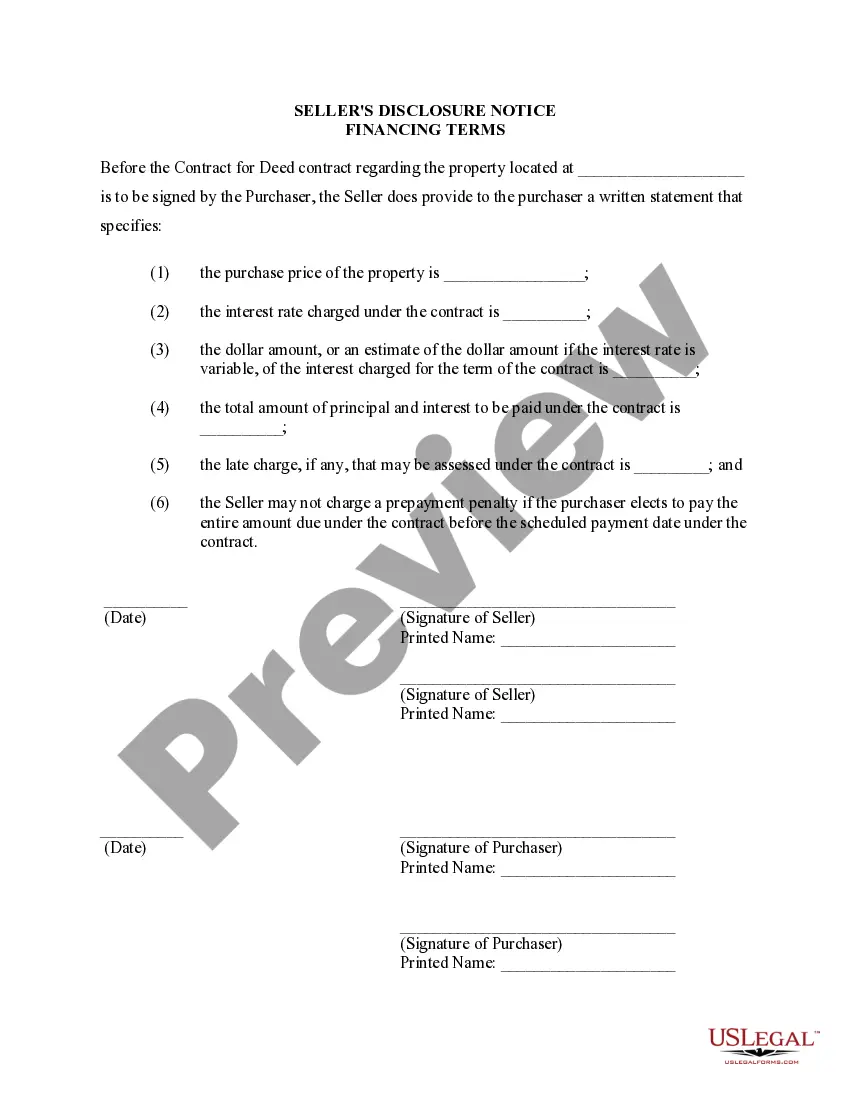
The Seller's Disclosure of Financing Terms for Residential Property is a critical document that outlines the financial details associated with a land contract, also known as a contract for deed. This form provides the buyer with essential information about the purchase price, interest rates, and any late charges that may apply. Unlike similar forms, this specific disclosure ensures transparency regarding the financial arrangement between the seller and purchaser, facilitating a smooth transaction process.
Key components of this form
- Property description: Identifies the specific residential property involved in the transaction.
- Purchase price: States the agreed-upon price for the property.
- Interest rate: Details the interest rate applicable to the financing terms.
- Total interest: Includes the total interest amount over the term of the contract.
- Principal and interest total: Outlines the total amount of principal and interest to be paid by the purchaser.
- Late charge policy: Specifies any late charges that may be levied for missed payments.
- Prepayment penalty: Indicates whether a prepayment penalty applies if the purchaser pays the total amount early.
When this form is needed
This form should be used when a seller and buyer agree to a land contract for the purchase of residential property. It is essential to provide this disclosure to the purchaser at or before the signing of the contract for deed, ensuring that all financing terms are clearly communicated and understood. Examples of when this form is applicable include sales of homes, vacant land, or other residential properties where a land contract is used as the means of financing.
Who needs this form
This form is intended for:
- Residential property sellers who are offering financing terms under a contract for deed.
- Residential property purchasers interested in understanding the financing details before signing the contract.
- Real estate professionals assisting clients with land contracts and related financing agreements.
How to prepare this document
- Identify the parties: Fill in the names of both the seller and purchaser.
- Specify the property: Clearly describe the property being sold, including the address.
- Enter financial details: Complete the fields for purchase price, interest rate, and total interest charges.
- Outline late charges: Include any applicable late fees for missed payments.
- Review and sign: Ensure both parties review the full document and provide their signatures with the date.
Does this document require notarization?
This form does not typically require notarization unless specified by local law. However, verifying the requirements for your state can help ensure that all legal protocols are followed.
Get your form ready online
Our built-in tools help you complete, sign, share, and store your documents in one place.
Make edits, fill in missing information, and update formatting in US Legal Forms—just like you would in MS Word.
Download a copy, print it, send it by email, or mail it via USPS—whatever works best for your next step.
Sign and collect signatures with our SignNow integration. Send to multiple recipients, set reminders, and more. Go Premium to unlock E-Sign.
If this form requires notarization, complete it online through a secure video call—no need to meet a notary in person or wait for an appointment.
We protect your documents and personal data by following strict security and privacy standards.

Make edits, fill in missing information, and update formatting in US Legal Forms—just like you would in MS Word.

Download a copy, print it, send it by email, or mail it via USPS—whatever works best for your next step.

Sign and collect signatures with our SignNow integration. Send to multiple recipients, set reminders, and more. Go Premium to unlock E-Sign.

If this form requires notarization, complete it online through a secure video call—no need to meet a notary in person or wait for an appointment.

We protect your documents and personal data by following strict security and privacy standards.
Typical mistakes to avoid
- Failing to provide the form to the purchaser before signing the contract.
- Not accurately specifying the interest rate or late charges related to the contract.
- Incompletely filling out essential fields, which may lead to confusion later.
Advantages of online completion
- Convenience: Easily download and customize the form to meet your specific needs.
- Editability: Allows buyers and sellers to input accurate details without the hassle of handwritten forms.
- Reliability: Legal forms created and reviewed by licensed attorneys ensure compliance and accuracy.
Legal use & context
- Helps prevent disputes by ensuring all financial terms are disclosed upfront.
- Serves as a legal record of the agreement between parties regarding financing.
Looking for another form?

Form popularity
FAQ
Although there are some basic disclosures required of sellers under federal law, Virginia law does not require sellers to disclose much information about their property at all.
A contract for deed is a legal agreement for the sale of property in which a buyer takes possession and makes payments directly to the seller, but the seller holds the title until the full payment is made.
You can sell your house on a land contract with an outstanding loan balance if your lender agrees and if the contract doesn't have a due-on-sale clause.
The Virginia Residential Property Disclosure act is a statutory scheme enacted by the General Assembly of Virginia that requires a seller of real estate in Virginia to furnish to a purchaser a residential property disclosure statement for the buyer to beware of certain matters that may affect the buyer's decision to
One such alternative is the contract for deed. In a contract for deed, the purchase of property is financed by the seller rather than a third-party lender such as a commercial bank or credit union.
In many states, the law requires a home seller to disclose to a potential buyer any problems or defects known about the home. In Virginia, however, the seller is obligated only to provide the buyer with a Residential Property Disclosure Statement, (Code of Virginia § 55-519), which contains minimal information.
Virginia is a caveat emptor (buyer beware) state. This essentially means that the responsibility for conducting a thorough inspection of the property that is contemplated to be purchased is on the Buyer.
You will need to include information about all appliances in the home, including which are included in the sale as well as whether they are operational. You will also need to disclose any room additions, damage, or neighborhood noise problems.