Texas Letter from Landlord to Tenant as Notice of Abandoned Personal Property
What this document covers
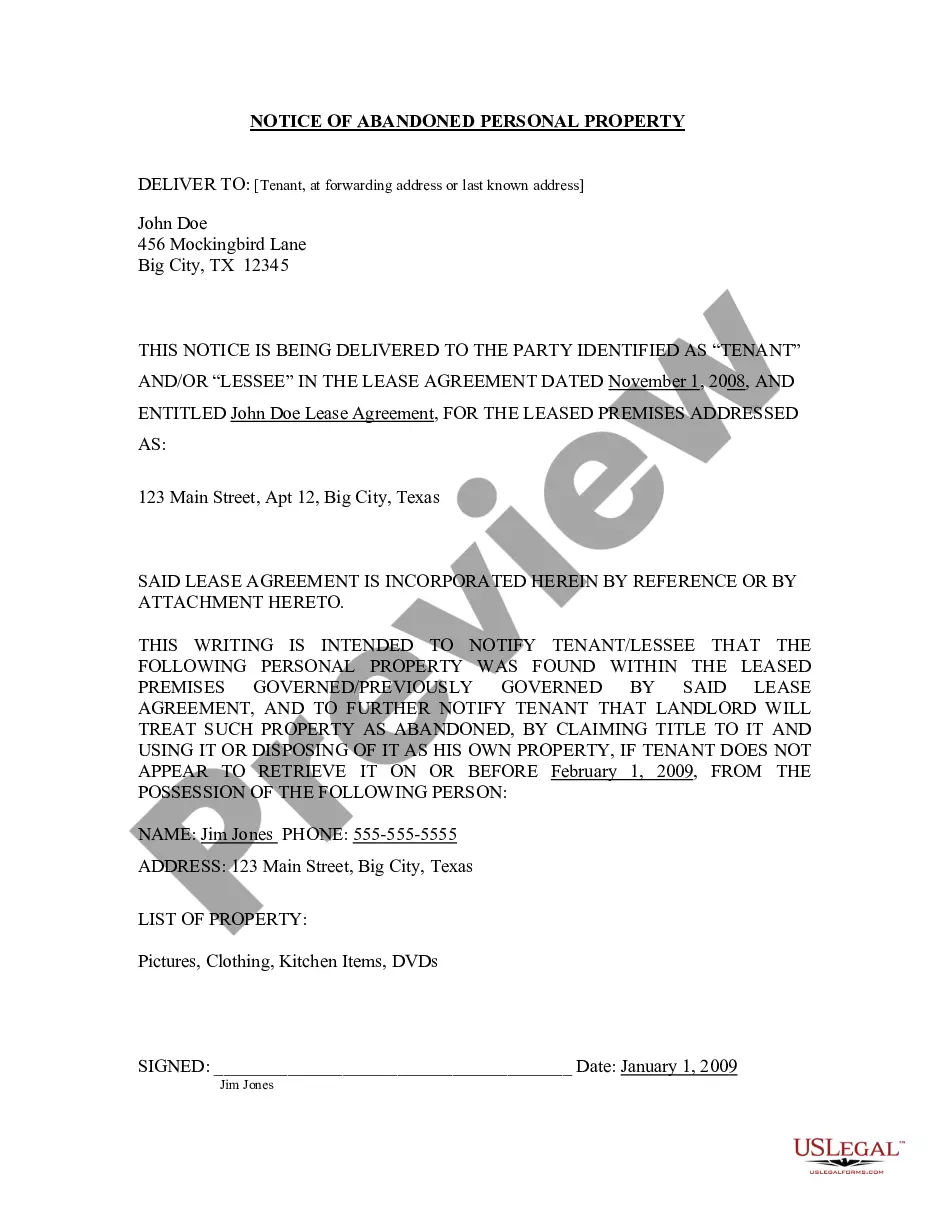
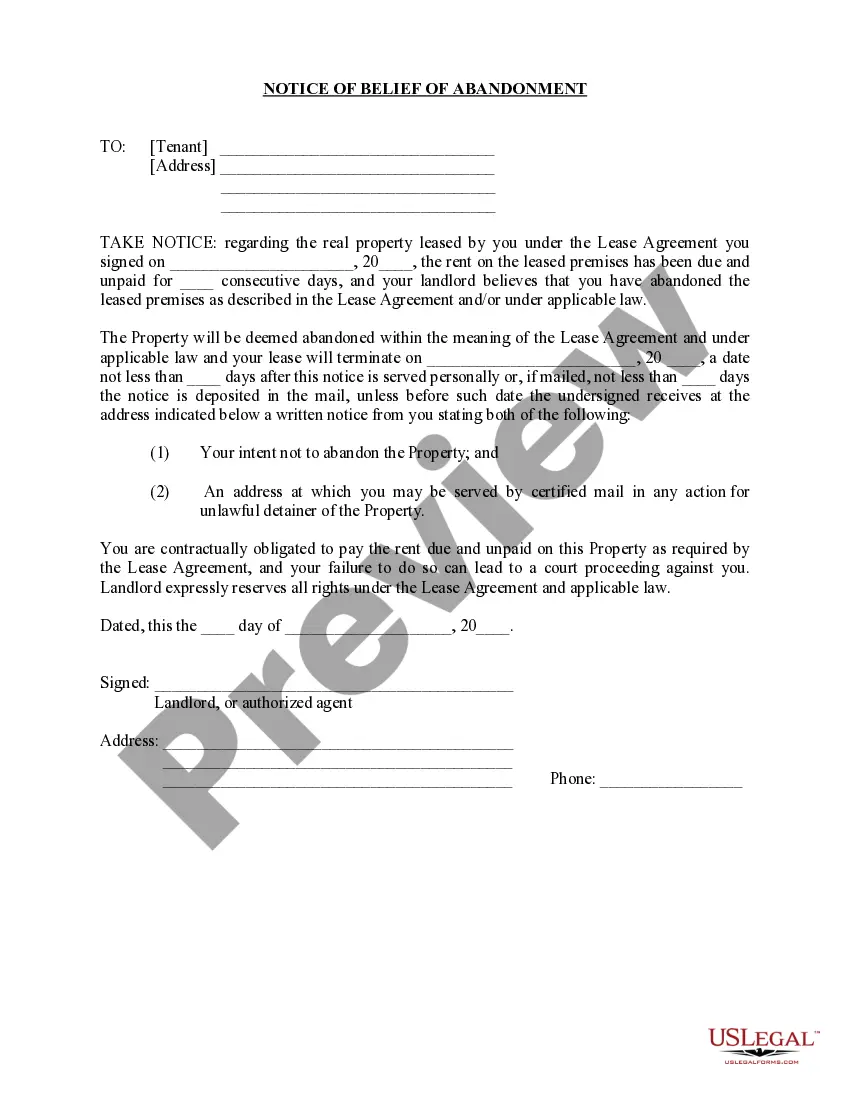
This Letter from Landlord to Tenant as Notice of Abandoned Personal Property is a formal notification that a landlord sends to a tenant regarding personal belongings left behind in a rental unit. The form informs the tenant of the specific items identified as abandoned and provides instructions for retrieving them. This document differs from general eviction notices by specifically addressing the personal property aspect and conforms to applicable state laws governing abandoned property rights.
Key components of this form
- Delivery address for the tenant (forwarding or last known address)
- Identification of the tenant and lease agreement details
- Listing of personal property recognized as abandoned
- Deadline for the tenant to retrieve the property
- Signature and date from the landlord


Situations where this form applies
This form should be used when a landlord discovers personal property within a rental unit after a tenant has vacated. It is applicable in situations where the landlord needs to formally notify the tenant that their belongings will be treated as abandoned unless retrieved by a specified deadline. Common scenarios include when a tenant moves out unexpectedly or leaves behind items in the unit.
Who can use this document
- Landlords seeking to claim abandoned property
- Property managers acting on behalf of landlords
- Tenants who have left personal items in a rental unit
How to complete this form
- Identify the tenant's correct forwarding or last known address.
- Specify the tenant's name and details of the lease agreement.
- List all items considered abandoned along with their condition if known.
- Set a clear deadline for the tenant to retrieve the items.
- Sign and date the notice for legal validation.
Does this document require notarization?
Notarization is generally not required for this form. However, certain states or situations might demand it. You can complete notarization online through US Legal Forms, powered by Notarize, using a verified video call available anytime.
Get your form ready online
Our built-in tools help you complete, sign, share, and store your documents in one place.
Make edits, fill in missing information, and update formatting in US Legal Forms—just like you would in MS Word.
Download a copy, print it, send it by email, or mail it via USPS—whatever works best for your next step.
Sign and collect signatures with our SignNow integration. Send to multiple recipients, set reminders, and more. Go Premium to unlock E-Sign.
If this form requires notarization, complete it online through a secure video call—no need to meet a notary in person or wait for an appointment.
We protect your documents and personal data by following strict security and privacy standards.

Make edits, fill in missing information, and update formatting in US Legal Forms—just like you would in MS Word.

Download a copy, print it, send it by email, or mail it via USPS—whatever works best for your next step.

Sign and collect signatures with our SignNow integration. Send to multiple recipients, set reminders, and more. Go Premium to unlock E-Sign.

If this form requires notarization, complete it online through a secure video call—no need to meet a notary in person or wait for an appointment.

We protect your documents and personal data by following strict security and privacy standards.
Common mistakes to avoid
- Failing to provide the tenant's accurate forwarding address.
- Not clearly listing all items to avoid ambiguity.
- Neglecting to sign the form, which may affect its validity.
- Setting an unreasonable retrieval deadline that does not comply with state laws.
Benefits of completing this form online
- Convenient access to legal forms without needing to consult a lawyer.
- Editable templates that allow for easy customization.
- Reliability, as forms are drafted by licensed attorneys to ensure compliance with legal standards.
Legal use & context
- The form serves as a legal document to protect landlords from claims of unlawfully disposing of tenants' possessions.
- This notification is typically enforceable in a court of law if the process is followed correctly.
- It helps to create a clear record of efforts made by the landlord to return personal property.
Main things to remember
- This letter serves as a formal notification regarding abandoned property left by a tenant.
- It provides clear deadlines and consequences for failure to retrieve belongings.
- Ensure compliance with state laws when using this form.
Looking for another form?
Form popularity
FAQ
Starting to Write State the most recent information you have on file and detail the attempts you have made to contact them. Warn that if there is no response within a specific time frame action will be taken. Post the letter to the last known address of the individual.
Abandonment of a Property - when a Tenant leaves their Property without giving notice to Evolve Housing and the Property is found to be vacant.
Property is considered abandoned only after a lease is terminated. Termination occurs when the lease is up and the tenant moves out, or if the tenant is legally evicted.
Under Texas Property Code, property is presumed abandoned after three years if: (1) the owner's existence and location is unknown to you, (2) no claim to the property has been asserted, and (3) no person has exercised an act of ownership.
Abandoned property is an asset that has been turned over to the state after several years of inactivity. State laws determine when an asset is legally considered abandoneddeadlines vary, though usually property must be unclaimed for at least two years to qualify.
Texas law defines the term abandon as leaving a child in any place without providing reasonable and necessary care for the child. The child must be left in a situation in were no reasonable adult would leave a child of that age and ability. There is another way a person can be charged with child abandonment.
If you personally deliver the notice to the tenant, then you must store the abandoned property for at least 15 days. If you mail the notice to the tenant (including email), then you must store the property for at least 18 days from the date the notice was mailed (see Cal.
Starting to Write State the most recent information you have on file and detail the attempts you have made to contact them. Warn that if there is no response within a specific time frame action will be taken. Post the letter to the last known address of the individual.