Texas Notice of Dishonored Check - Criminal - Keywords: bad check, bounced check
About this form
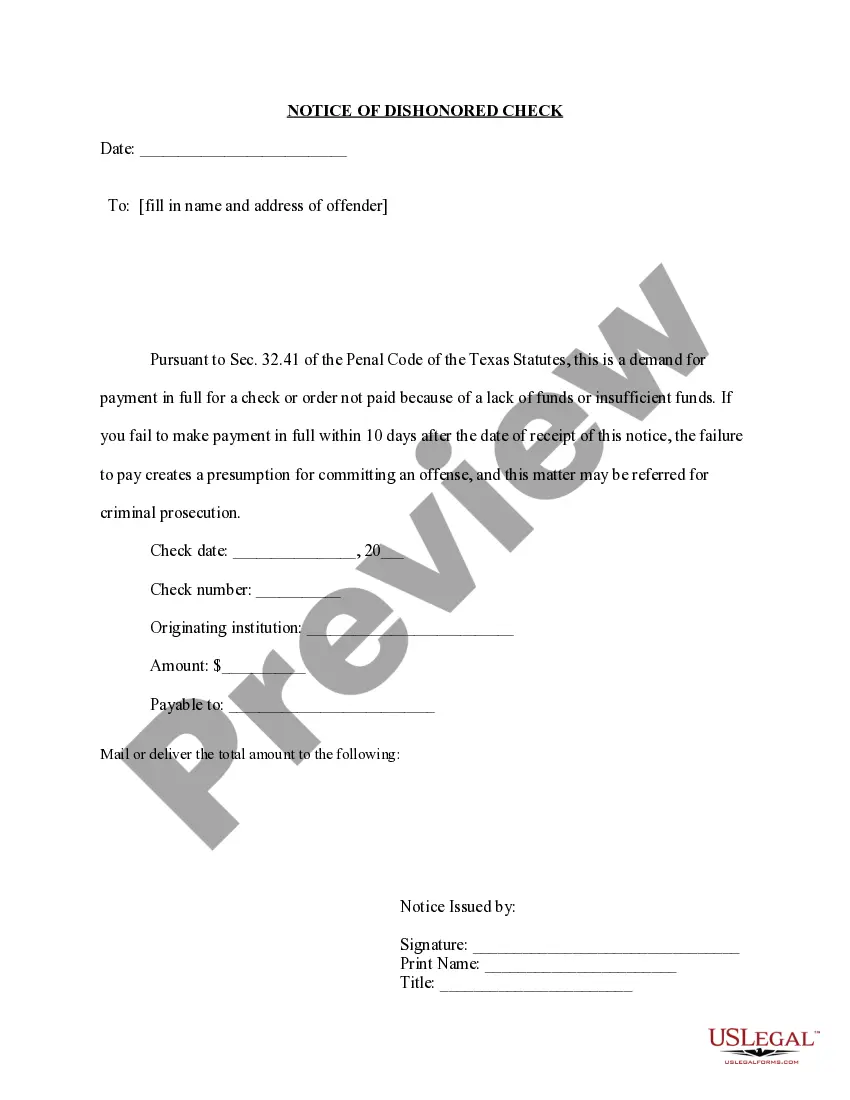
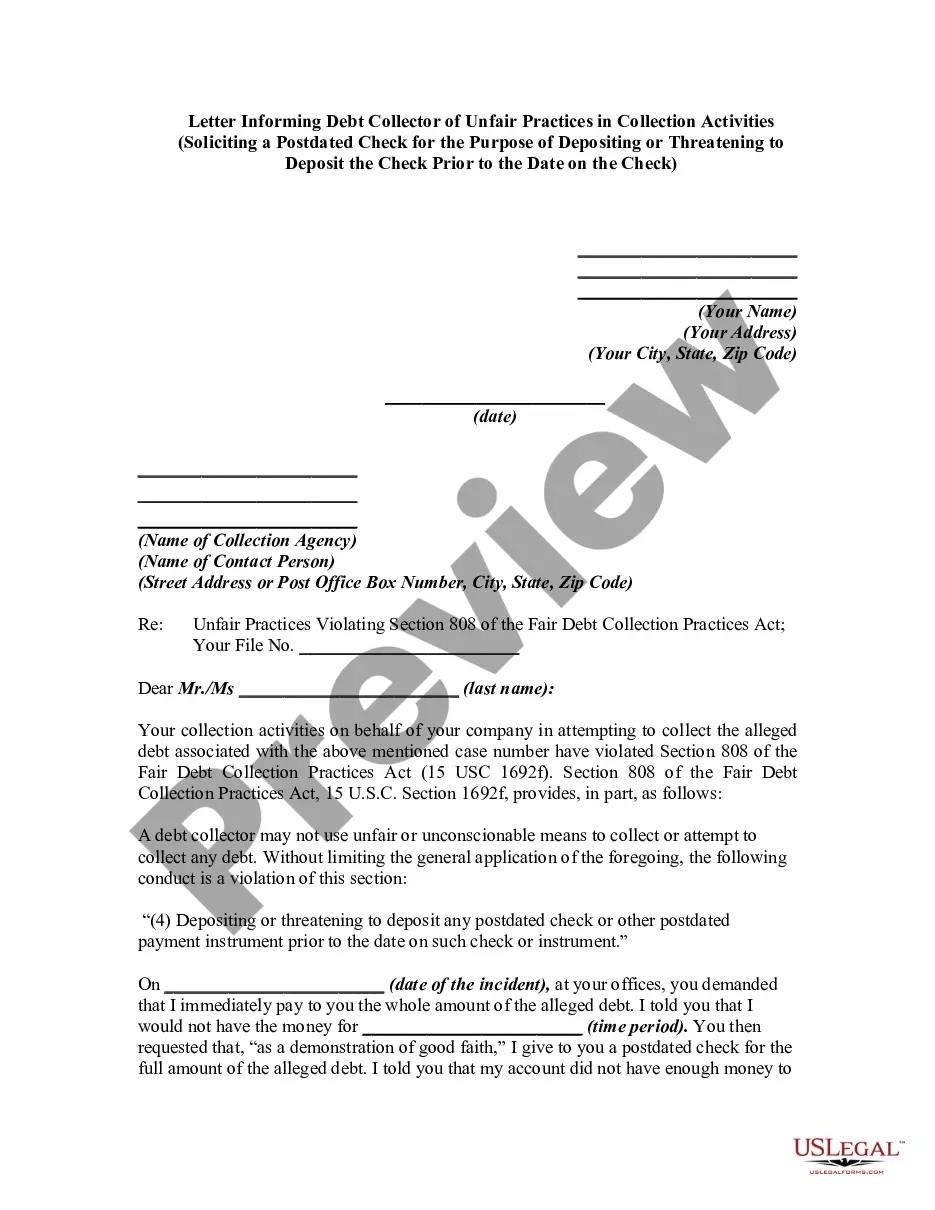
This is a Notice of Dishonored Check, commonly referred to as a bad check or bounced check. This form serves as an official notification to an individual or business that their check was not honored due to reasons such as insufficient funds or the absence of a valid checking account. The Notice is essential for businesses or individuals seeking to pursue recovery for the amount owed on the dishonored check.
Form components explained
- Check date: The date when the check was issued.
- Check number: The unique identification number assigned to the check.

Common use cases
You should use this form when you have received a check that was presented for payment but has been returned by the bank due to insufficient funds or because the account does not exist. Sending this notice is often a preliminary step before pursuing legal action or recovery efforts regarding the payment due.
Who needs this form
This form is intended for:
- Business owners who have accepted a check as payment.
- Individuals who have received a personal check that has bounced.
- Collection agencies managing recovery for dishonored checks.
Steps to complete this form
Follow these steps to complete the form:
- Identify the check date: Fill in the date when the check was written.
- Specify the check number: Enter the number that corresponds to the bounced check.
Does this form need to be notarized?
This form does not typically require notarization unless specified by local law. However, it is recommended to confirm any state-specific requirements regarding the notice of dishonored checks.
Get your form ready online
Our built-in tools help you complete, sign, share, and store your documents in one place.
Make edits, fill in missing information, and update formatting in US Legal Forms—just like you would in MS Word.
Download a copy, print it, send it by email, or mail it via USPS—whatever works best for your next step.
Sign and collect signatures with our SignNow integration. Send to multiple recipients, set reminders, and more. Go Premium to unlock E-Sign.
If this form requires notarization, complete it online through a secure video call—no need to meet a notary in person or wait for an appointment.
We protect your documents and personal data by following strict security and privacy standards.

Make edits, fill in missing information, and update formatting in US Legal Forms—just like you would in MS Word.

Download a copy, print it, send it by email, or mail it via USPS—whatever works best for your next step.

Sign and collect signatures with our SignNow integration. Send to multiple recipients, set reminders, and more. Go Premium to unlock E-Sign.

If this form requires notarization, complete it online through a secure video call—no need to meet a notary in person or wait for an appointment.

We protect your documents and personal data by following strict security and privacy standards.
Common mistakes
- Failing to include the correct check date and number can lead to confusion.
- Not sending the notice in a timely manner may impact recovery options.
- Neglecting to follow state-specific requirements for notifying the issuer.
Advantages of online completion
- Convenient online access to the form allows you to complete it quickly.
- Editable templates enable customization to your specific situation.
- Access to forms created by licensed attorneys ensures legal compliance.
Legal use & context
- Serves as a legally recognized notice of dishonor that may be used as evidence in court.
- Helps establish intent and notice for delinquent debts associated with bad checks.
- Facilitates recovery efforts by providing a formal record of communication with the debtor.
What to keep in mind
- Utilize this form to officially notify a check issuer about a bounced check.
- Complete all required fields accurately to avoid rejection of the notice.
- Be aware of your state's regulations regarding notification and collection of dishonored checks.
Looking for another form?
Form popularity
FAQ
In Texas, writing fraudulent checks is either a misdemeanor or a felony, depending on the amount on the check. For bad checks under $1,500, the writer of the check may be charged with a misdemeanor, writing bad checks over $1,500 can be considered a felony.
Send the letter certified mail. Visit your local district attorney's office if you do not hear back from the debtor. Bring your correspondence with you and a copy of the bad check. He will take the case over, and likely prosecute the check writer.
Contact the bank that placed the negative information on your report. If the information is true, it isn't obligated to change or remove the information. You can, however, write a short explanation of the circumstances surrounding the bad check for inclusion in your report.
Writing a bad check is a crime if the check writer knew that there were insufficient funds to cover the check and intended to defraud you.If the check writer does not pay you within 30 days, you may file a lawsuit.
People who write bad checks are normally charged fees by their banks and could be on the hook for any fees incurred by the payee. Knowingly writing a bad check may constitute a misdemeanor or felony, depending on the amount of the check and the state in which it was written.
Writing bad checks can lead to several theft charges, but with the help of a skilled defense attorney, you can work to reduce or even dismiss charges.
Writing a bad check is considered a wobbler crime in California, meaning it can be charged as either a misdemeanor or felony depending on circumstances of the crime. If the value of the check was under $450, the offense is generally charged as a misdemeanor. If the amount is over $450, you can be charged with a felony.
Writing a bad check is considered a wobbler crime in California, meaning it can be charged as either a misdemeanor or felony depending on circumstances of the crime. If the value of the check was under $450, the offense is generally charged as a misdemeanor. If the amount is over $450, you can be charged with a felony.
To be classified as a felony, the amount of the check must be over $1,500. Under the Texas Code of Criminal Procedure, a felony charge of theft by check has a statue of limitations of five years from the date of the offense.