Tennessee Quitclaim Deed from an Individual to Four Individuals as Joint Tenants with the Right of Survivorship
Overview of this form
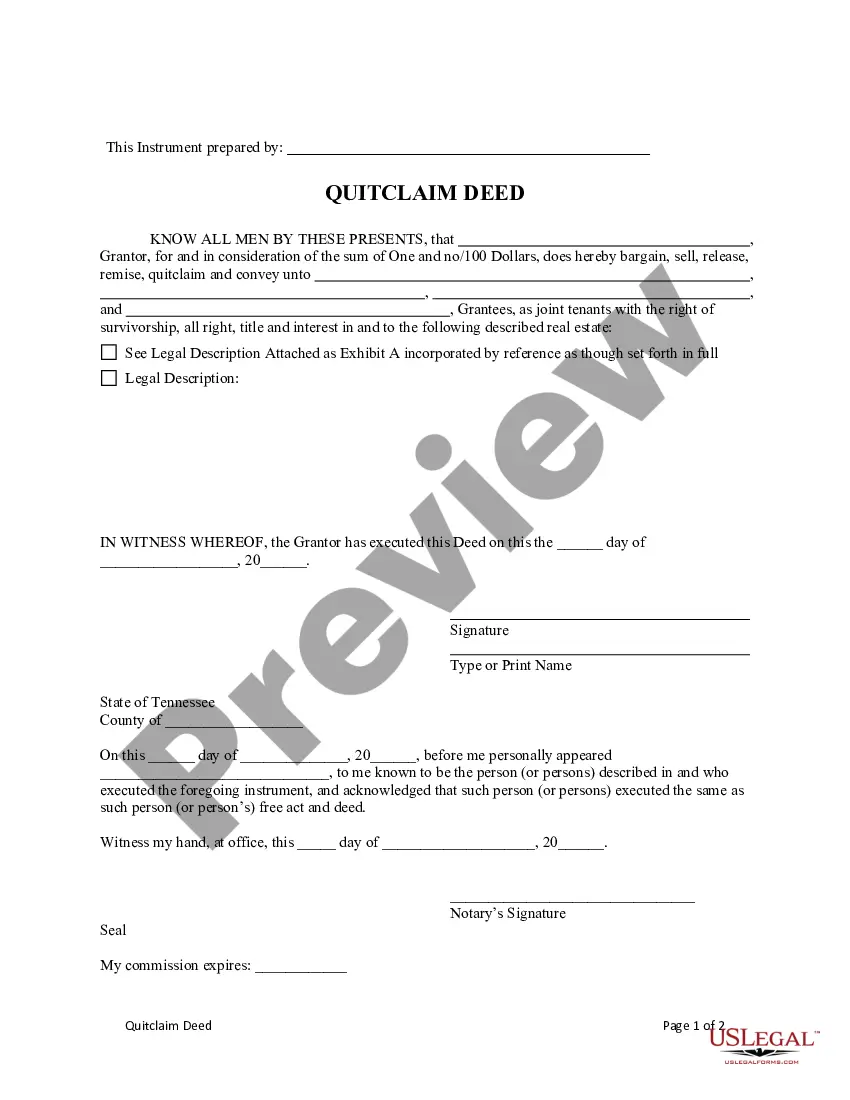
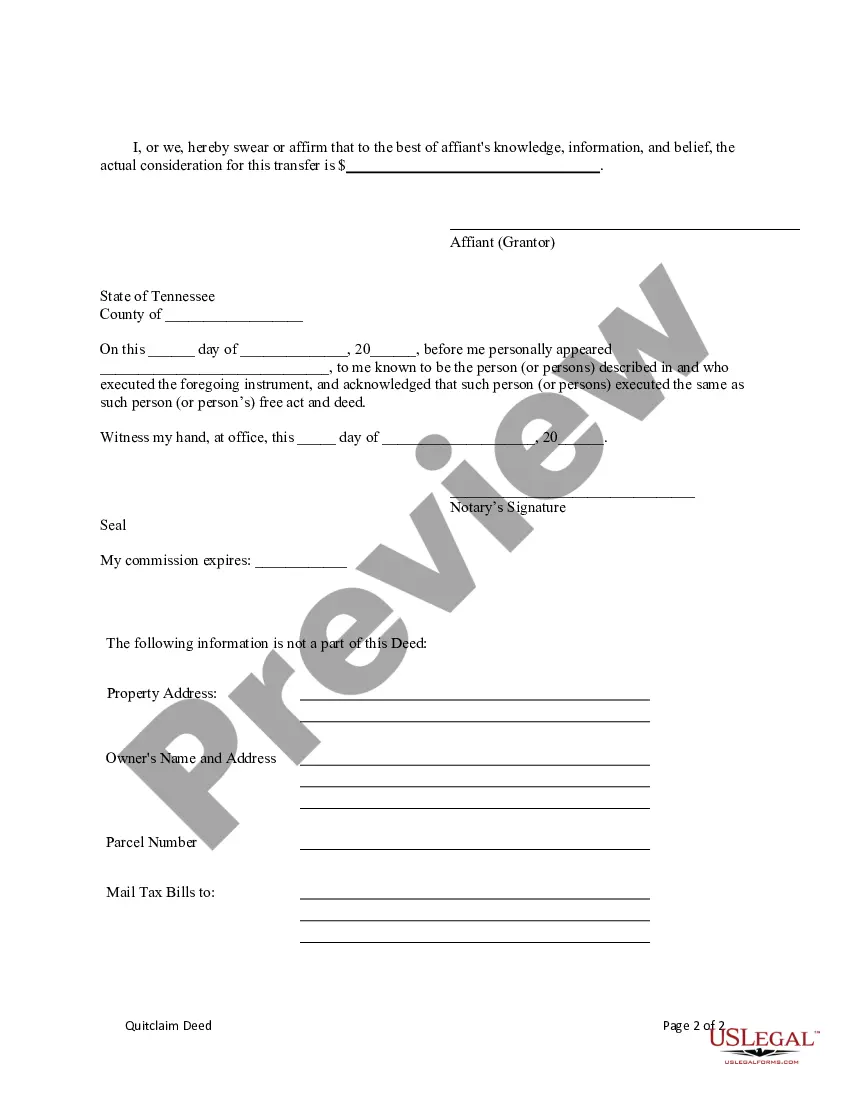
This Quitclaim Deed is a legal document where an individual, known as the Grantor, transfers ownership of a property to four individuals, referred to as Grantees. The Grantees hold the property as joint tenants with the right of survivorship, meaning that if one of them passes away, their share automatically transfers to the surviving Grantees. This form is tailored to meet state statutory requirements, distinguishing it from other types of deeds like Warranty Deeds, which offer greater legal protection to Grantees.
Form components explained
- Identifying information for the Grantor and Grantees
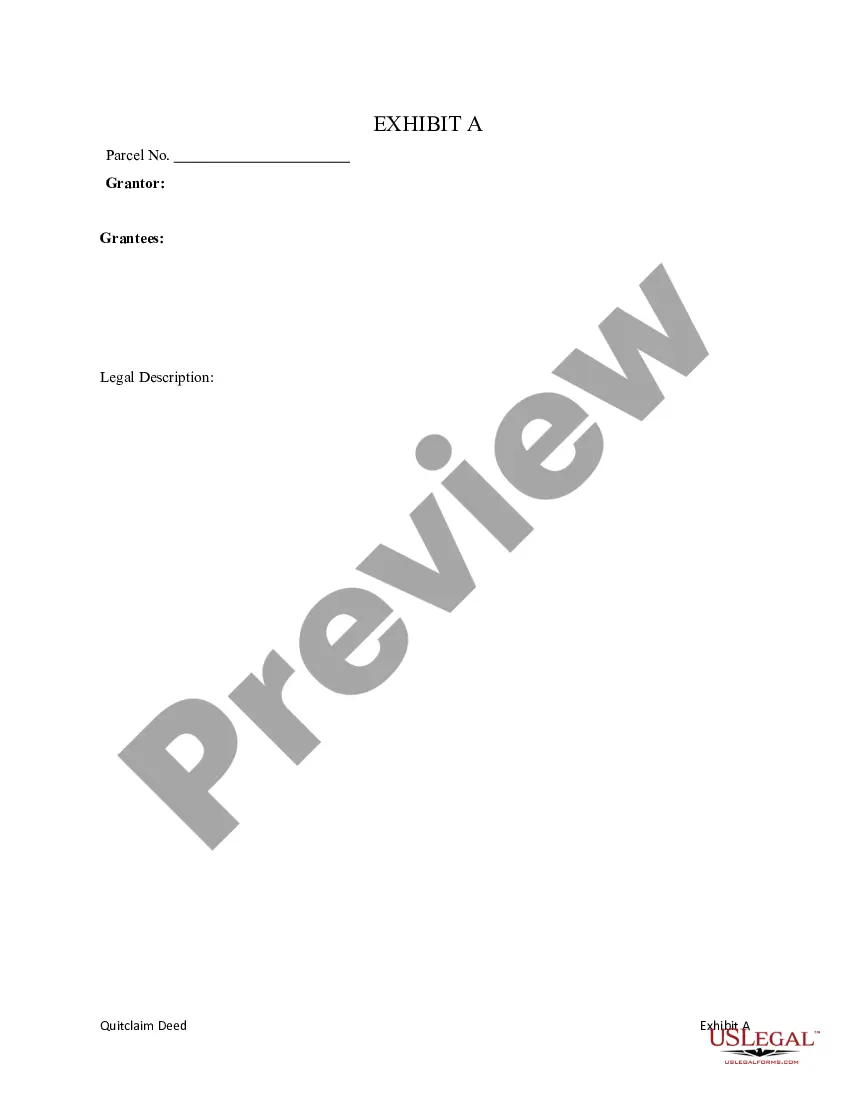
- Legal description of the property being transferred
- Statement of joint tenancy with right of survivorship
- Signature lines for the Grantor and notary public
- Date of the transaction




When to use this document
This form is needed when an individual wishes to transfer real estate ownership to four individuals while ensuring that all Grantees can inherit the property without going through probate. Common scenarios include family transfers, estate planning, or when co-owners wish to clarify ownership status. It is particularly useful in situations where the Grantor and Grantees are related or have agreed to share ownership equally.
Who should use this form
- Individuals looking to transfer property to multiple parties
- Family members involved in property sharing or inheritance
- Joint owners seeking to establish clear ownership rights
- Those engaging in estate planning or gift transfers of property
Completing this form step by step
- Identify the full names and addresses of the Grantor and Grantees.
- Provide a detailed legal description of the property being conveyed.
- Indicate the terms of joint tenancy with right of survivorship.
- Have the Grantor sign the deed in the presence of a notary public.
- Ensure the date of transfer is clearly stated on the form.
Notarization guidance
This form needs to be notarized to ensure legal validity. US Legal Forms provides secure online notarization powered by Notarize, allowing you to complete the process through a verified video call, available anytime.
Get your form ready online
Our built-in tools help you complete, sign, share, and store your documents in one place.
Make edits, fill in missing information, and update formatting in US Legal Forms—just like you would in MS Word.
Download a copy, print it, send it by email, or mail it via USPS—whatever works best for your next step.
Sign and collect signatures with our SignNow integration. Send to multiple recipients, set reminders, and more. Go Premium to unlock E-Sign.
If this form requires notarization, complete it online through a secure video call—no need to meet a notary in person or wait for an appointment.
We protect your documents and personal data by following strict security and privacy standards.

Make edits, fill in missing information, and update formatting in US Legal Forms—just like you would in MS Word.

Download a copy, print it, send it by email, or mail it via USPS—whatever works best for your next step.

Sign and collect signatures with our SignNow integration. Send to multiple recipients, set reminders, and more. Go Premium to unlock E-Sign.

If this form requires notarization, complete it online through a secure video call—no need to meet a notary in person or wait for an appointment.

We protect your documents and personal data by following strict security and privacy standards.
Typical mistakes to avoid
- Failing to include a complete legal description of the property.
- Not having the document notarized when required.
- Omitting names or signatures of the Grantees.
- Not clearly stating the terms of joint tenancy.
- Forgetting to check dates before submission.
Why use this form online
- Easy access to professionally drafted legal forms tailored to your needs.
- Convenience of completing the form from anywhere, at any time.
- Editability allows you to customize the form before printing.
- Instant download provides immediate use without waiting for shipping.
Looking for another form?

Form popularity
FAQ
While the joint tenant with right of survivorship can't will his share in the property to his heir, he can sell his interest in the property before his death. Once a joint tenant sells his share, this ends the joint tenancy ownership involving the share.
Joint ownership. Unlike a tenancy in common, where co-owners may possess unequal interests, the legal interest of each joint owner is equal to the interest of every other joint owner. If there are three joint owners, each owns an equal, undivided, one-third interest in the entire property.
In order to terminate a joint tenancy, one of the four unities must be destroyed. You may do this by conveying your joint tenancy interest to any third person. This can be done through gift or sale. Upon termination, a tenancy in common is formed between the third person and the remaining co-tenant(s).
If you look at the registered title to your own jointly owned property and the text isn't shown on it, you own it as joint tenants. If it is there, you own it as tenants-in-common.This title is dealt with by Land Registry, Sample Town Office.
You can apply to court to change your ex-partner's tenancy to your name, or remove their name from a joint tenancy. You can apply for a 'transfer of tenancy' if: your landlord refuses to change your tenancy. your tenancy doesn't allow a transfer.
Joint tenancy is a form of property ownership normally associated with real estate. Each party in a joint tenancy has an equal interest in the propertythe financial obligations as well as any benefits.
Both owners must consent to a sale. Tenants in common share separate, undivided interest in the home. Each tenant can sell or give away his share. If you want to sell the home with a tenant in common, you both must agree to sell your shares.
The deed specifies that the joint tenants own an equal amount of interest in the purchased property and are thus equally liable for it financially.Instead of selling, a joint tenant can choose to transfer their interest to another party.
Serve a written notice of the change (a 'notice of severance') on the other owners - a conveyancer can help you do this. Download and fill in form SEV to register a restriction without the other owners' agreement. Prepare any supporting documents you need to include.