South Carolina Last Will and Testament for Divorced person not Remarried with Minor Children
What this document covers
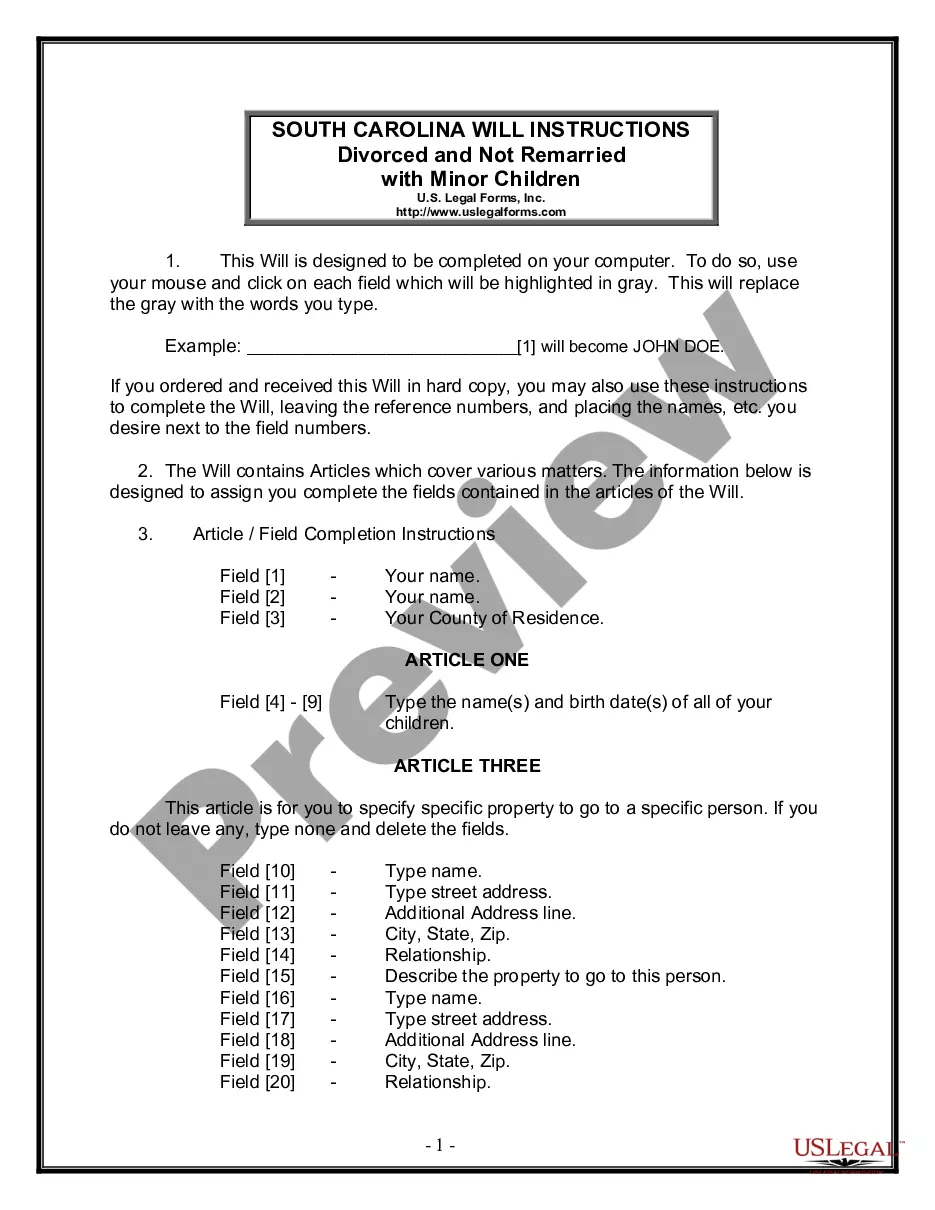
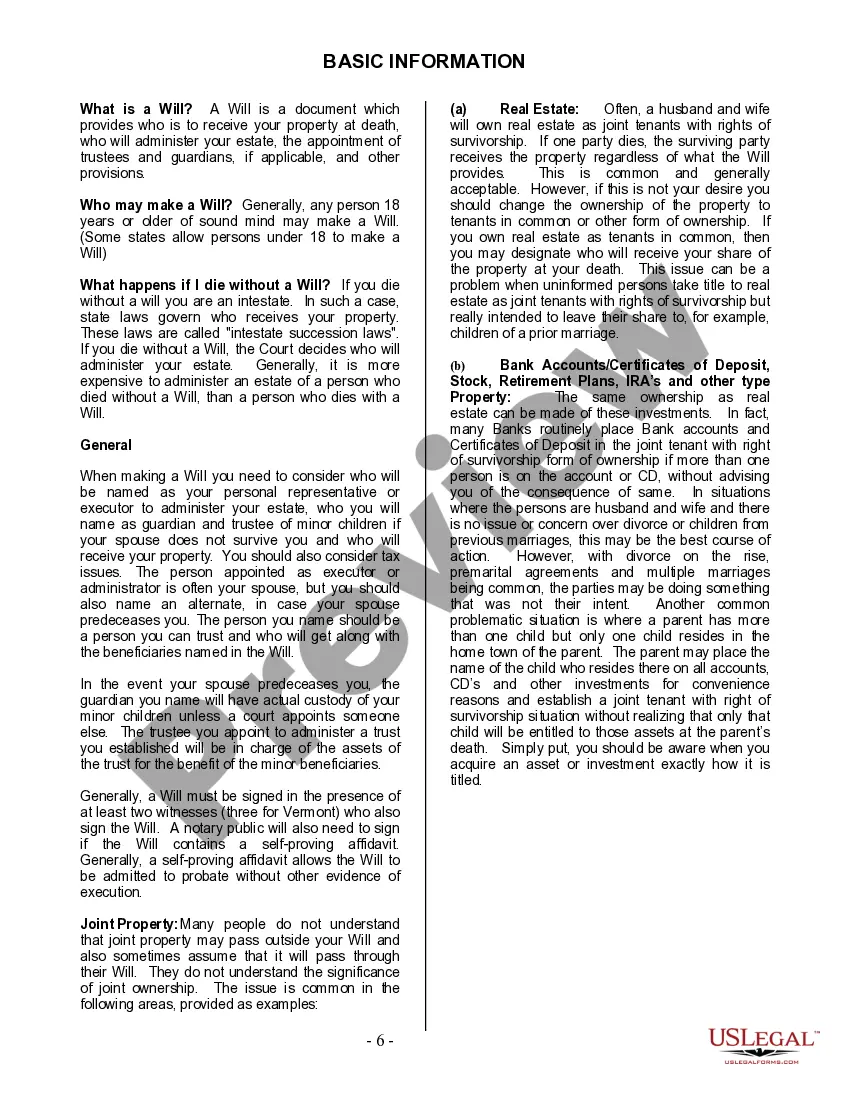
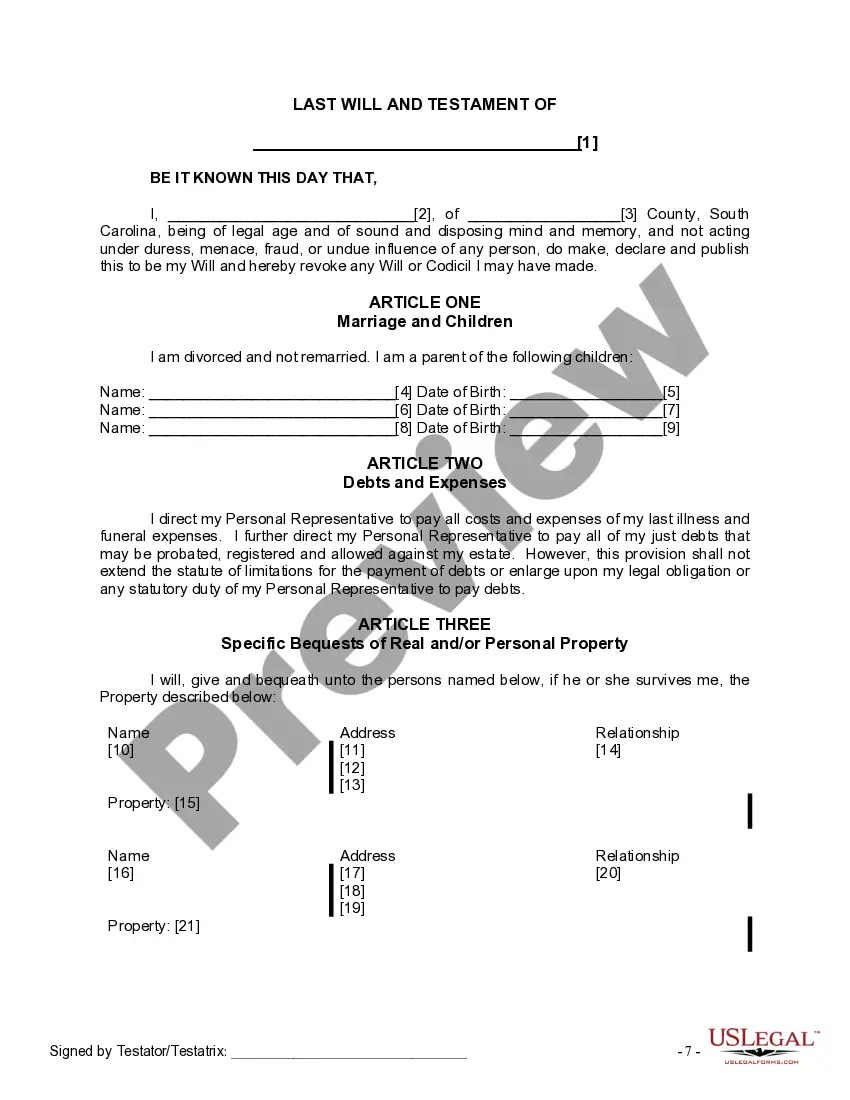
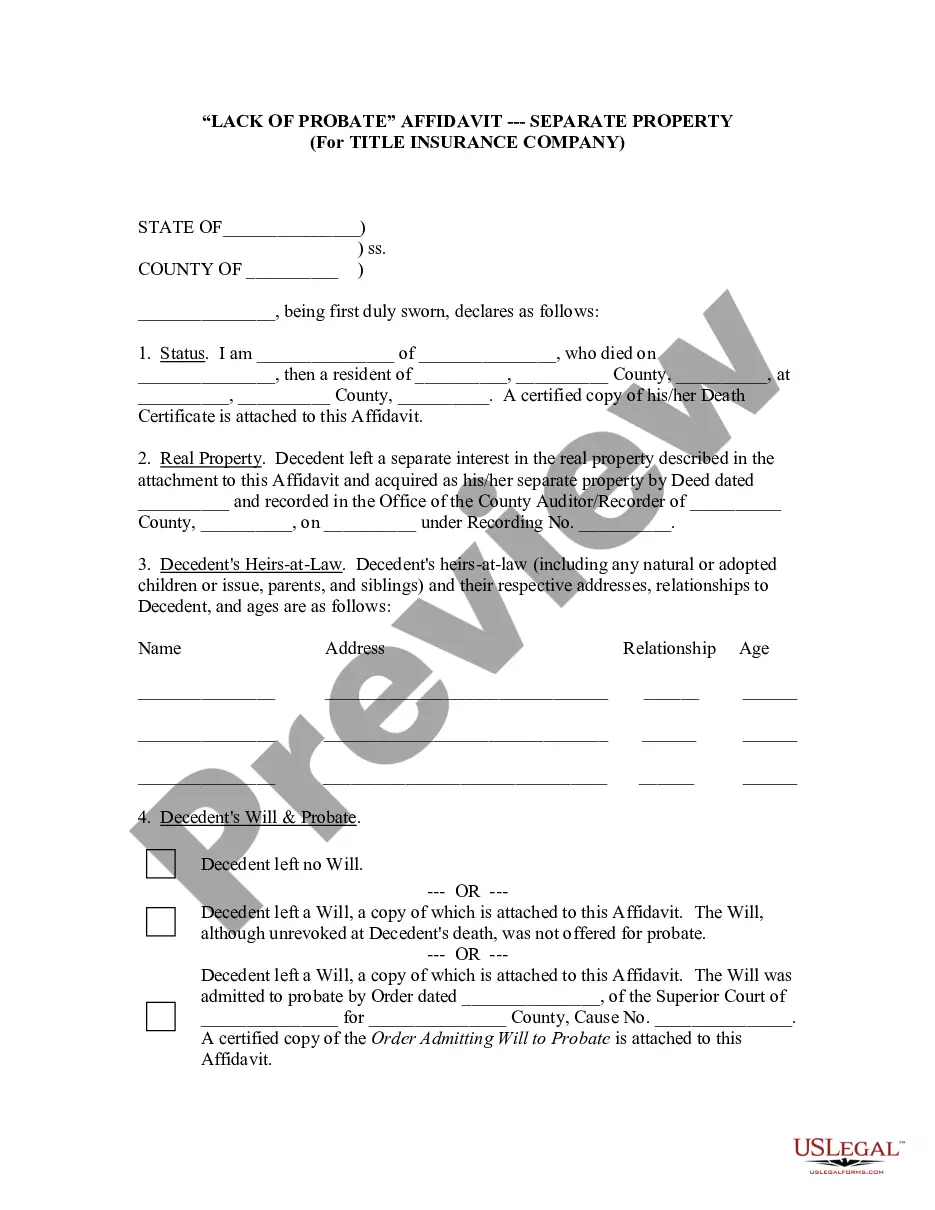
This Last Will and Testament is designed for a divorced person who has not remarried and has minor children. It outlines the distribution of your assets, appointment of guardians for your children, and the designation of an executor to manage your estate. Unlike general wills, this form specifically addresses the unique considerations for divorced individuals with dependents, ensuring your wishes are clearly documented and legally enforceable.
Form components explained
- Article One: Personal details and information about your children.
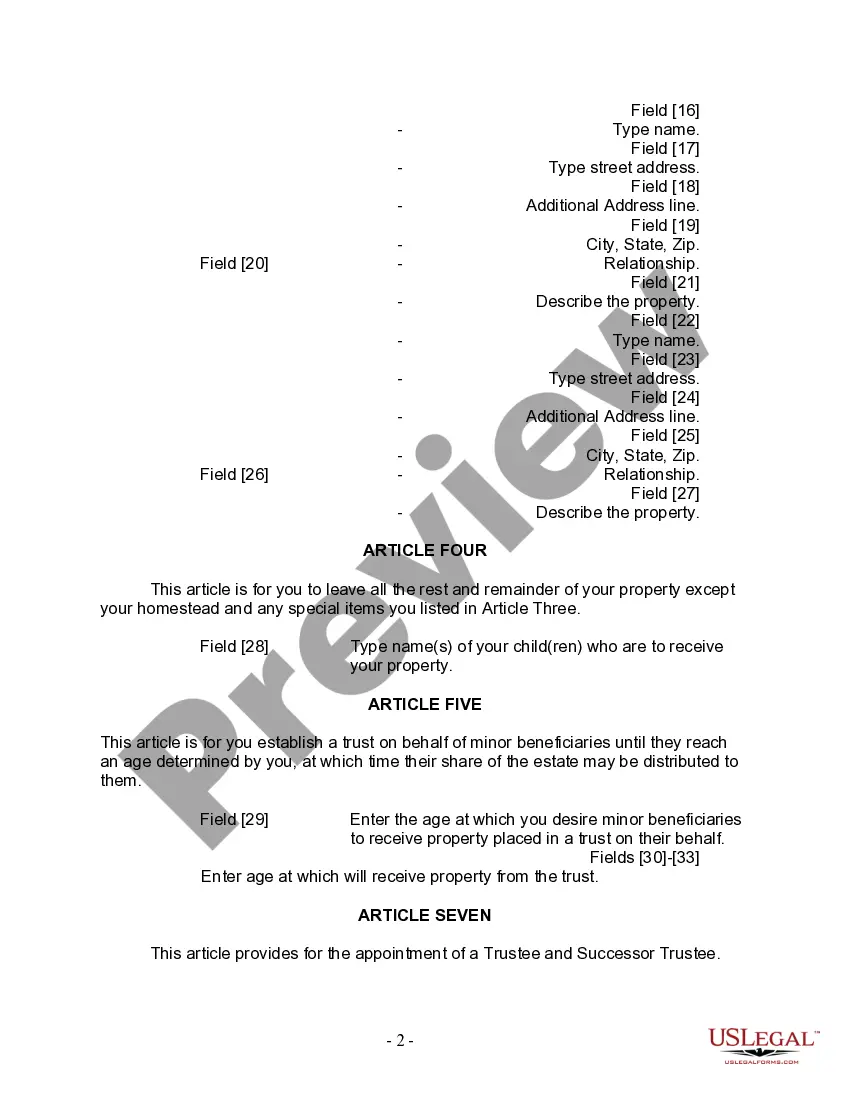
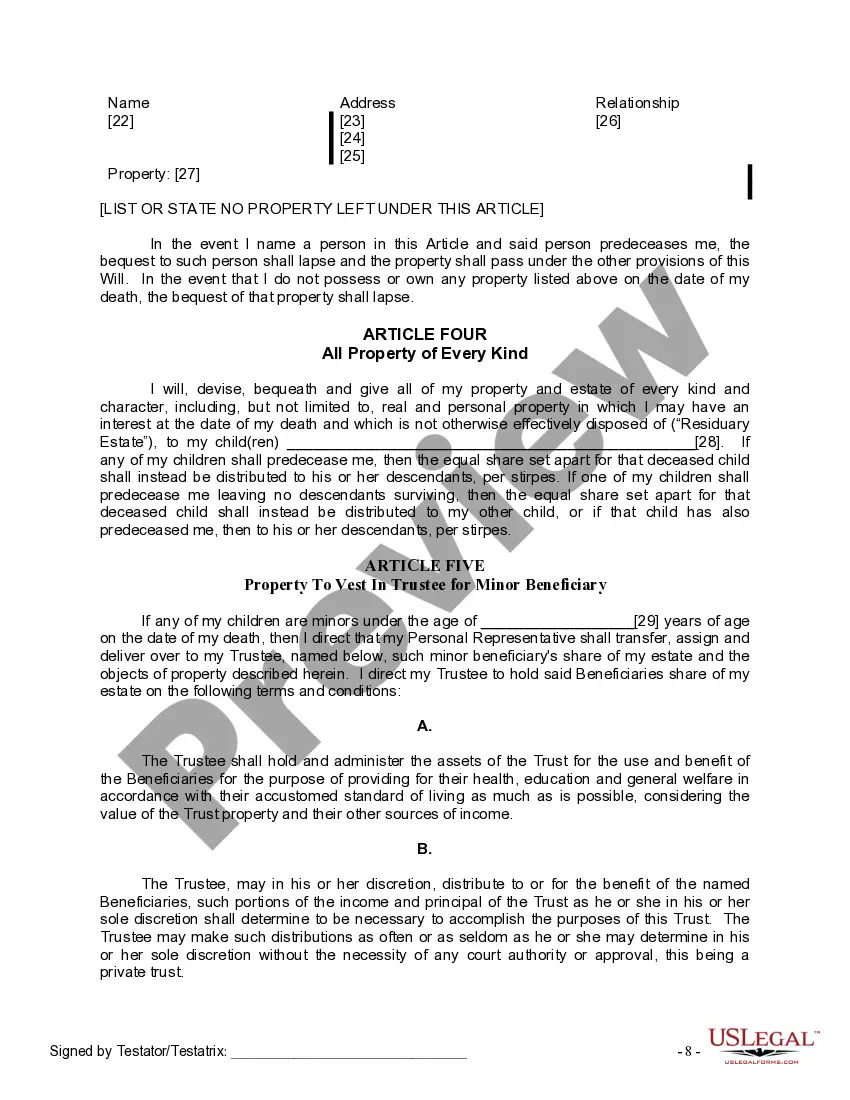
- Article Three: Specific bequests of property to individuals.
- Article Four: Distribution of the remaining estate to your children.
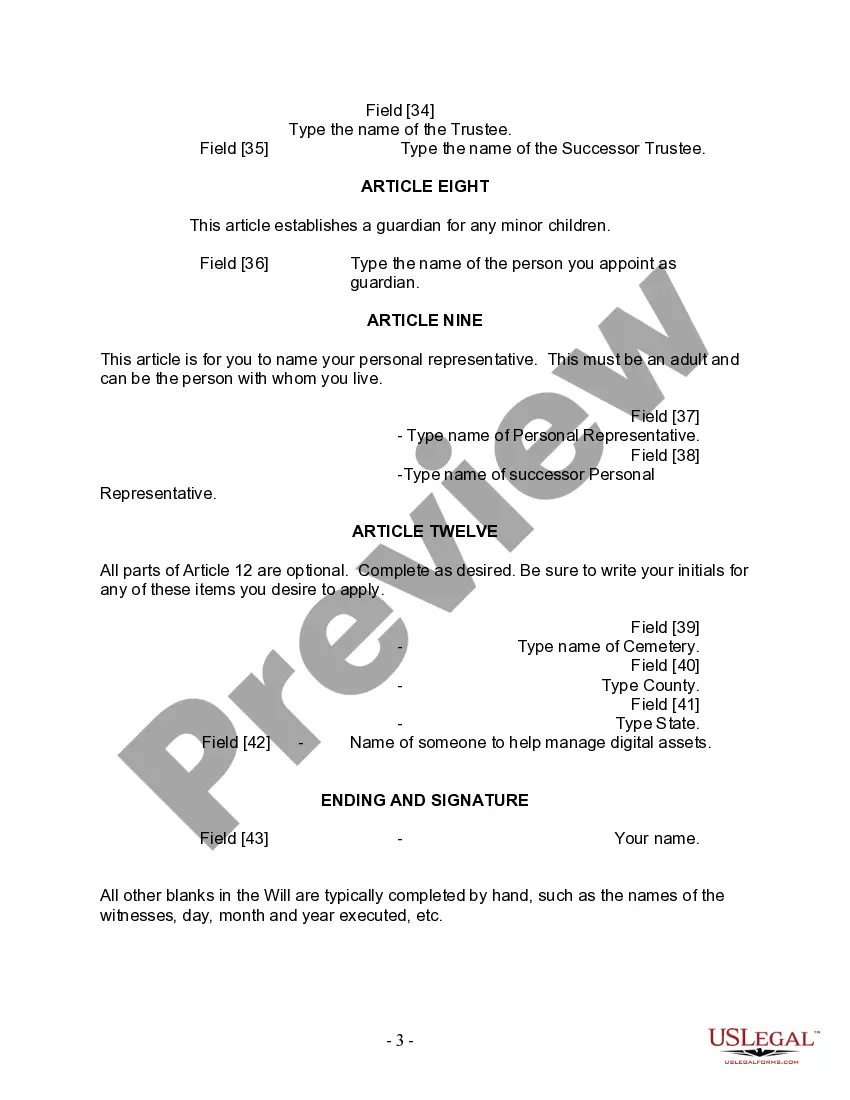
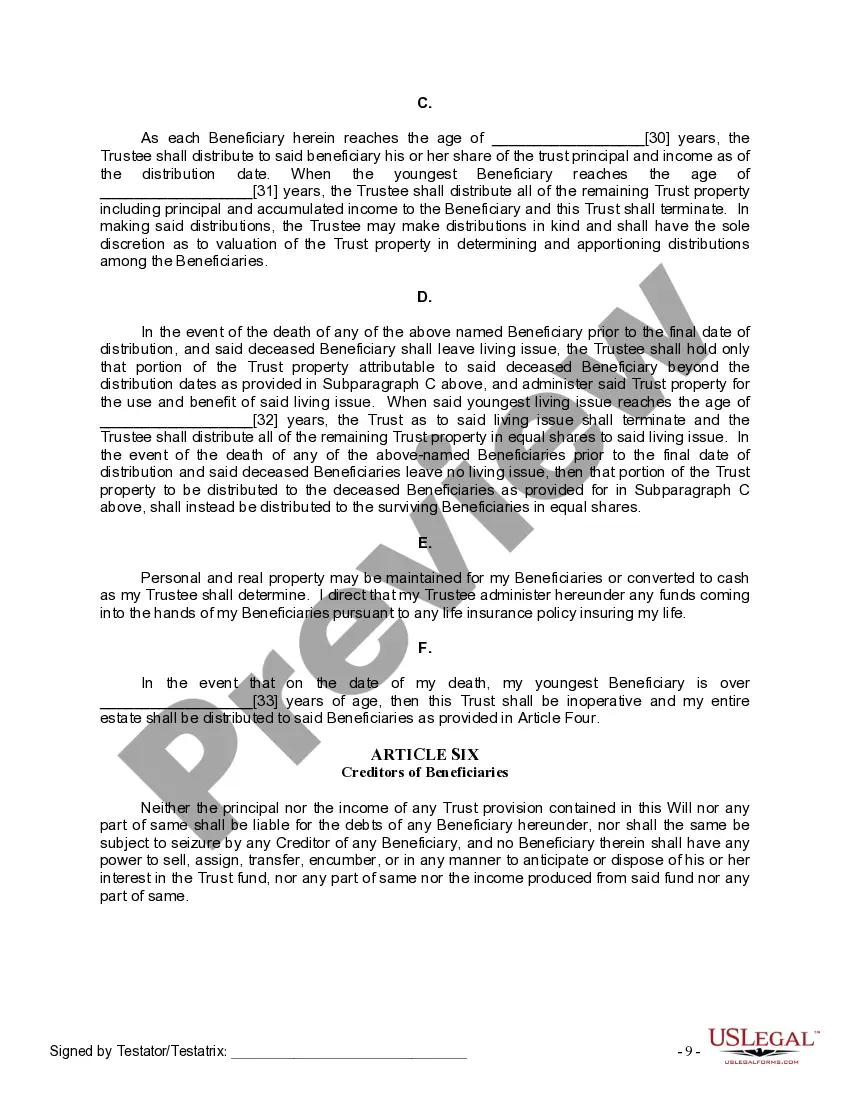
- Article Five: Establishment of a trust for minor beneficiaries.
- Article Eight: Appointment of a guardian for your minor children.
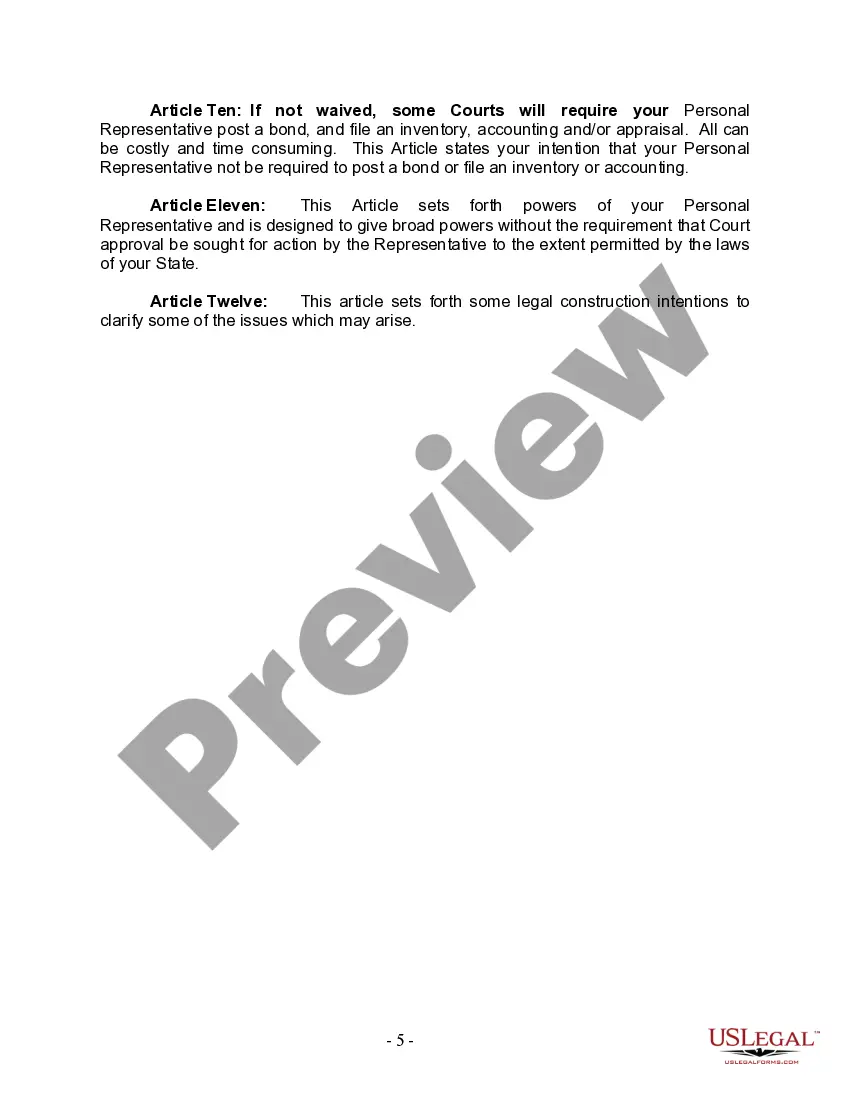
- Article Nine: Designation of a personal representative to execute the will.




When to use this document
This form is appropriate in scenarios where a divorced individual with minor children wishes to establish a clear legal will. It is needed when wanting to ensure that your assets are distributed according to your wishes, appoint a guardian for your children, and designate a personal representative to manage your estate after your passing.
Who this form is for
- Divorced individuals with minor children who wish to make a will.
- Single parents looking to establish guardianship for their children.
- Any adult of sound mind wanting to provide clear instructions for asset distribution.
Steps to complete this form
- Begin by entering your name, county of residence, and the names and birthdates of your children.
- Specify any specific property you wish to bequeath to individuals and include their full address and relationship to you.
- Detail how you wish to distribute the remainder of your estate to your children.
- Designate a trustee for any assets held in trust for minor children, including the terms for distribution when they reach a certain age.
- Appoint a guardian for your minor children and clearly name your personal representative.
Notarization requirements for this form
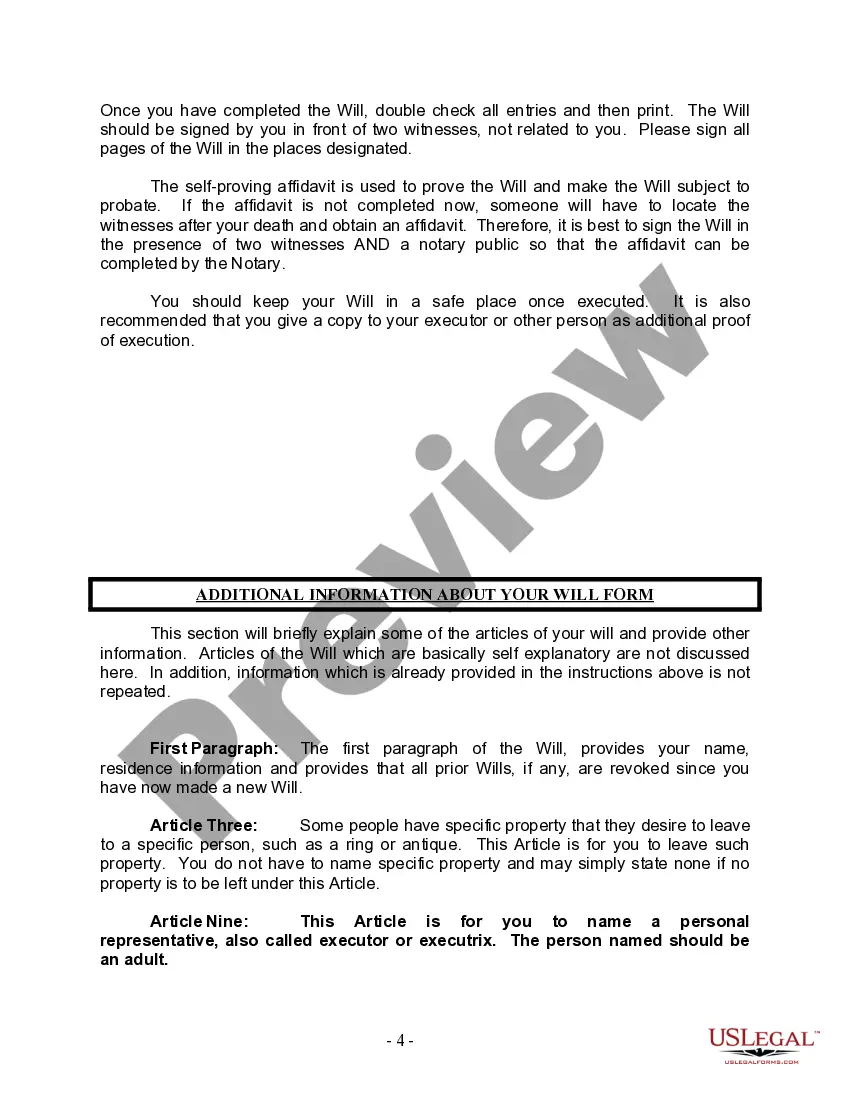
Yes, this form must be notarized to be legally valid. The will requires signatures from two witnesses, and if your state has adopted a self-proving affidavit statute, it must also be signed by a notary public to simplify the probate process.
Get your form ready online
Our built-in tools help you complete, sign, share, and store your documents in one place.
Make edits, fill in missing information, and update formatting in US Legal Forms—just like you would in MS Word.
Download a copy, print it, send it by email, or mail it via USPS—whatever works best for your next step.
Sign and collect signatures with our SignNow integration. Send to multiple recipients, set reminders, and more. Go Premium to unlock E-Sign.
If this form requires notarization, complete it online through a secure video call—no need to meet a notary in person or wait for an appointment.
We protect your documents and personal data by following strict security and privacy standards.

Make edits, fill in missing information, and update formatting in US Legal Forms—just like you would in MS Word.

Download a copy, print it, send it by email, or mail it via USPS—whatever works best for your next step.

Sign and collect signatures with our SignNow integration. Send to multiple recipients, set reminders, and more. Go Premium to unlock E-Sign.

If this form requires notarization, complete it online through a secure video call—no need to meet a notary in person or wait for an appointment.

We protect your documents and personal data by following strict security and privacy standards.
Avoid these common issues
- Failing to properly witness the signing of the will.
- Not appointing a successor personal representative.
- Omitting the establishment of a trust for minor beneficiaries.
- Neglecting to review and update the will after major life changes.
Benefits of completing this form online
- Convenience of completing your will at your own pace.
- Ability to easily edit and customize specific sections as needed.
- Accessibility to legal guidance integrated into the form.
- Secure download for easy access and storage.
Looking for another form?
Form popularity
FAQ
No. You can make your own will in South Carolina, using Nolo's do-it-yourself will software or online will programs. However, you may want to consult a lawyer in some situations. For example, if you think that your will might be contested or if you want to disinherit your spouse, you should talk with an attorney.
Deliver the will at death. Personal representative is appointed. Notice to intestate heirs is sent. Inventory and appraisement of the estate. Final accounting. Disbursements. Close the estate.
Witnesses: A South Carolina will must be signed by at least two individuals, each of whom witnessed the signing of the will or the testator's acknowledgement of the signature or of the will. Writing: A South Carolina will must be in writing. Beneficiaries: A testator can leave property to anyone.
South Carolina law requires that you deliver the will to the Probate Court within thirty (30) days after the person's death.
A South Carolina will must be filed with the Probate Court within thirty days of the decedent's death. Once the will is proven, the executor (person who oversees the deceased's estate) can proceed to wrap up the estate, which includes collecting and protecting property, paying off debts, and then distributing assets.
Do I Need to Have My Will Notarized? No, in South Carolina, you do not need to notarize your will to make it legal.A self-proving will speeds up probate because the court can accept the will without contacting the witnesses who signed it.
Handwritten wills prepared in South Carolina are not legal. However, a holographic will created in another state may be valid in South Carolina.
All wills must be property signed and witnessed to be effective. For example, South Carolina requires two witnesses for a will to be valid. A notary is not sufficient, or even required. Also it is important to have impartial persons as witnesses.