Rhode Island Notice of Dishonored Check - Civil - Keywords: bad check, bounced check
Overview of this form
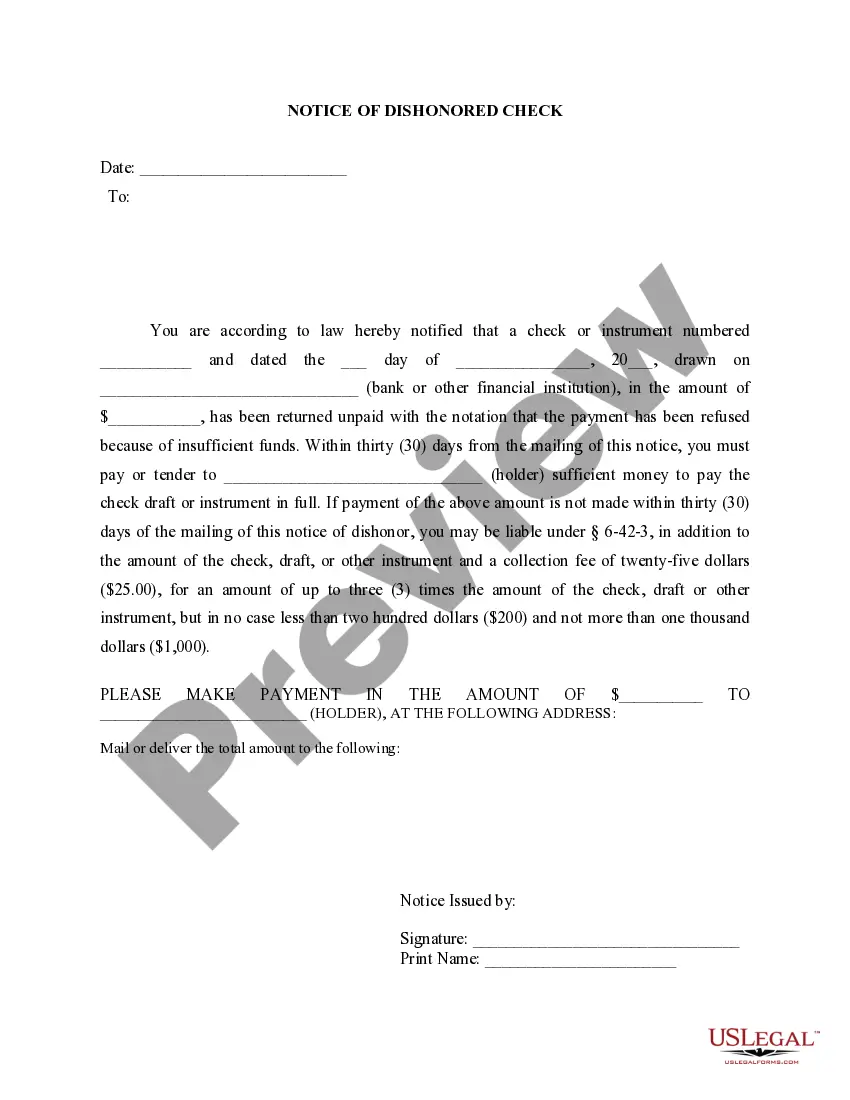
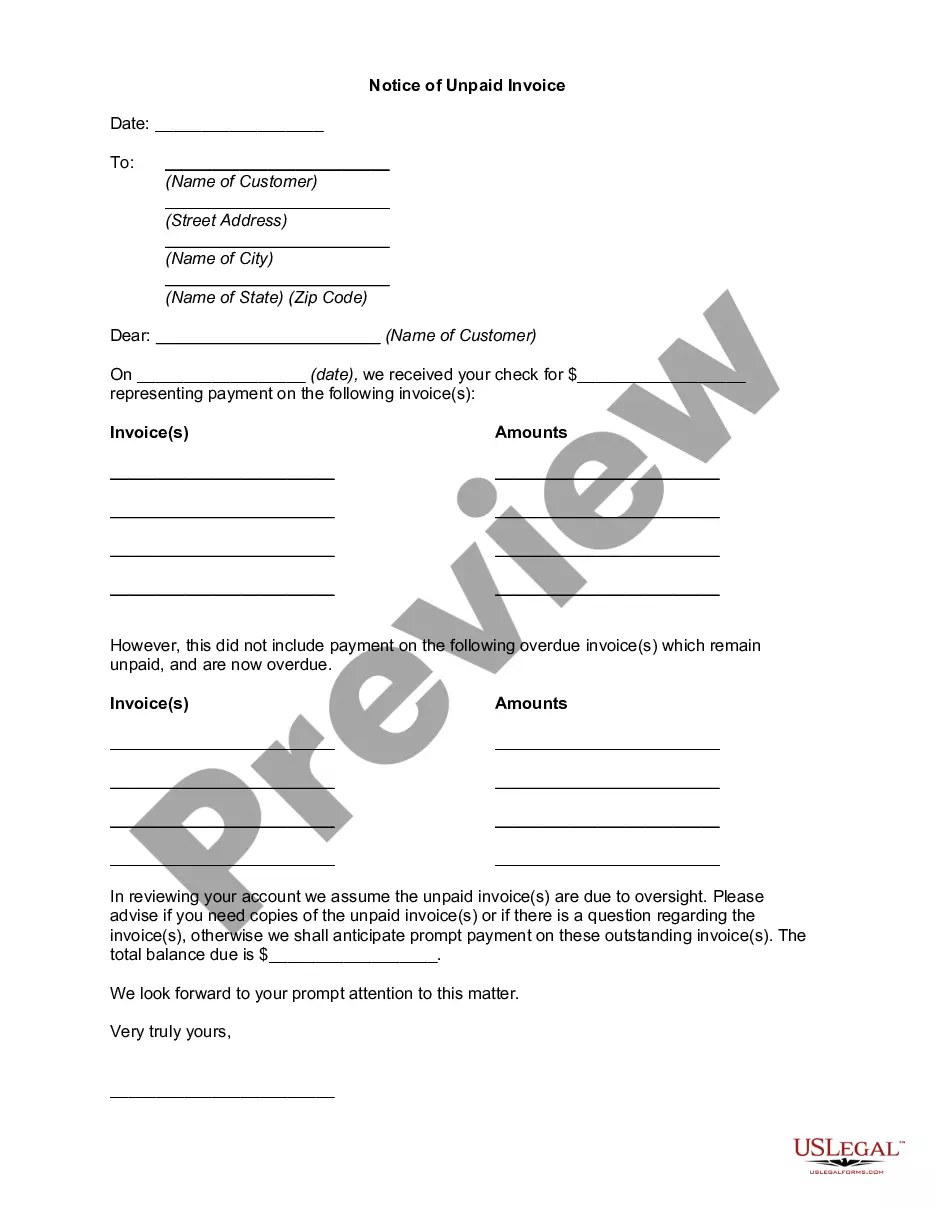
The Notice of Dishonored Check is a legal document used to inform a debtor that their check has bounced or been returned for insufficient funds. It is also known as a bad check notice. This form serves as a critical notification to the payee, allowing them to pursue recovery of the funds owed. By providing this notice, the payee ensures compliance with relevant state laws regarding dishonored checks, distinguishing it from other types of notices related to financial transactions.
What’s included in this form
- Debtor's contact information: Details of the person who issued the dishonored check.
- Check details: Information about the bounced check, including the amount and date.
- Notification statement: A declaration that the check has been returned due to insufficient funds or a closed account.
- Instructions for remedy: Guidance on how the debtor can resolve the issue and pay the outstanding amount.
- Signature line: A section for the payee to sign, affirming the delivery of the notice.


Situations where this form applies
This form is needed when a check has been returned due to insufficient funds or because the checking account no longer exists. Business owners and others who receive bounced checks should use this notice to document the dishonor and formally notify the debtor, which may be a prerequisite for collection efforts or legal action.
Who should use this form
- Individuals or businesses that have been issued a bounced check.
- Creditors seeking to recover funds from a debtor who has issued a bad check.
- Anyone intending to comply with state laws regarding the notification of dishonored checks.
Completing this form step by step
- Identify the debtor: Fill in the debtor's name and address where the notice will be sent.
- Specify the check details: Include the date of the check, the amount, and the reason for dishonor.
- Write the notification statement: Clearly state that the check was dishonored and provide instructions for payment.
- Sign the form: The payee must sign to verify that the notice has been issued.
- Send the notice: Ensure timely delivery of the notice to the debtor according to state requirements.
Does this form need to be notarized?
This form does not typically require notarization to be legally valid. However, some jurisdictions or document types may still require it. US Legal Forms provides secure online notarization powered by Notarize, available 24/7 for added convenience.
Get your form ready online
Our built-in tools help you complete, sign, share, and store your documents in one place.
Make edits, fill in missing information, and update formatting in US Legal Forms—just like you would in MS Word.
Download a copy, print it, send it by email, or mail it via USPS—whatever works best for your next step.
Sign and collect signatures with our SignNow integration. Send to multiple recipients, set reminders, and more. Go Premium to unlock E-Sign.
If this form requires notarization, complete it online through a secure video call—no need to meet a notary in person or wait for an appointment.
We protect your documents and personal data by following strict security and privacy standards.

Make edits, fill in missing information, and update formatting in US Legal Forms—just like you would in MS Word.

Download a copy, print it, send it by email, or mail it via USPS—whatever works best for your next step.

Sign and collect signatures with our SignNow integration. Send to multiple recipients, set reminders, and more. Go Premium to unlock E-Sign.

If this form requires notarization, complete it online through a secure video call—no need to meet a notary in person or wait for an appointment.

We protect your documents and personal data by following strict security and privacy standards.
Avoid these common issues
- Failing to provide accurate debtor information, which may delay recovery efforts.
- Not including the correct check details, leading to confusion.
- Forgetting to sign the notice, rendering it less effective.
- Not sending the notice within the required timeframe dictated by state law.
Why use this form online
- Immediate access: Download the form anytime without waiting for mail delivery.
- Editability: Customize the form to fit your specific situation and needs.
- Reliability: Ensure that the form is up to date with the latest legal standards.
Looking for another form?
Form popularity
FAQ
Writing a bad check, also known as a hot check, is illegal. Banks normally charge a fee to anyone who writes a bad check unintentionally. The punishment for trying to pass a bad check intentionally ranges from a misdemeanor to a felony.
Penal Code 476a PC is the California statute that makes it a crime for a person to write or pass a bad check, knowing there are insufficient funds to cover payment of the check. The offense can be charged as a felony if the value of the bad checks is more than $950.00. Otherwise, the offense is only a misdemeanor.
When there are insufficient funds in an account, and a bank decides to bounce a check, it charges the account holder an NSF fee. If the bank accepts the check, but it makes the account negative, the bank charges an overdraft (OD) fee. If the account stays negative, the bank may charge an extended overdraft fee.
Bouncing a check can happen to anyone. Write one and you'll owe your bank an NSF fee of between $27 and $35, and the recipient of the check is permitted to charge a returned-check fee of between $20 and $40 or a percentage of the check amount.
If you are given a bad check, you can sue for the amount of the check plus bank fees. You can also add damages to your claim.
People who write bad checks are normally charged fees by their banks and could be on the hook for any fees incurred by the payee. Knowingly writing a bad check may constitute a misdemeanor or felony, depending on the amount of the check and the state in which it was written.
A bounced check occurs when the writer of the check has insufficient funds available to fulfill the payment amount on the check to the payee. When a check bounces, they are not honored by the depositor's bank, and may result in fees and banking restrictions.
If the tellers at the checks bank tell you there ARE sufficient funds you have three options: cash the check immediately (actually get cash - probably not recommended if it's several thousand dollars), take the check to YOUR bank and deposit the funds (this will take 2-3 days for the check to clear - not recommended),
Writing bad checks can lead to several theft charges, but with the help of a skilled defense attorney, you can work to reduce or even dismiss charges.