Pennsylvania Warranty Deed from Individual to Corporation
Overview of this form
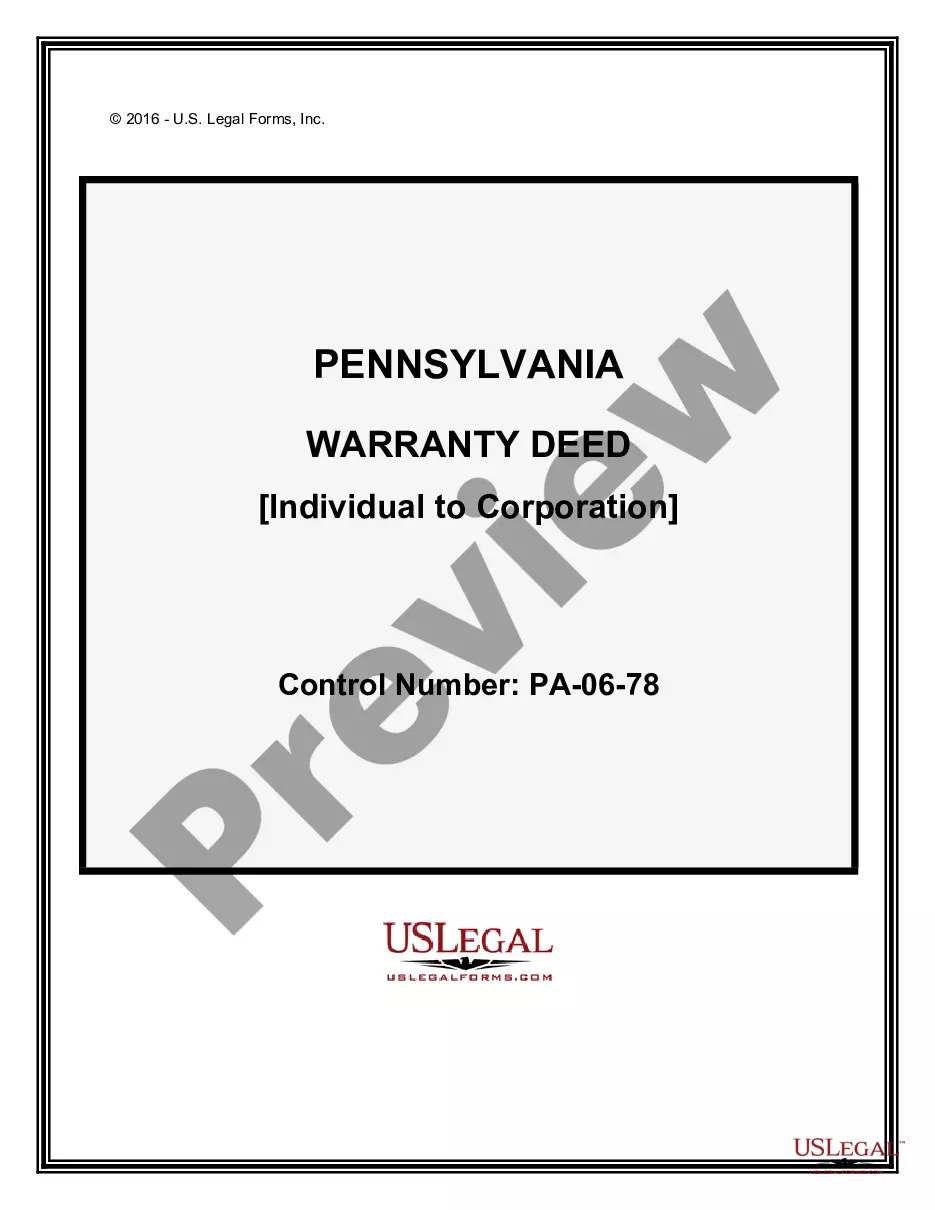
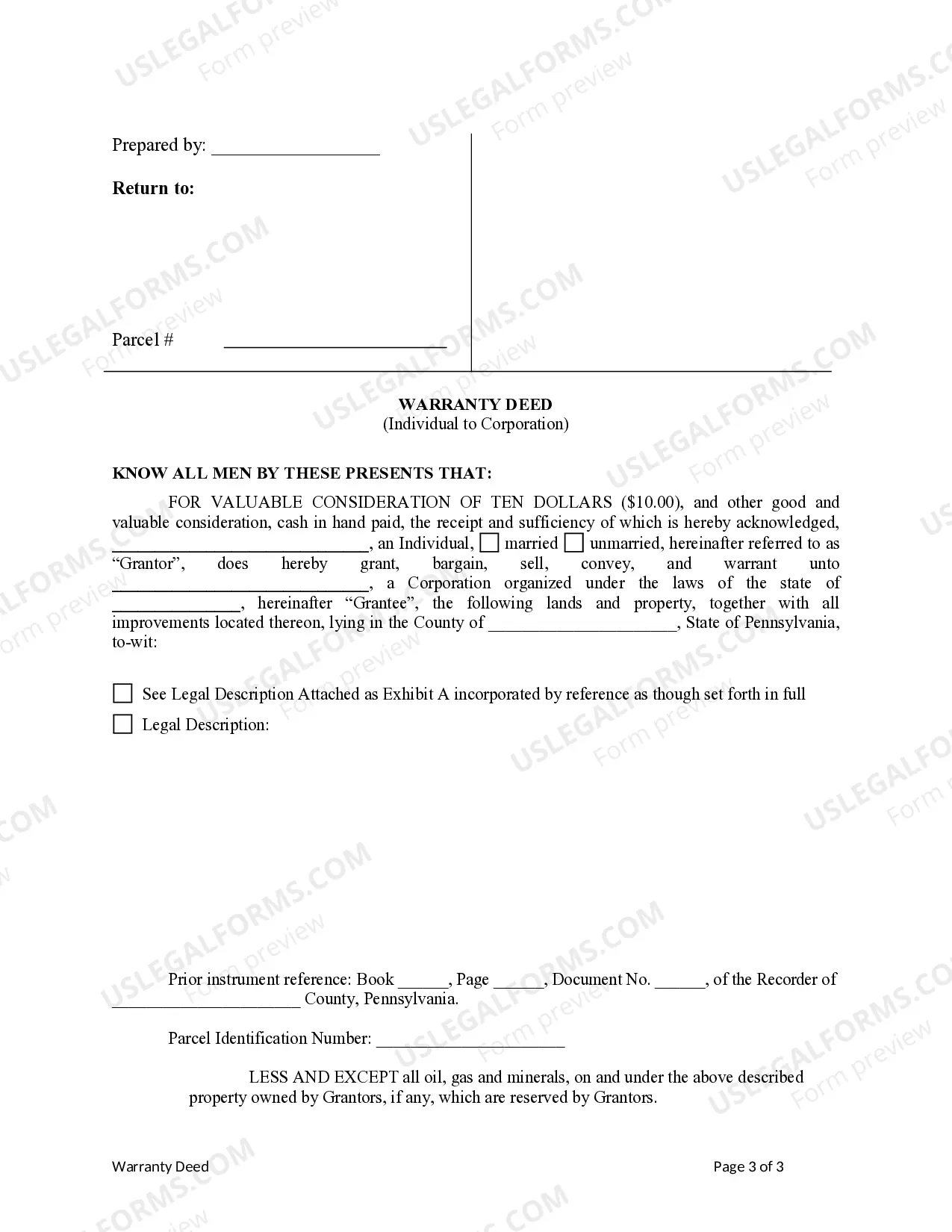
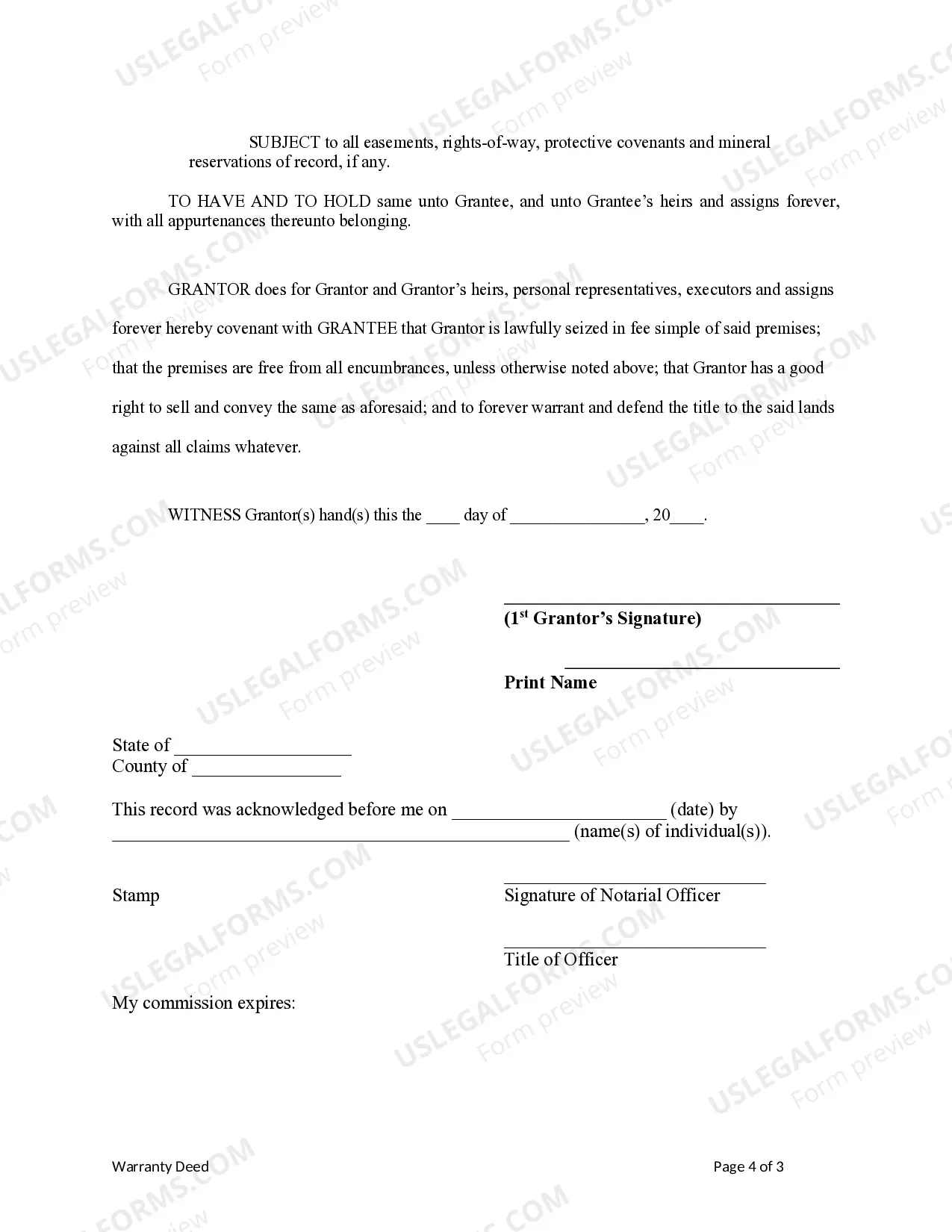
The Warranty Deed from Individual to Corporation is a legal document used to transfer real estate property from an individual (grantor) to a corporation (grantee). This form guarantees that the grantor holds clear title to the property and includes a warranty that protects the grantee from claims against the property, except for specified mineral rights. Unlike other types of deeds, this warranty deed not only conveys the property but also assures the grantee of a secure title.
Main sections of this form
- Grantor and Grantee Information: Details of the individual and corporation involved in the transfer.
- Legal Description: A precise description of the property being transferred.
- Warranty Clause: A promise by the grantor that the title is free from defects, except for exceptions noted.
- Mineral Rights Clause: States the exclusion of oil, gas, and minerals from the transfer unless specified otherwise.
- Signatures: Requires the grantor's signature and date to finalize the deed.


Common use cases
This form should be used when an individual wishes to transfer ownership of real estate to a corporation. It is typically needed in situations where a business entity requires direct ownership of property, such as for operational or investment purposes. Additionally, it protects the rights of the corporation by ensuring that the transfer is legally binding, thereby reducing the risk of future disputes regarding title ownership.
Who can use this document
- Individuals transferring property to a corporation.
- Corporations acquiring real estate from a private individual.
- Real estate investors seeking to formalize property ownership structures.
Completing this form step by step
- Identify the parties involved, including full names of the grantor and grantee.
- Specify the property by entering the full legal description, as required.
- Detail any exclusions, such as mineral rights, if applicable.
- Have the grantor sign and date the form in the designated area.
- Ensure relevant witnesses or notaries are present if required by state law.
Is notarization required?
This form needs to be notarized to ensure legal validity. US Legal Forms provides secure online notarization powered by Notarize, allowing you to complete the process through a verified video call, available anytime.
Get your form ready online
Our built-in tools help you complete, sign, share, and store your documents in one place.
Make edits, fill in missing information, and update formatting in US Legal Forms—just like you would in MS Word.
Download a copy, print it, send it by email, or mail it via USPS—whatever works best for your next step.
Sign and collect signatures with our SignNow integration. Send to multiple recipients, set reminders, and more. Go Premium to unlock E-Sign.
If this form requires notarization, complete it online through a secure video call—no need to meet a notary in person or wait for an appointment.
We protect your documents and personal data by following strict security and privacy standards.

Make edits, fill in missing information, and update formatting in US Legal Forms—just like you would in MS Word.

Download a copy, print it, send it by email, or mail it via USPS—whatever works best for your next step.

Sign and collect signatures with our SignNow integration. Send to multiple recipients, set reminders, and more. Go Premium to unlock E-Sign.

If this form requires notarization, complete it online through a secure video call—no need to meet a notary in person or wait for an appointment.

We protect your documents and personal data by following strict security and privacy standards.
Common mistakes to avoid
- Failing to provide a complete and accurate legal description of the property.
- Not specifying any exclusions related to mineral rights.
- Neglecting to sign and date the form, which invalidates the deed.
- Using outdated or incorrect versions of the warranty deed.
Why use this form online
- Convenient access to the form at any time without the need for a legal appointment.
- Editable fields that allow for easy completion on a computer, reducing errors.
- Instant downloads for immediate use, saving time and resources.
Legal use & context
- This warranty deed ensures that the property title is transferred free from defects, securing the interests of the grantee.
- Properly executed deeds are legally enforceable and can prevent ownership disputes in the future.
Quick recap
- A Warranty Deed from Individual to Corporation is crucial for transferring property ownership securely.
- The form includes important protections and exclusions, such as mineral rights.
- Ensure compliance with state laws and correct completion to avoid common mistakes.
Looking for another form?
Form popularity
FAQ
In order to make the Warranty Deed legally binding, the Seller needs to sign it front of a notary public. Then signed and notarized deed must be filed at the city or county office for recording property documents. Before filing with this office all previously billed property taxes must be paid in full.
The State of Pennsylvania charges 1% of the sales price and the municipality and school district USUALLY charge 1% between them for a total of 2% (i.e. 2% X 100,000 = $2,000). By custom, the buyer and seller split the cost. 1% to buyer, 1% to seller; however payment is dictated by the sales contract.
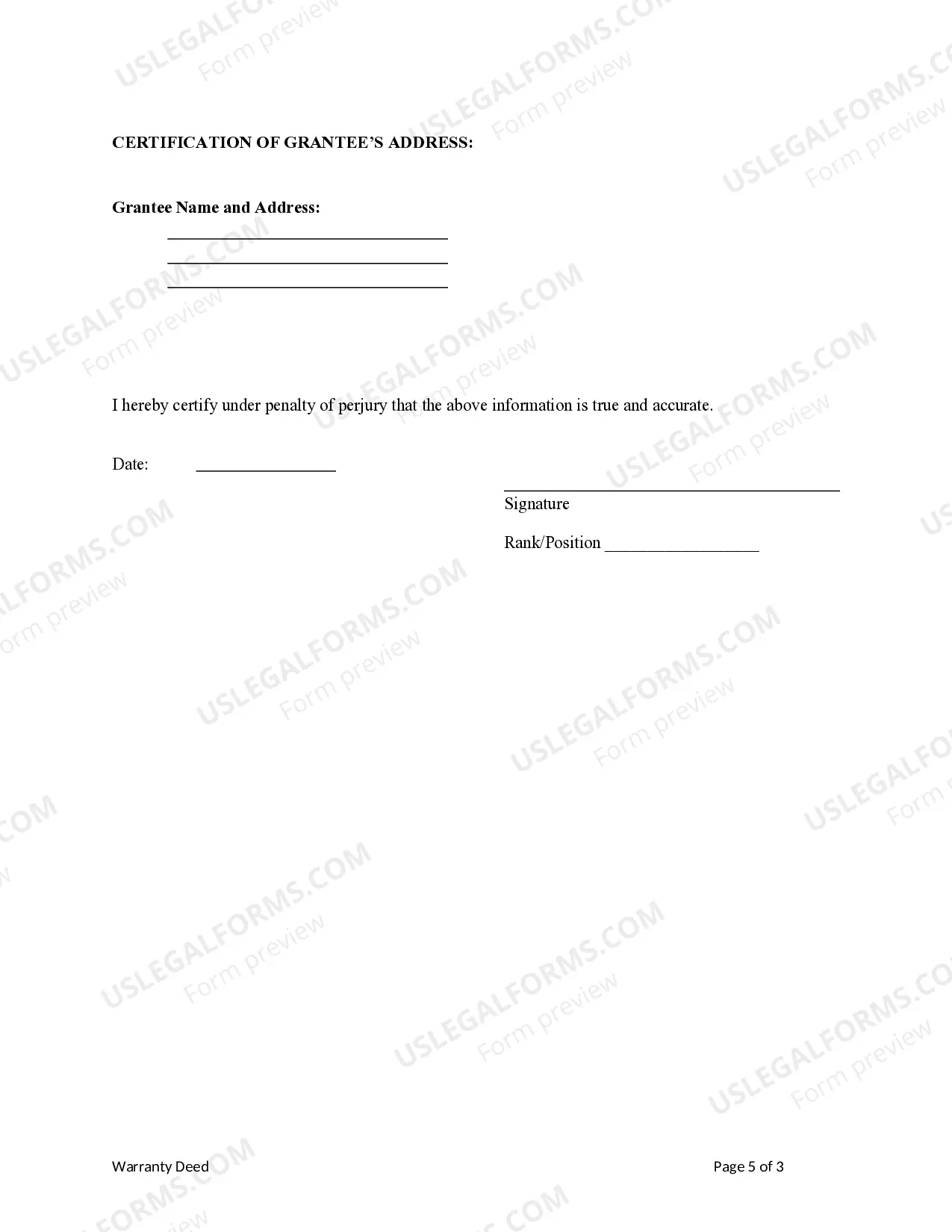
All deeds are to be signed in front of a Notary Public (just the Grantor) and the Grantee is to also sign the Certificate of Residency. Afterwards the deed may be filed with the Recorder's Office in the jurisdiction of the property.
It's important to note that a warranty deed does not actually prove the grantor has ownership (a title search is the best way to prove that), but it is a promise by the grantor that they are transferring ownership and if it turns out they don't actually own the property, the grantor will be responsible for compensating
Let's start with the definition of a deed: DEED: A written instrument by which one party, the Grantor, conveys the title of ownership in property to another party, the Grantee. A Warranty Deed contains promises, called covenants, that the Grantor makes to the Grantee.
To transfer property in Pennsylvania, you'll need to prepare and execute a deed and record it in the county where the property is located. If the transfer was in exchange for money, you'll have to pay transfer tax.
A warranty deed guarantees that: The grantor is the rightful owner of the property and has the legal right to transfer the title.The title would withstand third-party claims to ownership of the property. The grantor will do anything to ensure the grantee's title to the property.
Contrary to normal expectations, the Deed DOES NOT have to be recorded to be effective or to show delivery, and because of that, the Deed DOES NOT have to be signed in front of a Notary Public. However, if you plan to record it, then it does have to be notarized as that is a County Recorder requirement.
Typically, the lender will provide you with a copy of the deed of trust after the closing. The original warranty deeds are often mailed to the grantee after they are recorded. These are your original copies and should be kept in a safe place, such as a fireproof lockbox or a safe deposit box at a financial institution.