Oregon Agreement for Payment of Unpaid Rent
What is this form?
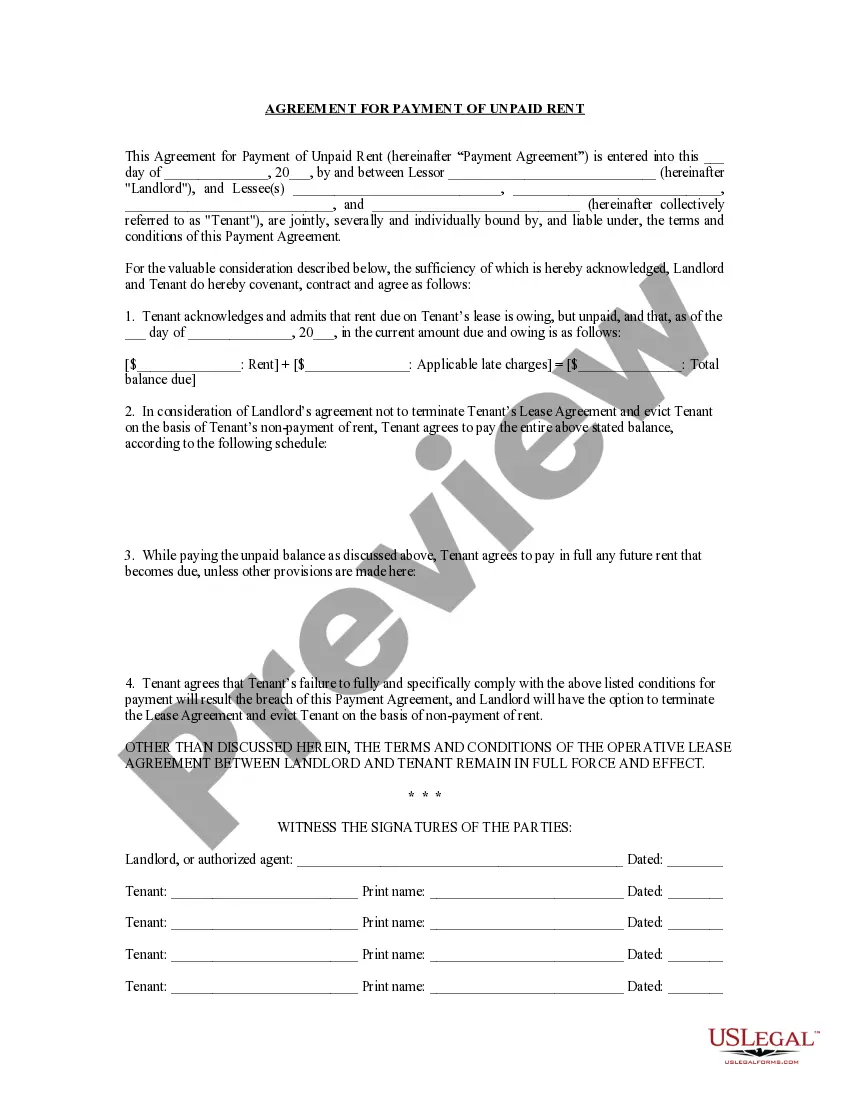
The Agreement for Payment of Unpaid Rent is a formal contract between a landlord and tenant to arrange for the repayment of overdue rent. This agreement specifies the amount owed, establishes a repayment schedule, and provides assurance that the tenant will not face eviction as long as they adhere to the terms outlined. This form is essential for situations where tenants are struggling to pay rent and require a structured approach to settle their debts while maintaining their housing status.
Key components of this form
- Identification of the parties: Clearly states who the landlord (Lessor) and tenant(s) (Lessee) are.
- Recognition of unpaid rent: The tenant acknowledges the specific amounts owed, including rent and any applicable late charges.
- Payment schedule: Details the terms for repayment of the overdue rent.
- Signatures: Requires signatures from all parties involved to validate the agreement.
- Retention of lease terms: Confirms that all other terms of the original lease remain in effect.

When to use this document
This form should be used when a tenant has fallen behind on rent and needs a structured payment plan to avoid eviction. It is particularly helpful in situations where the tenant has communicated their inability to pay the full rent amount but wishes to remain in the property by making partial payments over time. Utilizing this agreement can provide clarity and legal protections for both parties during a difficult financial period.
Who can use this document
This form is suitable for:
- Landlords seeking to formalize payment agreements with tenants who owe back rent.
- Tenants who need to arrange a payment plan with their landlord to avoid eviction.
- Those involved in residential rental agreements facing late rent situations.
How to prepare this document
- Identify the parties: Fill in the names of the landlord and tenant(s) at the beginning of the agreement.
- Specify the amount owed: Enter the total rent due and any applicable late fees in the designated sections.
- Outline the payment terms: Clearly state the repayment structure and deadlines as agreed upon by both parties.
- Sign the agreement: All parties must sign and date the document to validate the agreement.
- Retain a copy: Ensure both the landlord and tenant keep a signed copy for their records.
Notarization guidance
This form does not typically require notarization to be legally valid. However, some jurisdictions or document types may still require it. US Legal Forms provides secure online notarization powered by Notarize, available 24/7 for added convenience.
Get your form ready online
Our built-in tools help you complete, sign, share, and store your documents in one place.
Make edits, fill in missing information, and update formatting in US Legal Forms—just like you would in MS Word.
Download a copy, print it, send it by email, or mail it via USPS—whatever works best for your next step.
Sign and collect signatures with our SignNow integration. Send to multiple recipients, set reminders, and more. Go Premium to unlock E-Sign.
If this form requires notarization, complete it online through a secure video call—no need to meet a notary in person or wait for an appointment.
We protect your documents and personal data by following strict security and privacy standards.

Make edits, fill in missing information, and update formatting in US Legal Forms—just like you would in MS Word.

Download a copy, print it, send it by email, or mail it via USPS—whatever works best for your next step.

Sign and collect signatures with our SignNow integration. Send to multiple recipients, set reminders, and more. Go Premium to unlock E-Sign.

If this form requires notarization, complete it online through a secure video call—no need to meet a notary in person or wait for an appointment.

We protect your documents and personal data by following strict security and privacy standards.
Common mistakes
- Failing to accurately specify the total amount owed, leading to confusion.
- Not including all tenant signatures, which can invalidate the agreement.
- Omitting payment deadlines, resulting in disputes over repayment terms.
Why complete this form online
- Quick and easy access: Download the form and fill it out at your convenience.
- Editability: Customize the agreement to suit specific needs and circumstances.
- Professional quality: The forms are drafted by licensed attorneys to ensure legal compliance.
Looking for another form?
Form popularity
FAQ
Most rental agreements are short-term agreements, such as month-to-month tenancies, while lease agreements are usually for longer rental periods, such as six months, a year, or more.
Legally, a lease is just one way to rent an accommodation. A rent agreement can either be a lease or a licence and will be treated accordingly, based on the terms and conditions and renting period mentioned in the agreement.
If you have ever put a property on rent or have lived in a rented house, you must have signed a rent agreement.Also known as a lease agreement, the rent agreement is a written contract between the owner of a property (the landlord) and the tenant who takes it on rent.
Name the parties. A simple rental agreement form needs to name the parties signing the lease and where they live. Describe the premises. Define the term of the lease. Set how much rent is owed. Assign a security deposit amount. Finalize the lease.
Legally, a lease is just one way to rent an accommodation. A rent agreement can either be a lease or a licence and will be treated accordingly, based on the terms and conditions and renting period mentioned in the agreement.
If you are a landlord who is looking to write up a rental agreement, then you don't need to spend $250 an hour at your local lawyers office to get a contract written up. You can write up a rental agreement from your own home.
If you have ever put a property on rent or have lived in a rented house, you must have signed a rent agreement.Also known as a lease agreement, the rent agreement is a written contract between the owner of a property (the landlord) and the tenant who takes it on rent.
A rental agreement for a given house or apartment is also written to protect the rights of the tenant. The tenant is protected under the rental agreement in terms of rent increases, property damage and maintenance and insurance or property taxes for which the landlord may be responsible.