Ohio Living Trust Property Record
Understanding this form
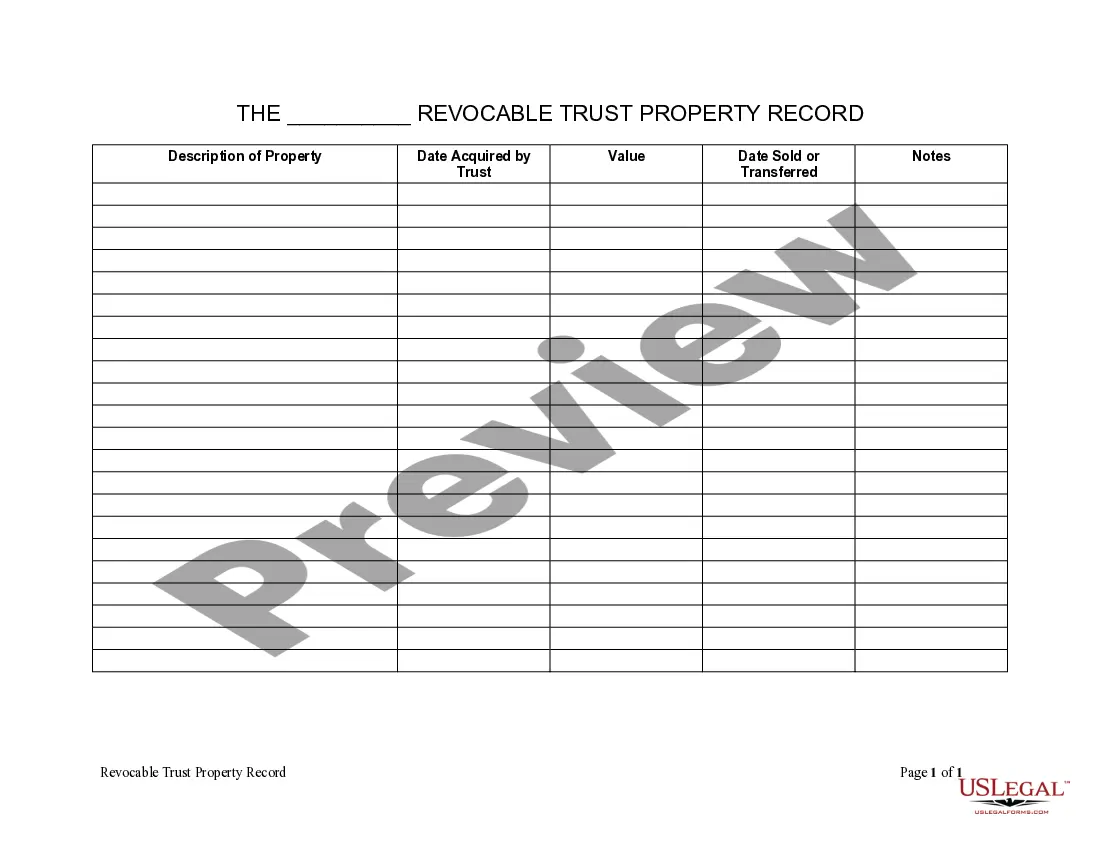
The Living Trust Property Record is a crucial document used to inventory and manage the assets held within a living trust. Unlike other estate planning forms, this inventory focuses on recording details about various types of property, including real estate, personal effects, and intellectual property. This form serves to ensure that all trust assets are documented, making the management and eventual distribution of these assets more efficient and clear for trustees and beneficiaries alike.
Form components explained
- Description of property: Provides a detailed account of each asset held in the trust.
- Date acquired by trust: Indicates when the trust took ownership of each property.
- Value: Lists the estimated worth of each asset as of the inventory date.
- Date sold or transferred: Records any dates related to the sale or transfer of trust property.

When this form is needed
This form should be used when establishing a living trust to maintain a clear record of all assets. It is particularly beneficial during the initial setup of the trust or whenever assets are added, sold, or transferred. This document can also assist in the administration of the trust during the lifetime of the trustor or upon their passing, ensuring that all properties are accounted for according to the trust's terms.
Who this form is for
- Individuals establishing a living trust to manage their assets.
- Trustees responsible for the management of a living trust.
- Beneficiaries who need a clear understanding of the assets within the trust.
- Estate planning professionals aiding clients in the trust creation process.
How to complete this form
- Identify each property that is to be included in the living trust.
- For each property, provide a detailed description that clearly identifies it.
- Enter the date on which the property was purchased or acquired by the trust.
- Assess and record the current value of each asset.
- Note any relevant dates related to the sale or transfer of the property, if applicable.
Notarization requirements for this form
In most cases, this form does not require notarization. However, some jurisdictions or signing circumstances might. US Legal Forms offers online notarization powered by Notarize, accessible 24/7 for a quick, remote process.
Get your form ready online
Our built-in tools help you complete, sign, share, and store your documents in one place.
Make edits, fill in missing information, and update formatting in US Legal Forms—just like you would in MS Word.
Download a copy, print it, send it by email, or mail it via USPS—whatever works best for your next step.
Sign and collect signatures with our SignNow integration. Send to multiple recipients, set reminders, and more. Go Premium to unlock E-Sign.
If this form requires notarization, complete it online through a secure video call—no need to meet a notary in person or wait for an appointment.
We protect your documents and personal data by following strict security and privacy standards.

Make edits, fill in missing information, and update formatting in US Legal Forms—just like you would in MS Word.

Download a copy, print it, send it by email, or mail it via USPS—whatever works best for your next step.

Sign and collect signatures with our SignNow integration. Send to multiple recipients, set reminders, and more. Go Premium to unlock E-Sign.

If this form requires notarization, complete it online through a secure video call—no need to meet a notary in person or wait for an appointment.

We protect your documents and personal data by following strict security and privacy standards.
Common mistakes
- Failing to update the inventory when new assets are added or sold.
- Omitting important details in the property description, leading to confusion.
- Incorrectly estimating the value of properties, which can affect trust administration.
- Not including dates of transfer for assets that have been sold or given away.
Advantages of online completion
- Easy access to legally vetted templates drafted by licensed attorneys.
- Immediate download capability, allowing for quick completion and use.
- Editability of the form ensures personalized and situation-specific adjustments.
- Convenient storage for your records, ensuring they are readily available when needed.
What to keep in mind
- The Living Trust Property Record is essential for tracking assets within a living trust.
- Key components include property descriptions, acquisition dates, and values.
- This form aids Trustees and estate planners in managing trusts effectively.
- Keep the document updated to reflect any changes in asset ownership or values.
Looking for another form?
Form popularity
FAQ
Funding a Trust Is Expensive... This is the major drawback to using a revocable living trust for many people, but it's not worth the time, money, and effort to create one if the trust isn't fully funded.
What happens if you have lost your Trust?If a Trust is lost, and the decedent has assets titled in the name of the Trust, the court will require that the heirs/Successor Trustees spend a significant amount of time and money searching for the Trust and documenting the search process.
If you can't find original living trust documents, you can contact the California Bar Association for assistance. Trusts aren't recorded anywhere, so you can't go to the County Recorder's office in the courthouse to ask to see a copy of the trust.
Legally your Trust now owns all of your assets, but you manage all of the assets as the Trustee. This is the essential step that allows you to avoid Probate Court because there is nothing for the courts to control when you die or become incapacitated.
Today clients who have living trusts normally keep the original copy. Having the attorney keep the original copy of the trust is not as important as keeping the original will used to be. At death, a copy of the trust generally suffices for all parties in place of the original.
Trusts created during your lifetime, known as living trusts, do not go into the public record after you die. With rare exceptions, trusts remain private regardless of whether you have an irrevocable or revocable trust at the time of your death.
Trusts are private documents and they typically remain private even after someone dies. The only way to obtain a copy of the Trust is to demand a copy from the Trustee (or whoever has a copy of the documents, if not the Trustee).
Trusts aren't public record, so they're not usually recorded anywhere. Instead, the trust attorney determines who is entitled to receive a copy of the document, even if state law doesn't require it.
If you can't find original living trust documents, you can contact the California Bar Association for assistance. Trusts aren't recorded anywhere, so you can't go to the County Recorder's office in the courthouse to ask to see a copy of the trust.