New York Letter from Landlord to Tenant as Notice of Default on Commercial Lease
About this form
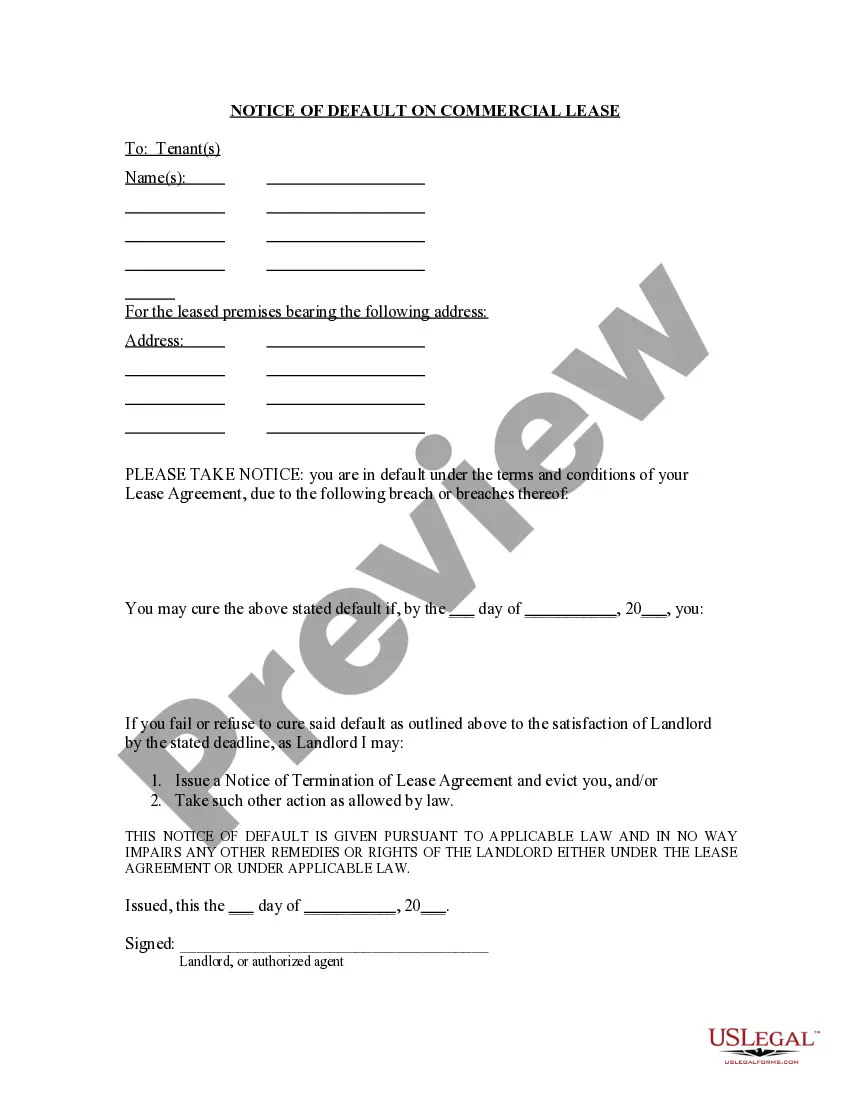
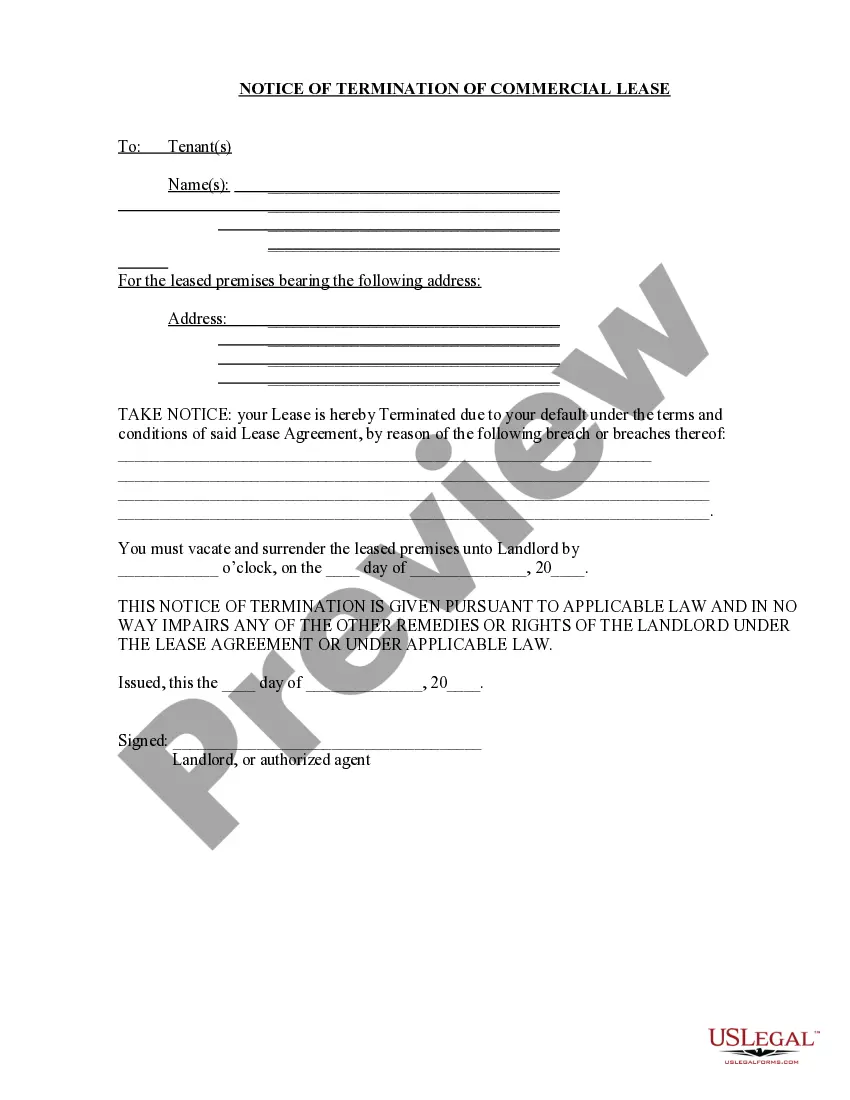
The Letter from Landlord to Tenant as Notice of Default on Commercial Lease is a formal communication from a landlord to a tenant indicating a default under the lease agreement. This notice details specific breaches, such as failure to pay rent, and sets a deadline for the tenant to correct these issues. Unlike other notice forms, this document emphasizes the consequences of failing to cure the identified defaults, including potential eviction proceedings.
What’s included in this form
- Identification of the landlord and tenant.
- Specification of the lease agreement in question.
- Clear outline of the specific breaches of the lease.
- Deadline for the tenant to cure the breaches.
- Statement of potential actions the landlord may take if breaches are not corrected.
- Signature line for the landlord or authorized agent.


When this form is needed
This form should be used when a landlord discovers that a tenant has failed to meet their obligations under a commercial lease agreement, such as missed rent payments or other breaches. It is essential to notify the tenant formally, giving them the opportunity to rectify the situation before legal action is taken, including eviction.
Intended users of this form
- Landlords managing commercial properties.
- Property managers on behalf of landlords.
- Legal representatives overseeing landlord-tenant issues.
How to prepare this document
- Enter the names and addresses of both the landlord and tenant.
- Specify the lease agreement and the nature of the default.
- Clearly state the deadline for curing the breach.
- Include a notice of possible actions if the breach is not cured.
- Sign and date the form.
Does this form need to be notarized?
Notarization is generally not required for this form. However, certain states or situations might demand it. You can complete notarization online through US Legal Forms, powered by Notarize, using a verified video call available anytime.
Get your form ready online
Our built-in tools help you complete, sign, share, and store your documents in one place.
Make edits, fill in missing information, and update formatting in US Legal Forms—just like you would in MS Word.
Download a copy, print it, send it by email, or mail it via USPS—whatever works best for your next step.
Sign and collect signatures with our SignNow integration. Send to multiple recipients, set reminders, and more. Go Premium to unlock E-Sign.
If this form requires notarization, complete it online through a secure video call—no need to meet a notary in person or wait for an appointment.
We protect your documents and personal data by following strict security and privacy standards.

Make edits, fill in missing information, and update formatting in US Legal Forms—just like you would in MS Word.

Download a copy, print it, send it by email, or mail it via USPS—whatever works best for your next step.

Sign and collect signatures with our SignNow integration. Send to multiple recipients, set reminders, and more. Go Premium to unlock E-Sign.

If this form requires notarization, complete it online through a secure video call—no need to meet a notary in person or wait for an appointment.

We protect your documents and personal data by following strict security and privacy standards.
Common mistakes to avoid
- Failing to include all necessary details about the breaches.
- Not providing a clear deadline for the tenant to cure the default.
- Neglecting to sign the notice before sending it.
Benefits of completing this form online
- Easy to customize and fill in specific information.
- Accessible from anywhere and anytime, increasing convenience.
- Instant download, eliminating wait times for paper forms.
Looking for another form?
Form popularity
FAQ
The law in New York allows commercial landlords to evict a tenant for specific reasons. These reasons include the non-payment of rent, substantial violation of lease terms (typically as provided in the lease agreement), holding over long after lease expiration, and creating a public nuisance.
If the commercial tenant is a shell corporation and/or does not have any assets of value, the commercial tenant may choose to walk away from its commercial lease obligations.Often the landlord will require guarantees in order to prevent a commercial tenant from walking away from its lease obligations.
If you're an assured tenant or a protected tenant Your landlord will have to give you notice if they want you to leave. They have to give the reasons why they want to evict you - for example, if you have rent arrears or you've damaged the property. Your landlord will have to go to court and get a court order.
So a tenant is likely to have to give between 3 and 4 months notice if rent is paid monthly, and 3 and 6 months notice if rent is paid quarterly.
Break rights can only be exercised on reasonable prior written notice and usually a minimum of 6 months' notice is required.It is therefore prudent for a landlord or tenant to ask its professional advisors to serve a break notice on its behalf and to review the validity of any such notice served by the other party.
In NYC, it usually takes about three weeks for a marshal to get their paperwork ready from the courts and serve the Notice of Eviction.
Surrender the Lease. One option for getting out of your commercial lease early is to approach your landlord and request to surrender the lease. Early Termination Clause. Some lease agreements will contain an early termination clause (commonly called a break clause). Assignment of Lease. Subletting the Premises. Licensing.
Landlords can try and forfeit a lease if a tenant is in breach of their obligations (this assumes that the lease document includes a right to forfeit).If a commercial lease contains a break clause, either or both parties to the agreement may seek to terminate the lease before its fixed period has ended.