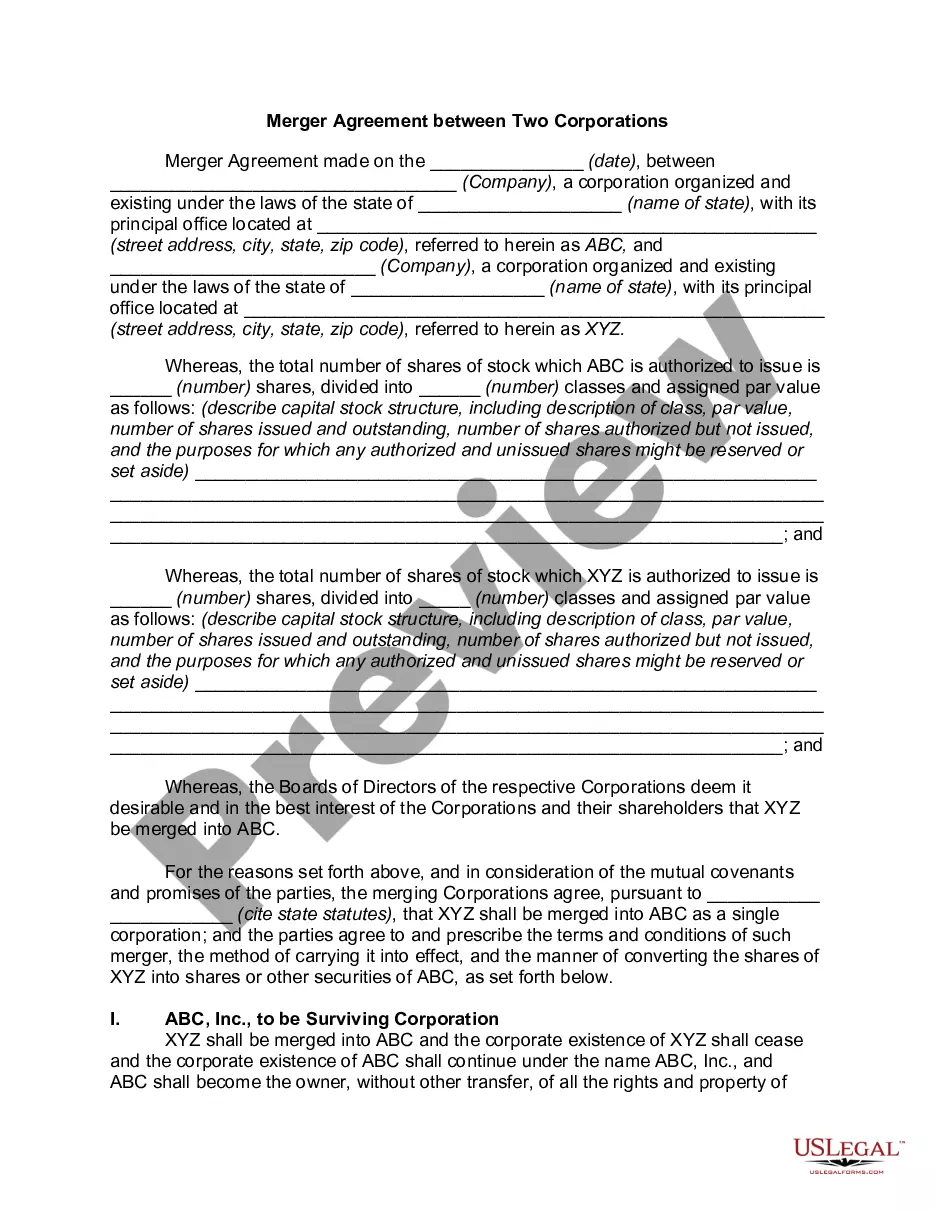
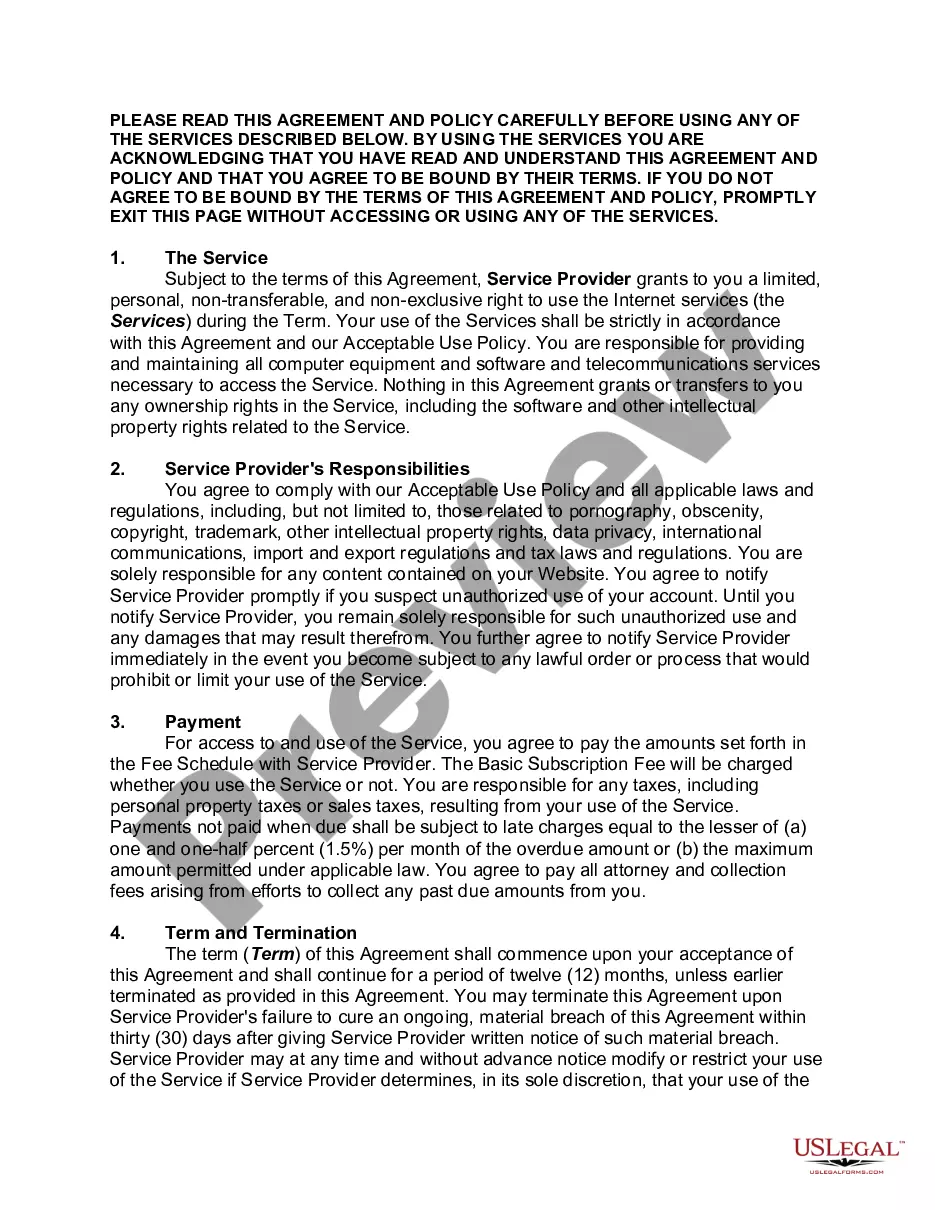
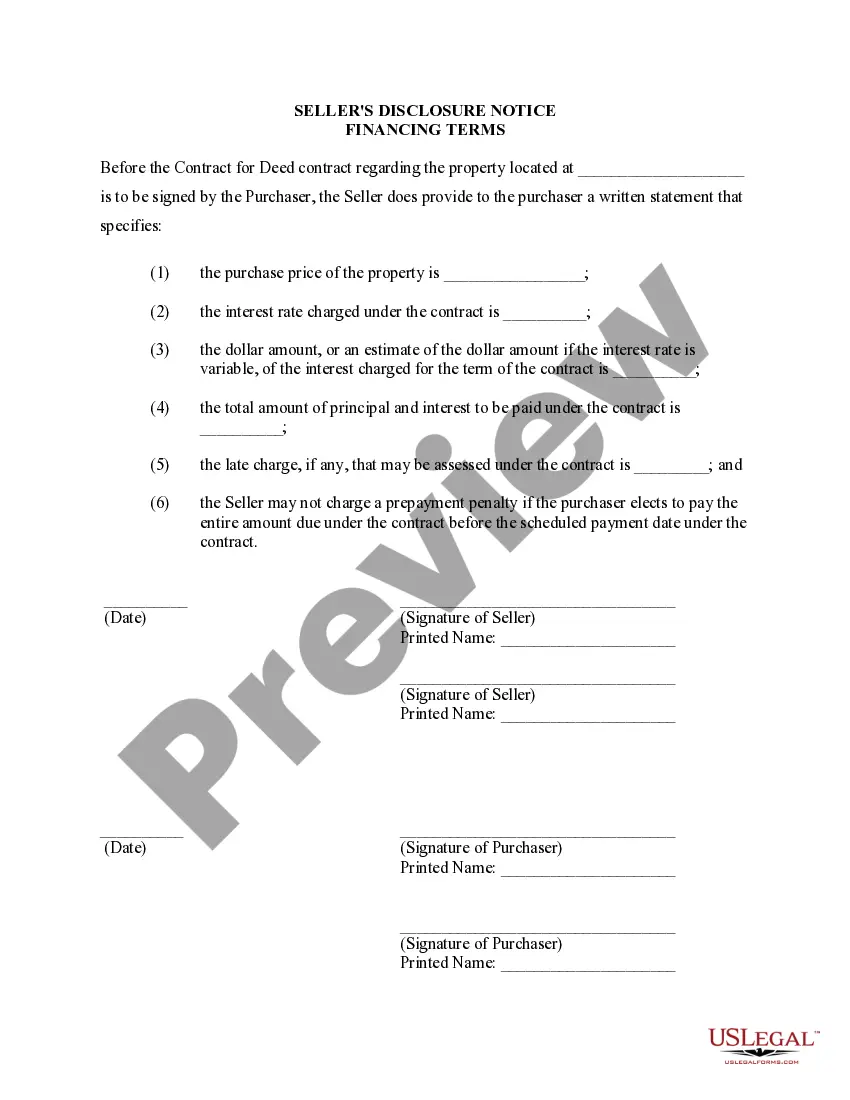
New York Seller's Disclosure of Financing Terms for Residential Property in connection with Contract or Agreement for Deed a/k/a Land Contract
Overview of this form
The Seller's Disclosure of Financing Terms for Residential Property is a legal document that outlines the terms of financing in a real estate transaction. Specifically, it informs the purchaser about the purchase price, payment structure, interest rates, and late charges associated with a contract for deed, also known as a land contract. This form ensures transparency between the seller and the buyer, providing essential financial details prior to signing the agreement.
Main sections of this form
- Purchase price of the property
- Payment schedule and amounts
- Interest rate details
- Policy on late charges
- Signatures of both the seller and the purchaser
When to use this form
This form should be utilized in situations where a seller is offering to finance the purchase of residential property through a contract for deed. It is typically used when the buyer does not have access to traditional financing options, enabling them to negotiate terms directly with the seller. This document should be presented to the purchaser at or before the signing of the contract to ensure all terms are clearly understood.
Intended users of this form
This form is intended for:
- Sellers of residential properties offering owner financing.
- Purchasers looking to buy property through a contract for deed.
- Real estate agents or brokers assisting in owner-financed transactions.
Steps to complete this form
- Identify the parties involved, including the seller and purchaser.
- Specify the property details, including the address and description.
- Clearly outline the purchase price and payment schedule.
- Indicate the interest rate and any applicable late charges.
- Obtain signatures from both parties to finalize the disclosure.
Does this form need to be notarized?
This form must be notarized to be legally valid. US Legal Forms provides secure online notarization powered by Notarize, allowing you to complete the process through a verified video call.
Get your form ready online
Our built-in tools help you complete, sign, share, and store your documents in one place.
Make edits, fill in missing information, and update formatting in US Legal Forms—just like you would in MS Word.
Download a copy, print it, send it by email, or mail it via USPS—whatever works best for your next step.
Sign and collect signatures with our SignNow integration. Send to multiple recipients, set reminders, and more. Go Premium to unlock E-Sign.
If this form requires notarization, complete it online through a secure video call—no need to meet a notary in person or wait for an appointment.
We protect your documents and personal data by following strict security and privacy standards.

Make edits, fill in missing information, and update formatting in US Legal Forms—just like you would in MS Word.

Download a copy, print it, send it by email, or mail it via USPS—whatever works best for your next step.

Sign and collect signatures with our SignNow integration. Send to multiple recipients, set reminders, and more. Go Premium to unlock E-Sign.

If this form requires notarization, complete it online through a secure video call—no need to meet a notary in person or wait for an appointment.

We protect your documents and personal data by following strict security and privacy standards.
Common mistakes to avoid
- Failing to provide complete and accurate payment details.
- Not updating terms if there are changes before signing.
- Omitting signatures from either party, making the document invalid.
Benefits of using this form online
- Convenient access to legally drafted forms at any time.
- Editable templates that allow users to customize the document to their needs.
- Reliable legal cover, ensuring compliance with current laws.
Looking for another form?
Form popularity
FAQ
Real Estate Transfer Disclosure Statement (TDS) The Transfer Disclosure Statement, also known as the TDS, is a form required by California law in most residential real estate transactions pursuant to California Civil Code 1102.
A contract for deed is a legal agreement for the sale of property in which a buyer takes possession and makes payments directly to the seller, but the seller holds the title until the full payment is made.
A seller disclosure form is a document required by State law that discloses certain physical and/or title conditions of a one- to four-unit residential property by a seller to a buyer during a title transfer. The laws regarding what sellers are required to disclose vary State-to-State.
A Seller is not required to provide a PCDS in British Columbia. If a Seller is not willing to provide a PCDS, they may not be disclosing a major issue with the property. The fact a Seller is not willing to provide a PCDS to a potential Buyer should be cause for concern to the Buyer.
Who Must Make These Seller Disclosures in California. As a broad rule, all sellers of residential real estate property containing one to four units in California must complete and provide written disclosures to the buyer.
Property disclosure statements essentially outline any flaws that the home sellers (and their real estate agents) are aware of that could negatively affect the home's value. These statements are required by law in most areas of the country so buyers can know a property's good and bad points before they close the deal.
But unlike buyers, sellers can't back out and forfeit their earnest deposit money (usually 1-3 percent of the offer price). If you decide to cancel a deal when the home is already under contract, you can be either legally forced to close anyway or sued for financial damages.
One such alternative is the contract for deed. In a contract for deed, the purchase of property is financed by the seller rather than a third-party lender such as a commercial bank or credit union.
You will need to include information about all appliances in the home, including which are included in the sale as well as whether they are operational. You will also need to disclose any room additions, damage, or neighborhood noise problems.