New Mexico Quitclaim Deed from Corporation to LLC
What this document covers
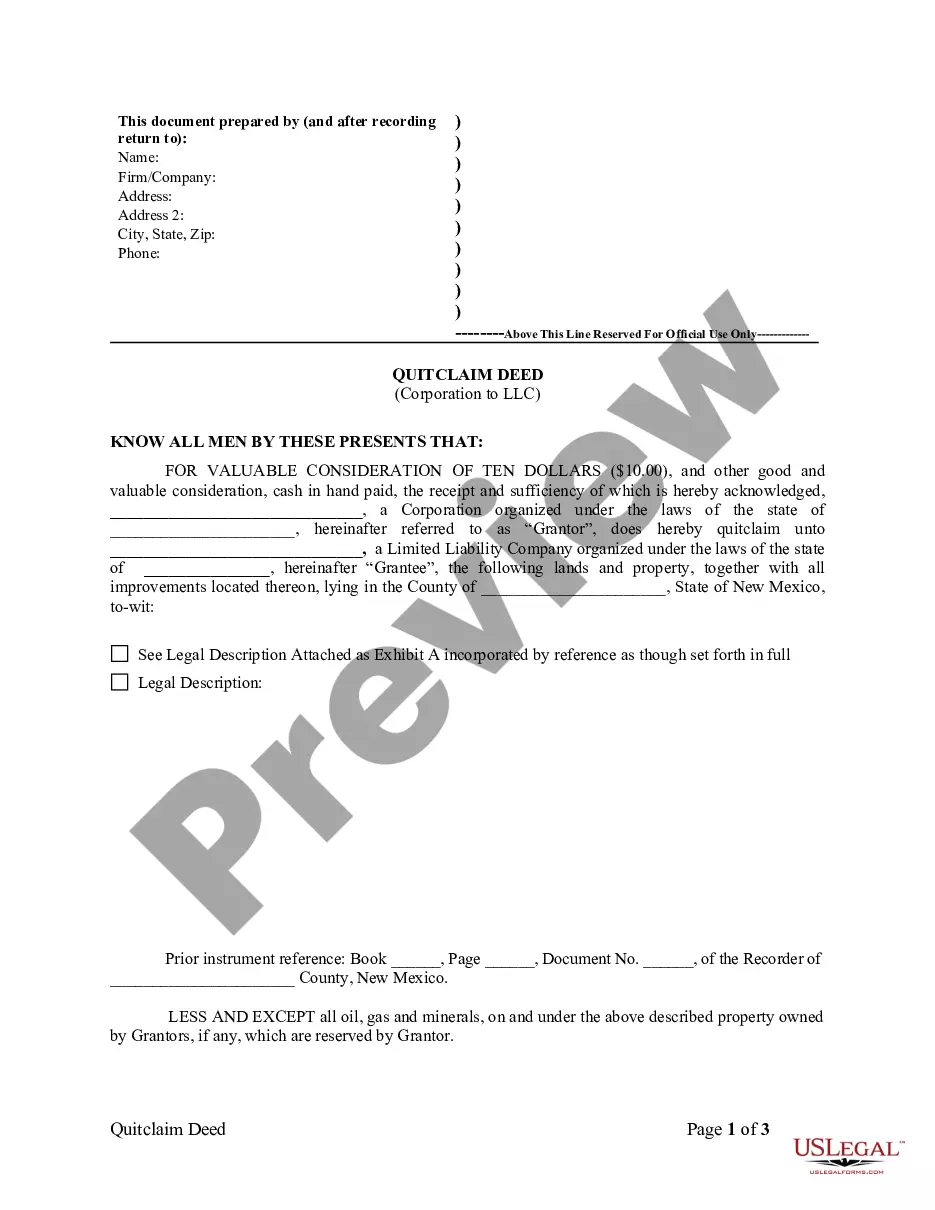
The Quitclaim Deed from Corporation to LLC is a legal document used to transfer property ownership from a corporation (the grantor) to a limited liability company (the grantee). This form is specifically designed for situations where a corporation is relinquishing its rights to a property, and it is important to note that it conveys only the interest that the grantor has in the property, without any guarantee of clear title. Unlike other deeds, such as warranty deeds, a quitclaim deed does not assure that there are no liens or claims against the property.
Form components explained
- Identification of parties: Clearly defines the grantor (corporation) and grantee (LLC).
- Legal description: Includes a detailed description of the property being transferred.
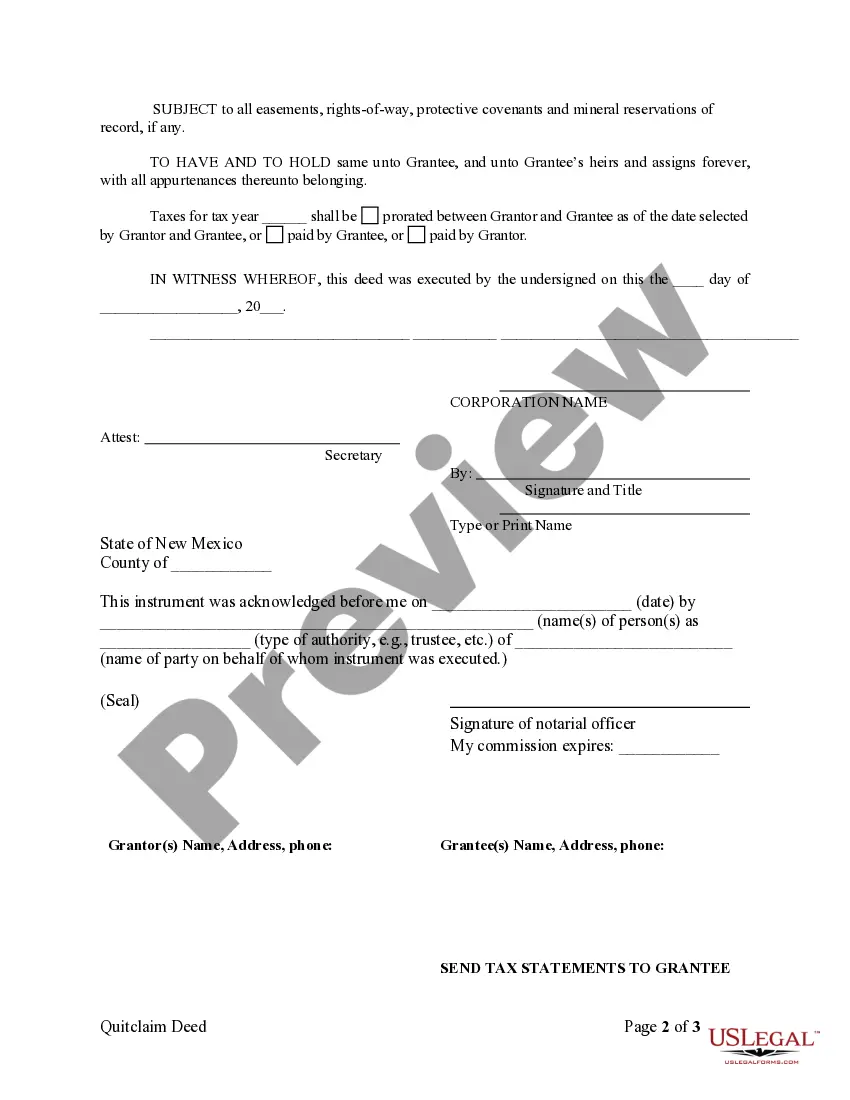
- Easements and reservations: Specifies any easements, rights-of-way, and mineral reservations that apply to the property.
- Transfer clause: States the intent to convey the property to the grantee.
- Execution: Details the requirements for signing and dating the document, ensuring it is legally binding.




When to use this document
This form is used when a corporation wishes to transfer its property to an LLC without providing warranties regarding the title. It is ideal for situations where the corporate grantor is divesting assets to an LLC for business restructuring, asset management, or for simplifying ownership among business partners. This transfer may also occur in estate planning or when one entity changes its structure.
Who can use this document
This form is suitable for:
- Corporations transferring real property to an LLC.
- Members of an LLC involved in real estate transactions.
- Legal professionals assisting in property transfer between entities.
- Business owners restructuring their property holdings.
Completing this form step by step
- Identify the parties: Fill in the names and addresses of the corporation (grantor) and the LLC (grantee).
- Specify the property: Include a complete legal description of the property being transferred.
- Review easements: Note any existing easements, rights-of-way, and reservations that apply to the property.
- Sign the document: Ensure that an authorized representative of the corporation signs the deed and dates it accurately.
- File the deed: Depending on local laws, file the completed deed with the appropriate governmental office to finalize the property transfer.
Notarization requirements for this form
This form does not typically require notarization unless specified by local law. However, verifying with your legal advisor or local regulations is prudent to ensure compliance.
Get your form ready online
Our built-in tools help you complete, sign, share, and store your documents in one place.
Make edits, fill in missing information, and update formatting in US Legal Forms—just like you would in MS Word.
Download a copy, print it, send it by email, or mail it via USPS—whatever works best for your next step.
Sign and collect signatures with our SignNow integration. Send to multiple recipients, set reminders, and more. Go Premium to unlock E-Sign.
If this form requires notarization, complete it online through a secure video call—no need to meet a notary in person or wait for an appointment.
We protect your documents and personal data by following strict security and privacy standards.

Make edits, fill in missing information, and update formatting in US Legal Forms—just like you would in MS Word.

Download a copy, print it, send it by email, or mail it via USPS—whatever works best for your next step.

Sign and collect signatures with our SignNow integration. Send to multiple recipients, set reminders, and more. Go Premium to unlock E-Sign.

If this form requires notarization, complete it online through a secure video call—no need to meet a notary in person or wait for an appointment.

We protect your documents and personal data by following strict security and privacy standards.
Typical mistakes to avoid
- Failing to include a complete legal description of the property.
- Not having the document signed by an authorized representative of the corporation.
- Neglecting to mention any existing easements or mineral rights, which can affect ownership.
- Forgetting to date the document, which may lead to questions about validity.
Why use this form online
- Convenience: Access legal documents anytime, without the need for in-person consultations.
- Editability: Customize the form easily to suit your specific transaction needs.
- Reliability: Ensure compliance with state laws through professionally drafted templates.
Looking for another form?
Form popularity
FAQ
But you might be wondering if an owner can transfer a deed to another person without a real estate lawyer. The answer is yes. Parties to a transaction are always free to prepare their own deeds.A quitclaim deed, for example, is far simpler than a warranty deed.
Step 1 Write in the name of the grantor or seller. Step 2 Fill in the name and address of the grantee or buyer. Step 3 Specify the property information including county, lot, block and recording information. Step 4 Sign and date in the presence of a notary public.
They are commonly used to add/remove someone to/from real estate title or deed (divorce, name changes, family and trust transfers). The quitclaim deed is a legal document (deed) used to transfer interest in real estate from one person or entity (grantor) to another (grantee).
In order to transfer a property into one person's name, you will need to complete a 'Transfer of Whole of Registered Title' form and send it to HM Land Registry, along with the correct fee and identity verification forms. In some cases, there may also be Stamp Duty Land Tax to pay.
To use a Quitclaim Deed to add someone to a property deed or title, you would need to create a Quitclaim Deed and list all of the current owners in the grantor section. In the grantee section, you would list all of the current owners as well as the person you would like to add.
Notary Public (Section 47-1-44) In New Mexico it must be signed with a Notary Public viewing the Grantor(s) signature(s). Recording A quit claim deed is required to be filed at the County Clerk's Office where the property is located along with the required recording fee(s).
To transfer ownership of a property a new deed must be filed with the County Clerk's Office before the name and address are changed in the Assessor's records. Once the Assessor's records are updated the Treasurer's Office will get the update in the new billing cycle.
A New Mexico quitclaim deed transfers property without any guarantees, including title guarantees or a guarantee that the seller (grantor) has the right to transfer the property. Because of the risk of a quitclaim deed in New Mexico, it is best done when both parties trust each other. An alternative is a warranty deed.