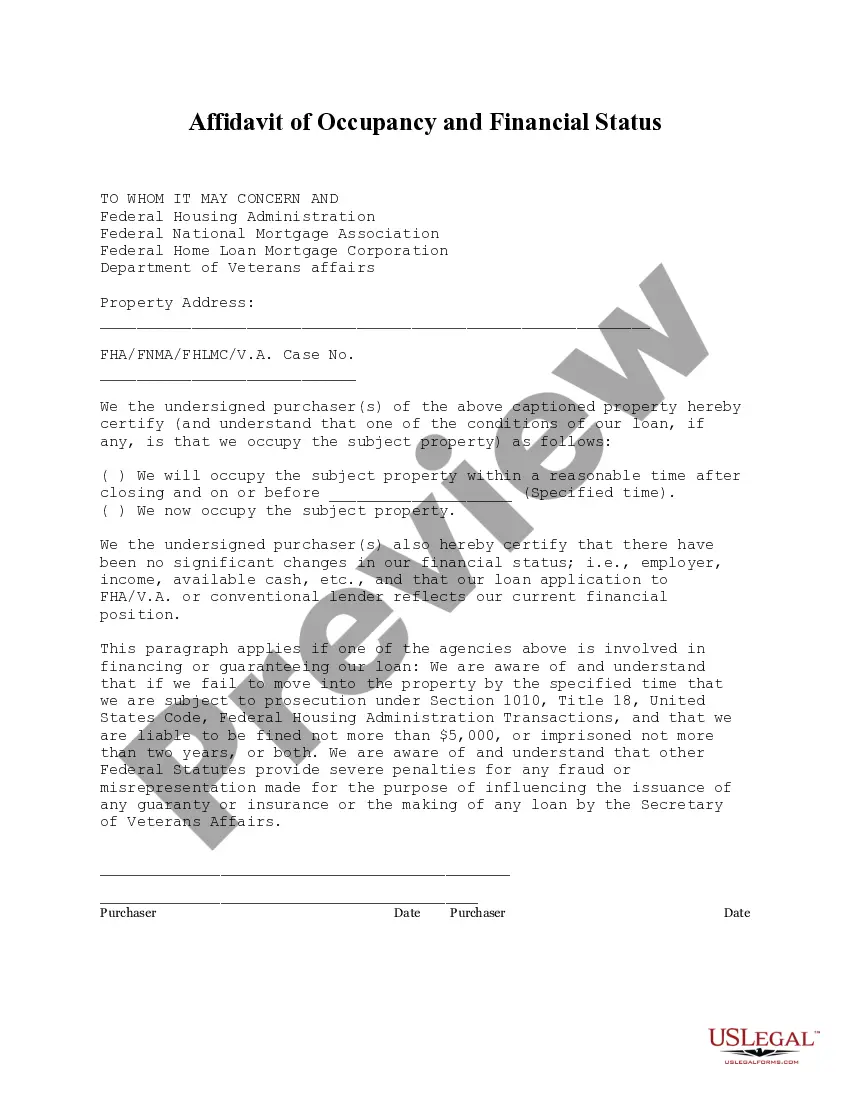
New Jersey Affidavit of Occupancy and Financial Status
About this form
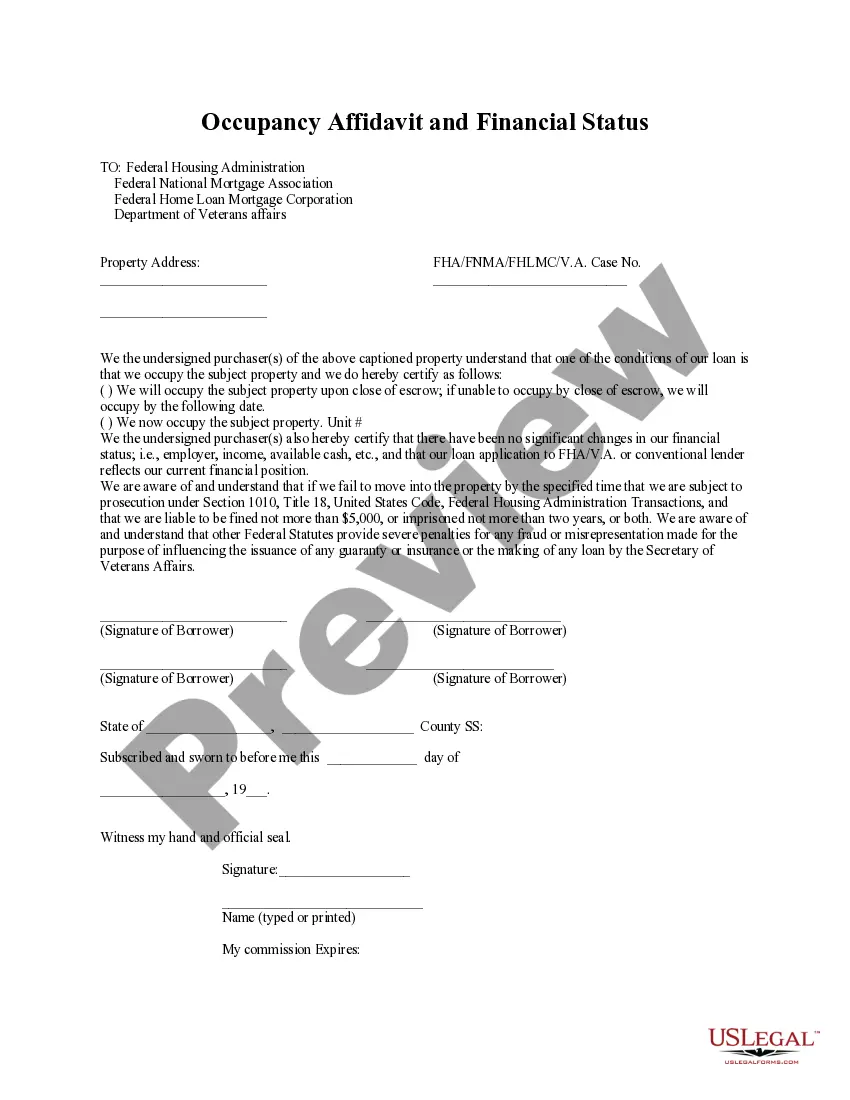
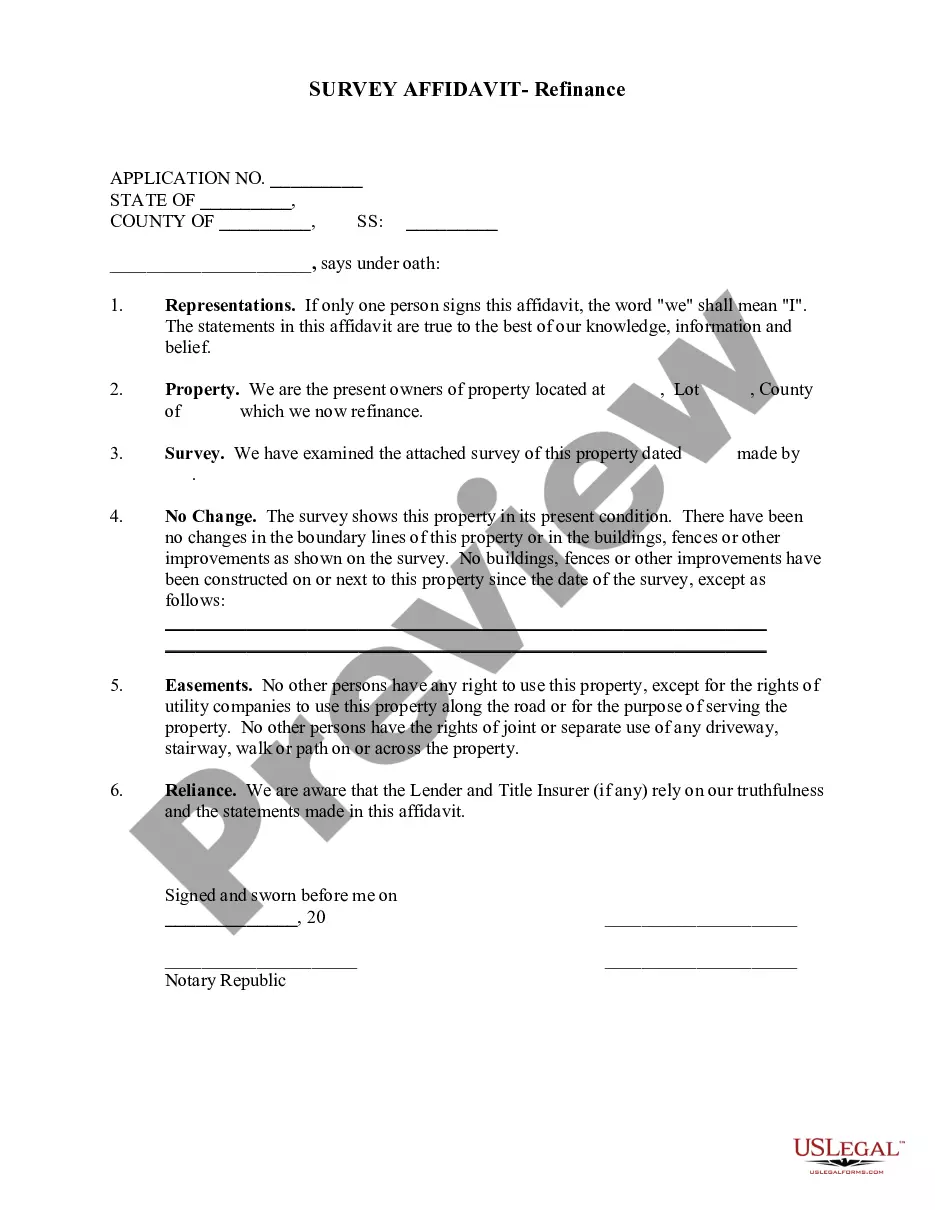
The Affidavit of Occupancy and Financial Status is a legal document used by buyers to confirm their intent to occupy a property as their primary residence after closing. This form ensures that there have been no significant changes in the buyer's financial situation since the loan application was submitted. It is an essential component in real estate transactions, particularly when dealing with certain federally backed loans, setting it apart from other occupancy certifications.
Key components of this form
- Property address: Details the location of the property being purchased.
- Certification of intent to occupy: Buyers declare when they will occupy the property or confirm they already do.
- Financial status declaration: Buyers attest that their financial situation remains unchanged since the loan application.
- Awareness of legal obligations: Buyers acknowledge the penalties for failing to occupy the property as declared.
- Signatures and dates: Required from all purchasers to validate the affidavit.

When to use this form
This form should be used during the closing phase of a real estate transaction when buyers are acquiring a property through a loan. It is essential when working with lenders that require evidence of residency intentions and current financial status, especially for FHA, VA, or conventional financing. If your lender requests proof of intent to live in the property, using this affidavit is necessary.
Who needs this form
This affidavit is intended for:
- Homebuyers who will occupy the property as their primary home.
- Individuals applying for loans that require verification of occupancy intent.
- Anyone involved in a real estate transaction with federal loan backing, such as FHA or VA loans.
How to prepare this document
- Identify the property: Fill in the complete address of the property being purchased.
- Specify the occupancy date: Indicate when you plan to occupy the property or confirm you already do.
- Ensure accuracy of financial status: Confirm that there have been no changes in your financial situation since the loan application.
- Understand legal implications: Read the statements regarding occupancy requirements and penalties for non-compliance.
- Sign and date: All purchasers must sign and date the affidavit to validate it.
Notarization guidance
This form does not typically require notarization unless specified by local law. Always check your stateâs requirements before submission to ensure compliance.
Get your form ready online
Our built-in tools help you complete, sign, share, and store your documents in one place.
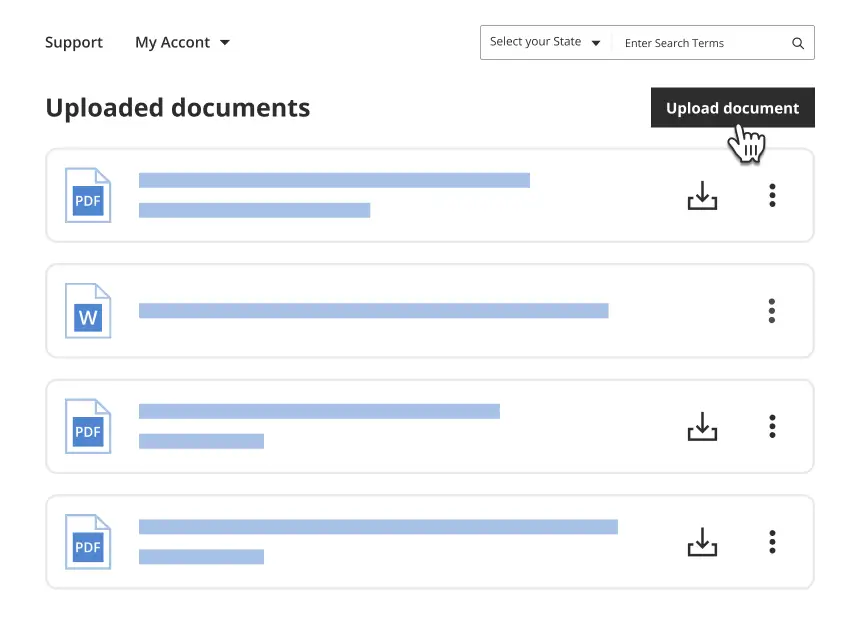
Make edits, fill in missing information, and update formatting in US Legal Forms—just like you would in MS Word.
Download a copy, print it, send it by email, or mail it via USPS—whatever works best for your next step.
Sign and collect signatures with our SignNow integration. Send to multiple recipients, set reminders, and more. Go Premium to unlock E-Sign.
If this form requires notarization, complete it online through a secure video call—no need to meet a notary in person or wait for an appointment.
We protect your documents and personal data by following strict security and privacy standards.
Make edits, fill in missing information, and update formatting in US Legal Forms—just like you would in MS Word.
Download a copy, print it, send it by email, or mail it via USPS—whatever works best for your next step.
Sign and collect signatures with our SignNow integration. Send to multiple recipients, set reminders, and more. Go Premium to unlock E-Sign.

If this form requires notarization, complete it online through a secure video call—no need to meet a notary in person or wait for an appointment.
We protect your documents and personal data by following strict security and privacy standards.
Common mistakes
- Not specifying a clear occupancy date.
- Failing to accurately reflect any changes in financial status.
- Not signing or dating the form, which could render it invalid.
- Ignoring the penalties for misrepresentation which could lead to serious legal consequences.
Why complete this form online
- Immediate access: Download and complete the form at your convenience.
- Editability: Make changes easily before finalizing the document.
- Reliable templates: Prepared by licensed attorneys to ensure legal compliance.
Legal use & context
- Enforceable document: Serves as a legally binding affidavit evidencing the buyer's intentions and financial status.
- Disclosure compliance: Helps meet the requirements set forth by lenders and federal entities involved in real estate transactions.
- Fraud prevention: Provides legal ramifications for falsifying information, ensuring accountability in the loan process.
Summary of main points
- The Affidavit of Occupancy and Financial Status certifies a buyer's intention to occupy a property as their primary residence.
- This form is essential for securing mortgages from federal entities.
- Document accuracy and completeness are critical to avoid future legal issues.
Looking for another form?
Form popularity
FAQ
Most towns in New Jersey require a landlord to obtain a new Certificate of Occupancy each and every time a new tenant moves in to a residential dwelling.In towns where certificates of occupancy are required, a dwelling rented without a certificate of occupancy constitutes an illegal contract.
Once the certificate of occupancy is written and issued, it is good for 90 days.
Even if you receive your certificate of occupancy, you may have to meet other inspection requirements before you can sell. In most New Jersey cities, for instance, you can't sell unless the fire inspector approves the number and placement of smoke detectors in your house.
Realty Transfer Fee: Sellers pay a 1% Realty Transfer Fee on all home sales. The buyer is not responsible for this fee. However, buyers may pay an additional 1% fee on all home sales of $1 million or more. You can find more information on the Realty Transfer Fee, including rates and exemptions, here.
A Temporary Certificate of Occupancy (TCO) may be issued if the work is substantially complete, there are no outstanding health or safety issues and the building or space can be occupied safely. A TCO is issued for a defined period of time during which any remaining items are to be completed.
Page 1. The following is a check list for obtaining a Certificate of Occupancy. This inspection is a visual inspection mainly looking for safety hazards and unsanitary conditions along with any Code Violations.
A Certificate of Occupancy is the document which is given at the completion of the project. The Certificate of Occupancy, issued by the Construction Official, permits occupancy of a building or structure.
In New Jersey, sellers of residential properties must comply with smoke detector, fire extinguisher and carbon monoxide regulations.Depending on the city and county in which the property is located, you may also have to obtain a certificate of occupancy.
NJ Taxation An Affidavit of Consideration (RTF-1 ) must be filed with any deed in which a full or partial exemption is claimed from the Realty Transfer Fee.